Chapter 11:
Society, Culture & Reform
         1820-1860
The Second Great Awakening
        • Religious revivals that were a reaction against rationalism&
        Calvinist(Puritan) teachings of original sin & predestination were
                                     rejected

    •     Timothy Dwight, president of Yale College, helped usher in the
         second Great awakening by conducting campus revivals that led
             hundreds of young men to become evangelist preachers

•        In 1823, minister Charles G. Finney sparked numerous revivals in
         New York where he appealed to people’s emotions and preached
              that people could be saved through faith and hard work
•       This religious movement also developed the Baptist and Methodist
                                      religion

•       William Miller founded the religion the Seventh Day Adventists by
        claiming the world would end on October21, 1844 so people must
                   immediately be saved but nothing happened

•       Joseph Smith also created a new religion called Mormons in 1830
        and led people west and when he died, Brigham Young took over
           and led people to Utah where they founded some colonies
The Second Great
     Awakening(Con.)
• This religious movement also developed
     the Baptist and Methodist religion

 • William Miller founded the religion the
  Seventh Day Adventists by claiming the
  world would end on October21, 1844 so
   people must immediately be saved but
            nothing happened

    • Joseph Smith also created a new
  religion called Mormons in 1830 and led
  people west and when he died, Brigham
  Young took over and led people to Utah
Transcendentalists
• Ralph Waldo Emerson and Henry David Thoreau believed in
  looking for one’s inner self and God in nature

• Thoreau conducted an experiment where he lived in the
  woods for two years to discover essential truths about life

• Brook Farm: George Ripley conducted a communal
  experiment to see how well people could interact living
  with each other
   – More experiments occurred because people wanted to create a
     utopia—resulted in the formation of the Shakers, the New
     Harmony experiment and the Fourier Phalanxes
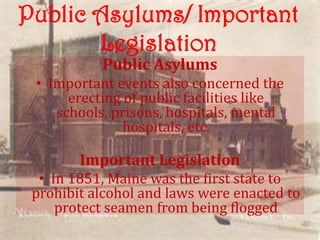
Public Asylums/ Important
       Legislation
           Public Asylums
 • Important events also concerned the
      erecting of public facilities like
    schools, prisons, hospitals, mental
               hospitals, etc.

        Important Legislation
  • In 1851, Maine was the first state to
 prohibit alcohol and laws were enacted to
     protect seamen from being flogged
Women’s Rights
   Movement/Antislavery Movement
                        Women’s Rights
• Sarah and Angelina Grimke objected to the male opposition to
                    their antislavery activities
    – Sarah wrote: Letter on the Condition of Women and the
                        Equality of the Sexes
• Seneca Falls: Feminists met at Seneca Falls, New York, which
    was the first Women’s Rights Convention in the history of
                              America
                    Antislavery Movement
  • The U.S. tried to move freed blacks out of the colonies by
       creating a settlement for them in Monrovia, Liberia

    • In 1831, William Lloyd Garrison published a newspaper
  called, The Liberator, which marked the beginning of the radical
   abolitionist movement which caused a split in the abolitionist
                             movement

• Nat Turner, a Virginia slave, led a revolt, killing fifty five white
  males and the whites retaliated by killing hundreds of blacks
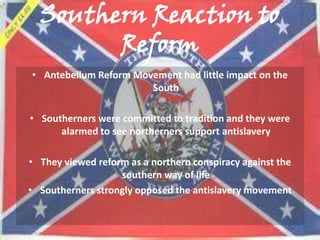
Southern Reaction to
        Reform
• Antebellum Reform Movement had little impact on the
                       South

• Southerners were committed to tradition and they were
      alarmed to see northerners support antislavery

• They viewed reform as a northern conspiracy against the
                   southern way of life
• Southerners strongly opposed the antislavery movement
Political Issues


   •Development of religious reforms derived from political
  beliefs, such as the policies of the Jacksonian democracy.
     •All of the religious revivals led to the Second Great
                           Awakening.
    •Aside from religion, political ideas started to lead to a
 development of new institutions within the United States.
•Mental hospitals, schools for the blind and deaf, prisons, and
  public schools started to come into consideration through
      governments because of humanitarian reformers.
Social issues/ changes
• The Second Great Awakening led to divisions in society. More
  religions came into place separating the moral beliefs of citizens.
• There were many activists and religious groups that provided
  leadership within people and created organized voluntary society.
            –Baptists & Methodists
            –Millennialism
            –Mormons
• Communal experiments: widespread more throughout the 19th
  century than ever. It was attempts to withdraw from conventional
  society into ideal communities, or utopias. The survival of these
  communities was minimal, but somewhat attainable with the
  extensive efforts.
• Arts, literature, and ideas formed a new type of culture within the
  people of the United States.
Social issues/ changes
                    (continued)
• The new way of thinking morally led to the importance of artistic
  expression over the pursuit of wealth.
• Transcendentalists, such as Ralph Waldo Emerson, questioned
  doctrines of established churches and sought more for
  individualistic institutions through the essence of God.
• Women’s rights and changing the American families also started
  to come into play.
• There were many women’s rights movements that were initiated
  by the women reformers in the 19th century during a time where
  new definitions of male and female roles started to form.
• Antislavery movements also affected society perspectives. There
  were multiple abolitionists fighting to put an end to slavery, which
  reflected negative views of southern states.
Economic Issues/ changes
•    As reforms increased, so did economic changes. With all of the proposals to create
     new institutions, more government funding was required to fill it.
•    Public schools, for example, were campaigned through hopes of achieving “free’’
     tax-supported school systems


                  Religious issues/ changes
    •There was a strong reaction against rationalism during the 19th century.
    •More religions began to form around personal beliefs. There was a
    development of religions that were formed by educated people, leading
    to the Second Great Awakening.
    •This was sight of the independency and individual views of society that
    began to come into acceptation.
Agricultural issues/ changes
•   With the artistic movements arising, agriculture coincided with it. Classical Greek
    styles formed into the structure of the modern Jacksonian era. It glorified the
    democratic spirit of the republic.
•   One of the most identifying characteristics of Greek society still noticeable today
    is the columns that began to grace the common architectures.


           Industrial issues/ changes
          •Industrial American started to build up with all of the reforms
          proposing new institutions.
          •All of the new institutions, such as the prisons and hospitals,
          contributed to the ideas still alive in modern society.
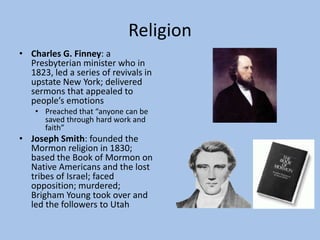
Religion
• Charles G. Finney: a
  Presbyterian minister who in
  1823, led a series of revivals in
  upstate New York; delivered
  sermons that appealed to
  people’s emotions
    • Preached that “anyone can be
      saved through hard work and
      faith”
• Joseph Smith: founded the
  Mormon religion in 1830;
  based the Book of Mormon on
  Native Americans and the lost
  tribes of Israel; faced
  opposition; murdered;
  Brigham Young took over and
  led the followers to Utah
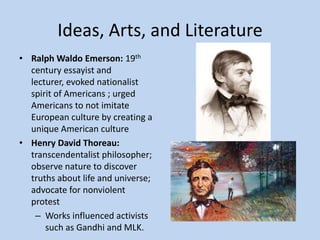
Ideas, Arts, and Literature
• Ralph Waldo Emerson: 19th
  century essayist and
  lecturer, evoked nationalist
  spirit of Americans ; urged
  Americans to not imitate
  European culture by creating a
  unique American culture
• Henry David Thoreau:
  transcendentalist philosopher;
  observe nature to discover
  truths about life and universe;
  advocate for nonviolent
  protest
   – Works influenced activists
      such as Gandhi and MLK.
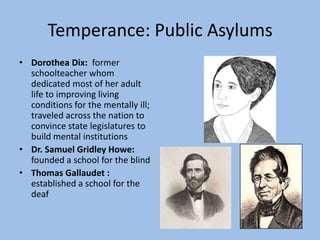
Temperance: Public Asylums
• Dorothea Dix: former
  schoolteacher whom
  dedicated most of her adult
  life to improving living
  conditions for the mentally ill;
  traveled across the nation to
  convince state legislatures to
  build mental institutions
• Dr. Samuel Gridley Howe:
  founded a school for the blind
• Thomas Gallaudet :
  established a school for the
  deaf
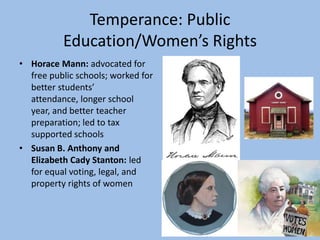
Temperance: Public
          Education/Women’s Rights
• Horace Mann: advocated for
  free public schools; worked for
  better students’
  attendance, longer school
  year, and better teacher
  preparation; led to tax
  supported schools
• Susan B. Anthony and
  Elizabeth Cady Stanton: led
  for equal voting, legal, and
  property rights of women
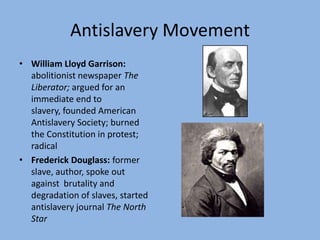
Antislavery Movement
• William Lloyd Garrison:
  abolitionist newspaper The
  Liberator; argued for an
  immediate end to
  slavery, founded American
  Antislavery Society; burned
  the Constitution in protest;
  radical
• Frederick Douglass: former
  slave, author, spoke out
  against brutality and
  degradation of slaves, started
  antislavery journal The North
  Star

1820-1860: Society, Culture, and Reforms

  • 1.
    Chapter 11: Society, Culture& Reform 1820-1860
  • 2.
    The Second GreatAwakening • Religious revivals that were a reaction against rationalism& Calvinist(Puritan) teachings of original sin & predestination were rejected • Timothy Dwight, president of Yale College, helped usher in the second Great awakening by conducting campus revivals that led hundreds of young men to become evangelist preachers • In 1823, minister Charles G. Finney sparked numerous revivals in New York where he appealed to people’s emotions and preached that people could be saved through faith and hard work • This religious movement also developed the Baptist and Methodist religion • William Miller founded the religion the Seventh Day Adventists by claiming the world would end on October21, 1844 so people must immediately be saved but nothing happened • Joseph Smith also created a new religion called Mormons in 1830 and led people west and when he died, Brigham Young took over and led people to Utah where they founded some colonies
  • 3.
    The Second Great Awakening(Con.) • This religious movement also developed the Baptist and Methodist religion • William Miller founded the religion the Seventh Day Adventists by claiming the world would end on October21, 1844 so people must immediately be saved but nothing happened • Joseph Smith also created a new religion called Mormons in 1830 and led people west and when he died, Brigham Young took over and led people to Utah
  • 4.
    Transcendentalists • Ralph WaldoEmerson and Henry David Thoreau believed in looking for one’s inner self and God in nature • Thoreau conducted an experiment where he lived in the woods for two years to discover essential truths about life • Brook Farm: George Ripley conducted a communal experiment to see how well people could interact living with each other – More experiments occurred because people wanted to create a utopia—resulted in the formation of the Shakers, the New Harmony experiment and the Fourier Phalanxes
  • 5.
    Public Asylums/ Important Legislation Public Asylums • Important events also concerned the erecting of public facilities like schools, prisons, hospitals, mental hospitals, etc. Important Legislation • In 1851, Maine was the first state to prohibit alcohol and laws were enacted to protect seamen from being flogged
  • 6.
    Women’s Rights Movement/Antislavery Movement Women’s Rights • Sarah and Angelina Grimke objected to the male opposition to their antislavery activities – Sarah wrote: Letter on the Condition of Women and the Equality of the Sexes • Seneca Falls: Feminists met at Seneca Falls, New York, which was the first Women’s Rights Convention in the history of America Antislavery Movement • The U.S. tried to move freed blacks out of the colonies by creating a settlement for them in Monrovia, Liberia • In 1831, William Lloyd Garrison published a newspaper called, The Liberator, which marked the beginning of the radical abolitionist movement which caused a split in the abolitionist movement • Nat Turner, a Virginia slave, led a revolt, killing fifty five white males and the whites retaliated by killing hundreds of blacks
  • 7.
    Southern Reaction to Reform • Antebellum Reform Movement had little impact on the South • Southerners were committed to tradition and they were alarmed to see northerners support antislavery • They viewed reform as a northern conspiracy against the southern way of life • Southerners strongly opposed the antislavery movement
  • 8.
    Political Issues •Development of religious reforms derived from political beliefs, such as the policies of the Jacksonian democracy. •All of the religious revivals led to the Second Great Awakening. •Aside from religion, political ideas started to lead to a development of new institutions within the United States. •Mental hospitals, schools for the blind and deaf, prisons, and public schools started to come into consideration through governments because of humanitarian reformers.
  • 9.
    Social issues/ changes •The Second Great Awakening led to divisions in society. More religions came into place separating the moral beliefs of citizens. • There were many activists and religious groups that provided leadership within people and created organized voluntary society. –Baptists & Methodists –Millennialism –Mormons • Communal experiments: widespread more throughout the 19th century than ever. It was attempts to withdraw from conventional society into ideal communities, or utopias. The survival of these communities was minimal, but somewhat attainable with the extensive efforts. • Arts, literature, and ideas formed a new type of culture within the people of the United States.
  • 10.
    Social issues/ changes (continued) • The new way of thinking morally led to the importance of artistic expression over the pursuit of wealth. • Transcendentalists, such as Ralph Waldo Emerson, questioned doctrines of established churches and sought more for individualistic institutions through the essence of God. • Women’s rights and changing the American families also started to come into play. • There were many women’s rights movements that were initiated by the women reformers in the 19th century during a time where new definitions of male and female roles started to form. • Antislavery movements also affected society perspectives. There were multiple abolitionists fighting to put an end to slavery, which reflected negative views of southern states.
  • 11.
    Economic Issues/ changes • As reforms increased, so did economic changes. With all of the proposals to create new institutions, more government funding was required to fill it. • Public schools, for example, were campaigned through hopes of achieving “free’’ tax-supported school systems Religious issues/ changes •There was a strong reaction against rationalism during the 19th century. •More religions began to form around personal beliefs. There was a development of religions that were formed by educated people, leading to the Second Great Awakening. •This was sight of the independency and individual views of society that began to come into acceptation.
  • 12.
    Agricultural issues/ changes • With the artistic movements arising, agriculture coincided with it. Classical Greek styles formed into the structure of the modern Jacksonian era. It glorified the democratic spirit of the republic. • One of the most identifying characteristics of Greek society still noticeable today is the columns that began to grace the common architectures. Industrial issues/ changes •Industrial American started to build up with all of the reforms proposing new institutions. •All of the new institutions, such as the prisons and hospitals, contributed to the ideas still alive in modern society.
  • 13.
    Religion • Charles G.Finney: a Presbyterian minister who in 1823, led a series of revivals in upstate New York; delivered sermons that appealed to people’s emotions • Preached that “anyone can be saved through hard work and faith” • Joseph Smith: founded the Mormon religion in 1830; based the Book of Mormon on Native Americans and the lost tribes of Israel; faced opposition; murdered; Brigham Young took over and led the followers to Utah
  • 14.
    Ideas, Arts, andLiterature • Ralph Waldo Emerson: 19th century essayist and lecturer, evoked nationalist spirit of Americans ; urged Americans to not imitate European culture by creating a unique American culture • Henry David Thoreau: transcendentalist philosopher; observe nature to discover truths about life and universe; advocate for nonviolent protest – Works influenced activists such as Gandhi and MLK.
  • 15.
    Temperance: Public Asylums •Dorothea Dix: former schoolteacher whom dedicated most of her adult life to improving living conditions for the mentally ill; traveled across the nation to convince state legislatures to build mental institutions • Dr. Samuel Gridley Howe: founded a school for the blind • Thomas Gallaudet : established a school for the deaf
  • 16.
    Temperance: Public Education/Women’s Rights • Horace Mann: advocated for free public schools; worked for better students’ attendance, longer school year, and better teacher preparation; led to tax supported schools • Susan B. Anthony and Elizabeth Cady Stanton: led for equal voting, legal, and property rights of women
  • 17.
    Antislavery Movement • WilliamLloyd Garrison: abolitionist newspaper The Liberator; argued for an immediate end to slavery, founded American Antislavery Society; burned the Constitution in protest; radical • Frederick Douglass: former slave, author, spoke out against brutality and degradation of slaves, started antislavery journal The North Star