Southern 
Population-1820
Missouri Compromise, 1820
Growth of slavery
Growth of slavery
Characteristics of the 
Antebellum South 
1. Primarily agrarian. 
2. Economic power shifted from the 
“upper South” to the “lower South.” 
3. “Cotton Is King!” 
* 1860 5 mil. bales a yr. 
(57% of total US exports). 
4. Very slow development of industrialization. 
5. Rudimentary financial system. 
6. Inadequate transportation system.
Slaves Picking Cotton 
on a Mississippi Plantation
Slaves Using the Cotton Gin
Value of Cotton Exports 
As % of All US Exports 
How does this foreshadow the 
Civil War?
Slave Auction Notice, 1823
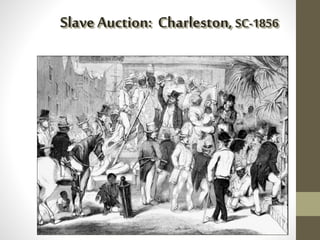
Slave Auction: Charleston, SC-1856
Slave Accoutrements 
Slave Master 
Brands 
Slave muzzle 
Slave 
leg 
irons 
Slave 
tag, 
SC
Anti-Slave Pamphlet
Slave Resistance 
2. Refusal to work hard. 
3. Isolated acts of sabotage. 
4. Escape via the Underground Railroad.
Quilt Patterns as Secret Messages 
The Monkey Wrench pattern, on the left, 
alerted escapees to gather up tools and 
prepare to flee; the Drunkard Path 
design, on the right, warned escapees not 
to follow a straight route.
Runaway Slave Ads
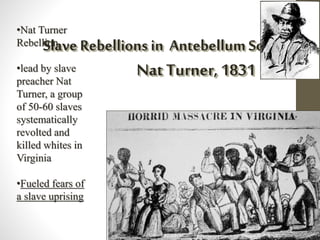
Slave Rebellions in Antebellum South: 
Nat Turner, 1831 
•Nat Turner 
Rebellion 
•lead by slave 
preacher Nat 
Turner, a group 
of 50-60 slaves 
systematically 
revolted and 
killed whites in 
Virginia 
•Fueled fears of 
a slave uprising
The 2nd 
Great Awakening
The Rise of Popular Religion 
In France, I had almost always seen 
the spirit of religion and the spirit of 
freedom pursuing courses diametrically 
opposed to each other; but in America, 
I found that they were intimately 
united, and that they reigned in common 
over the same country… Religion was the 
foremost of the political institutions of 
the United States. 
-- Alexis de Tocqueville, 1832 
R1-1
Second Great Awakening 
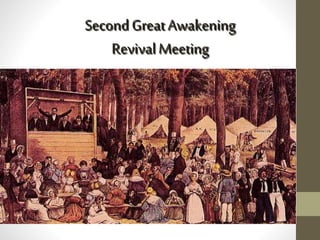
Revival Meeting
The Second Great Awakening 
“Spiritual Reform From Within” 
[Religious Revivalism] 
Social Reforms & Redefining the Ideal 
of Equality 
Temperance 
Asylum & 
Penal Reform 
Education 
Women’s 
Rights 
*Abolitionism*
Second Great Awakening 
• As a result of the Second Great Awakening (a series 
of revivals starting in the 1790s-early 1800s), the 
dominant form of Christianity in America became 
evangelical Protestantism 
• Membership in the major Protestant churches— 
Congregational, Presbyterian, Baptist, and Methodist— 
soared 
• By 1840 an estimated half of the adult population was 
connected to some church, with the Methodists emerging 
as the largest denomination in both the North and the 
South
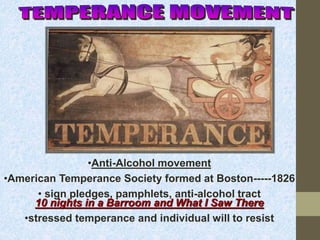
•Anti-Alcohol movement 
•American Temperance Society formed at Boston-----1826 
• sign pledges, pamphlets, anti-alcohol tract 
10 nights in a Barroom and What I Saw There 
•stressed temperance and individual will to resist
The Temperance 
Movement 
• During the next 
decade 
approximately 5000 
local temperance 
societies were 
founded 
• As the movement 
gained momentum, 
annual per capita 
consumption of 
alcohol dropped 
sharply
The Drunkard’s Progress 
From the first glass to the grave, 1846
Educational Reform 
In 1800 Massachusetts 
was the only state 
requiring free public 
schools supported by 
community funds 
Middle-class reformers called for tax-supported 
education, arguing to business 
leaders that the new economic order needed 
educated workers 
By 1860 every state offered free public 
education to whites. *US had one of the 
highest literacy rates*
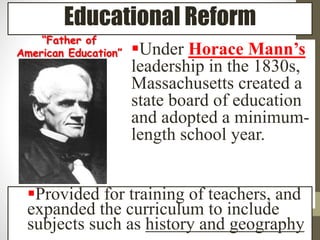
Educational Reform 
Under Horace Mann’s 
leadership in the 1830s, 
Massachusetts created a 
state board of education 
and adopted a minimum-length 
school year. 
“Father of 
American Education” 
Provided for training of teachers, and 
expanded the curriculum to include 
subjects such as history and geography
The Asylum 
Movement 
• Dorothea Dix, a Boston 
schoolteacher, took the lead 
in advocating state supported asylums 
for the mentally ill 
• She attracted much attention to the 
movement by her report detailing the 
horrors to which the mentally ill were 
subjected 
– being chained, kept in cages and closets, 
and beaten with rods 
• In response to her efforts, 28 states 
maintained mental institutions by 1860
The Asylum Movement 
(orphanages, jails, hospitals) 
• Asylums isolated and 
separated the criminal, 
the insane, the ill, and 
the dependent from 
outside society 
• “Rehabilitation” 
– The goal of care in 
asylums, which had 
focused on confinement, 
shifted to the reform of 
personal character
Dorothea Dix Asylum - 1849
Abolitionism 
• William Lloyd Garrison, 
publisher of the The 
Liberator, first appeared in 
1831 and sent shock waves 
across the entire country 
– He repudiated gradual 
emancipation and embraced 
immediate end to slavery at 
once 
– He advocated racial equality 
and argued that slaveholders 
should not be compensated for 
freeing slaves.
The Liberator 
Premiere issue  January 1, 1831
Abolitionism 
• Free blacks, such as Frederick 
Douglass, who had escaped from slavery 
in Maryland, also joined the abolitionist 
movement 
• To abolitionists, slavery was a moral, not 
an economic question 
• But most of all, abolitionists denounced 
slavery as contrary to Christian teaching 
• 1845 --> The Narrative of the Life 
Of Frederick Douglass 
• 1847 --> “The North Star”
Sojourner Truth (1787-1883) 
or Isabella Baumfree 
1850 --> The Narrative of Sojourner Truth 
a former slave who lived in Florence, MA in the 
mid-1800′s, was a nationally known advocate for 
R2-1e0 quality and justice.
Harriet Tubman 
(1820-1913) 
• Helped over 300 slaves 
to freedom. 
• $40,000 bounty on her 
head. 
• Served as a Union spy 
during the Civil War. 
“Moses” 
 “Conductor” ==== leader of the escape 
 “Passengers” ==== escaping slaves 
 “Tracks” ==== routes 
 “Trains” ==== farm wagons transporting 
the escaping slaves 
 “Depots” ==== safe houses to rest/sleep
Antebellum Women- early 1800s 
1. Unable to vote. 
2. Legal status of a minor. 
3. Single --> could own her own 
property. 
4. Married --> no control over her 
property or her children. 
5. Could not initiate divorce. 
6. Couldn’t make wills, sign a 
contract, or bring suit in court 
without her husband’s permission.
“Separate Spheres” Concept 
Republican Motherhood evolved 
into the “Cult of Domesticity” 
• A woman’s “sphere” was in the home (it was a 
refuge from the cruel world outside). 
• Her role was to “civilize” her husband and 
family. 
• An 1830s MA minister: 
The power of woman is her dependence. A woman 
who gives up that dependence on man to become a 
reformer yields the power God has given her for 
her protection, and her character becomes 
unnatural!
Cult of Domesticity = Slavery 
The 2nd Great Awakening inspired women 
to improve society. 
Angelina Grimké Sarah Grimké 
 Southern Abolitionists who also 
fought for women’s rights 
Lucy Stone 
 American Women’s 
Suffrage Assoc. 
 edited Woman’s Journal 
R2-9
Women’s Rights Movement 
When abolitionists divided over the issue 
of female participation, women found it 
easy to identify with the situation of the 
slaves 
1848: Feminist reform led to Seneca Falls 
Convention 
Significance: launched modern women’s 
rights movement 
Established the arguments and the 
program for the women’s rights movement 
for the remainder of the century
What It Would Be Like If Ladies Had Their 
Own Way! 
R2-8
Women’s Rights 
Lucretia Mott Elizabeth Cady Stanton 
1848 --> Seneca Falls Declaration of Sentiments
The first Woman’s rights 
movement was in Seneca Falls, 
New York in 1849…… 
•Educational and professional 
opportunities 
•Property rights 
•Legal equality 
•repeal of laws awarding the father 
custody of the children in divorce. 
•Suffrage rights
1830’s to 1900’s 
•Elizabeth Cady Stanton 
•Susan B. Anthony 
•Women’s rights reformers 
•citizenship 
•right to vote 
•education 
•Supported the abolition of 
slavery 
Picture/Anthony & Stanton
Possible DBQ/FR: 
“Reform movements in the United States 
sought to expand democratic ideals.” 
Assess (evaluate, judge or appraise) 
the validity (strength or soundness) of 
this statement with specific reference to 
the years 1825 to 1850.

6 antebellum

  • 2.
  • 3.
  • 4.
  • 5.
  • 6.
    Characteristics of the Antebellum South 1. Primarily agrarian. 2. Economic power shifted from the “upper South” to the “lower South.” 3. “Cotton Is King!” * 1860 5 mil. bales a yr. (57% of total US exports). 4. Very slow development of industrialization. 5. Rudimentary financial system. 6. Inadequate transportation system.
  • 7.
    Slaves Picking Cotton on a Mississippi Plantation
  • 8.
    Slaves Using theCotton Gin
  • 9.
    Value of CottonExports As % of All US Exports How does this foreshadow the Civil War?
  • 11.
  • 12.
  • 13.
    Slave Accoutrements SlaveMaster Brands Slave muzzle Slave leg irons Slave tag, SC
  • 14.
  • 16.
    Slave Resistance 2.Refusal to work hard. 3. Isolated acts of sabotage. 4. Escape via the Underground Railroad.
  • 17.
    Quilt Patterns asSecret Messages The Monkey Wrench pattern, on the left, alerted escapees to gather up tools and prepare to flee; the Drunkard Path design, on the right, warned escapees not to follow a straight route.
  • 18.
  • 19.
    Slave Rebellions inAntebellum South: Nat Turner, 1831 •Nat Turner Rebellion •lead by slave preacher Nat Turner, a group of 50-60 slaves systematically revolted and killed whites in Virginia •Fueled fears of a slave uprising
  • 20.
    The 2nd GreatAwakening
  • 21.
    The Rise ofPopular Religion In France, I had almost always seen the spirit of religion and the spirit of freedom pursuing courses diametrically opposed to each other; but in America, I found that they were intimately united, and that they reigned in common over the same country… Religion was the foremost of the political institutions of the United States. -- Alexis de Tocqueville, 1832 R1-1
  • 22.
    Second Great Awakening Revival Meeting
  • 23.
    The Second GreatAwakening “Spiritual Reform From Within” [Religious Revivalism] Social Reforms & Redefining the Ideal of Equality Temperance Asylum & Penal Reform Education Women’s Rights *Abolitionism*
  • 24.
    Second Great Awakening • As a result of the Second Great Awakening (a series of revivals starting in the 1790s-early 1800s), the dominant form of Christianity in America became evangelical Protestantism • Membership in the major Protestant churches— Congregational, Presbyterian, Baptist, and Methodist— soared • By 1840 an estimated half of the adult population was connected to some church, with the Methodists emerging as the largest denomination in both the North and the South
  • 26.
    •Anti-Alcohol movement •AmericanTemperance Society formed at Boston-----1826 • sign pledges, pamphlets, anti-alcohol tract 10 nights in a Barroom and What I Saw There •stressed temperance and individual will to resist
  • 27.
    The Temperance Movement • During the next decade approximately 5000 local temperance societies were founded • As the movement gained momentum, annual per capita consumption of alcohol dropped sharply
  • 28.
    The Drunkard’s Progress From the first glass to the grave, 1846
  • 29.
    Educational Reform In1800 Massachusetts was the only state requiring free public schools supported by community funds Middle-class reformers called for tax-supported education, arguing to business leaders that the new economic order needed educated workers By 1860 every state offered free public education to whites. *US had one of the highest literacy rates*
  • 30.
    Educational Reform UnderHorace Mann’s leadership in the 1830s, Massachusetts created a state board of education and adopted a minimum-length school year. “Father of American Education” Provided for training of teachers, and expanded the curriculum to include subjects such as history and geography
  • 31.
    The Asylum Movement • Dorothea Dix, a Boston schoolteacher, took the lead in advocating state supported asylums for the mentally ill • She attracted much attention to the movement by her report detailing the horrors to which the mentally ill were subjected – being chained, kept in cages and closets, and beaten with rods • In response to her efforts, 28 states maintained mental institutions by 1860
  • 32.
    The Asylum Movement (orphanages, jails, hospitals) • Asylums isolated and separated the criminal, the insane, the ill, and the dependent from outside society • “Rehabilitation” – The goal of care in asylums, which had focused on confinement, shifted to the reform of personal character
  • 33.
  • 34.
    Abolitionism • WilliamLloyd Garrison, publisher of the The Liberator, first appeared in 1831 and sent shock waves across the entire country – He repudiated gradual emancipation and embraced immediate end to slavery at once – He advocated racial equality and argued that slaveholders should not be compensated for freeing slaves.
  • 35.
    The Liberator Premiereissue  January 1, 1831
  • 36.
    Abolitionism • Freeblacks, such as Frederick Douglass, who had escaped from slavery in Maryland, also joined the abolitionist movement • To abolitionists, slavery was a moral, not an economic question • But most of all, abolitionists denounced slavery as contrary to Christian teaching • 1845 --> The Narrative of the Life Of Frederick Douglass • 1847 --> “The North Star”
  • 37.
    Sojourner Truth (1787-1883) or Isabella Baumfree 1850 --> The Narrative of Sojourner Truth a former slave who lived in Florence, MA in the mid-1800′s, was a nationally known advocate for R2-1e0 quality and justice.
  • 38.
    Harriet Tubman (1820-1913) • Helped over 300 slaves to freedom. • $40,000 bounty on her head. • Served as a Union spy during the Civil War. “Moses”  “Conductor” ==== leader of the escape  “Passengers” ==== escaping slaves  “Tracks” ==== routes  “Trains” ==== farm wagons transporting the escaping slaves  “Depots” ==== safe houses to rest/sleep
  • 39.
    Antebellum Women- early1800s 1. Unable to vote. 2. Legal status of a minor. 3. Single --> could own her own property. 4. Married --> no control over her property or her children. 5. Could not initiate divorce. 6. Couldn’t make wills, sign a contract, or bring suit in court without her husband’s permission.
  • 40.
    “Separate Spheres” Concept Republican Motherhood evolved into the “Cult of Domesticity” • A woman’s “sphere” was in the home (it was a refuge from the cruel world outside). • Her role was to “civilize” her husband and family. • An 1830s MA minister: The power of woman is her dependence. A woman who gives up that dependence on man to become a reformer yields the power God has given her for her protection, and her character becomes unnatural!
  • 41.
    Cult of Domesticity= Slavery The 2nd Great Awakening inspired women to improve society. Angelina Grimké Sarah Grimké  Southern Abolitionists who also fought for women’s rights Lucy Stone  American Women’s Suffrage Assoc.  edited Woman’s Journal R2-9
  • 42.
    Women’s Rights Movement When abolitionists divided over the issue of female participation, women found it easy to identify with the situation of the slaves 1848: Feminist reform led to Seneca Falls Convention Significance: launched modern women’s rights movement Established the arguments and the program for the women’s rights movement for the remainder of the century
  • 43.
    What It WouldBe Like If Ladies Had Their Own Way! R2-8
  • 44.
    Women’s Rights LucretiaMott Elizabeth Cady Stanton 1848 --> Seneca Falls Declaration of Sentiments
  • 45.
    The first Woman’srights movement was in Seneca Falls, New York in 1849…… •Educational and professional opportunities •Property rights •Legal equality •repeal of laws awarding the father custody of the children in divorce. •Suffrage rights
  • 46.
    1830’s to 1900’s •Elizabeth Cady Stanton •Susan B. Anthony •Women’s rights reformers •citizenship •right to vote •education •Supported the abolition of slavery Picture/Anthony & Stanton
  • 47.
    Possible DBQ/FR: “Reformmovements in the United States sought to expand democratic ideals.” Assess (evaluate, judge or appraise) the validity (strength or soundness) of this statement with specific reference to the years 1825 to 1850.