The Revolutionary
     Period:
    The Age of Reason
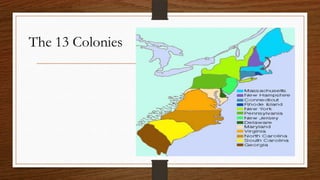
The 13 Colonies
• Critical thinking is the ability to think clearly and rationally. It includes the
  ability to engage in reflective and independent thinking.

• Someone with critical thinking skills is able to do the following:
    •   Understand the logical connections between ideas
    •   Identify, construct and evaluate arguments
    •   Detect inconsistencies and common mistakes in reasoning
    •   Solve problems systematically
    •   Reflect on the justifications of one’s own beliefs and values
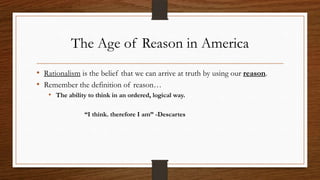
The Age of Reason in America
• Rationalism is the belief that we can arrive at truth by using our reason.
• Remember the definition of reason…
   • The ability to think in an ordered, logical way.

                “I think. therefore I am” -Descartes
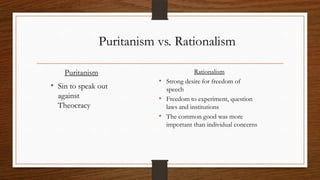
Puritanism vs. Rationalism

    Puritanism                           Rationalism
                            • Strong desire for freedom of
• Sin to speak out            speech
  against                   • Freedom to experiment, question
  Theocracy                   laws and institutions
                            • The common good was more
                              important than individual concerns
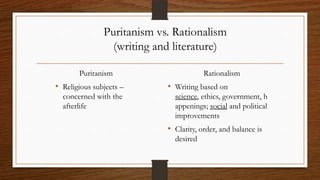
Puritanism vs. Rationalism
                 (writing and literature)

       Puritanism                       Rationalism
• Religious subjects –      • Writing based on
  concerned with the          science, ethics, government, h
  afterlife                   appenings; social and political
                              improvements
                            • Clarity, order, and balance is
                              desired
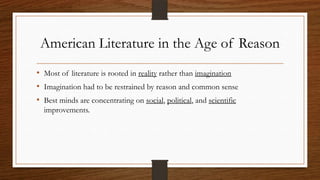
American Literature in the Age of Reason
• Most of literature is rooted in reality rather than imagination
• Imagination had to be restrained by reason and common sense
• Best minds are concentrating on social, political, and scientific
  improvements.
The most common types of literature:
•   Pamphlets
•   Speeches
•   Essays
•   Letters
•   Some poems and ballads (but are used to urge Americans into political
    action)
Prominent Writers
•   Benjamin Franklin – “Sayings of Poor Richard”
•   Patrick Henry – “Speech at the Virginia Convention”
•   Thomas Paine – “Common Sense”
•   Thomas Jefferson - “The Declaration of Independence”
The Declaration of
  Independence
   Thomas Jefferson, July 4, 1776
ORIGIN OF THE DECLARATION OF
                INDEPENDENCE

During June and July of 1776, the main question facing the Second Continental
Congress at Philadelphia revolved around independence: should the American
colonies represented at this Congress declare their separation and freedom
from the United Kingdom of Great Britain? After intense debate, the delegates
voted on July 2, 1776 in favor of Richard Henry Lee's resolution for
independence. On July 4, the Congress discussed and approved, with a few
changes, the formal Declaration of Independence written by Thomas Jefferson
on behalf of a five-person committee appointed by Congress (Maier 1997;
McClellan 1989).
Structure and Key Ideas

• The first part is an introduction that states the purpose of the
  document, which was to explain why the American people were declaring
  independence from the government of Great Britain.
Structure and Key Ideas

 The second part is a theory of good government and individual rights generally
accepted by Americans from the 1770s until today. In this theory, all individuals are
equal in their possession of certain immutable rights. These rights are not granted by
the government. Rather, they are inherent to human nature. Therefore, the first purpose
of a good government is to secure or protect these rights. Further, a good government
is based on the consent of the governed -- the people -- who are the sole source of the
government's authority. If their government persistently violates this theory of good
government, then the people have the right to overthrow it.
Structure and Key Ideas
The third part of the document is a list of grievances against King George
III, who was singled out to represent the actions of the British government.
These grievances are examples of actions that violated the criteria for good
government stated in the second part of the Declaration of Independence.
These grievances, therefore, justify separation from the King's bad government
and establishment of a good government to replace it.
Structure and Key Ideas
The fourth and final part of the document is an unqualified
assertion of sovereignty by the United States of America. It
proclaims the determination of Americans to defend and maintain
their independence and rights.
Background
• With the American colonies already at war with Great Britain, the second
  Continental Congress felt the need to declare their independence formally. A
  committee was appointed to prepare a document, and Thomas Jefferson
  wrote a first draft. After minor revisions, the draft was accepted by the
  committee and officially approved by the congress on July 4, 1776.
Purpose
• The Declaration of Independence, completed and signed in July of
  1776, marked the official separation between the 13 colonies and Great
  Britain. An armed struggle between the colonies and Britain had begun just
  over a year before, with the Battles of Lexington and Concord.
• Prior to the French and Indian war, the colonists had enjoyed over a hundred
  years of "salutary neglect." In other words, although laws were in place to
  maintain the subordinate status of the colonies to Great Britain, they were
  usually not enforced.
• Colonists initially protested these acts through peaceful means such as
  petition, boycott, and committees. They argued that since they had no
  representation in Parliament, they could not be rightfully taxed by
  Parliament.
• The job of drafting the Declaration of Independence fell to the youngest
  member of the committee, Thomas Jefferson. In composing the
  declaration, Jefferson drew on ideas from the Enlightenment, especially
  those of John Locke. Not only did the declaration represent a milestone in
  the history of the United States, it also turned the political philosophies of
  18th century Europe into real political practice.
Preamble

• Government exist to support the rights of men. Government exist only
  through the power of the people that they represent. When a government
  fails to grant rights to the people and removes the involvement of the
  people, the people have the right to change their government in a way that
  will allow for their unalienable rights to be protected.
List of abuses and usurpations
• The colonies have suffered 27 at the hands of the King George III. Each of
  these abuses has been directed at the colonies for the purpose of establishing
  a tyrannical government in North America.
• The first 12 abuses involve King George III’s establishment of a tyrannical
  authority in place of representative government.
• Abuses 13 through 22 describe the involvement of parliament in destroying
  the colonists' right to self-rule. The king has "combined with others" to
  subject the colonists to legislation passed without colonial input or consent.
• The last 5 abuses, 23 through 27, refer to specific actions that the King of
  Great Britain took to abandon the colonies and to wage war against them.
  The King has attempted to suppress the colonial rebellion through violence
  and military means.
Past actions of colonists
• Up until this declaration, colonists have used non-violent means, such as
  petitions, to protest the abuses of King George III. Each attempt to request
  peaceful negotiations was met by neglect and more abuse.

• Additionally, colonists tried to appeal to Parliament and other British citizens for
  help. These attempts were ignored. Colonists appealed to British citizens' sense of
  justice, to their shared heritage and culture, and to their economic connection.
  These attempts failed, however, and the colonies have no other choice but to
  declare separation. In doing so, the new separate nation will view British citizens as
  enemies during wartime, and as friends in peacetime.
Conclusion and definition of a new
                    government
• The Second Continental Congress represents the people of the new nation
  called the United States of America. This declaration informs all the people
  of the world that the 13 united colonies are free from British rule and any
  political connections with Great Britain. The declaration also serves to
  appeal to the people of the world to understand the reasons why this
  separation is justifiable.
References:
• http://www.sparknotes.com/history/american/declaration/

The Declaration of Independence

  • 1.
    The Revolutionary Period: The Age of Reason
  • 2.
  • 3.
    • Critical thinkingis the ability to think clearly and rationally. It includes the ability to engage in reflective and independent thinking. • Someone with critical thinking skills is able to do the following: • Understand the logical connections between ideas • Identify, construct and evaluate arguments • Detect inconsistencies and common mistakes in reasoning • Solve problems systematically • Reflect on the justifications of one’s own beliefs and values
  • 4.
    The Age ofReason in America • Rationalism is the belief that we can arrive at truth by using our reason. • Remember the definition of reason… • The ability to think in an ordered, logical way. “I think. therefore I am” -Descartes
  • 5.
    Puritanism vs. Rationalism Puritanism Rationalism • Strong desire for freedom of • Sin to speak out speech against • Freedom to experiment, question Theocracy laws and institutions • The common good was more important than individual concerns
  • 6.
    Puritanism vs. Rationalism (writing and literature) Puritanism Rationalism • Religious subjects – • Writing based on concerned with the science, ethics, government, h afterlife appenings; social and political improvements • Clarity, order, and balance is desired
  • 7.
    American Literature inthe Age of Reason • Most of literature is rooted in reality rather than imagination • Imagination had to be restrained by reason and common sense • Best minds are concentrating on social, political, and scientific improvements.
  • 8.
    The most commontypes of literature: • Pamphlets • Speeches • Essays • Letters • Some poems and ballads (but are used to urge Americans into political action)
  • 9.
    Prominent Writers • Benjamin Franklin – “Sayings of Poor Richard” • Patrick Henry – “Speech at the Virginia Convention” • Thomas Paine – “Common Sense” • Thomas Jefferson - “The Declaration of Independence”
  • 10.
    The Declaration of Independence Thomas Jefferson, July 4, 1776
  • 11.
    ORIGIN OF THEDECLARATION OF INDEPENDENCE During June and July of 1776, the main question facing the Second Continental Congress at Philadelphia revolved around independence: should the American colonies represented at this Congress declare their separation and freedom from the United Kingdom of Great Britain? After intense debate, the delegates voted on July 2, 1776 in favor of Richard Henry Lee's resolution for independence. On July 4, the Congress discussed and approved, with a few changes, the formal Declaration of Independence written by Thomas Jefferson on behalf of a five-person committee appointed by Congress (Maier 1997; McClellan 1989).
  • 12.
    Structure and KeyIdeas • The first part is an introduction that states the purpose of the document, which was to explain why the American people were declaring independence from the government of Great Britain.
  • 13.
    Structure and KeyIdeas The second part is a theory of good government and individual rights generally accepted by Americans from the 1770s until today. In this theory, all individuals are equal in their possession of certain immutable rights. These rights are not granted by the government. Rather, they are inherent to human nature. Therefore, the first purpose of a good government is to secure or protect these rights. Further, a good government is based on the consent of the governed -- the people -- who are the sole source of the government's authority. If their government persistently violates this theory of good government, then the people have the right to overthrow it.
  • 14.
    Structure and KeyIdeas The third part of the document is a list of grievances against King George III, who was singled out to represent the actions of the British government. These grievances are examples of actions that violated the criteria for good government stated in the second part of the Declaration of Independence. These grievances, therefore, justify separation from the King's bad government and establishment of a good government to replace it.
  • 15.
    Structure and KeyIdeas The fourth and final part of the document is an unqualified assertion of sovereignty by the United States of America. It proclaims the determination of Americans to defend and maintain their independence and rights.
  • 16.
    Background • With theAmerican colonies already at war with Great Britain, the second Continental Congress felt the need to declare their independence formally. A committee was appointed to prepare a document, and Thomas Jefferson wrote a first draft. After minor revisions, the draft was accepted by the committee and officially approved by the congress on July 4, 1776.
  • 17.
    Purpose • The Declarationof Independence, completed and signed in July of 1776, marked the official separation between the 13 colonies and Great Britain. An armed struggle between the colonies and Britain had begun just over a year before, with the Battles of Lexington and Concord.
  • 18.
    • Prior tothe French and Indian war, the colonists had enjoyed over a hundred years of "salutary neglect." In other words, although laws were in place to maintain the subordinate status of the colonies to Great Britain, they were usually not enforced.
  • 19.
    • Colonists initiallyprotested these acts through peaceful means such as petition, boycott, and committees. They argued that since they had no representation in Parliament, they could not be rightfully taxed by Parliament.
  • 20.
    • The jobof drafting the Declaration of Independence fell to the youngest member of the committee, Thomas Jefferson. In composing the declaration, Jefferson drew on ideas from the Enlightenment, especially those of John Locke. Not only did the declaration represent a milestone in the history of the United States, it also turned the political philosophies of 18th century Europe into real political practice.
  • 21.
    Preamble • Government existto support the rights of men. Government exist only through the power of the people that they represent. When a government fails to grant rights to the people and removes the involvement of the people, the people have the right to change their government in a way that will allow for their unalienable rights to be protected.
  • 22.
    List of abusesand usurpations • The colonies have suffered 27 at the hands of the King George III. Each of these abuses has been directed at the colonies for the purpose of establishing a tyrannical government in North America.
  • 23.
    • The first12 abuses involve King George III’s establishment of a tyrannical authority in place of representative government.
  • 24.
    • Abuses 13through 22 describe the involvement of parliament in destroying the colonists' right to self-rule. The king has "combined with others" to subject the colonists to legislation passed without colonial input or consent.
  • 25.
    • The last5 abuses, 23 through 27, refer to specific actions that the King of Great Britain took to abandon the colonies and to wage war against them. The King has attempted to suppress the colonial rebellion through violence and military means.
  • 26.
    Past actions ofcolonists • Up until this declaration, colonists have used non-violent means, such as petitions, to protest the abuses of King George III. Each attempt to request peaceful negotiations was met by neglect and more abuse. • Additionally, colonists tried to appeal to Parliament and other British citizens for help. These attempts were ignored. Colonists appealed to British citizens' sense of justice, to their shared heritage and culture, and to their economic connection. These attempts failed, however, and the colonies have no other choice but to declare separation. In doing so, the new separate nation will view British citizens as enemies during wartime, and as friends in peacetime.
  • 27.
    Conclusion and definitionof a new government • The Second Continental Congress represents the people of the new nation called the United States of America. This declaration informs all the people of the world that the 13 united colonies are free from British rule and any political connections with Great Britain. The declaration also serves to appeal to the people of the world to understand the reasons why this separation is justifiable.
  • 28.

Editor's Notes

  • #2 The ability to think in an ordered, logical way.
  • #22 It has become necessary for the 13 colonies to separate from Great Britain. These 13 colonies have the right to become a nation as legitimate as any other nation. Additionally, it is important to explain to the public, including those in other nations, why this declaration of independence is being made.This declaration is based on certain truths. All men are meant to be equal and to have certain rights ("unalienable rights") that the government should never take away. These rights include "life, liberty and the pursuit of happiness."