Ms. Susan M. Pojer Horace Greeley HS  Chappaqua, NY Antebellum Revivalism & Reform
1.   The Second  Great Awakening “ Spiritual Reform From Within” [Religious Revivalism] Social Reforms & Redefining the Ideal of Equality Temperance Asylum & Penal Reform Education Women ’s Rights Abolitionism
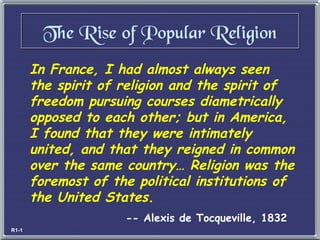
In France, I had almost always seen the spirit of religion and the spirit of freedom pursuing courses diametrically opposed to each other; but in America, I found that they were intimately united, and that they reigned in common over the same country… Religion was the foremost of the political institutions of the United States. -- Alexis de Tocqueville, 1832 The Rise of Popular Religion R1-1
“ The Pursuit  of Perfection” In  Antebellum America
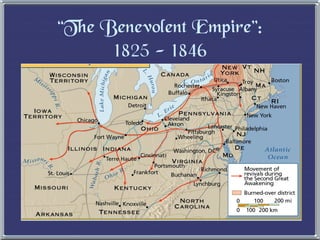
“ The Benevolent Empire”: 1825 - 1846
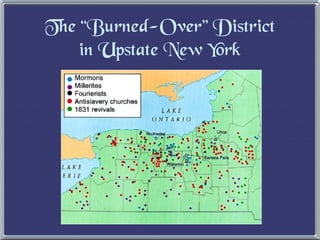
The  “Burned-Over” District in Upstate New York
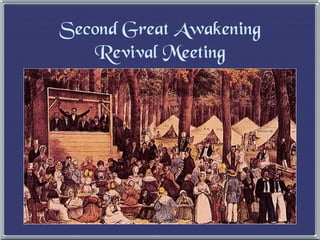
Second Great Awakening Revival Meeting
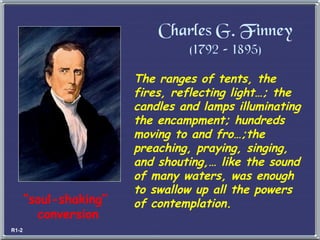
The ranges of tents, the fires, reflecting light…; the candles and lamps illuminating the encampment; hundreds moving to and fro…;the preaching, praying, singing, and shouting,… like the sound of many waters, was enough to swallow up all the powers of contemplation. Charles G. Finney (1792 – 1895) “ soul-shaking”  conversion R1-2
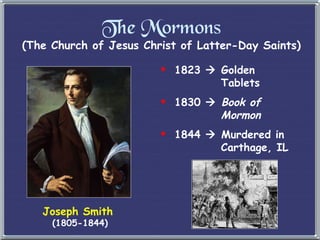
The Mormons (The Church of Jesus Christ of Latter-Day Saints) Joseph Smith   (1805-1844) 1823    Golden   Tablets 1830     Book of    Mormon 1844    Murdered in   Carthage, IL
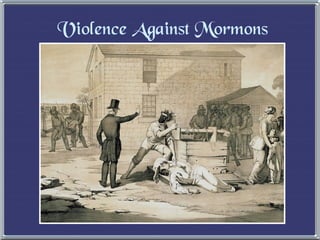
Violence Against Mormons
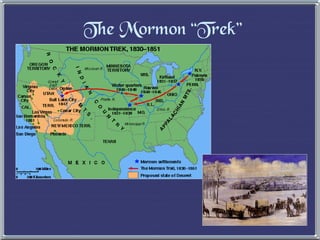
The Mormon  “Trek”
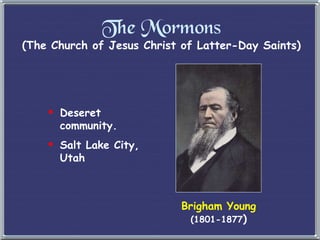
The Mormons (The Church of Jesus Christ of Latter-Day Saints) Deseret community. Salt Lake City, Utah Brigham Young (1801-1877 )
Mother Ann Lee  (1736-1784) If you will take up your crosses against the works of generations, and follow Christ in the regeneration, God will cleanse you from all unrighteousness. Remember the cries of those who are in need and trouble, that when you are in trouble, God may hear your cries.   If you improve in one talent, God will give you  more. The  Shakers R1-4
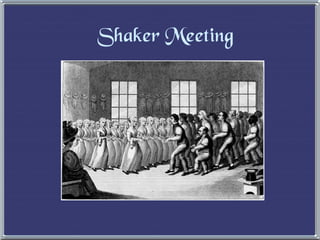
Shaker Meeting
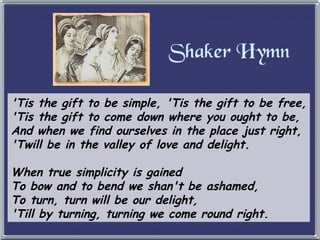
Shaker Hymn 'Tis the gift to be simple, 'Tis the gift to be free, 'Tis the gift to come down where you ought to be, And when we find ourselves in the place just right, 'Twill be in the valley of love and delight. When true simplicity is gained To bow and to bend we shan't be ashamed, To turn, turn will be our delight, 'Till by turning, turning we come round right.
Shaker Simplicity & Utility
2.   Transcendentalism (European Romanticism) Liberation from  understanding  and the cultivation of  reasoning . ” “ Transcend” the limits of intellect and allow the emotions, the SOUL, to create an original relationship with the Universe.
Transcendentalist Thinking Man must acknowledge a body of moral truths that were intuitive and must TRANSCEND more sensational proof: The infinite benevolence of God. The infinite benevolence of nature. The divinity of man. They instinctively rejected all secular authority and the authority of organized churches and the Scriptures, of law, or of conventions
Transcendentalism (European Romanticism) Therefore, if man was divine, it would be wicked that he should be held in slavery, or his soul corrupted by superstition, or his mind clouded by ignorance!!  Thus, the role of the reformer was to restore man to that divinity which God had endowed them.
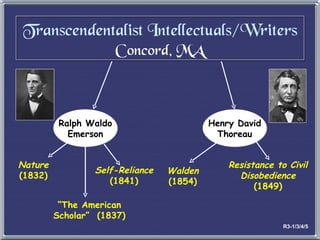
Transcendentalist Intellectuals/Writers Concord, MA Ralph Waldo Emerson Henry David Thoreau Nature (1832) Walden (1854) Resistance to Civil Disobedience (1849) Self-Reliance  (1841) “ The American Scholar”  (1837) R3-1/3/4/5
The Transcendentalist Agenda Give freedom to the slave. Give well-being to the poor and the miserable. Give learning to the ignorant. Give health to the sick. Give peace and justice to society.
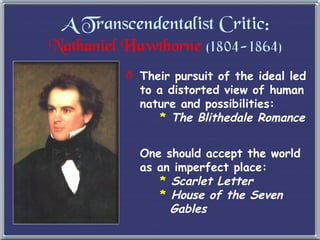
Their pursuit of the ideal led to a distorted view of human nature and possibilities:   *   The Blithedale Romance A Transcendentalist Critic: Nathaniel Hawthorne   (1804-1864) One should accept the world as an imperfect place:   *   Scarlet Letter   *   House of the Seven   Gables
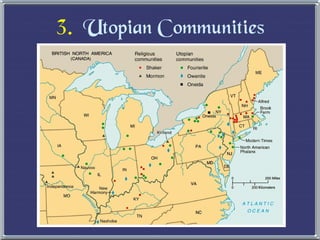
3 .   Utopian Communities
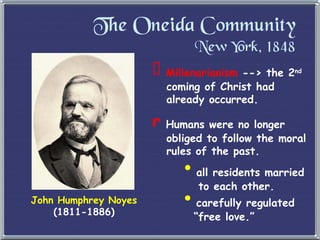
The Oneida Community New York, 1848 John Humphrey Noyes (1811-1886) Millenarianism  --> the 2 nd   coming of Christ had   already occurred. Humans were no longer   obliged to follow the moral   rules of the past. all residents married   to each other. carefully regulated   “free love.”
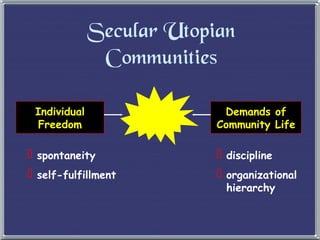
Secular Utopian Communities Individual Freedom Demands of Community Life spontaneity self-fulfillment discipline organizational hierarchy
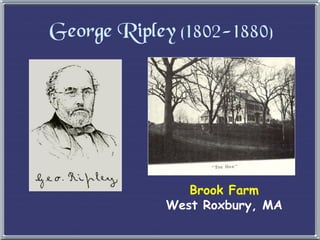
Brook Farm West Roxbury, MA George Ripley  (1802-1880)
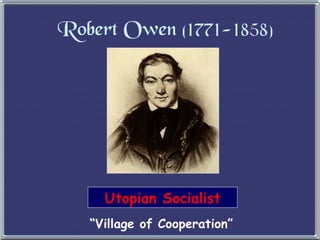
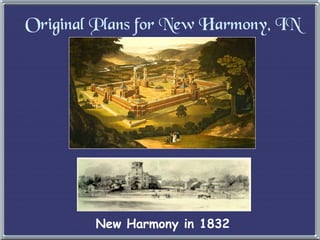
Robert Owen  (1771-1858) Utopian Socialist “ Village of Cooperation”
Original Plans for New Harmony, IN New Harmony in 1832
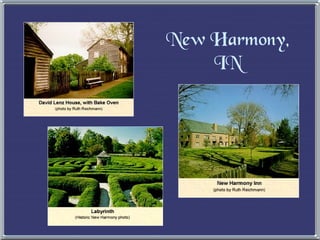
New Harmony, IN
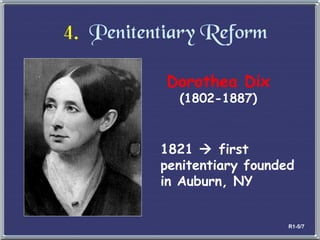
4.   Penitentiary Reform Dorothea Dix (1802-1887) 1821    first penitentiary founded in Auburn, NY R1-5/7
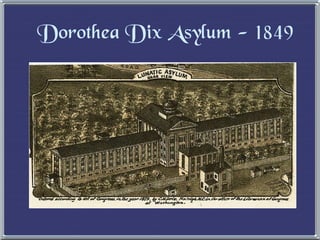
Dorothea Dix Asylum - 1849
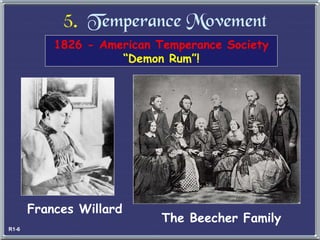
5.   Temperance Movement Frances Willard The Beecher Family 1826 - American Temperance Society “Demon Rum”! R1-6
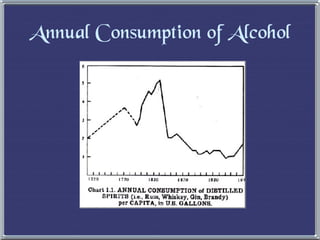
Annual Consumption of Alcohol
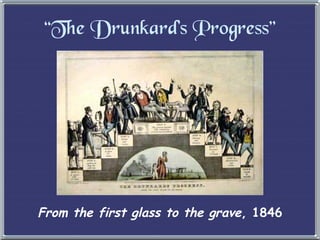
“ The Drunkard’s Progress” From the first glass to the grave , 1846
6.   Social Reform    Prostitution The  “Fallen Woman” Sarah Ingraham (1802-1887) 1835     Advocate of Moral  Reform Female Moral Reform Society  focused on the  “Johns” & pimps, not the girls. R2-1
7.   Educational Reform Religious Training    Secular Education MA    always on the forefront of public   educational reform   *   1 st  state to establish tax support for    local public schools. By 1860 every state offered free public    education to whites.   *  US had one of the highest literacy rates.
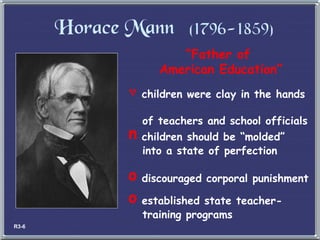
“ Father of  American Education ” Horace Mann   (1796-1859) children were clay in the hands    of teachers and school officials children should be  “molded”    into a state of perfection discouraged corporal punishment established state teacher-   training programs R3-6
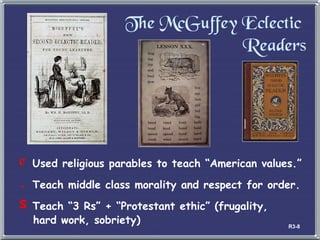
The McGuffey Eclectic  Readers Used religious parables to teach  “American values.” Teach middle class morality and respect for order. Teach  “3 Rs” + “Protestant ethic” (frugality,    hard work, sobriety) R3-8
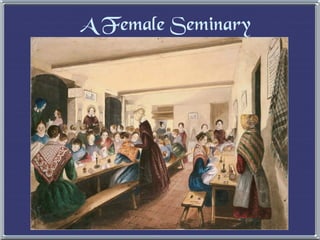
Women Educators Troy, NY Female Seminary curriculum:  math, physics,    history, geography. train female teachers Emma Willard (1787-1870) Mary Lyons (1797-1849) 1837    she established   Mt. Holyoke  [So. Hadley, MA]    as the first college for women.
A Female Seminary
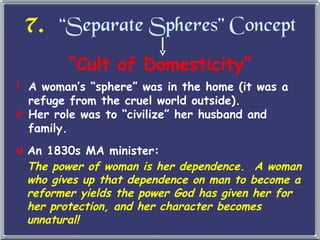
7.   “Separate Spheres” Concept “ Cult of Domesticity” A woman ’s “sphere” was in the home (it was a refuge from the cruel world outside). Her role was to  “civilize” her husband and family. An 1830s MA minister: The power of woman is her dependence.  A woman who gives up that dependence on man to become a reformer yields the power God has given her for her protection, and her character becomes unnatural!
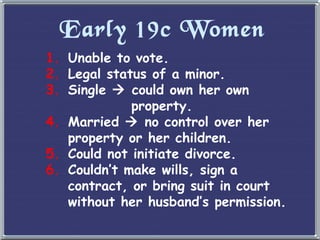
Early 19c Women Unable to vote. Legal status of a minor. Single    could own her own   property. Married    no control over her property or her children. Could not initiate divorce. Couldn ’t make wills, sign a contract, or bring suit in court without her husband’s permission.
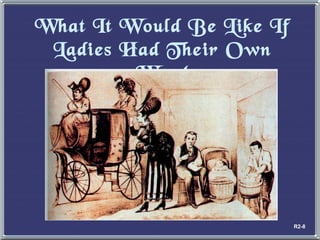
What It Would Be Like If Ladies Had Their Own Way! R2-8
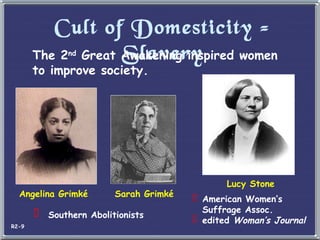
Cult of Domesticity = Slavery The 2 nd  Great Awakening inspired women to improve society. Angelina Grimk é Sarah Grimk é Southern Abolitionists Lucy Stone American Women ’s Suffrage Assoc. edited  Woman ’s Journal R2-9
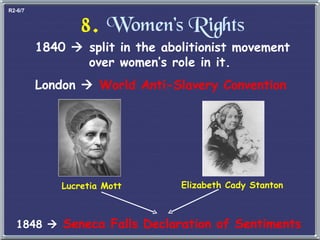
8.   Women ’s Rights 1840    split in the abolitionist movement   over women ’s role in it. London     World Anti-Slavery Convention Lucretia Mott Elizabeth Cady Stanton 1848     Seneca Falls Declaration of Sentiments R2-6/7
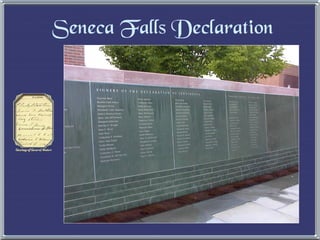
Seneca Falls Declaration
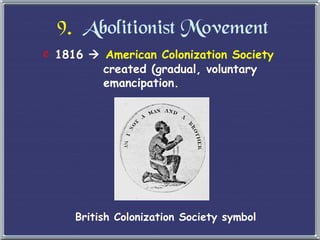
9.   Abolitionist Movement 1816     American Colonization Society   created (gradual, voluntary   emancipation. British Colonization Society symbol
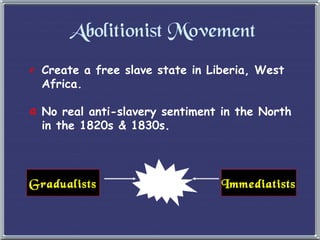
Abolitionist Movement Create a free slave state in Liberia, West Africa. No real anti-slavery sentiment in the North  in the 1820s & 1830s. Gradualists Immediatists
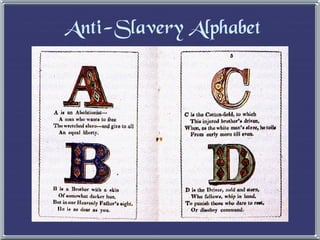
Anti-Slavery Alphabet
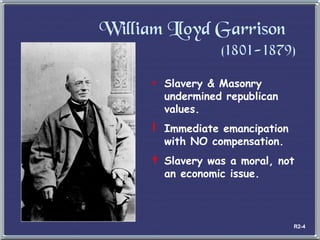
William Lloyd Garrison  (1801-1879) Slavery & Masonry undermined republican values. Immediate emancipation  with NO compensation. Slavery was a moral, not an economic issue. R2-4
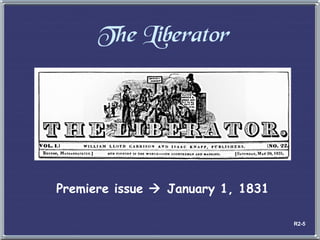
The Liberator Premiere issue    January 1, 1831 R2-5
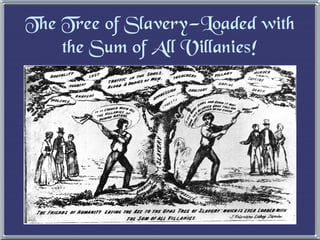
The Tree of Slavery—Loaded with the Sum of All Villanies!
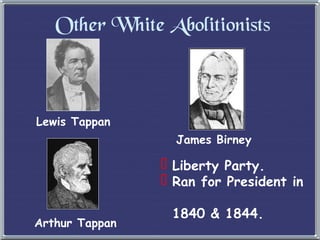
Other White Abolitionists Lewis Tappan Arthur Tappan James Birney Liberty Party. Ran for President in  1840 & 1844.
Black Abolitionists David Walker (1785-1830) 1829     Appeal to the Coloured    Citizens of the World Fight for freedom rather than  wait to be set free by whites .
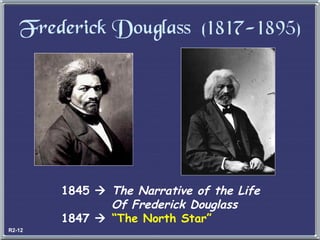
Frederick Douglass  (1817-1895) 1845     The Narrative of the Life   Of Frederick Douglass 1847     “The North Star” R2-12
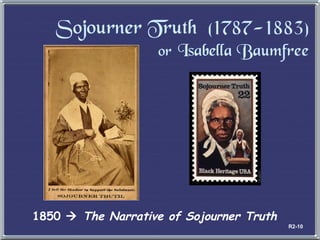
Sojourner Truth  (1787-1883) or  Isabella Baumfree 1850     The Narrative of Sojourner Truth  R2-10
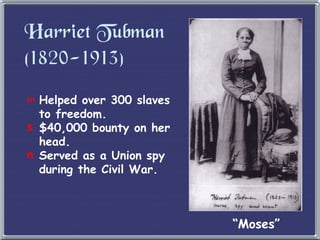
Harriet Tubman (1820-1913) Helped over 300 slaves to freedom. $40,000 bounty on her head. Served as a Union spy during the Civil War. “ Moses”
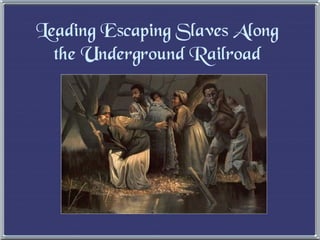
Leading Escaping Slaves Along the Underground Railroad
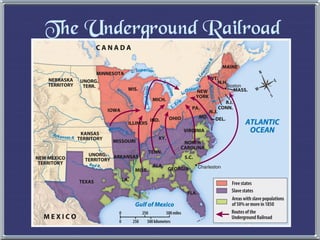
The Underground Railroad
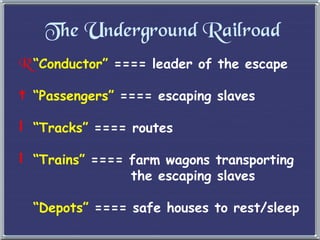
The Underground Railroad “ Conductor”  ==== leader of the escape “ Passengers”  ==== escaping slaves “ Tracks”  ==== routes “ Trains”  ==== farm wagons transporting   the escaping slaves “ Depots”  ==== safe houses to rest/sleep

Antebellum reformers

  • 1.
    Ms. Susan M.Pojer Horace Greeley HS Chappaqua, NY Antebellum Revivalism & Reform
  • 2.
    1. The Second Great Awakening “ Spiritual Reform From Within” [Religious Revivalism] Social Reforms & Redefining the Ideal of Equality Temperance Asylum & Penal Reform Education Women ’s Rights Abolitionism
  • 3.
    In France, Ihad almost always seen the spirit of religion and the spirit of freedom pursuing courses diametrically opposed to each other; but in America, I found that they were intimately united, and that they reigned in common over the same country… Religion was the foremost of the political institutions of the United States. -- Alexis de Tocqueville, 1832 The Rise of Popular Religion R1-1
  • 4.
    “ The Pursuit of Perfection” In Antebellum America
  • 5.
    “ The BenevolentEmpire”: 1825 - 1846
  • 6.
    The “Burned-Over”District in Upstate New York
  • 7.
    Second Great AwakeningRevival Meeting
  • 8.
    The ranges oftents, the fires, reflecting light…; the candles and lamps illuminating the encampment; hundreds moving to and fro…;the preaching, praying, singing, and shouting,… like the sound of many waters, was enough to swallow up all the powers of contemplation. Charles G. Finney (1792 – 1895) “ soul-shaking” conversion R1-2
  • 9.
    The Mormons (TheChurch of Jesus Christ of Latter-Day Saints) Joseph Smith (1805-1844) 1823  Golden Tablets 1830  Book of Mormon 1844  Murdered in Carthage, IL
  • 10.
  • 11.
    The Mormon “Trek”
  • 12.
    The Mormons (TheChurch of Jesus Christ of Latter-Day Saints) Deseret community. Salt Lake City, Utah Brigham Young (1801-1877 )
  • 13.
    Mother Ann Lee (1736-1784) If you will take up your crosses against the works of generations, and follow Christ in the regeneration, God will cleanse you from all unrighteousness. Remember the cries of those who are in need and trouble, that when you are in trouble, God may hear your cries. If you improve in one talent, God will give you more. The Shakers R1-4
  • 14.
  • 15.
    Shaker Hymn 'Tisthe gift to be simple, 'Tis the gift to be free, 'Tis the gift to come down where you ought to be, And when we find ourselves in the place just right, 'Twill be in the valley of love and delight. When true simplicity is gained To bow and to bend we shan't be ashamed, To turn, turn will be our delight, 'Till by turning, turning we come round right.
  • 16.
  • 17.
    2. Transcendentalism (European Romanticism) Liberation from understanding and the cultivation of reasoning . ” “ Transcend” the limits of intellect and allow the emotions, the SOUL, to create an original relationship with the Universe.
  • 18.
    Transcendentalist Thinking Manmust acknowledge a body of moral truths that were intuitive and must TRANSCEND more sensational proof: The infinite benevolence of God. The infinite benevolence of nature. The divinity of man. They instinctively rejected all secular authority and the authority of organized churches and the Scriptures, of law, or of conventions
  • 19.
    Transcendentalism (European Romanticism)Therefore, if man was divine, it would be wicked that he should be held in slavery, or his soul corrupted by superstition, or his mind clouded by ignorance!! Thus, the role of the reformer was to restore man to that divinity which God had endowed them.
  • 20.
    Transcendentalist Intellectuals/Writers Concord,MA Ralph Waldo Emerson Henry David Thoreau Nature (1832) Walden (1854) Resistance to Civil Disobedience (1849) Self-Reliance (1841) “ The American Scholar” (1837) R3-1/3/4/5
  • 21.
    The Transcendentalist AgendaGive freedom to the slave. Give well-being to the poor and the miserable. Give learning to the ignorant. Give health to the sick. Give peace and justice to society.
  • 22.
    Their pursuit ofthe ideal led to a distorted view of human nature and possibilities: * The Blithedale Romance A Transcendentalist Critic: Nathaniel Hawthorne (1804-1864) One should accept the world as an imperfect place: * Scarlet Letter * House of the Seven Gables
  • 23.
    3 . Utopian Communities
  • 24.
    The Oneida CommunityNew York, 1848 John Humphrey Noyes (1811-1886) Millenarianism --> the 2 nd coming of Christ had already occurred. Humans were no longer obliged to follow the moral rules of the past. all residents married to each other. carefully regulated “free love.”
  • 25.
    Secular Utopian CommunitiesIndividual Freedom Demands of Community Life spontaneity self-fulfillment discipline organizational hierarchy
  • 26.
    Brook Farm WestRoxbury, MA George Ripley (1802-1880)
  • 27.
    Robert Owen (1771-1858) Utopian Socialist “ Village of Cooperation”
  • 28.
    Original Plans forNew Harmony, IN New Harmony in 1832
  • 29.
  • 30.
    4. Penitentiary Reform Dorothea Dix (1802-1887) 1821  first penitentiary founded in Auburn, NY R1-5/7
  • 31.
  • 32.
    5. Temperance Movement Frances Willard The Beecher Family 1826 - American Temperance Society “Demon Rum”! R1-6
  • 33.
  • 34.
    “ The Drunkard’sProgress” From the first glass to the grave , 1846
  • 35.
    6. Social Reform  Prostitution The “Fallen Woman” Sarah Ingraham (1802-1887) 1835  Advocate of Moral Reform Female Moral Reform Society focused on the “Johns” & pimps, not the girls. R2-1
  • 36.
    7. Educational Reform Religious Training  Secular Education MA  always on the forefront of public educational reform * 1 st state to establish tax support for local public schools. By 1860 every state offered free public education to whites. * US had one of the highest literacy rates.
  • 37.
    “ Father of American Education ” Horace Mann (1796-1859) children were clay in the hands of teachers and school officials children should be “molded” into a state of perfection discouraged corporal punishment established state teacher- training programs R3-6
  • 38.
    The McGuffey Eclectic Readers Used religious parables to teach “American values.” Teach middle class morality and respect for order. Teach “3 Rs” + “Protestant ethic” (frugality, hard work, sobriety) R3-8
  • 39.
    Women Educators Troy,NY Female Seminary curriculum: math, physics, history, geography. train female teachers Emma Willard (1787-1870) Mary Lyons (1797-1849) 1837  she established Mt. Holyoke [So. Hadley, MA] as the first college for women.
  • 40.
  • 41.
    7. “Separate Spheres” Concept “ Cult of Domesticity” A woman ’s “sphere” was in the home (it was a refuge from the cruel world outside). Her role was to “civilize” her husband and family. An 1830s MA minister: The power of woman is her dependence. A woman who gives up that dependence on man to become a reformer yields the power God has given her for her protection, and her character becomes unnatural!
  • 42.
    Early 19c WomenUnable to vote. Legal status of a minor. Single  could own her own property. Married  no control over her property or her children. Could not initiate divorce. Couldn ’t make wills, sign a contract, or bring suit in court without her husband’s permission.
  • 43.
    What It WouldBe Like If Ladies Had Their Own Way! R2-8
  • 44.
    Cult of Domesticity= Slavery The 2 nd Great Awakening inspired women to improve society. Angelina Grimk é Sarah Grimk é Southern Abolitionists Lucy Stone American Women ’s Suffrage Assoc. edited Woman ’s Journal R2-9
  • 45.
    8. Women ’s Rights 1840  split in the abolitionist movement over women ’s role in it. London  World Anti-Slavery Convention Lucretia Mott Elizabeth Cady Stanton 1848  Seneca Falls Declaration of Sentiments R2-6/7
  • 46.
  • 47.
    9. Abolitionist Movement 1816  American Colonization Society created (gradual, voluntary emancipation. British Colonization Society symbol
  • 48.
    Abolitionist Movement Createa free slave state in Liberia, West Africa. No real anti-slavery sentiment in the North in the 1820s & 1830s. Gradualists Immediatists
  • 49.
  • 50.
    William Lloyd Garrison (1801-1879) Slavery & Masonry undermined republican values. Immediate emancipation with NO compensation. Slavery was a moral, not an economic issue. R2-4
  • 51.
    The Liberator Premiereissue  January 1, 1831 R2-5
  • 52.
    The Tree ofSlavery—Loaded with the Sum of All Villanies!
  • 53.
    Other White AbolitionistsLewis Tappan Arthur Tappan James Birney Liberty Party. Ran for President in 1840 & 1844.
  • 54.
    Black Abolitionists DavidWalker (1785-1830) 1829  Appeal to the Coloured Citizens of the World Fight for freedom rather than wait to be set free by whites .
  • 55.
    Frederick Douglass (1817-1895) 1845  The Narrative of the Life Of Frederick Douglass 1847  “The North Star” R2-12
  • 56.
    Sojourner Truth (1787-1883) or Isabella Baumfree 1850  The Narrative of Sojourner Truth R2-10
  • 57.
    Harriet Tubman (1820-1913)Helped over 300 slaves to freedom. $40,000 bounty on her head. Served as a Union spy during the Civil War. “ Moses”
  • 58.
    Leading Escaping SlavesAlong the Underground Railroad
  • 59.
  • 60.
    The Underground Railroad“ Conductor” ==== leader of the escape “ Passengers” ==== escaping slaves “ Tracks” ==== routes “ Trains” ==== farm wagons transporting the escaping slaves “ Depots” ==== safe houses to rest/sleep