Conquistadors
Who were they?
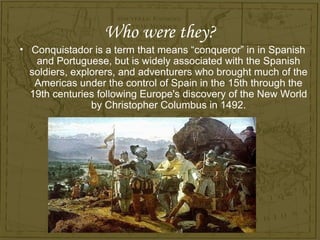
• Conquistador is a term that means “conqueror” in in Spanish
   and Portuguese, but is widely associated with the Spanish
  soldiers, explorers, and adventurers who brought much of the
   Americas under the control of Spain in the 15th through the
  19th centuries following Europe's discovery of the New World
                by Christopher Columbus in 1492.
The Conquests
• The stated purposes of these conquests were to
  equally spread the word of God and to bring this
  new civilization in the most obscure parts of the
  world into the Spanish Crown as dutiful vassals.
• Spain accomplished this goal with astounding
  ability, quickly expanding its borders far larger
  than previous Golden empires like Rome, Greece
  and Egypt.
• However, Spanish Conquest of Americas were a
  series of unfortunate and morally questionable
  acts driven by greed for gold and resulted in the
  destruction of several native civilizations.
Famous Conquistadors
• Hernan Cortez – Famous for leading
  an expedition into Mexico and
  defeating the Aztec empire at
  Tenochtitlan.

• Francisco Pizarro – Famous for
  leading an expedition into South
  America and defeating the Incan
  empire.
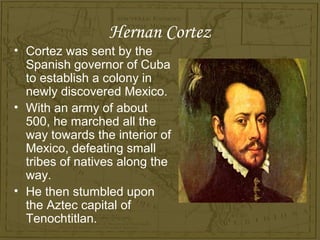
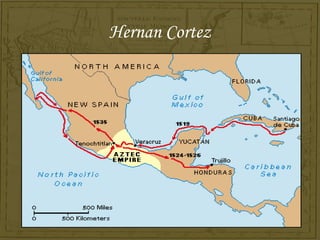
Hernan Cortez
• Cortez was sent by the
  Spanish governor of Cuba
  to establish a colony in
  newly discovered Mexico.
• With an army of about
  500, he marched all the
  way towards the interior of
  Mexico, defeating small
  tribes of natives along the
  way.
• He then stumbled upon
  the Aztec capital of
  Tenochtitlan.
Hernan Cortez
The Aztecs
• The Aztecs were the largest group of people living in Mexico
  at the time of Spanish arrival.
• Before the Aztecs, there was the Olmec and Mayan
  civilizations.
• The Olmec is sometimes considered the “mother culture” of
  Mesoamerica. They were the first to settle in the region
  thousands of years ago.
• Following the Olmec were the Mayans. The Mayans
  created complex hieroglyphic style of writing and accurate
  calendars.
• Like the Olmecs and the Mayans before them, Aztec culture
  had rich and complex mythological and religious traditions,
  developed social structure, as well as reaching remarkable
  architectural and artistic accomplishments.
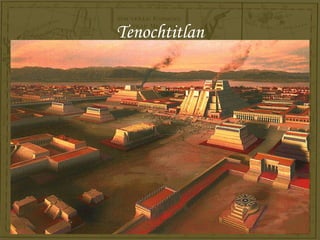
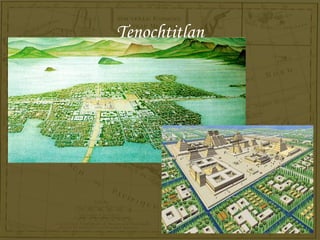
Tenochtitlan
• The Aztecs were, by far, the largest group in Mexico
  by the year 1500.
• The population was around 30 million and they were
  immensely wealthy from conquering neighboring
  lands.
• At the heart of the empire was the grand city of
  Tenochtitlan. This capital city was estimated to have
  over 200-300,000 inhabitants.
• According to records, that would make it one of the
  largest cities in the world at the time. Compared to
  Europe, only Paris, Venice and Constantinople would
  have been larger.
Tenochtitlan
Tenochtitlan
The Aztecs – Did You Know?
• Aztecs did not refer to themselves as Aztecs, but
  as the Mexica.
• Aztecs believed that the gods sacrificed
  themselves so that humans could live. The Aztecs
  would in turn would make human sacrifices as
  repayment to the gods. Many times they would eat
  the flesh and drink the blood of the sacrificed.
  Sound familiar?
• Aztecs had a complex calendar based on
  astrology, similar to the Mayans and Olmecs.
• Tenochtitlan had a zoo, botanical gardens and
  even 12 saltwater ponds or “aquariums”.
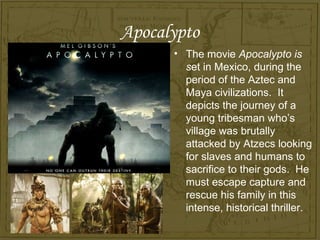
Apocalypto
      • The movie Apocalypto is
        set in Mexico, during the
        period of the Aztec and
        Maya civilizations. It
        depicts the journey of a
        young tribesman who’s
        village was brutally
        attacked by Atzecs looking
        for slaves and humans to
        sacrifice to their gods. He
        must escape capture and
        rescue his family in this
        intense, historical thriller.
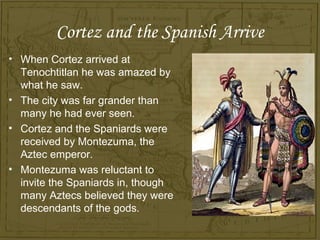
Cortez and the Spanish Arrive
• When Cortez arrived at
  Tenochtitlan he was amazed by
  what he saw.
• The city was far grander than
  many he had ever seen.
• Cortez and the Spaniards were
  received by Montezuma, the
  Aztec emperor.
• Montezuma was reluctant to
  invite the Spaniards in, though
  many Aztecs believed they were
  descendants of the gods.
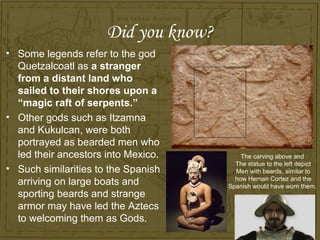
Did you know?
• Some legends refer to the god
  Quetzalcoatl as a stranger
  from a distant land who
  sailed to their shores upon a
  “magic raft of serpents.”
• Other gods such as Itzamna
  and Kukulcan, were both
  portrayed as bearded men who
  led their ancestors into Mexico.        The carving above and
                                        The statue to the left depict
• Such similarities to the Spanish      Men with beards, similar to
                                        how Hernan Cortez and the
  arriving on large boats and         Spanish would have worn them.
  sporting beards and strange
  armor may have led the Aztecs
  to welcoming them as Gods.
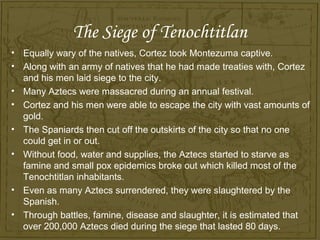
The Siege of Tenochtitlan
• Equally wary of the natives, Cortez took Montezuma captive.
• Along with an army of natives that he had made treaties with, Cortez
  and his men laid siege to the city.
• Many Aztecs were massacred during an annual festival.
• Cortez and his men were able to escape the city with vast amounts of
  gold.
• The Spaniards then cut off the outskirts of the city so that no one
  could get in or out.
• Without food, water and supplies, the Aztecs started to starve as
  famine and small pox epidemics broke out which killed most of the
  Tenochtitlan inhabitants.
• Even as many Aztecs surrendered, they were slaughtered by the
  Spanish.
• Through battles, famine, disease and slaughter, it is estimated that
  over 200,000 Aztecs died during the siege that lasted 80 days.
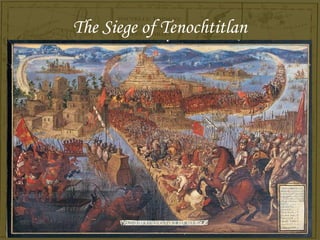
The Siege of Tenochtitlan
Tenochtitlan
• Following the siege, Cortez and the Spaniards and their
  native allies looted the city, slaughtered any remaining
  inhabitants.
• Cortez directed the destruction and leveling of most of
  the city which was then re-built for Spanish use. Today,
  Mexico City is built on top of the ruins of Tenochtitlan.
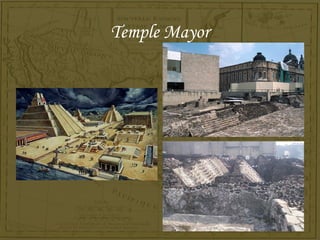
• It wasn’t until the 1970’s when the construction of the
  metro line in Mexico City that the ruins of the Temple
  Mayor was uncovered. A small excavated portion is
  available to the public.
Temple Mayor
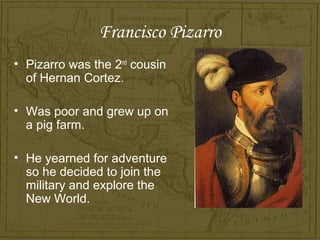
Francisco Pizarro
• Pizarro was the 2nd cousin
  of Hernan Cortez.

• Was poor and grew up on
  a pig farm.

• He yearned for adventure
  so he decided to join the
  military and explore the
  New World.
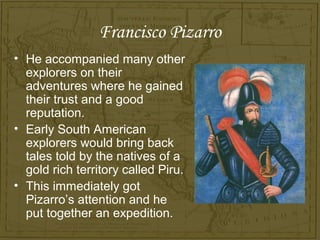
Francisco Pizarro
• He accompanied many other
  explorers on their
  adventures where he gained
  their trust and a good
  reputation.
• Early South American
  explorers would bring back
  tales told by the natives of a
  gold rich territory called Piru.
• This immediately got
  Pizarro’s attention and he
  put together an expedition.
Conquest of Peru

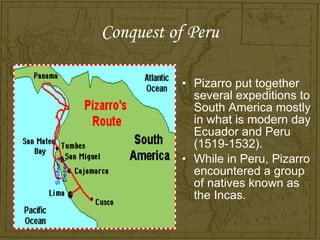
          • Pizarro put together
            several expeditions to
            South America mostly
            in what is modern day
            Ecuador and Peru
            (1519-1532).
          • While in Peru, Pizarro
            encountered a group
            of natives known as
            the Incas.
The Incas
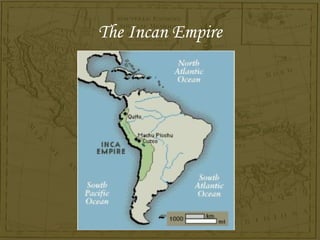
• The Incas were the largest group of natives in the New World.
• It is estimated that their total population was upwards of 40
  million prior to Spanish arrival.
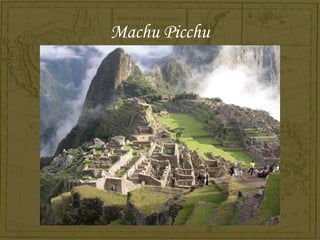
• The Incas were known for building a complex network of roads
  and fortresses. They are sometimes referred to as the
  “Romans of the New World.”
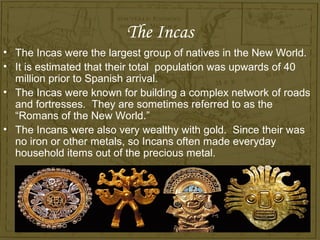
• The Incans were also very wealthy with gold. Since their was
  no iron or other metals, so Incans often made everyday
  household items out of the precious metal.
The Incan Empire
Machu Picchu
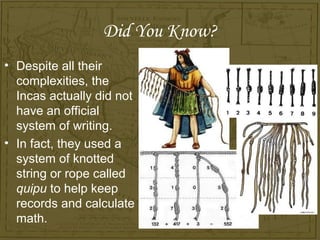
Did You Know?
• Despite all their
  complexities, the
  Incas actually did not
  have an official
  system of writing.
• In fact, they used a
  system of knotted
  string or rope called
  quipu to help keep
  records and calculate
  math.
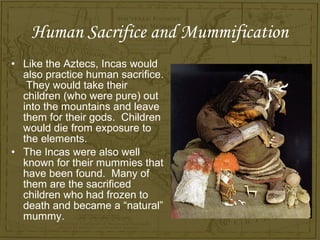
Human Sacrifice and Mummification
• Like the Aztecs, Incas would
  also practice human sacrifice.
   They would take their
  children (who were pure) out
  into the mountains and leave
  them for their gods. Children
  would die from exposure to
  the elements.
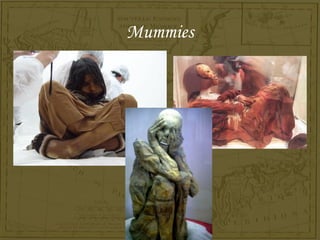
• The Incas were also well
  known for their mummies that
  have been found. Many of
  them are the sacrificed
  children who had frozen to
  death and became a “natural”
  mummy.
Mummies
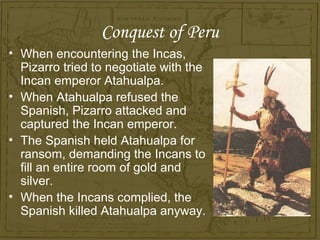
Conquest of Peru
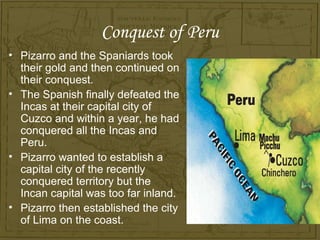
• When encountering the Incas,
  Pizarro tried to negotiate with the
  Incan emperor Atahualpa.
• When Atahualpa refused the
  Spanish, Pizarro attacked and
  captured the Incan emperor.
• The Spanish held Atahualpa for
  ransom, demanding the Incans to
  fill an entire room of gold and
  silver.
• When the Incans complied, the
  Spanish killed Atahualpa anyway.
Conquest of Peru
• Pizarro and the Spaniards took
  their gold and then continued on
  their conquest.
• The Spanish finally defeated the
  Incas at their capital city of
  Cuzco and within a year, he had
  conquered all the Incas and
  Peru.
• Pizarro wanted to establish a
  capital city of the recently
  conquered territory but the
  Incan capital was too far inland.
• Pizarro then established the city
  of Lima on the coast.
Kuzco?
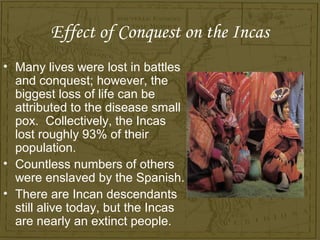
Effect of Conquest on the Incas
• Many lives were lost in battles
  and conquest; however, the
  biggest loss of life can be
  attributed to the disease small
  pox. Collectively, the Incas
  lost roughly 93% of their
  population.
• Countless numbers of others
  were enslaved by the Spanish.
• There are Incan descendants
  still alive today, but the Incas
  are nearly an extinct people.
The Fate and Legacy of Pizarro
• By the time he had died, Pizarro had
  expanded the Spanish empire to reach well
  into South America and also made Spain
  one of the richest countries in the world.
  Even today, many countries are heavily
  influenced by Spanish culture.
• His conquest was very improbable
  considering he accomplished so much
  conquering of lands with such a small army.
• This puts him higher than Cortez in terms of
  conquests.

Conquistadors

  • 1.
  • 2.
    Who were they? •Conquistador is a term that means “conqueror” in in Spanish and Portuguese, but is widely associated with the Spanish soldiers, explorers, and adventurers who brought much of the Americas under the control of Spain in the 15th through the 19th centuries following Europe's discovery of the New World by Christopher Columbus in 1492.
  • 3.
    The Conquests • Thestated purposes of these conquests were to equally spread the word of God and to bring this new civilization in the most obscure parts of the world into the Spanish Crown as dutiful vassals. • Spain accomplished this goal with astounding ability, quickly expanding its borders far larger than previous Golden empires like Rome, Greece and Egypt. • However, Spanish Conquest of Americas were a series of unfortunate and morally questionable acts driven by greed for gold and resulted in the destruction of several native civilizations.
  • 4.
    Famous Conquistadors • HernanCortez – Famous for leading an expedition into Mexico and defeating the Aztec empire at Tenochtitlan. • Francisco Pizarro – Famous for leading an expedition into South America and defeating the Incan empire.
  • 5.
    Hernan Cortez • Cortezwas sent by the Spanish governor of Cuba to establish a colony in newly discovered Mexico. • With an army of about 500, he marched all the way towards the interior of Mexico, defeating small tribes of natives along the way. • He then stumbled upon the Aztec capital of Tenochtitlan.
  • 6.
  • 7.
    The Aztecs • TheAztecs were the largest group of people living in Mexico at the time of Spanish arrival. • Before the Aztecs, there was the Olmec and Mayan civilizations. • The Olmec is sometimes considered the “mother culture” of Mesoamerica. They were the first to settle in the region thousands of years ago. • Following the Olmec were the Mayans. The Mayans created complex hieroglyphic style of writing and accurate calendars. • Like the Olmecs and the Mayans before them, Aztec culture had rich and complex mythological and religious traditions, developed social structure, as well as reaching remarkable architectural and artistic accomplishments.
  • 8.
    Tenochtitlan • The Aztecswere, by far, the largest group in Mexico by the year 1500. • The population was around 30 million and they were immensely wealthy from conquering neighboring lands. • At the heart of the empire was the grand city of Tenochtitlan. This capital city was estimated to have over 200-300,000 inhabitants. • According to records, that would make it one of the largest cities in the world at the time. Compared to Europe, only Paris, Venice and Constantinople would have been larger.
  • 9.
  • 10.
  • 11.
    The Aztecs –Did You Know? • Aztecs did not refer to themselves as Aztecs, but as the Mexica. • Aztecs believed that the gods sacrificed themselves so that humans could live. The Aztecs would in turn would make human sacrifices as repayment to the gods. Many times they would eat the flesh and drink the blood of the sacrificed. Sound familiar? • Aztecs had a complex calendar based on astrology, similar to the Mayans and Olmecs. • Tenochtitlan had a zoo, botanical gardens and even 12 saltwater ponds or “aquariums”.
  • 12.
    Apocalypto • The movie Apocalypto is set in Mexico, during the period of the Aztec and Maya civilizations. It depicts the journey of a young tribesman who’s village was brutally attacked by Atzecs looking for slaves and humans to sacrifice to their gods. He must escape capture and rescue his family in this intense, historical thriller.
  • 13.
    Cortez and theSpanish Arrive • When Cortez arrived at Tenochtitlan he was amazed by what he saw. • The city was far grander than many he had ever seen. • Cortez and the Spaniards were received by Montezuma, the Aztec emperor. • Montezuma was reluctant to invite the Spaniards in, though many Aztecs believed they were descendants of the gods.
  • 14.
    Did you know? •Some legends refer to the god Quetzalcoatl as a stranger from a distant land who sailed to their shores upon a “magic raft of serpents.” • Other gods such as Itzamna and Kukulcan, were both portrayed as bearded men who led their ancestors into Mexico. The carving above and The statue to the left depict • Such similarities to the Spanish Men with beards, similar to how Hernan Cortez and the arriving on large boats and Spanish would have worn them. sporting beards and strange armor may have led the Aztecs to welcoming them as Gods.
  • 15.
    The Siege ofTenochtitlan • Equally wary of the natives, Cortez took Montezuma captive. • Along with an army of natives that he had made treaties with, Cortez and his men laid siege to the city. • Many Aztecs were massacred during an annual festival. • Cortez and his men were able to escape the city with vast amounts of gold. • The Spaniards then cut off the outskirts of the city so that no one could get in or out. • Without food, water and supplies, the Aztecs started to starve as famine and small pox epidemics broke out which killed most of the Tenochtitlan inhabitants. • Even as many Aztecs surrendered, they were slaughtered by the Spanish. • Through battles, famine, disease and slaughter, it is estimated that over 200,000 Aztecs died during the siege that lasted 80 days.
  • 16.
    The Siege ofTenochtitlan
  • 17.
    Tenochtitlan • Following thesiege, Cortez and the Spaniards and their native allies looted the city, slaughtered any remaining inhabitants. • Cortez directed the destruction and leveling of most of the city which was then re-built for Spanish use. Today, Mexico City is built on top of the ruins of Tenochtitlan. • It wasn’t until the 1970’s when the construction of the metro line in Mexico City that the ruins of the Temple Mayor was uncovered. A small excavated portion is available to the public.
  • 18.
  • 19.
    Francisco Pizarro • Pizarrowas the 2nd cousin of Hernan Cortez. • Was poor and grew up on a pig farm. • He yearned for adventure so he decided to join the military and explore the New World.
  • 20.
    Francisco Pizarro • Heaccompanied many other explorers on their adventures where he gained their trust and a good reputation. • Early South American explorers would bring back tales told by the natives of a gold rich territory called Piru. • This immediately got Pizarro’s attention and he put together an expedition.
  • 21.
    Conquest of Peru • Pizarro put together several expeditions to South America mostly in what is modern day Ecuador and Peru (1519-1532). • While in Peru, Pizarro encountered a group of natives known as the Incas.
  • 22.
    The Incas • TheIncas were the largest group of natives in the New World. • It is estimated that their total population was upwards of 40 million prior to Spanish arrival. • The Incas were known for building a complex network of roads and fortresses. They are sometimes referred to as the “Romans of the New World.” • The Incans were also very wealthy with gold. Since their was no iron or other metals, so Incans often made everyday household items out of the precious metal.
  • 23.
  • 24.
  • 25.
    Did You Know? •Despite all their complexities, the Incas actually did not have an official system of writing. • In fact, they used a system of knotted string or rope called quipu to help keep records and calculate math.
  • 26.
    Human Sacrifice andMummification • Like the Aztecs, Incas would also practice human sacrifice. They would take their children (who were pure) out into the mountains and leave them for their gods. Children would die from exposure to the elements. • The Incas were also well known for their mummies that have been found. Many of them are the sacrificed children who had frozen to death and became a “natural” mummy.
  • 27.
  • 28.
    Conquest of Peru •When encountering the Incas, Pizarro tried to negotiate with the Incan emperor Atahualpa. • When Atahualpa refused the Spanish, Pizarro attacked and captured the Incan emperor. • The Spanish held Atahualpa for ransom, demanding the Incans to fill an entire room of gold and silver. • When the Incans complied, the Spanish killed Atahualpa anyway.
  • 29.
    Conquest of Peru •Pizarro and the Spaniards took their gold and then continued on their conquest. • The Spanish finally defeated the Incas at their capital city of Cuzco and within a year, he had conquered all the Incas and Peru. • Pizarro wanted to establish a capital city of the recently conquered territory but the Incan capital was too far inland. • Pizarro then established the city of Lima on the coast.
  • 30.
  • 32.
    Effect of Conqueston the Incas • Many lives were lost in battles and conquest; however, the biggest loss of life can be attributed to the disease small pox. Collectively, the Incas lost roughly 93% of their population. • Countless numbers of others were enslaved by the Spanish. • There are Incan descendants still alive today, but the Incas are nearly an extinct people.
  • 33.
    The Fate andLegacy of Pizarro • By the time he had died, Pizarro had expanded the Spanish empire to reach well into South America and also made Spain one of the richest countries in the world. Even today, many countries are heavily influenced by Spanish culture. • His conquest was very improbable considering he accomplished so much conquering of lands with such a small army. • This puts him higher than Cortez in terms of conquests.

Editor's Notes

  • #14 When Mexico was discovered in 1518, Vilasquez chose Cortez to make a colony there On November 8, 1519, Cortez reached Tenochtitlan (Mexico City) and was received by Montezuma, the Aztec emperor. Soon after Cortez established headquarters in the capital, he learned that the Aztecs had plundered Veracruz. He seized Montezuma and forced him to surrender the attackers. Then he had them executed Velasquez sent 1400 solders to arrest Cortez, but he defeated the army and most of the survivors joined him Cortez returned to Tenochtitlan. Aztec warriors ambushed him. Montezuma was brought to pacify his people, but they stoned him to death.
  • #16 When Mexico was discovered in 1518, Vilasquez chose Cortez to make a colony there On November 8, 1519, Cortez reached Tenochtitlan (Mexico City) and was received by Montezuma, the Aztec emperor. Soon after Cortez established headquarters in the capital, he learned that the Aztecs had plundered Veracruz. He seized Montezuma and forced him to surrender the attackers. Then he had them executed Velasquez sent 1400 solders to arrest Cortez, but he defeated the army and most of the survivors joined him Cortez returned to Tenochtitlan. Aztec warriors ambushed him. Montezuma was brought to pacify his people, but they stoned him to death.
  • #18 When Mexico was discovered in 1518, Vilasquez chose Cortez to make a colony there On November 8, 1519, Cortez reached Tenochtitlan (Mexico City) and was received by Montezuma, the Aztec emperor. Soon after Cortez established headquarters in the capital, he learned that the Aztecs had plundered Veracruz. He seized Montezuma and forced him to surrender the attackers. Then he had them executed Velasquez sent 1400 solders to arrest Cortez, but he defeated the army and most of the survivors joined him Cortez returned to Tenochtitlan. Aztec warriors ambushed him. Montezuma was brought to pacify his people, but they stoned him to death.
  • #26 When Mexico was discovered in 1518, Vilasquez chose Cortez to make a colony there On November 8, 1519, Cortez reached Tenochtitlan (Mexico City) and was received by Montezuma, the Aztec emperor. Soon after Cortez established headquarters in the capital, he learned that the Aztecs had plundered Veracruz. He seized Montezuma and forced him to surrender the attackers. Then he had them executed Velasquez sent 1400 solders to arrest Cortez, but he defeated the army and most of the survivors joined him Cortez returned to Tenochtitlan. Aztec warriors ambushed him. Montezuma was brought to pacify his people, but they stoned him to death.