Segregation
and
Discrimination
African-Americans Fight Legal
Discrimination:
• As African Americans exercised their newly won
political and social rights during Reconstruction,
they faced hostile and often violent opposition
from whites
• African Americans eventually fell victim to laws
restricting their civil rights but never stopped
fighting for equality
• Southern states had adopted a broad system of
legal policies of racial discrimination and devised
methods to weaken African-American political
power
Voting Restrictions:
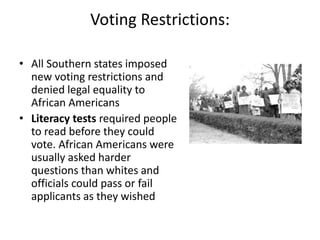
• All Southern states imposed
new voting restrictions and
denied legal equality to
African Americans
• Literacy tests required people
to read before they could
vote. African Americans were
usually asked harder
questions than whites and
officials could pass or fail
applicants as they wished
Voting Restrictions:
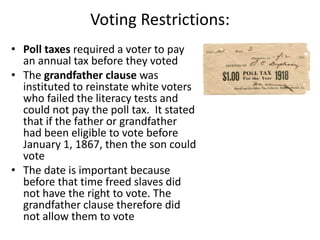
• Poll taxes required a voter to pay
an annual tax before they voted
• The grandfather clause was
instituted to reinstate white voters
who failed the literacy tests and
could not pay the poll tax. It stated
that if the father or grandfather
had been eligible to vote before
January 1, 1867, then the son could
vote
• The date is important because
before that time freed slaves did
not have the right to vote. The
grandfather clause therefore did
not allow them to vote
Jim Crow Laws:
• During the 1870s and 1880s,
the Supreme Court failed to
overturn poll tax or
grandfather clause
• Southern states passed racial
segregation laws to separate
white and black people in
public and private facilities
Jim Crow Laws:
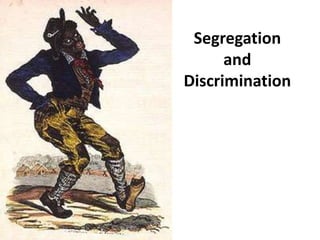
• These laws came to be known
as Jim Crow laws after a
popular minstrel song that
ended in the words “Jump,
Jim Crow”
• Racial segregation was put
into effect in schools,
hospitals, parks, and
transportation systems
throughout the South
Jim Crow Laws:
• Eventually a legal case reached
the U.S. Supreme Court to test
the constitutionality of
segregation
• In 1896, in Plessy v. Ferguson,
the Supreme Court ruled that
the separation of races in
public accommodations was
legal and did not violate the
Fourteenth Amendment
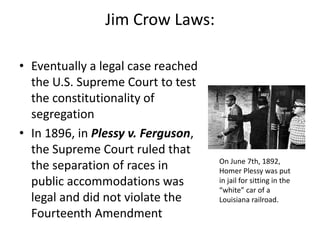
On June 7th, 1892,
Homer Plessy was put
in jail for sitting in the
“white” car of a
Louisiana railroad.

Segregation and Discrimination

  • 1.
  • 2.
    African-Americans Fight Legal Discrimination: •As African Americans exercised their newly won political and social rights during Reconstruction, they faced hostile and often violent opposition from whites • African Americans eventually fell victim to laws restricting their civil rights but never stopped fighting for equality • Southern states had adopted a broad system of legal policies of racial discrimination and devised methods to weaken African-American political power
  • 3.
    Voting Restrictions: • AllSouthern states imposed new voting restrictions and denied legal equality to African Americans • Literacy tests required people to read before they could vote. African Americans were usually asked harder questions than whites and officials could pass or fail applicants as they wished
  • 4.
    Voting Restrictions: • Polltaxes required a voter to pay an annual tax before they voted • The grandfather clause was instituted to reinstate white voters who failed the literacy tests and could not pay the poll tax. It stated that if the father or grandfather had been eligible to vote before January 1, 1867, then the son could vote • The date is important because before that time freed slaves did not have the right to vote. The grandfather clause therefore did not allow them to vote
  • 5.
    Jim Crow Laws: •During the 1870s and 1880s, the Supreme Court failed to overturn poll tax or grandfather clause • Southern states passed racial segregation laws to separate white and black people in public and private facilities
  • 6.
    Jim Crow Laws: •These laws came to be known as Jim Crow laws after a popular minstrel song that ended in the words “Jump, Jim Crow” • Racial segregation was put into effect in schools, hospitals, parks, and transportation systems throughout the South
  • 7.
    Jim Crow Laws: •Eventually a legal case reached the U.S. Supreme Court to test the constitutionality of segregation • In 1896, in Plessy v. Ferguson, the Supreme Court ruled that the separation of races in public accommodations was legal and did not violate the Fourteenth Amendment On June 7th, 1892, Homer Plessy was put in jail for sitting in the “white” car of a Louisiana railroad.