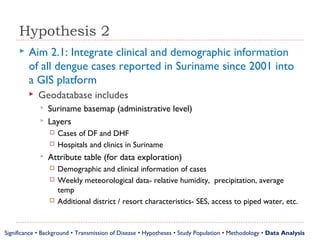
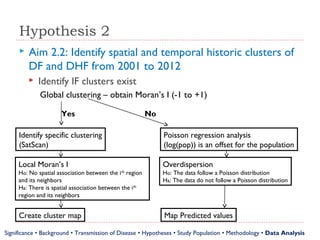
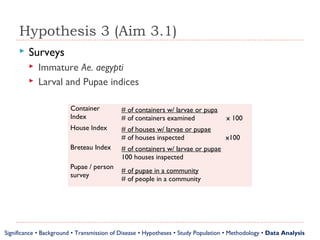
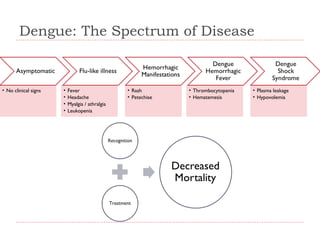
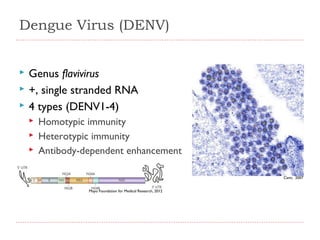
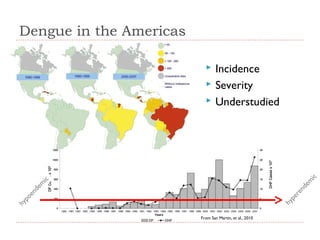
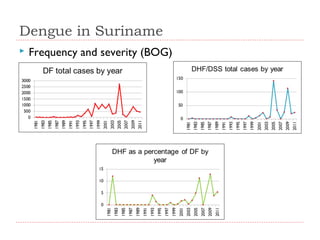
This document discusses vector-borne diseases, specifically dengue fever, in Suriname. It outlines three hypotheses: 1) that certain demographic and clinical factors are associated with severe dengue cases in Suriname, 2) that spatial and temporal trends can identify disease hotspots, and 3) that prediction models can identify effective prevention strategies. The methodology involves analyzing clinical data from hospitals to test the first hypothesis, integrating case data into a GIS to map trends and clusters for the second hypothesis, and conducting environmental surveys to inform low-cost interventions for the third hypothesis. The analysis will characterize dengue epidemiology in Suriname and identify priority areas and strategies for control efforts.







![Hypothesis 1 (Aim 1.2)
Multivariate analysis
Test for association of indicators on the development of DHF
Logistic regression model
Test for indicators and interaction variables (α = 0.5)
Binary outcome: [Y = 0]: no DHF; [Y = 1]: DHF
Stepwise forward selection of categorical indicator variables
Maximum Likelihood method / likelihood ratio
Odds ratio (95% confidence interval)
Chi Square goodness of fit (α = 0.5)
Significance: p < 0.05
Significance • Background • Transmission of Disease • Hypotheses • Study Population • Methodology • Data Analysis](https://image.slidesharecdn.com/vbdanddengue1-131208024158-phpapp01/85/Vector-borne-disease-and-Dengue-29-320.jpg)