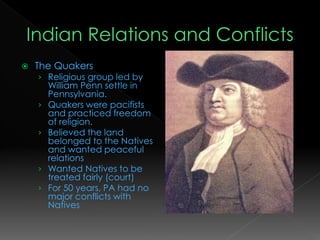
 The Quakers
› Religious group led by
William Penn settle in
Pennsylvania.
› Quakers were pacifists
and practiced freedom
of religion.
› Believed the land
belonged to the Natives
and wanted peaceful
relations
› Wanted Natives to be
treated fairly (court)
› For 50 years, PA had no
major conflicts with
Natives
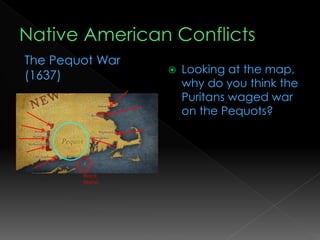
 Looking at the map,
why do you think the
Puritans waged war
on the Pequots?
The Pequot War
(1637)
Block
Island
The Pequot War (1637)
 a white trader, Indian-kidnapper, trouble
maker was killed giving settlers an excuse
to attack Natives
 Looking to avoid battle, colonists sought
to terrorize Native-Americans by killing
noncombatants, women, and children
 The Pequot were all but annihilated (and
the Narragansett on Block Island)
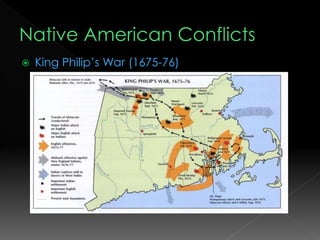
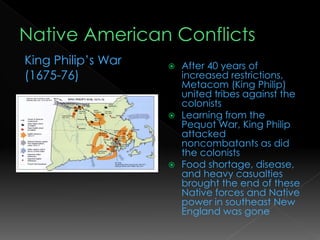
 King Philip’s War (1675-76)
 After 40 years of
increased restrictions,
Metacom (King Philip)
united tribes against the
colonists
 Learning from the
Pequot War, King Philip
attacked
noncombatants as did
the colonists
 Food shortage, disease,
and heavy casualties
brought the end of these
Native forces and Native
power in southeast New
England was gone
King Philip’s War
(1675-76)
Bacon’s Rebellion (1676)
 Begins as a conflict between Virginia settlers on
their western frontier and the Doeg and
Susquehannock Indians
 The Virginia governor refused to support the
settlers because they disobeyed his orders
 Ultimately it became a political battle between
the elite upper class, supported by Governor
Berkley and the poor farmers, indentured
servants, freemen, and slaves led by Nathaniel
Bacon
 Bacon would lead his forces against
Jamestown running Berkley off who would
return 1 month later after Bacon dies.
Bacon’s Rebellion (1676)
 Berkley would be recalled to London to
answer to the king for his failed policies
 Ultimately losing, Bacon is sometimes
considered “The Torchbearer of the
Revolution”
› the first struggle of common man v aristocrat
› frontier v tidewater
› defiance of a duly constituted authority
 This would be the same type of defiance
that would spark the American Revolution
100 years later!
 British Policies
› Navigation Acts
 reinforced trade restrictions of the colonies by the use of
writs of assistance
 the trial of smugglers was turned over to Admiralty
Courts instead of colonial courts (who usually found
colonial smugglers not guilty)
› Board of Trade
 primary role was to make the colonies serve England’s
economic needs
 investigate the enforcement of the Navigation Acts and
made recommendations on how to improve them
 London was over 3000 miles away and didn’t truly
understand the colonies
 British Policies
› Salutary Neglect
 the loyalty of the colonies provided little need
for England to strictly enforce the now stronger
Navigation Acts
 England “neglected” its colonies for its own
benefit (salutary = beneficial)
 as a result, the colonies were able to grow
more and more independent

Indian Relations & Bacon’s Rebellion

  • 2.
     The Quakers ›Religious group led by William Penn settle in Pennsylvania. › Quakers were pacifists and practiced freedom of religion. › Believed the land belonged to the Natives and wanted peaceful relations › Wanted Natives to be treated fairly (court) › For 50 years, PA had no major conflicts with Natives
  • 3.
     Looking atthe map, why do you think the Puritans waged war on the Pequots? The Pequot War (1637) Block Island
  • 4.
    The Pequot War(1637)  a white trader, Indian-kidnapper, trouble maker was killed giving settlers an excuse to attack Natives  Looking to avoid battle, colonists sought to terrorize Native-Americans by killing noncombatants, women, and children  The Pequot were all but annihilated (and the Narragansett on Block Island)
  • 5.
     King Philip’sWar (1675-76)
  • 6.
     After 40years of increased restrictions, Metacom (King Philip) united tribes against the colonists  Learning from the Pequot War, King Philip attacked noncombatants as did the colonists  Food shortage, disease, and heavy casualties brought the end of these Native forces and Native power in southeast New England was gone King Philip’s War (1675-76)
  • 7.
    Bacon’s Rebellion (1676) Begins as a conflict between Virginia settlers on their western frontier and the Doeg and Susquehannock Indians  The Virginia governor refused to support the settlers because they disobeyed his orders  Ultimately it became a political battle between the elite upper class, supported by Governor Berkley and the poor farmers, indentured servants, freemen, and slaves led by Nathaniel Bacon  Bacon would lead his forces against Jamestown running Berkley off who would return 1 month later after Bacon dies.
  • 8.
    Bacon’s Rebellion (1676) Berkley would be recalled to London to answer to the king for his failed policies  Ultimately losing, Bacon is sometimes considered “The Torchbearer of the Revolution” › the first struggle of common man v aristocrat › frontier v tidewater › defiance of a duly constituted authority  This would be the same type of defiance that would spark the American Revolution 100 years later!
  • 9.
     British Policies ›Navigation Acts  reinforced trade restrictions of the colonies by the use of writs of assistance  the trial of smugglers was turned over to Admiralty Courts instead of colonial courts (who usually found colonial smugglers not guilty) › Board of Trade  primary role was to make the colonies serve England’s economic needs  investigate the enforcement of the Navigation Acts and made recommendations on how to improve them  London was over 3000 miles away and didn’t truly understand the colonies
  • 10.
     British Policies ›Salutary Neglect  the loyalty of the colonies provided little need for England to strictly enforce the now stronger Navigation Acts  England “neglected” its colonies for its own benefit (salutary = beneficial)  as a result, the colonies were able to grow more and more independent