The Ferment ofThe Ferment of
Reform & CultureReform & Culture
1790-1860
Religion in AmericaReligion in America
• 75% of 23 million attended
church regularly
• Religion had become more
liberal
• 1794 – Thomas Paine’s
The Age of Reason
attacked the church
In France, I had almost always seen
the spirit of religion and the spirit of
freedom pursuing courses diametrically
opposed to each other; but in America,
I found that they were intimately
united, and that they reigned in common
over the same country… Religion was the
foremost of the political institutions of
the United States.
-- Alexis de Tocqueville, 1832
The Rise of Popular ReligionThe Rise of Popular Religion
R1-1
• Deism
–Franklin & Jefferson
–Relied on reason over faith
• Unitarianism
–belief in God as one person
not the Trinity
–Stressed the essential
goodness of human beings
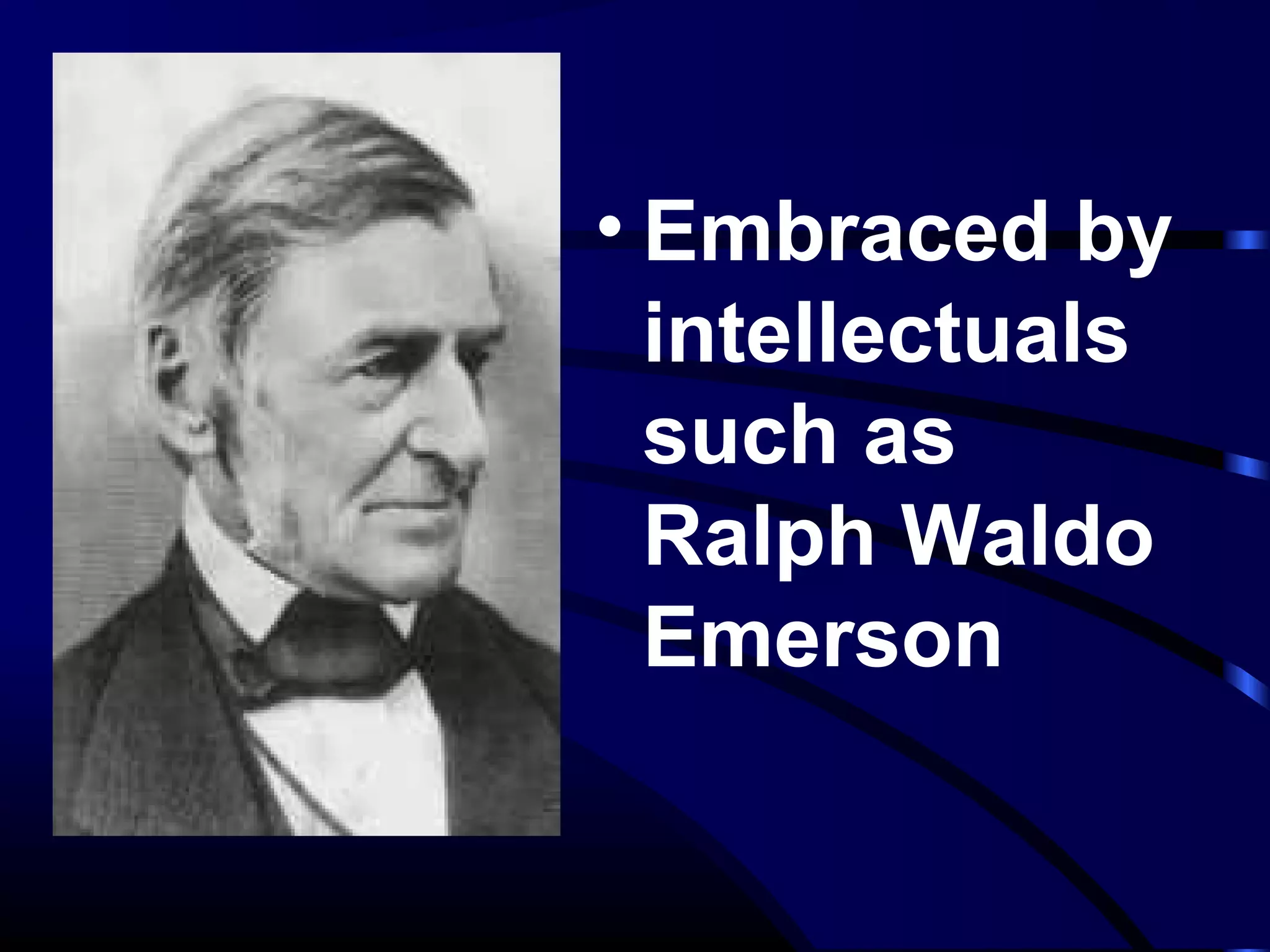
• Embraced by
intellectuals
such as
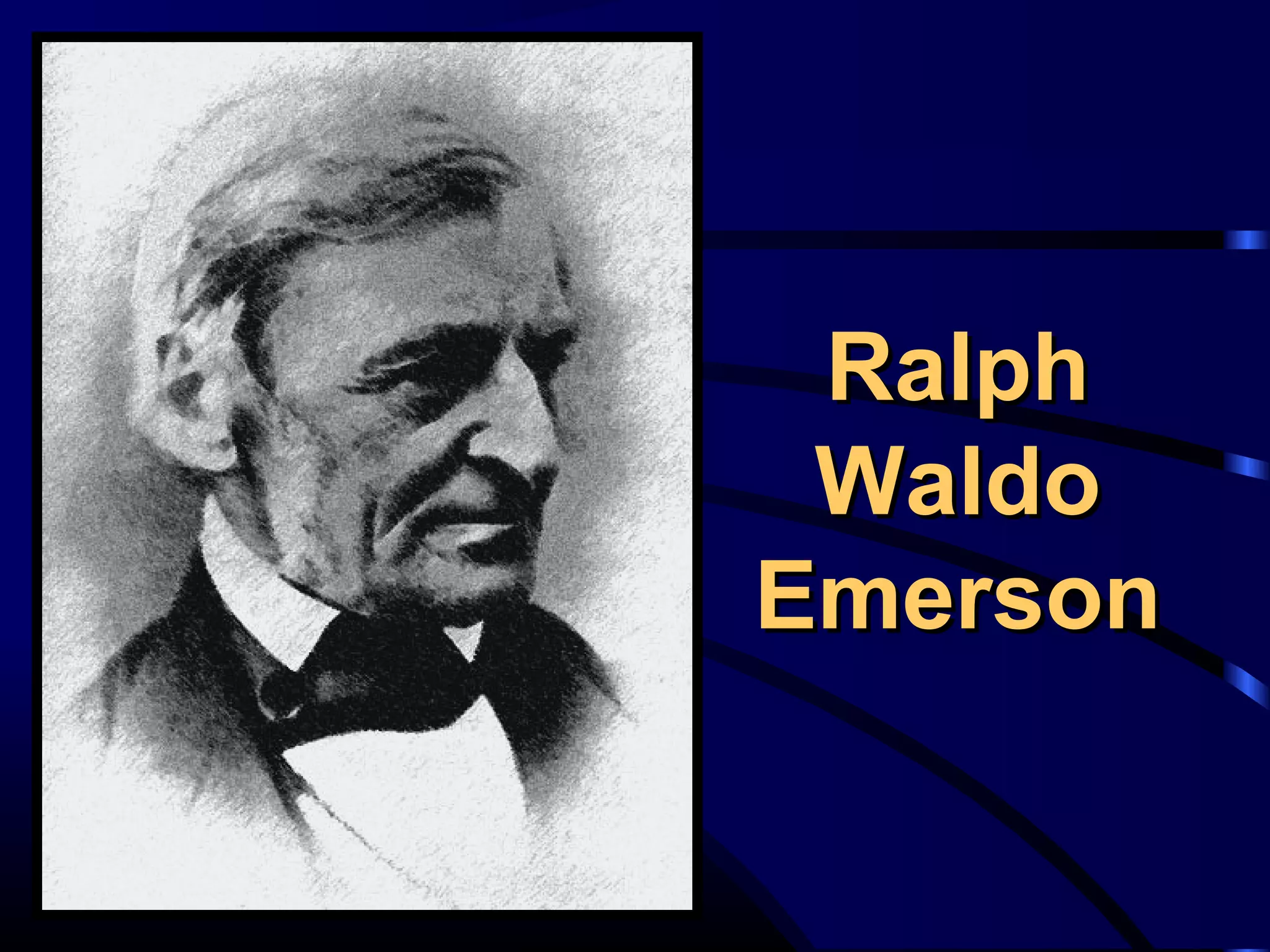
Ralph Waldo
Emerson
The Second GreatThe Second Great
AwakeningAwakening
• 1800 - began as a backlash
against the liberalism of the
Age of Reason
• Led to an era of evangelism
& reform
• Effects:
–“Born-again” Christians
–Reorganized churches &
new sects
–New reform movements:
•Temperance
•Abolitionism
•Women’s Movement
•Prison Reform
• Methodists & Baptists led
camp meetings
–sent missionaries to the
Indians & overseas
–Peter Cartwright
•Methodist “circuit rider”
preacher
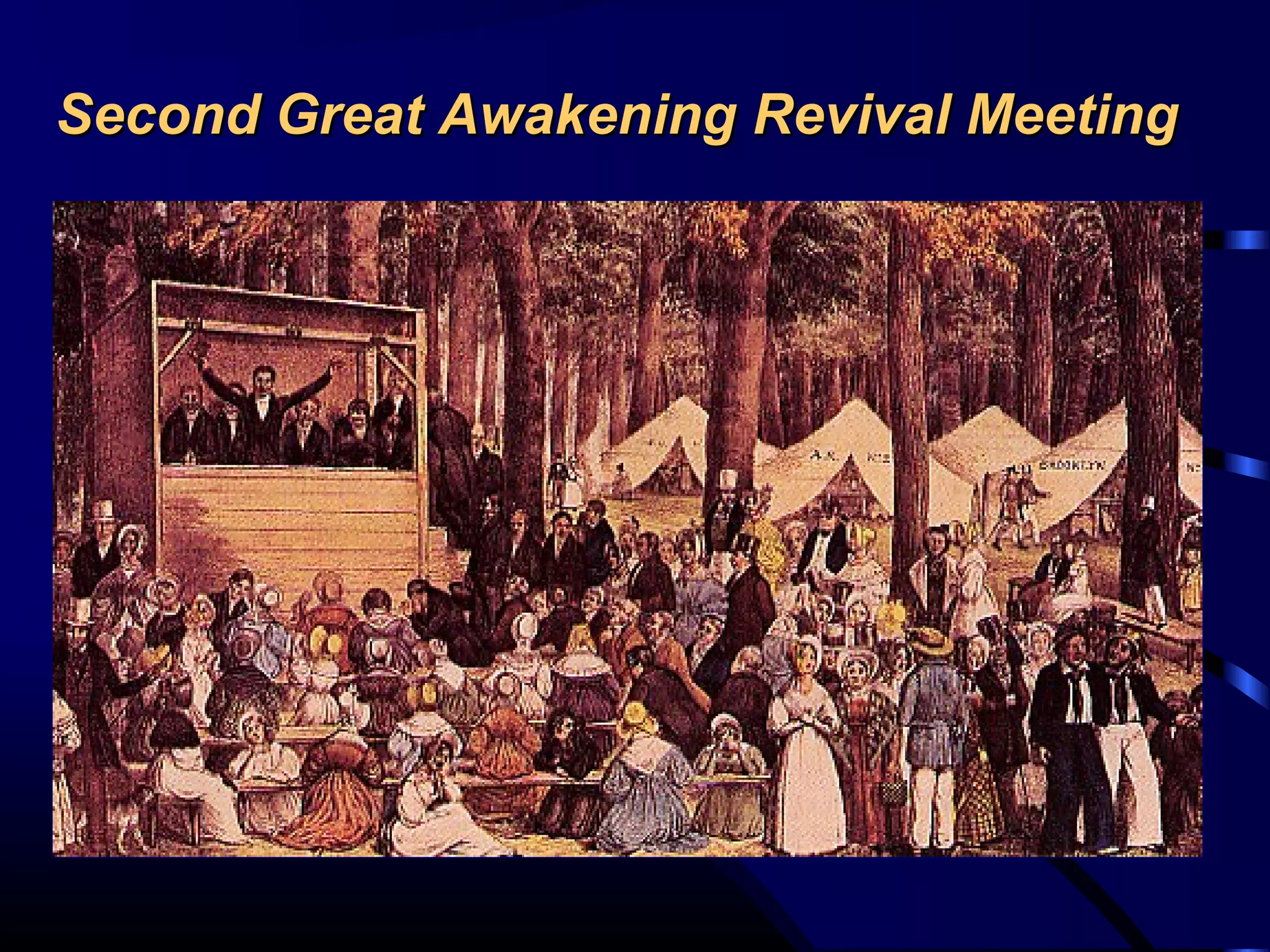
Second Great Awakening Revival MeetingSecond Great Awakening Revival Meeting
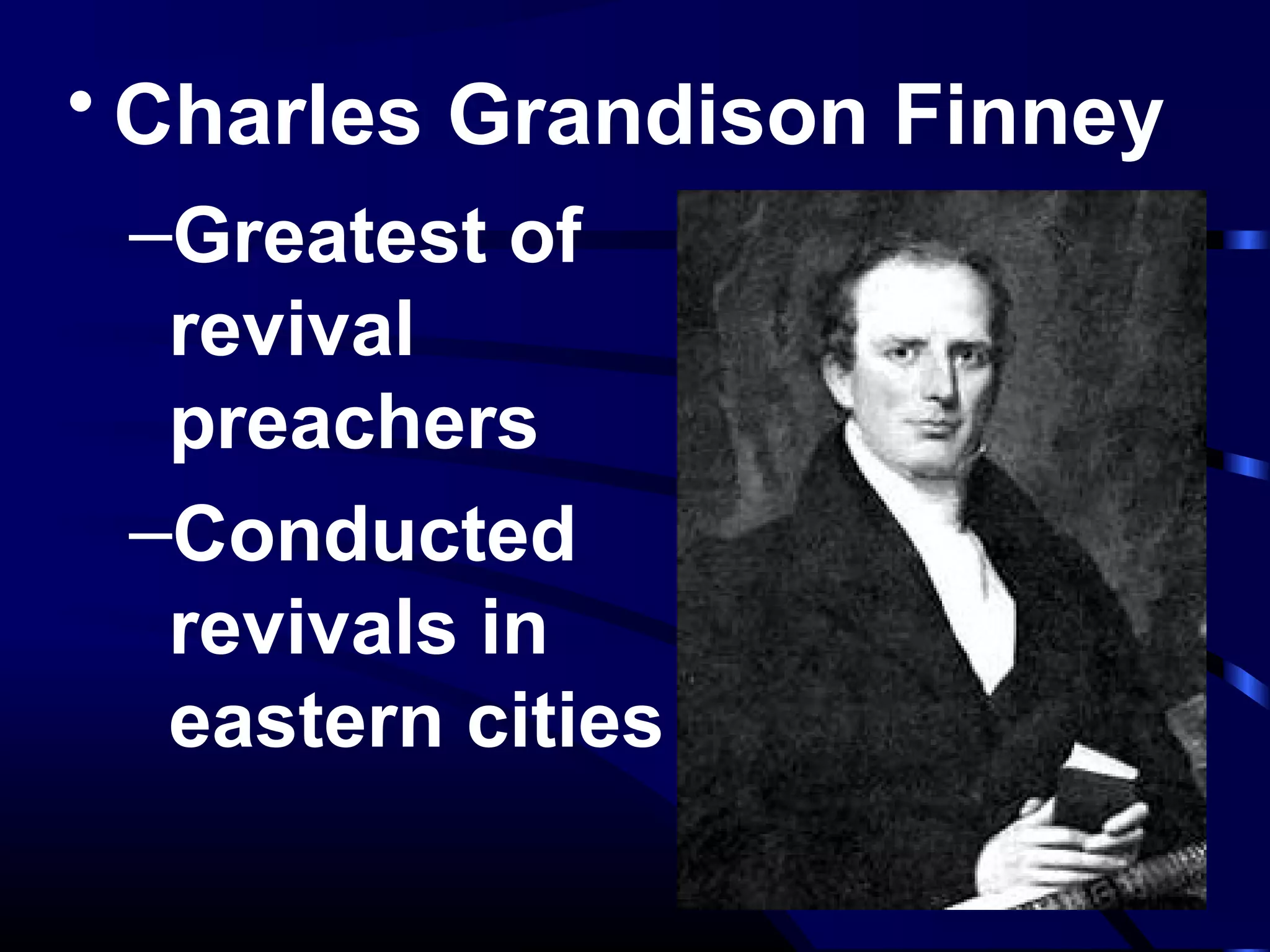
• Charles Grandison Finney
–Greatest of
revival
preachers
–Conducted
revivals in
eastern cities
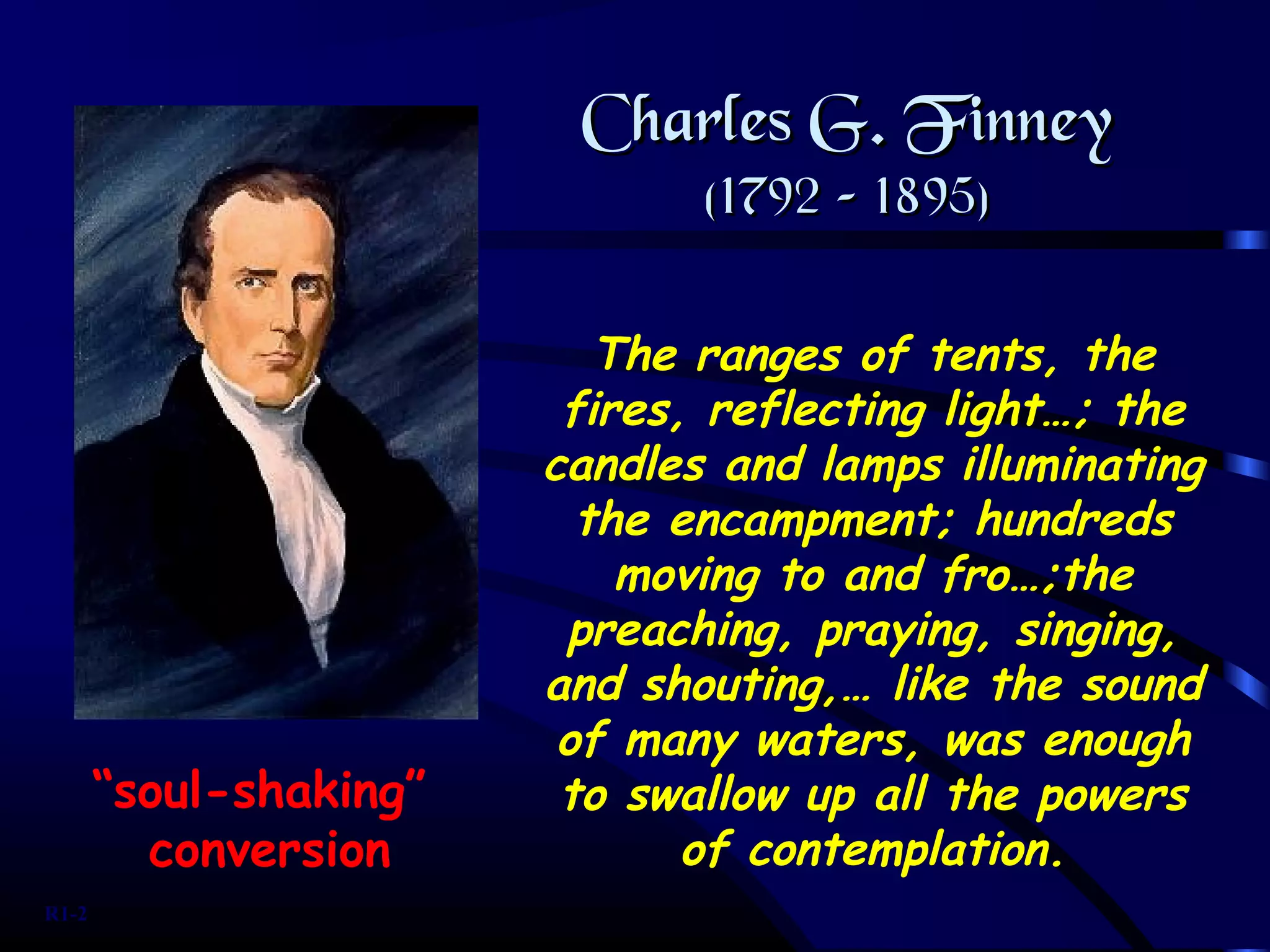
The ranges of tents, the
fires, reflecting light…; the
candles and lamps illuminating
the encampment; hundreds
moving to and fro…;the
preaching, praying, singing,
and shouting,… like the sound
of many waters, was enough
to swallow up all the powers
of contemplation.
Charles G. FinneyCharles G. Finney
(1792 – 1895)(1792 – 1895)
“soul-shaking”
conversion
R1-2
New Religious SectsNew Religious Sects
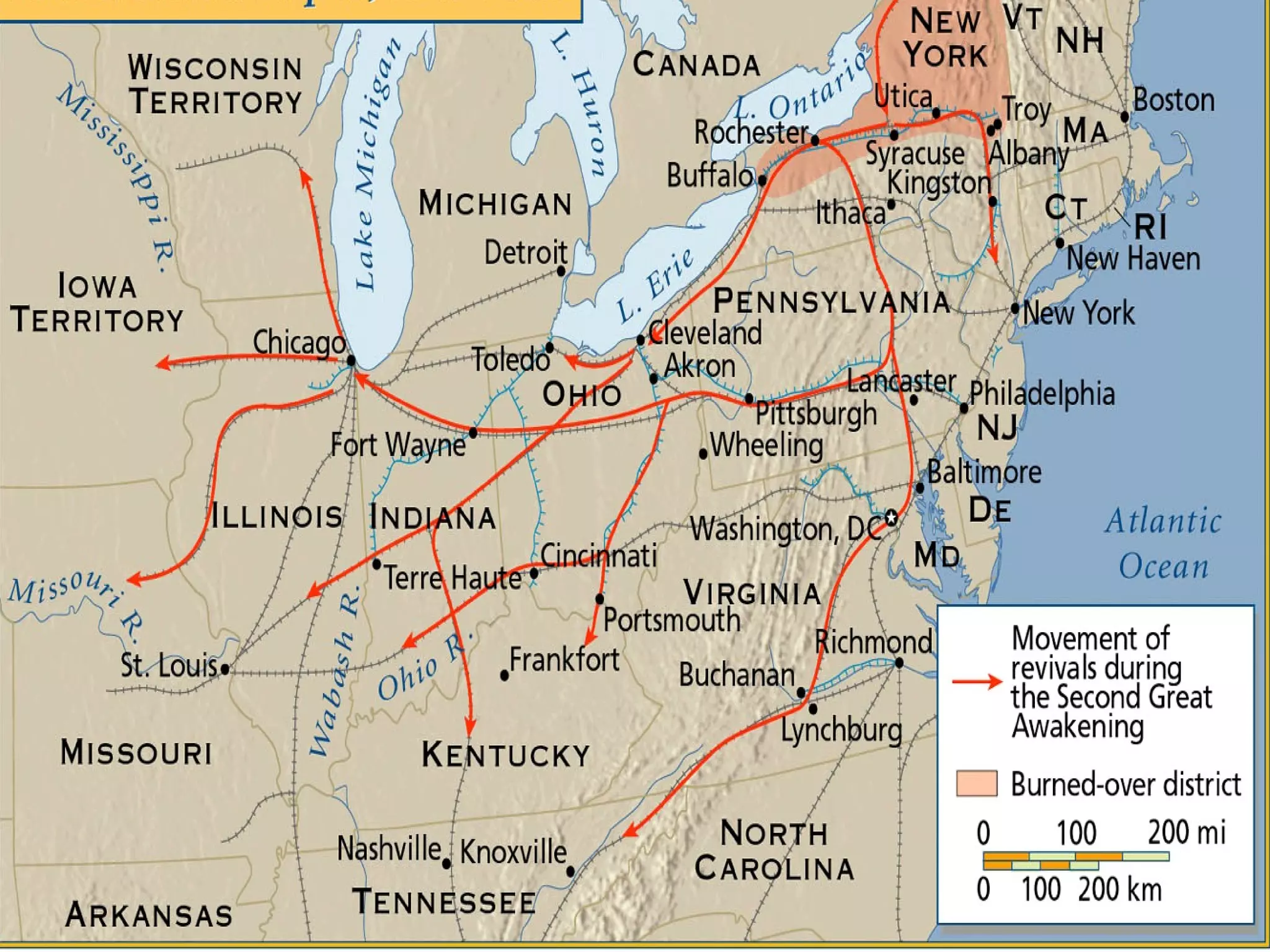
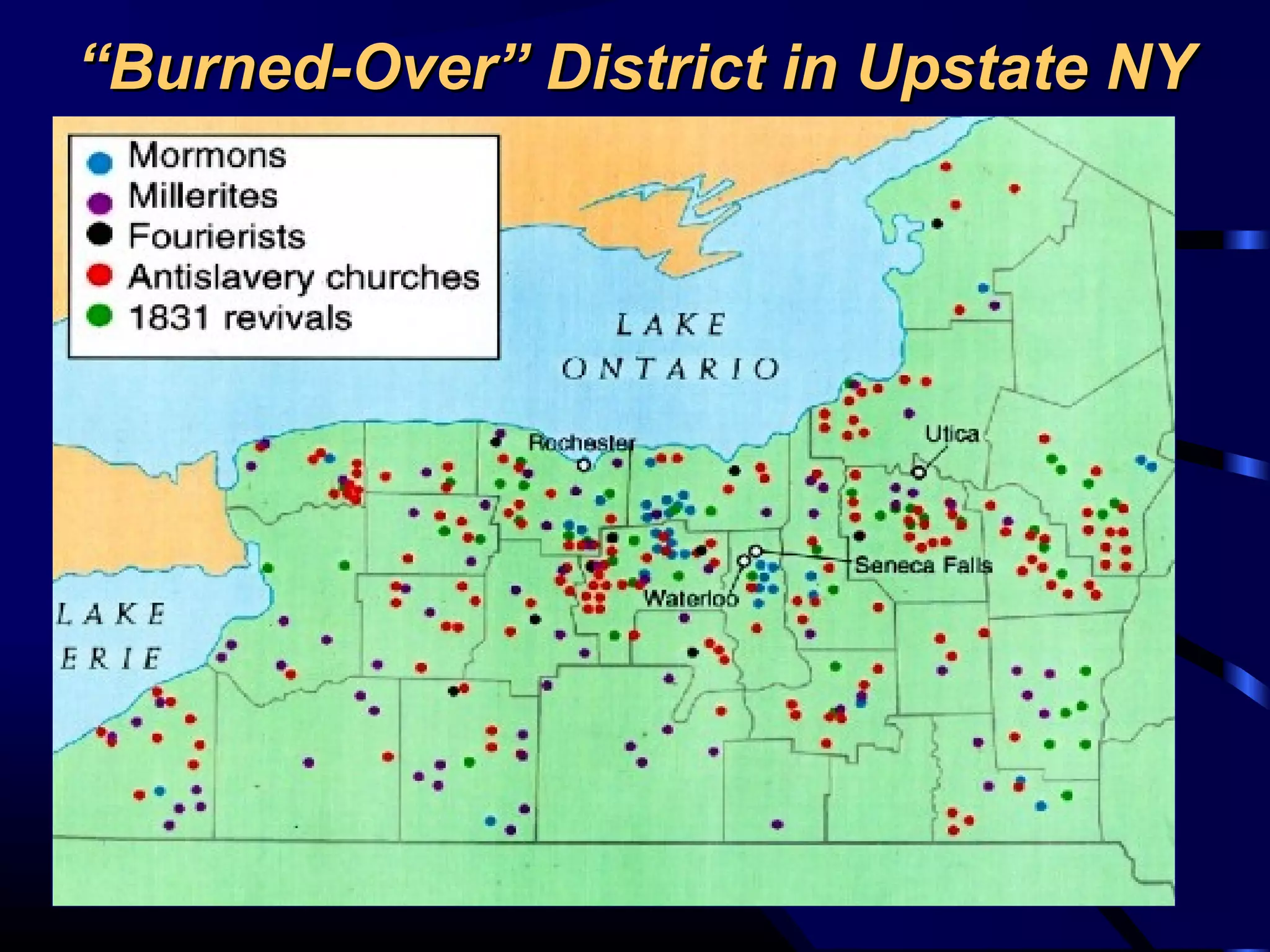
• “Burned-Over District”
–Western NY
• Adventists (Millerites)
–William Miller led to believe
the second coming was to
happen on Oct. 22, 1844
““Burned-Over” District in Upstate NYBurned-Over” District in Upstate NY
• Class & region lines
widened as well
–Southern & northern
churches broke apart over
slavery
–Foreshadowing of secession
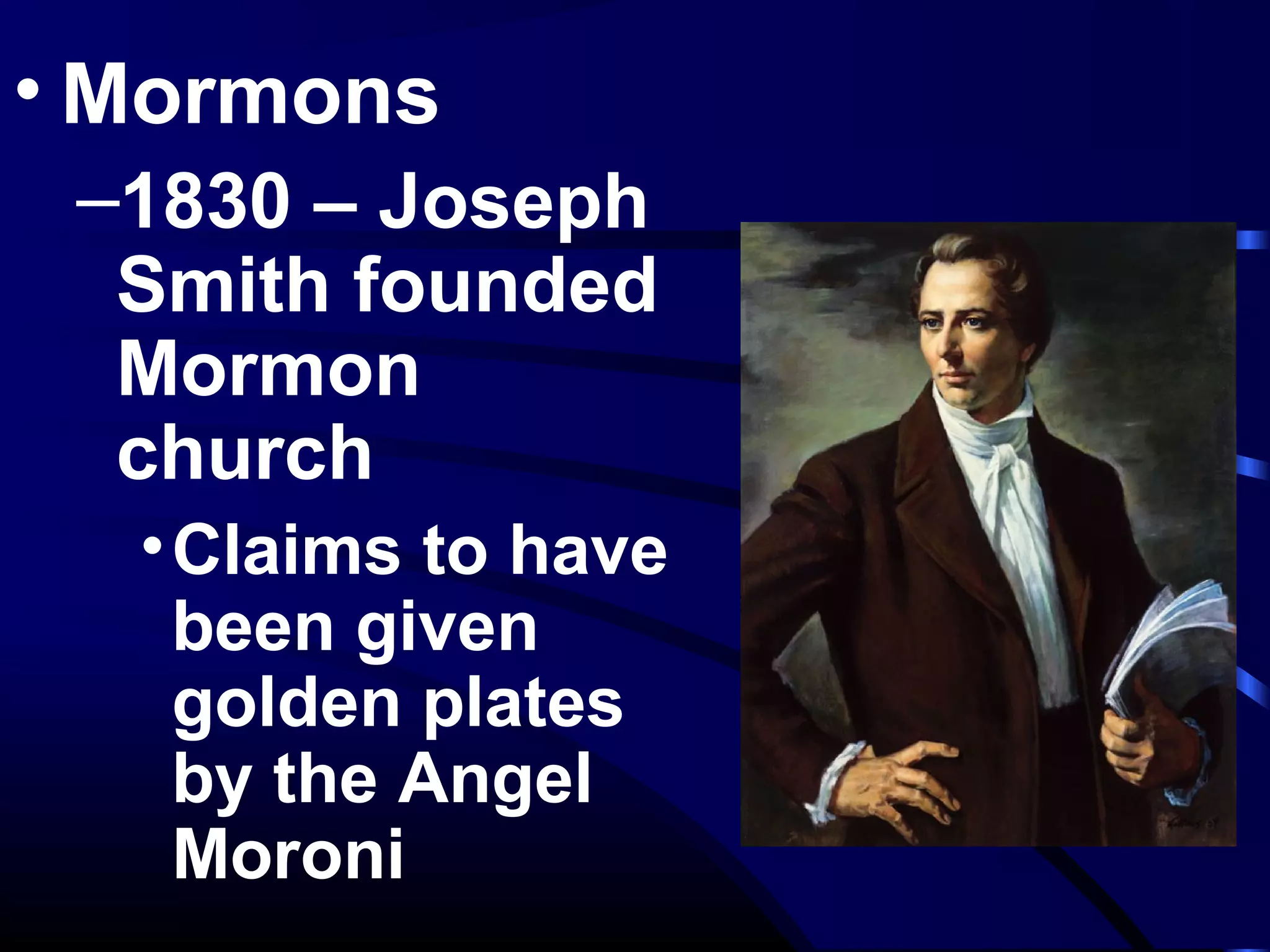
• Mormons
–1830 – Joseph
Smith founded
Mormon
church
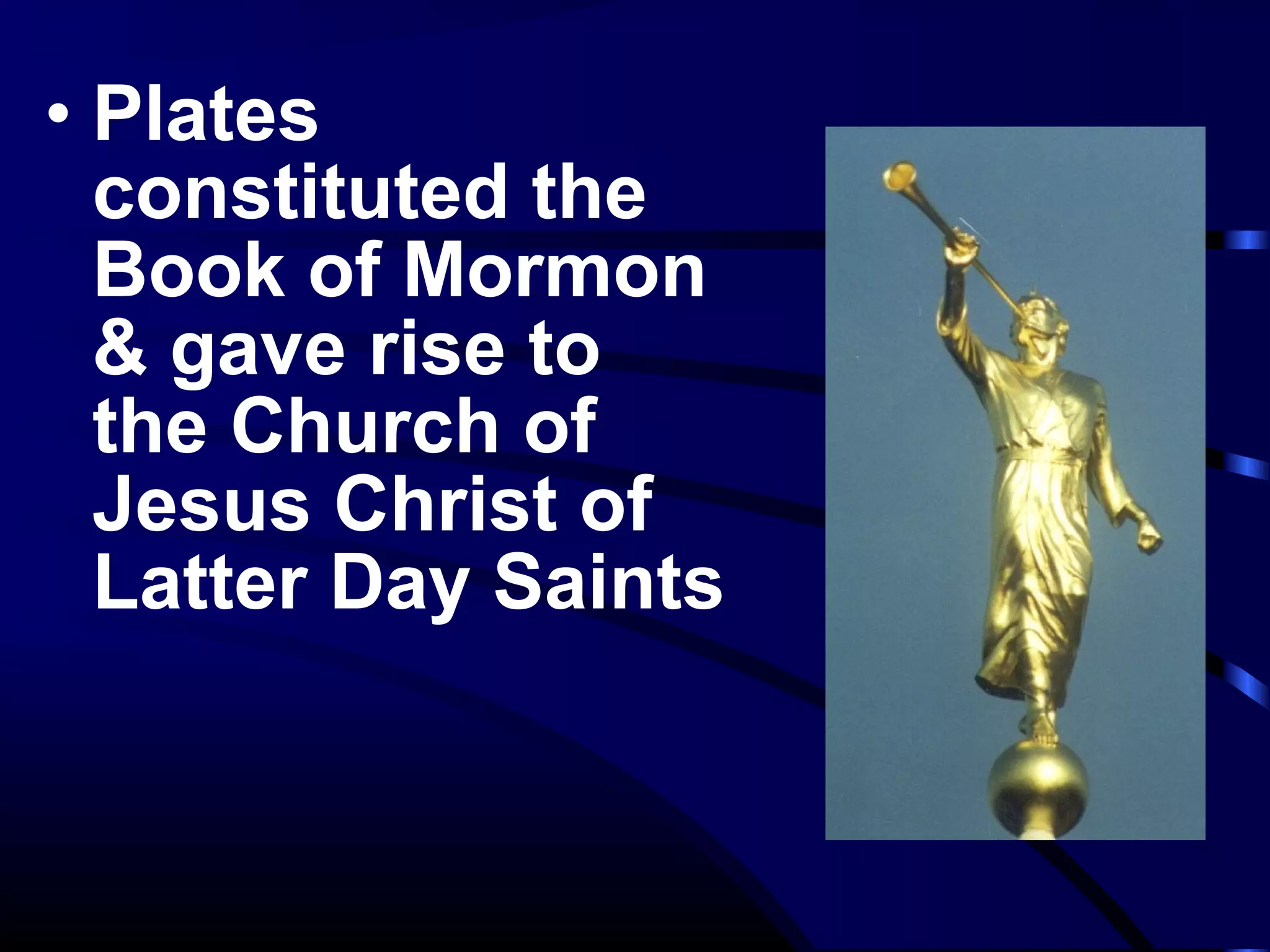
•Claims to have
been given
golden plates
by the Angel
Moroni
• Plates
constituted the
Book of Mormon
& gave rise to
the Church of
Jesus Christ of
Latter Day Saints
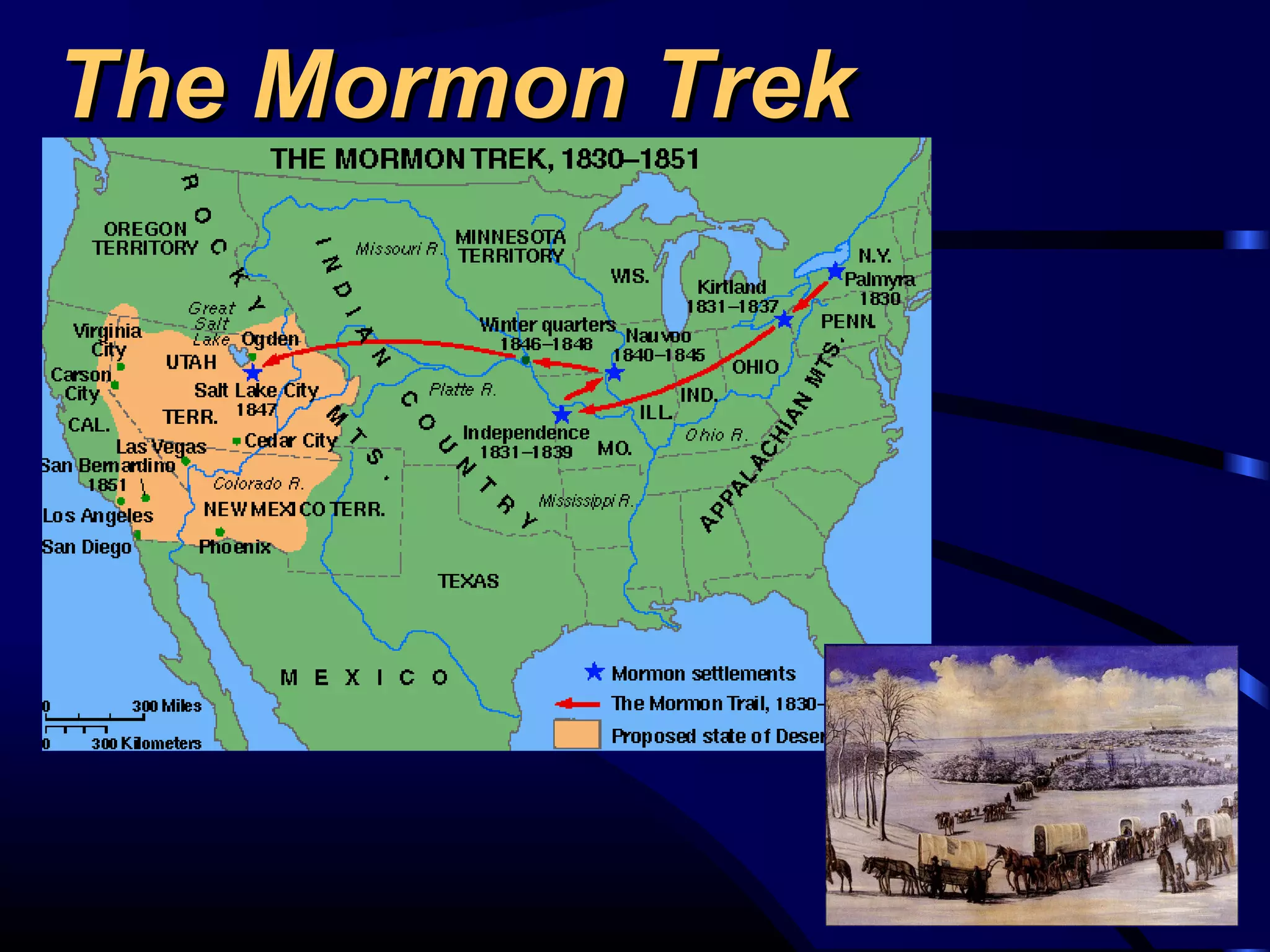
• Mormons followed Smith west
to Ohio, Missouri & finally
Illinois
• Persecuted for cooperativism,
voting as a unit, having their
own militia, & practicing
polygamy
• 1844: Joseph Smith & his
brother were killed by a mob in
Carthage, IL
• 1846-47: Brigham Young led
Mormons to Salt Lake, Utah
–5000 settled by 1848
The Mormon TrekThe Mormon Trek
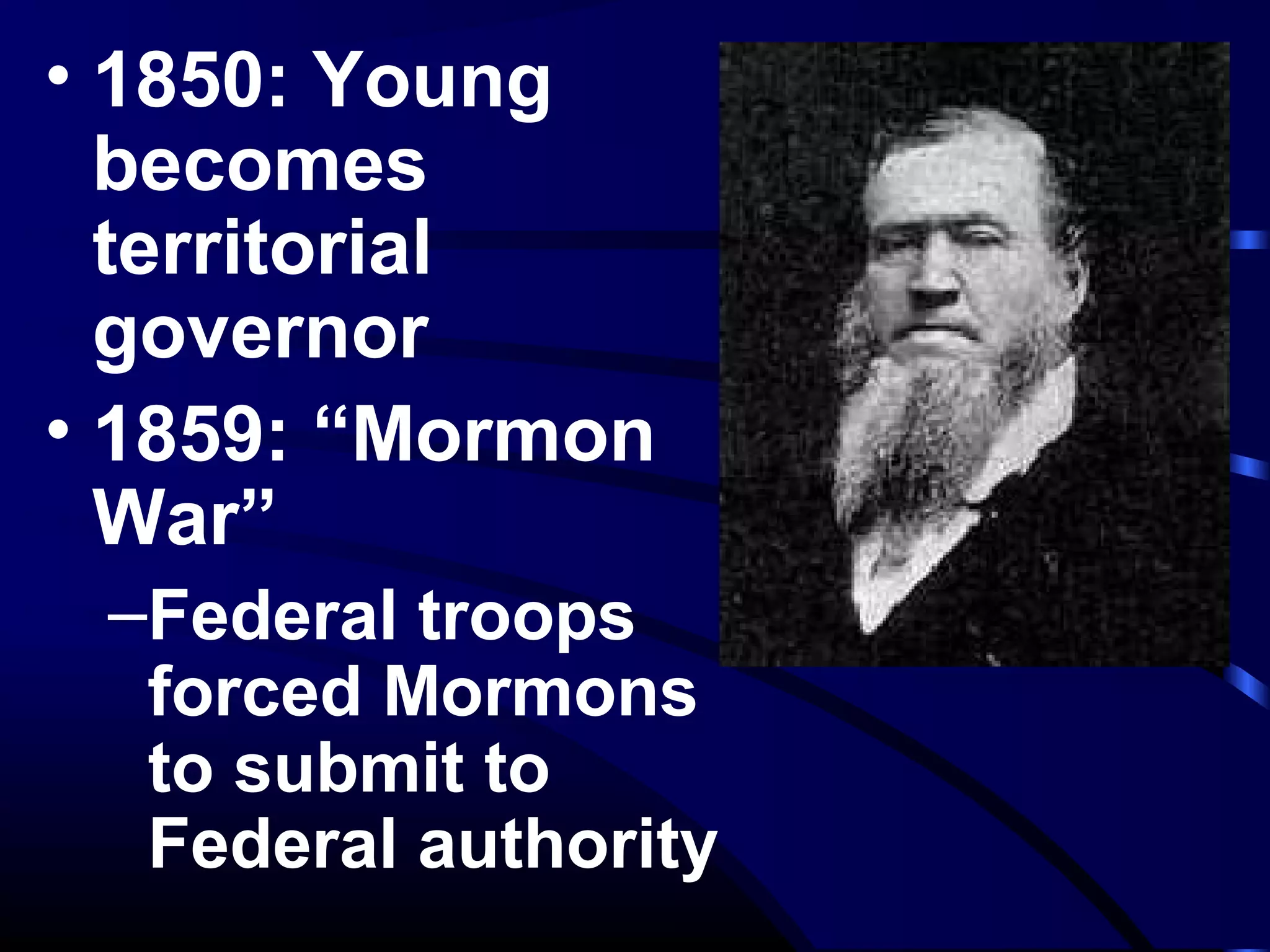
• 1850: Young
becomes
territorial
governor
• 1859: “Mormon
War”
–Federal troops
forced Mormons
to submit to
Federal authority
Education ReformsEducation Reforms
• Free tax-supported
education slowly gained
support at all levels of
society (1825-1850)
–The Little Red Schoolhouse
& the “3 R’s”
Winslow HomerWinslow Homer
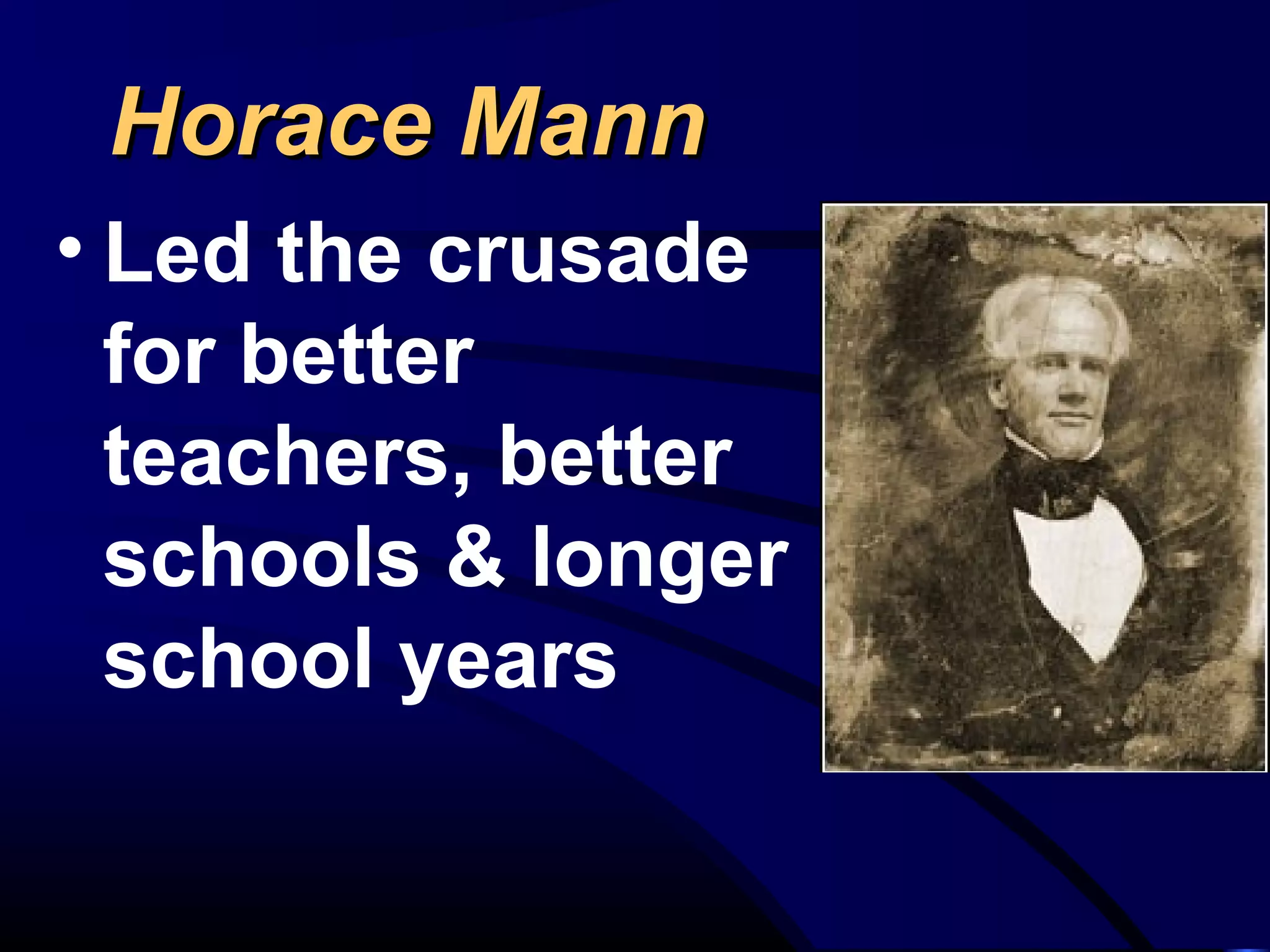
Horace MannHorace Mann
• Led the crusade
for better
teachers, better
schools & longer
school years
• Helped create “normal
schools”
–Teaching colleges to
train teachers
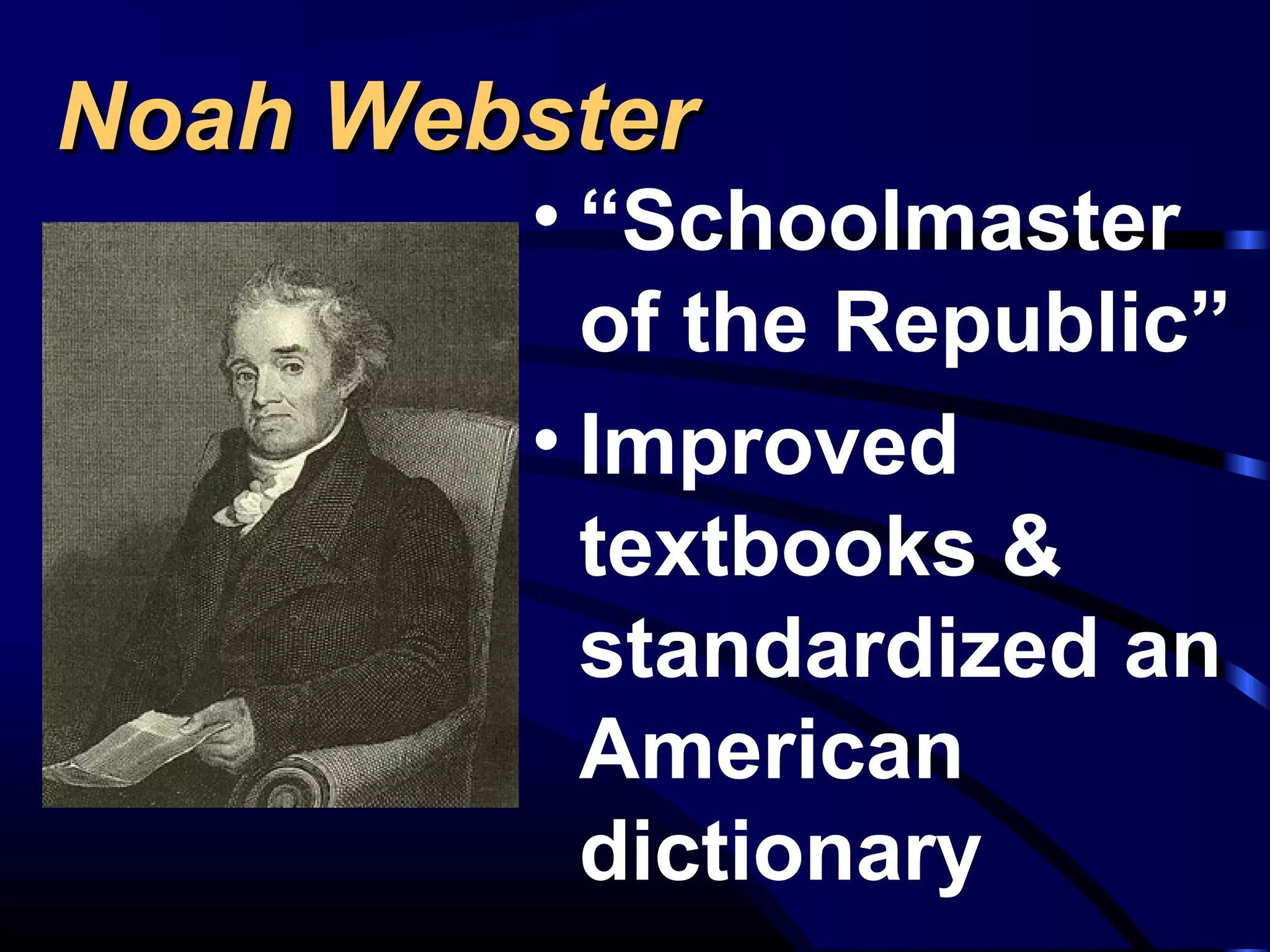
Noah WebsterNoah Webster
• “Schoolmaster
of the Republic”
• Improved
textbooks &
standardized an
American
dictionary
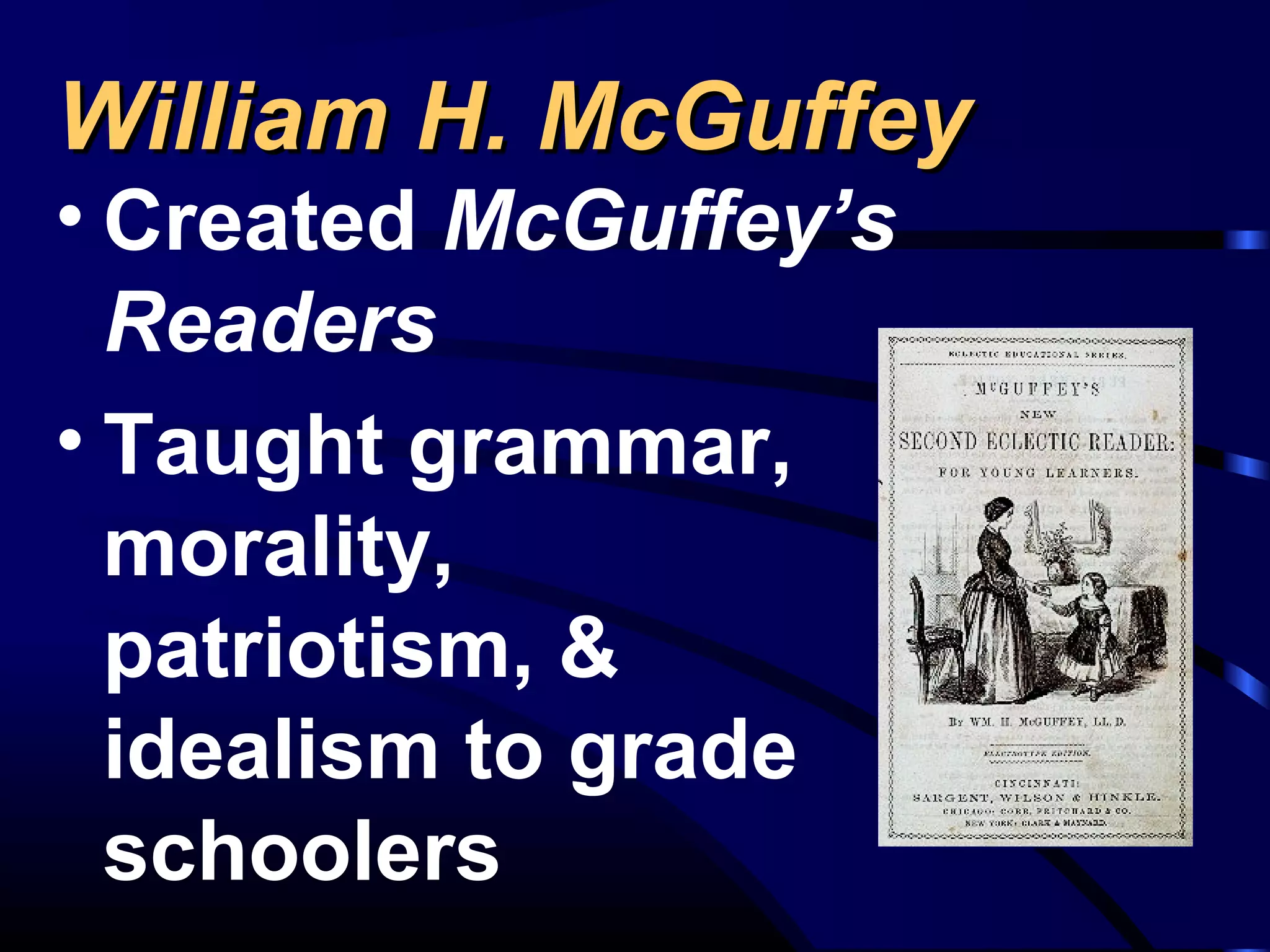
William H. McGuffeyWilliam H. McGuffey
• Created McGuffey’s
Readers
• Taught grammar,
morality,
patriotism, &
idealism to grade
schoolers
Higher EducationHigher Education
• Second Great Awakening
led to the creation of many
small, denominational
liberal-arts colleges
• Federal land grant colleges
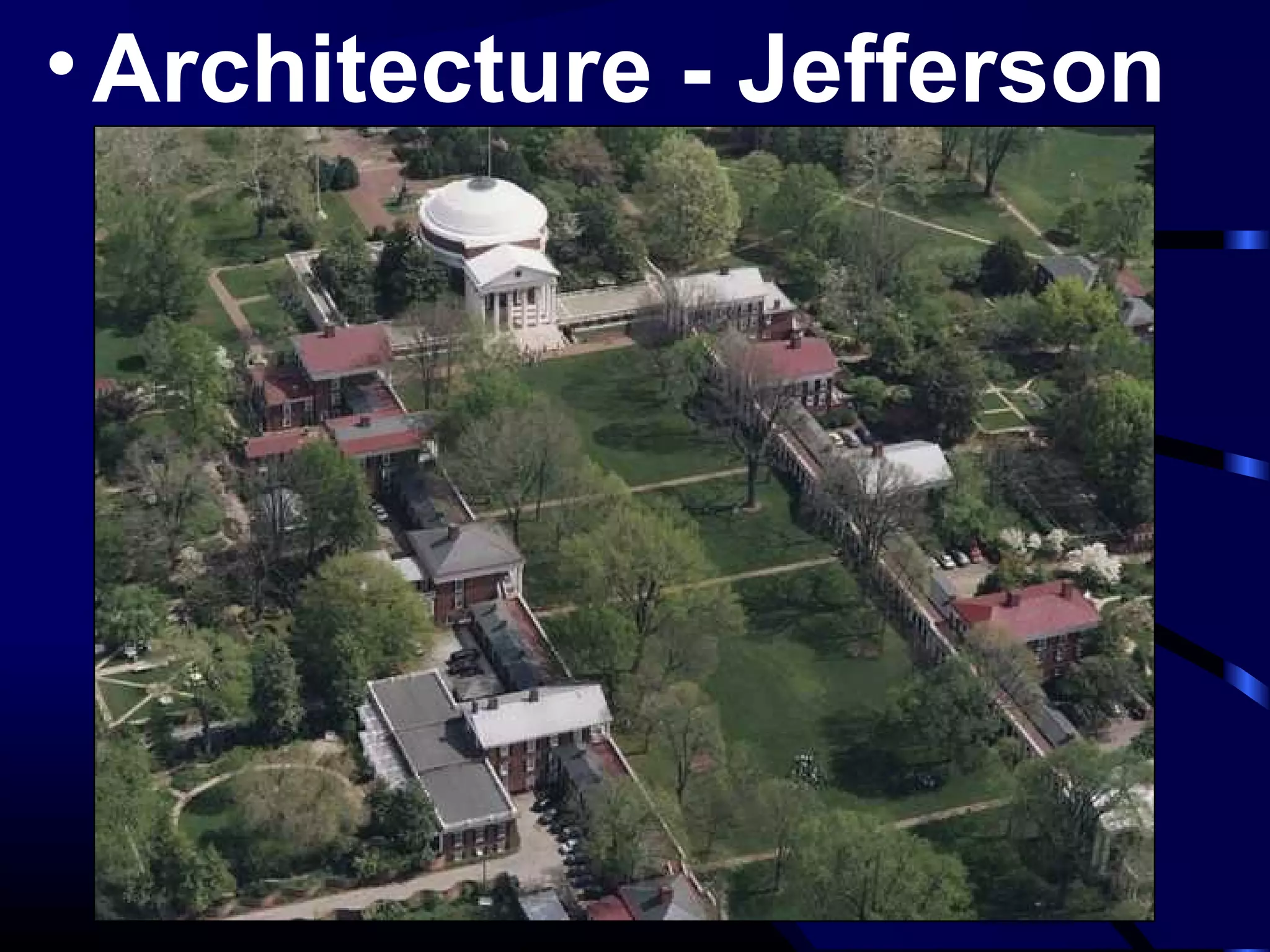
University of Virginia 1819University of Virginia 1819
• Founded & designed by
Thomas Jefferson
• Founded as a non-religious
institution dedicated to
science & modern language
Women’s EducationWomen’s Education
• Considered frivolous
• 1821 – Emma Willard
established the Troy
Female Seminary
• 1837 – Oberlin College
admitted women after
already having admitted
Blacks
• Mary Lyon established
Mount Holyoke Seminary
in Mass.
The LyceumsThe Lyceums
• Travelling lecturers made
the circuit
• Gave talks on science,
literature, & philosophy
• Ralph Waldo Emerson
Age of ReformAge of Reform
• Most driven by evangelical
Christians
• Reform movements
included:
–Education
–Women’s rights
–Communal living
–Slavery
–Medical programs
–Polygamy
–Celibacy
–Anti-tobacco
–Anti-alcohol
–Mail on Sundays
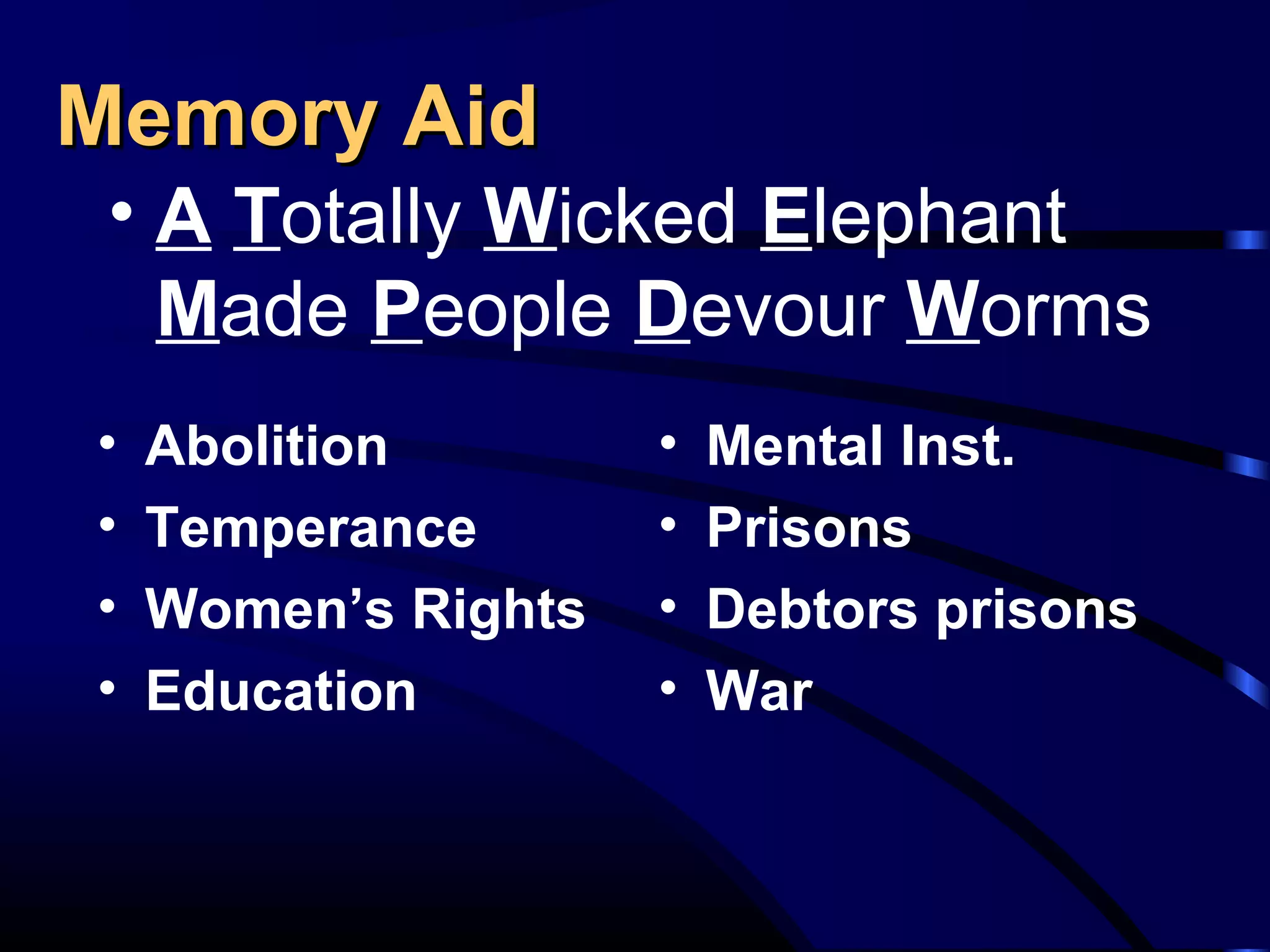
Memory AidMemory Aid
• A Totally Wicked Elephant
Made People Devour Worms
• Abolition
• Temperance
• Women’s Rights
• Education
• Mental Inst.
• Prisons
• Debtors prisons
• War
• Women very involved in
abolitionism, women’s
suffrage & other reforms
Prison ReformPrison Reform
• Laboring class voted for
an end to debtors prisons
• Number of capital crimes
reduced
• Prisons called to reform
instead of punish
Dorothea DixDorothea Dix
• Traveled 60,000 miles
chronicling the abuses
against the mentally ill
• Petitioned Massachusetts
Legislature to improve
conditions
American Peace SocietyAmerican Peace Society
• Anti-war group led by
William Ladd called for
an end to all war
Temperance MovementTemperance Movement
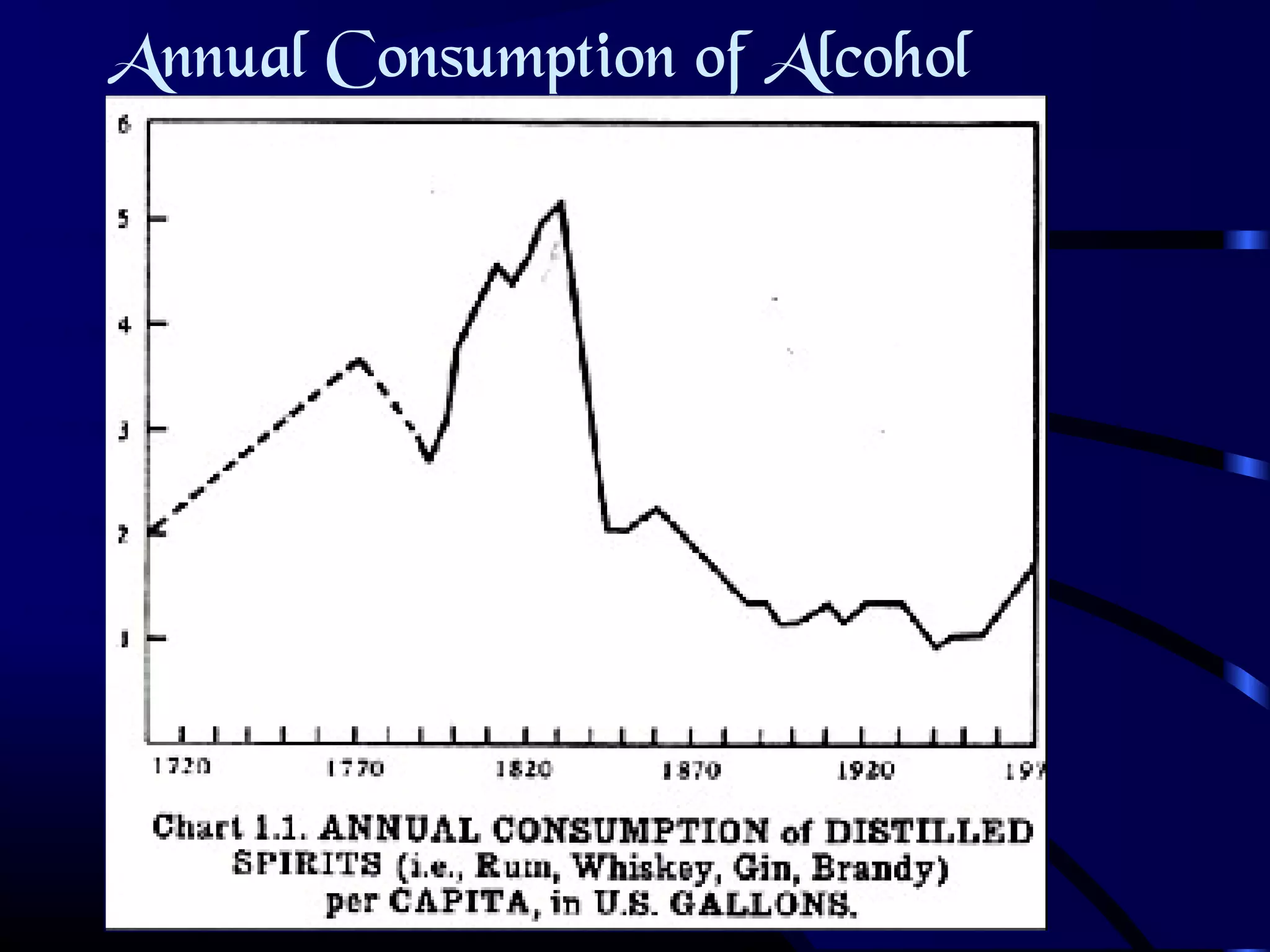
• Custom & hard lifestyle
led to widespread alcohol
abuse
• 1826 – American
Temperance Society
formed
• Tolerance
–moderation in use of
alcohol
• Prohibition
–make alcohol illegal
Annual Consumption of Alcohol
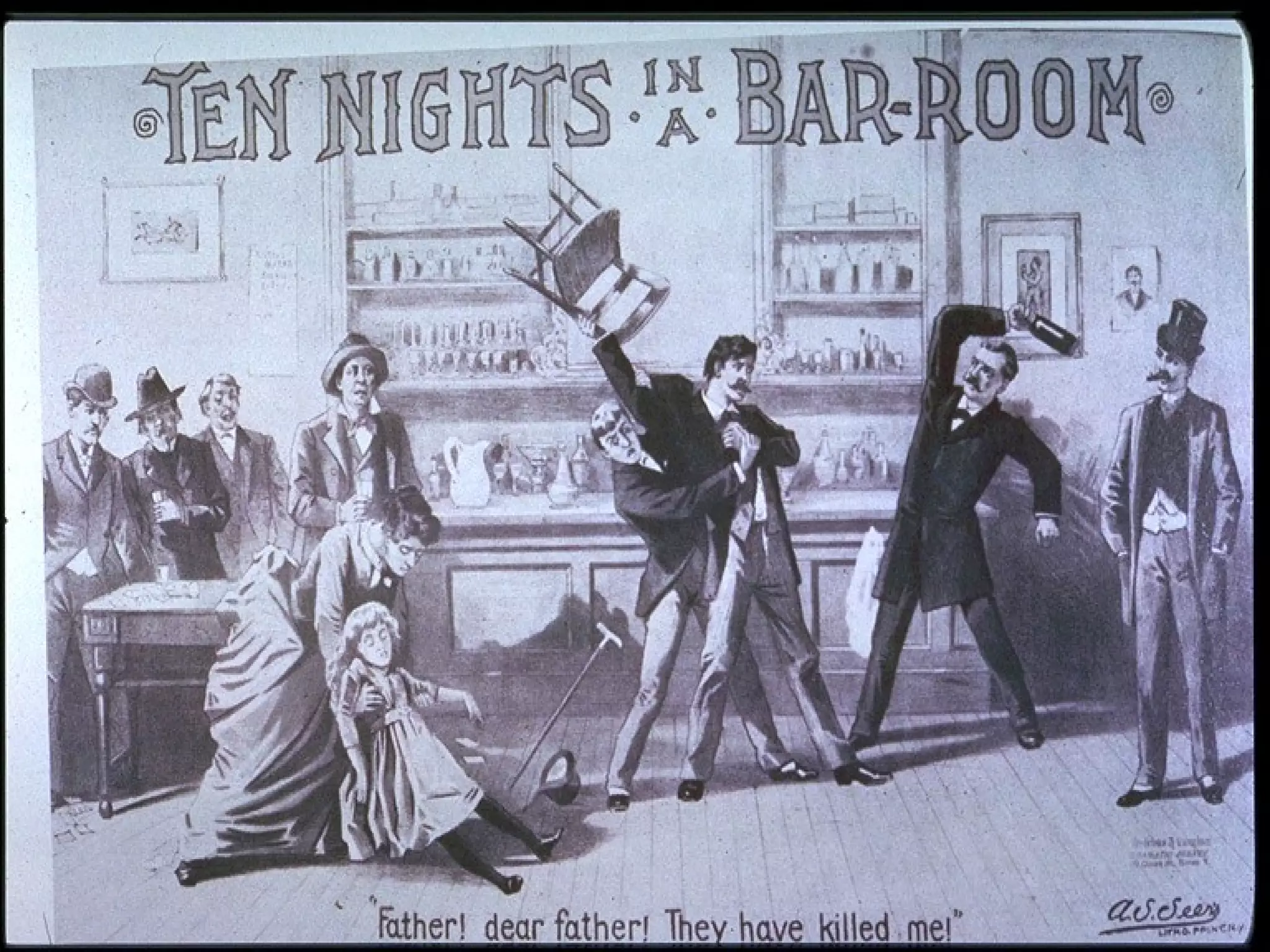
Ten Nights in a BarroomTen Nights in a Barroom
and What I Saw Thereand What I Saw There
• Novel by T.S. Arthur in
1854
• Depicted how a stable
village was transformed by
a new tavern
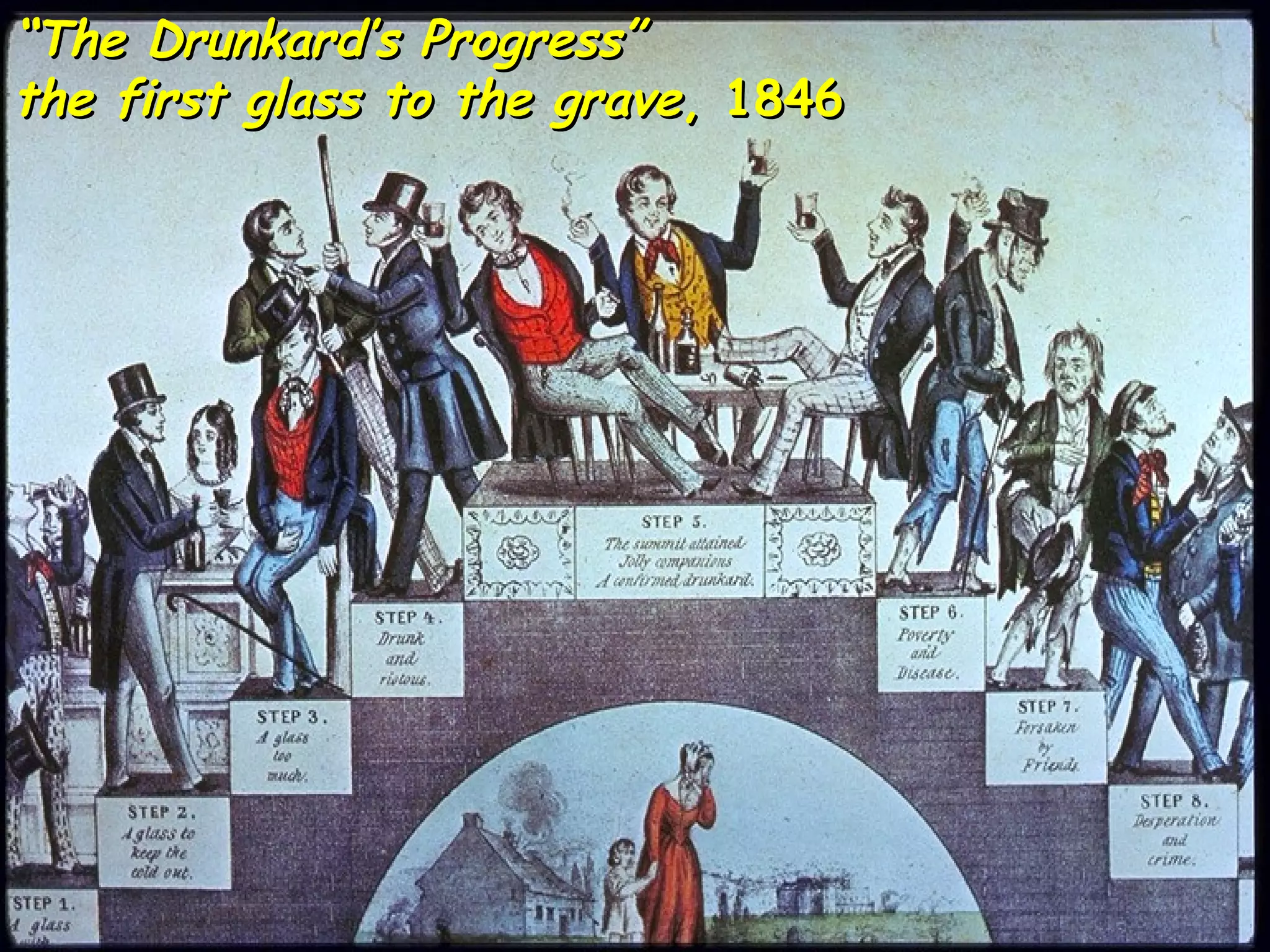
““The Drunkard’s Progress”The Drunkard’s Progress”
the first glass to the gravethe first glass to the grave, 1846, 1846
• Neal S. Dow
–sponsored the Maine Law
of 1851
–prohibited the manufacture
& sale of alcohol
–12 states had laws by 1857
Women’s RightsWomen’s Rights
• Industrial Rev. had
separated men & women
into distinct roles
• Women physically &
emotionally weak yet
artistic & refined
• “Cult of domesticity”
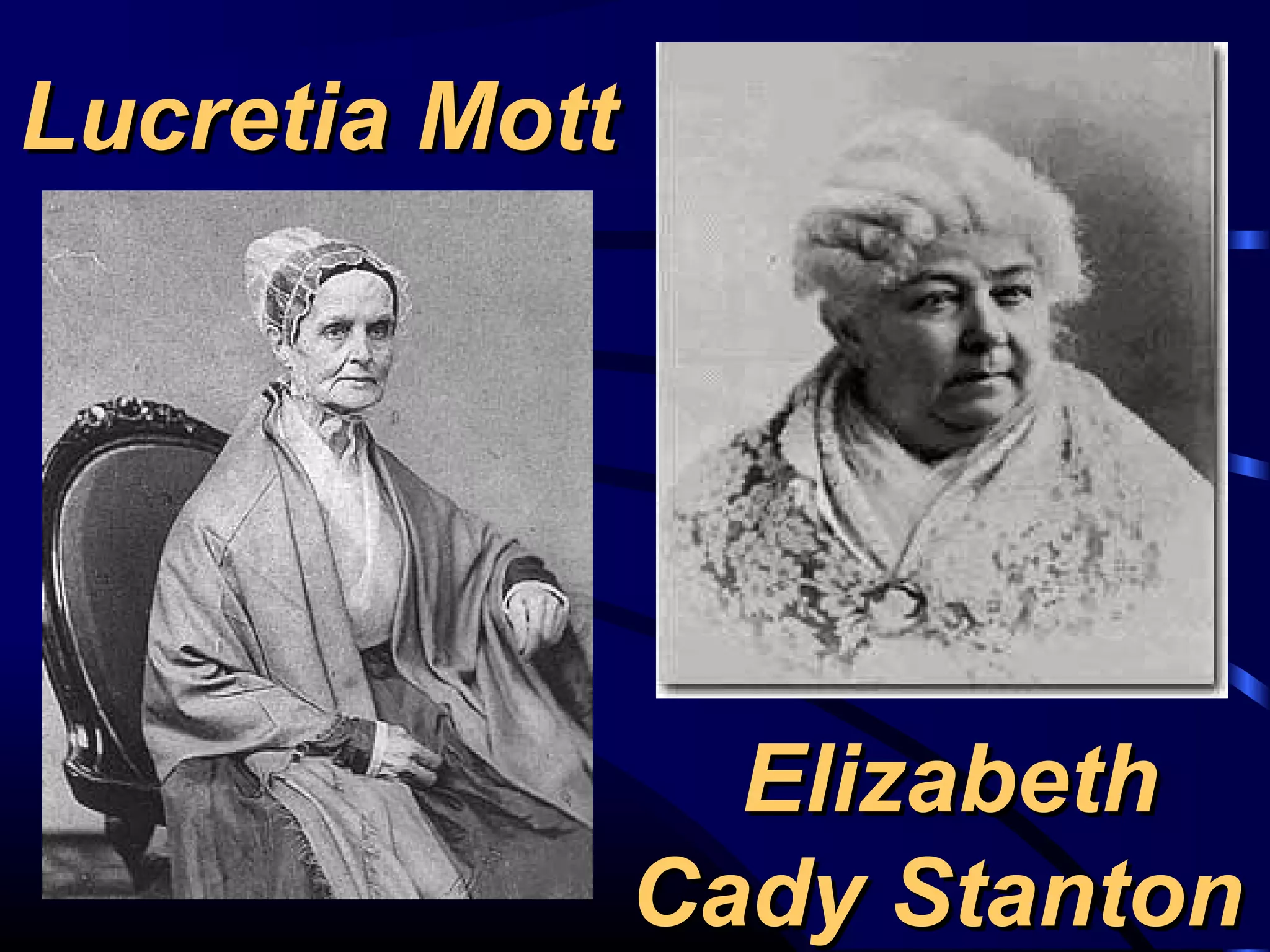
Lucretia MottLucretia Mott
ElizabethElizabeth
Cady StantonCady Stanton
• Stanton & Mott organized
Seneca Falls Conference
• Stanton urged equality,
rights to sue & own property
• Advocated women’s
suffrage
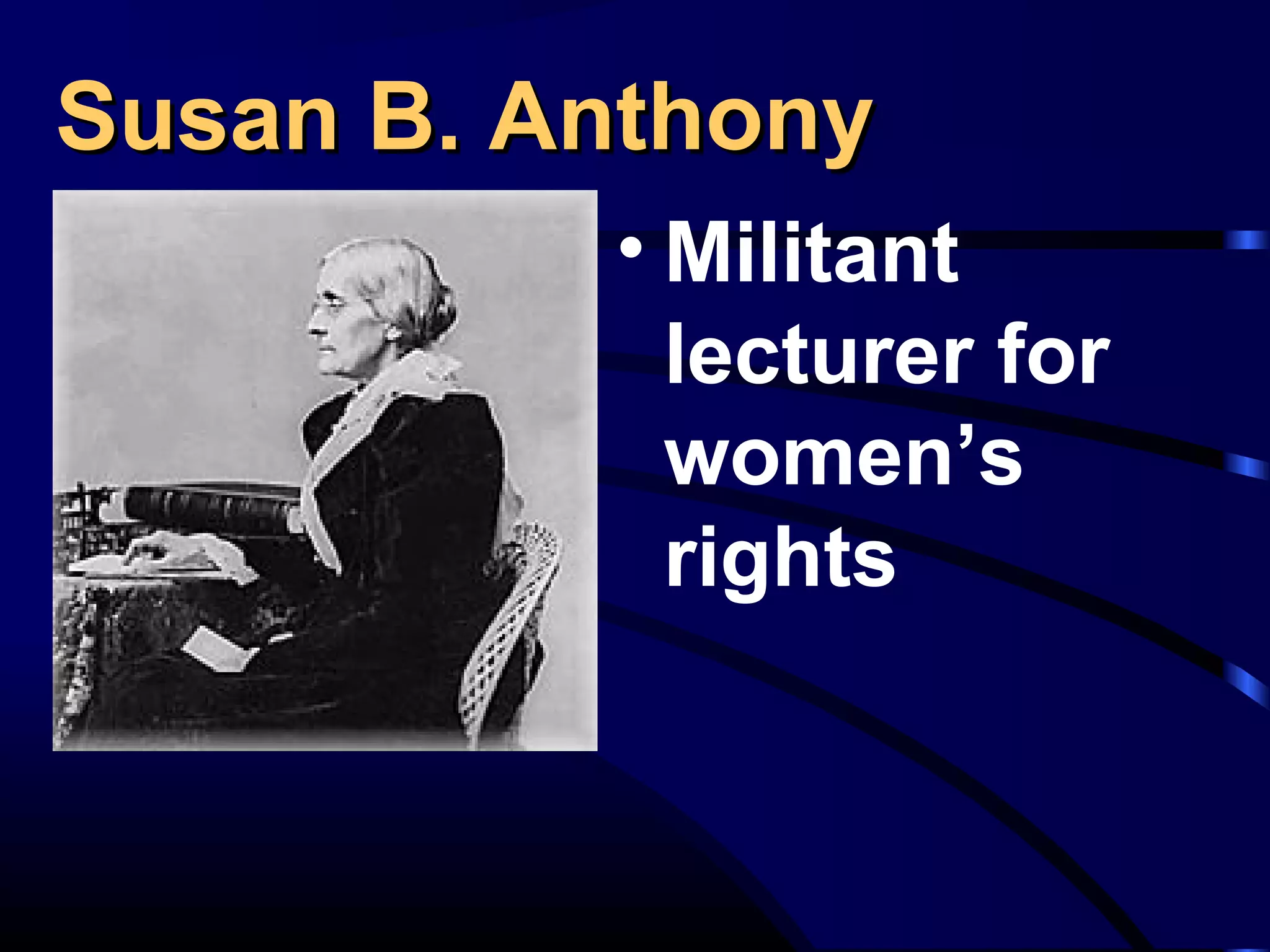
Susan B. AnthonySusan B. Anthony
• Militant
lecturer for
women’s
rights
• Dr. Elizabeth Blackwell
–first female graduate of a
medical college
• Margaret Fuller
–edited The Dial
• Grimke sisters
–spoke against slavery
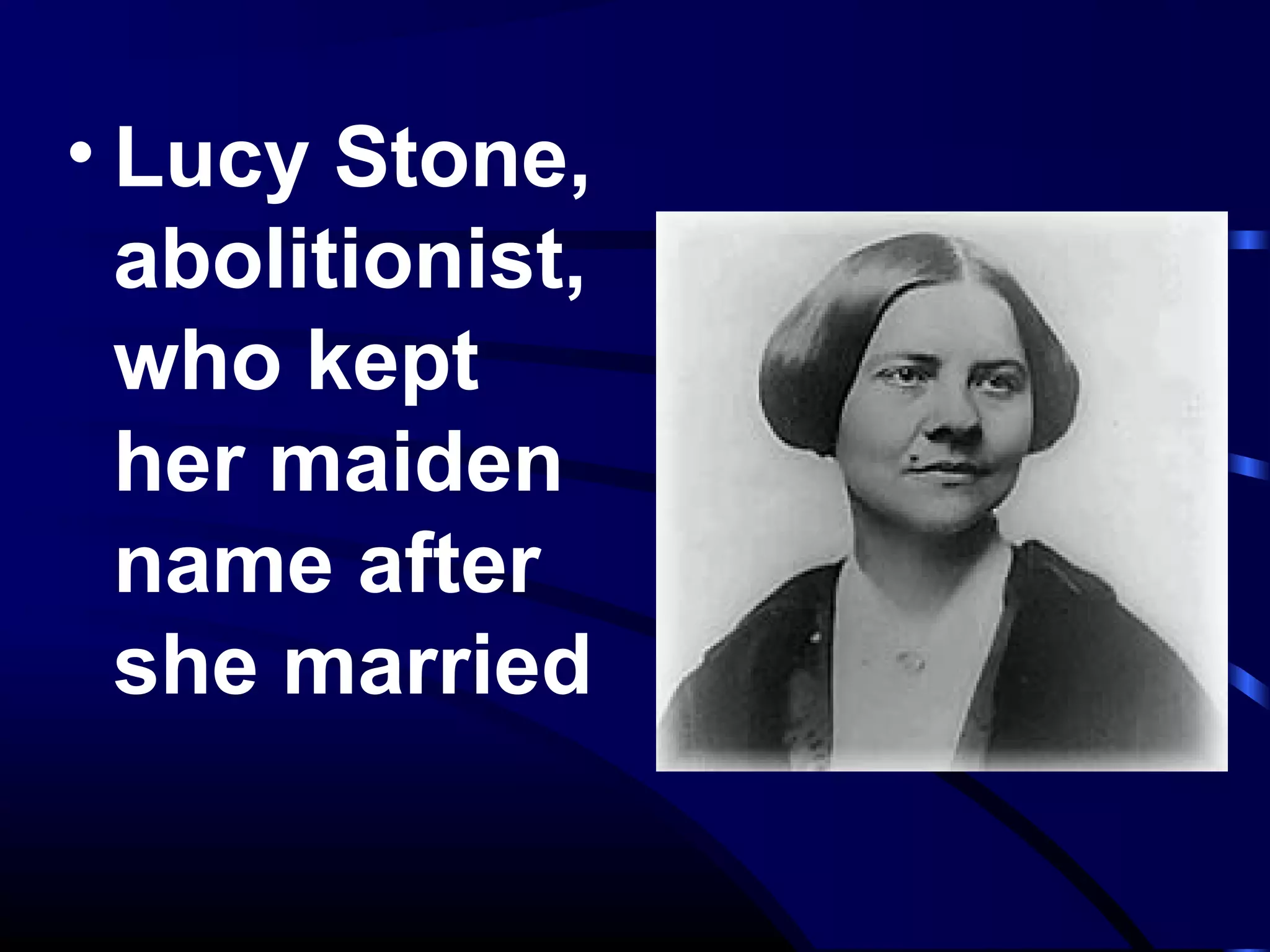
• Lucy Stone,
abolitionist,
who kept
her maiden
name after
she married
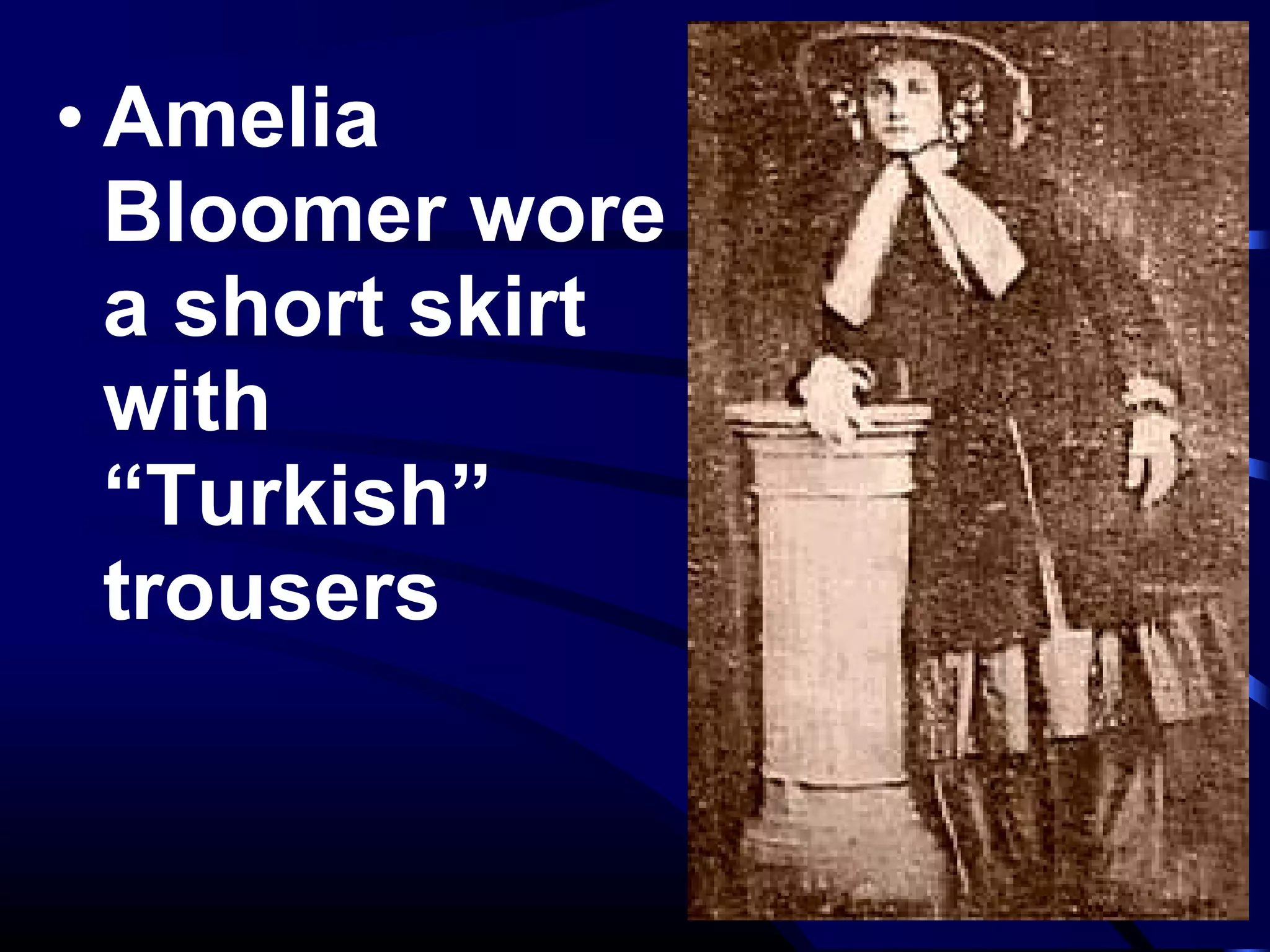
• Amelia
Bloomer wore
a short skirt
with
“Turkish”
trousers
Seneca Falls (1848)Seneca Falls (1848)
• Women’s Rights Convention
• 61 women, 34 men attended
• “Declaration of Sentiments”
read by Stanton
–“All men & women are created
equal”
–Demanded women’s suffrage
• Launched woman’s rights
movement
• Eclipsed by Abolition &
the Civil War
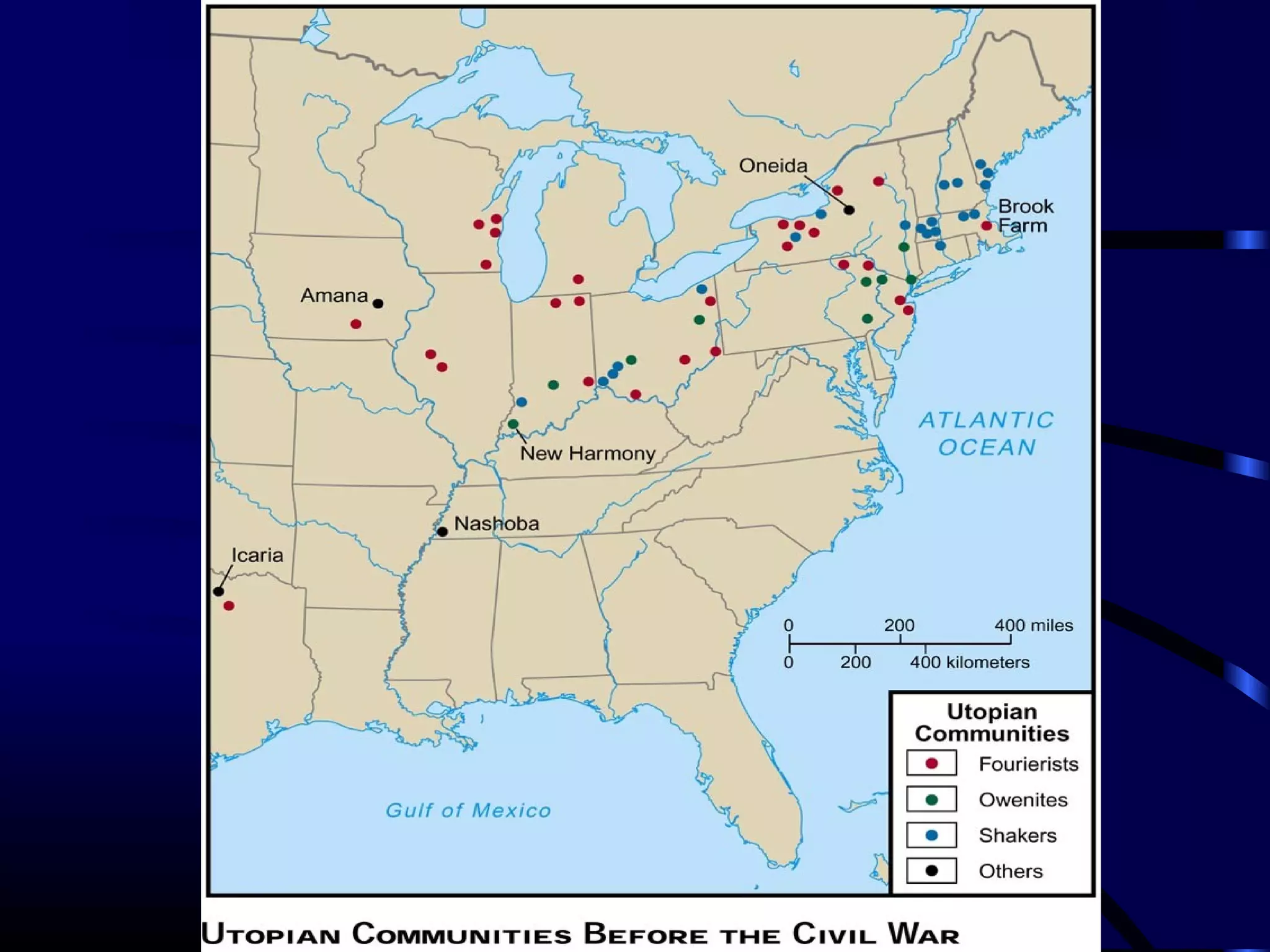
UtopianismUtopianism
• 40+ communes created
during the period
• New Harmony (1825)
–Robert Owen established in
Indiana with 1000 people
–Attracted scholars &
scoundrels
Brook Farm (1841)Brook Farm (1841)
• 20 transcendentalist
intellectuals
• Successful attempt at
communal living until fire
destroyed the experiment
Oneida Colony (1848)Oneida Colony (1848)
• Founded in NY
• Experimented in “complex
marriages” & eugenics
• Made & sold steel traps &
silverware
• Troubles with law led to end
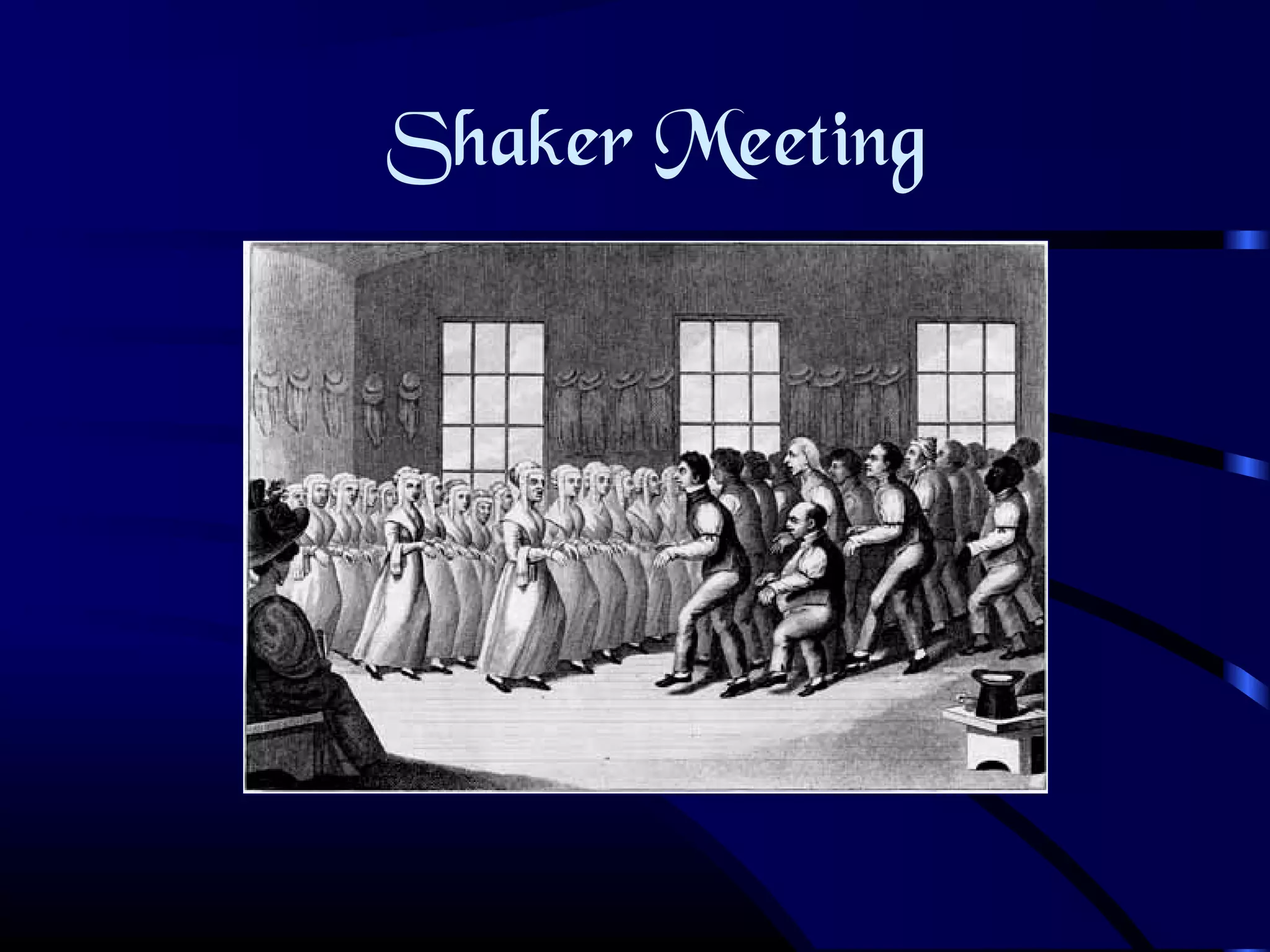
Shakers (1776-1940)Shakers (1776-1940)
• 6000 members in 1840
• Celibacy & simplicity
• Equal spirit of men &
women
• Opposition to marriage &
sex led to extinction
Shaker Meeting
Scientific AchievementScientific Achievement
• Practical science
• Nathaniel Bowditch
(Navigation)
• Matthew Maury
(Oceanography)
• Benjamin Silliman (chemist &
geology professor at Yale)
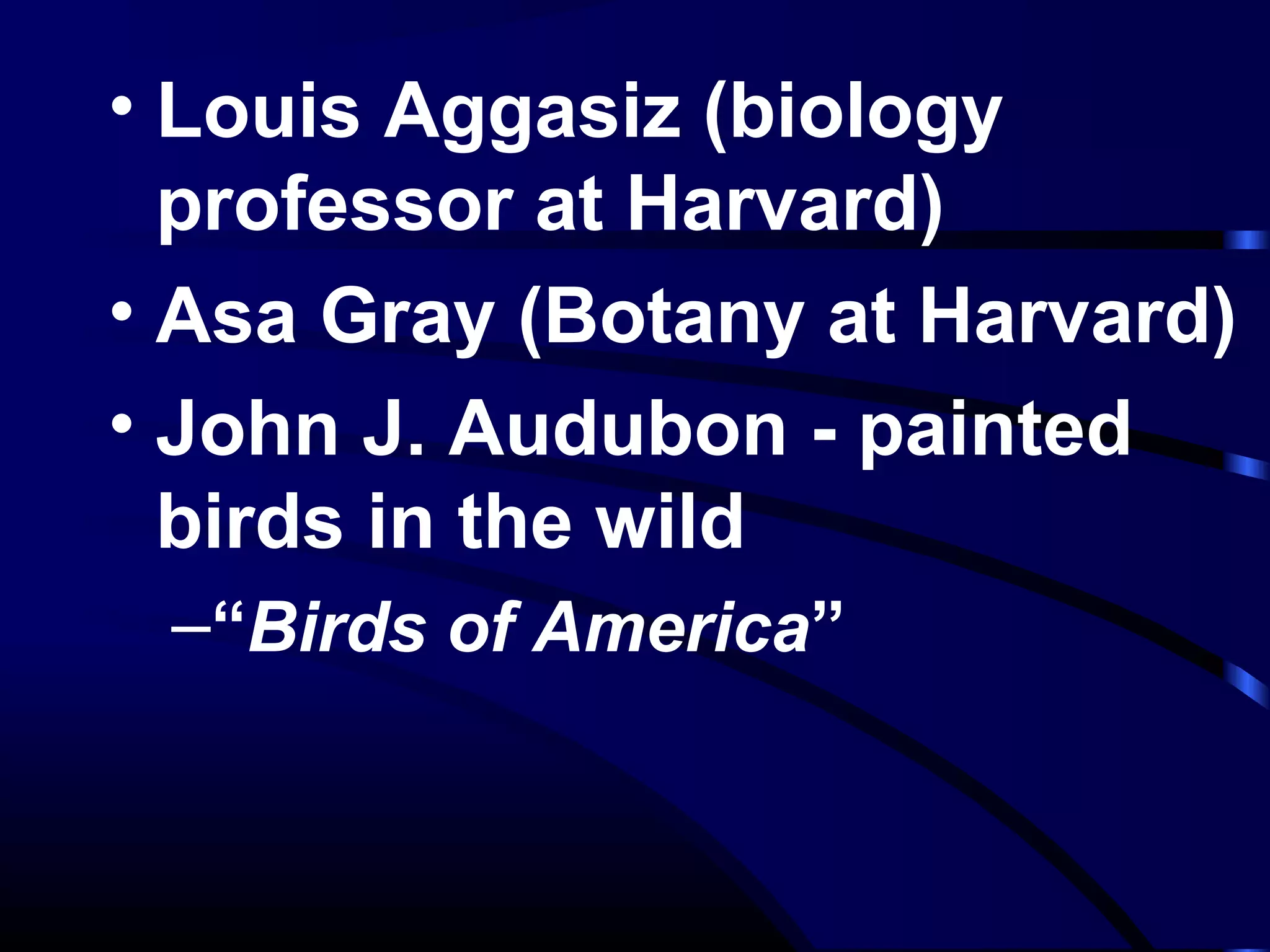
• Louis Aggasiz (biology
professor at Harvard)
• Asa Gray (Botany at Harvard)
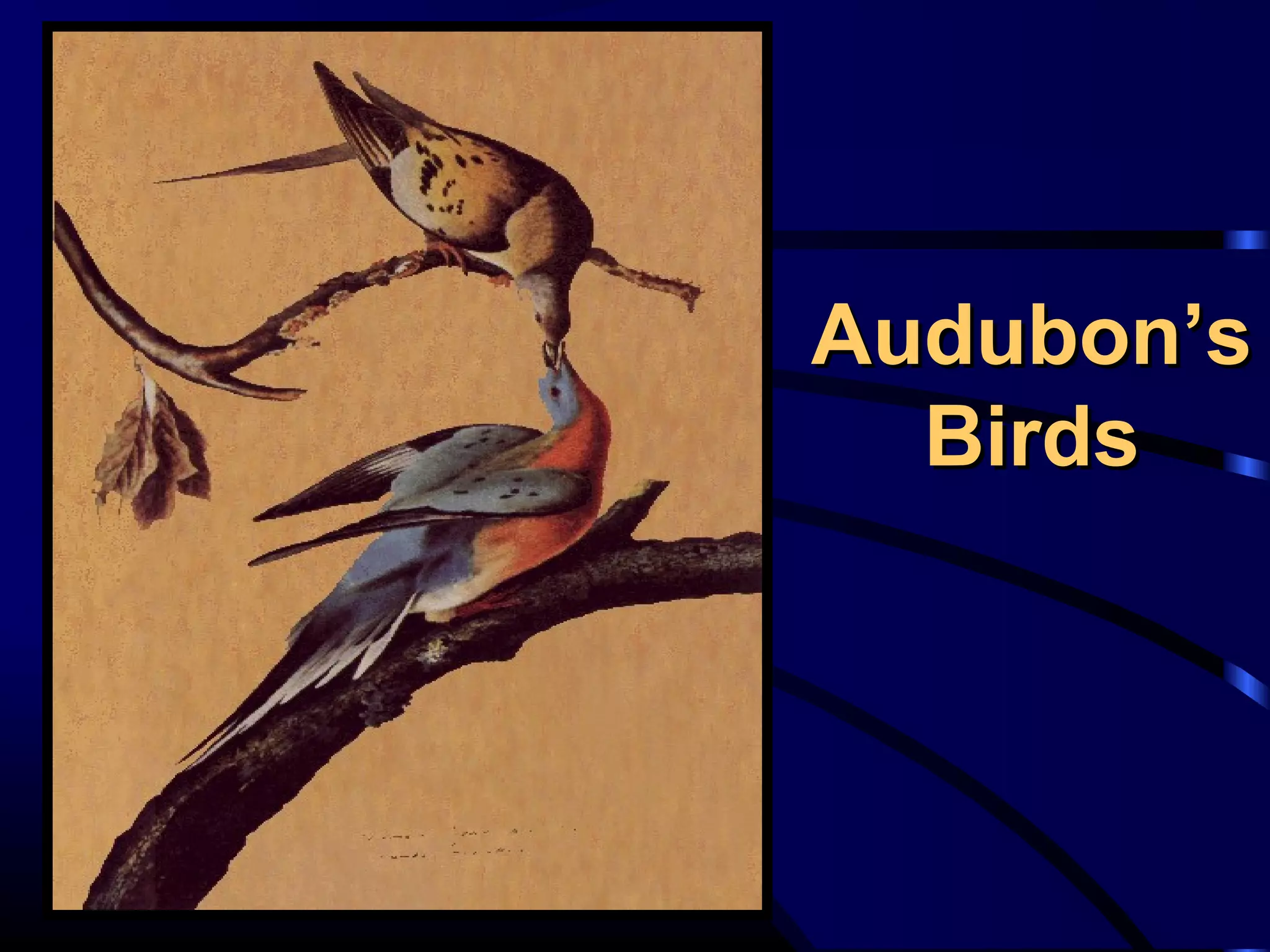
• John J. Audubon - painted
birds in the wild
–“Birds of America”
Audubon’sAudubon’s
BirdsBirds
• Medicine slow to catch up
to scientific achievement
–Bleeding
–Smallpox plagues
–40 year life expectancy in
1850
–Surgery & whiskey
ArtisticArtistic
AchievementsAchievements
•Architecture - Jefferson
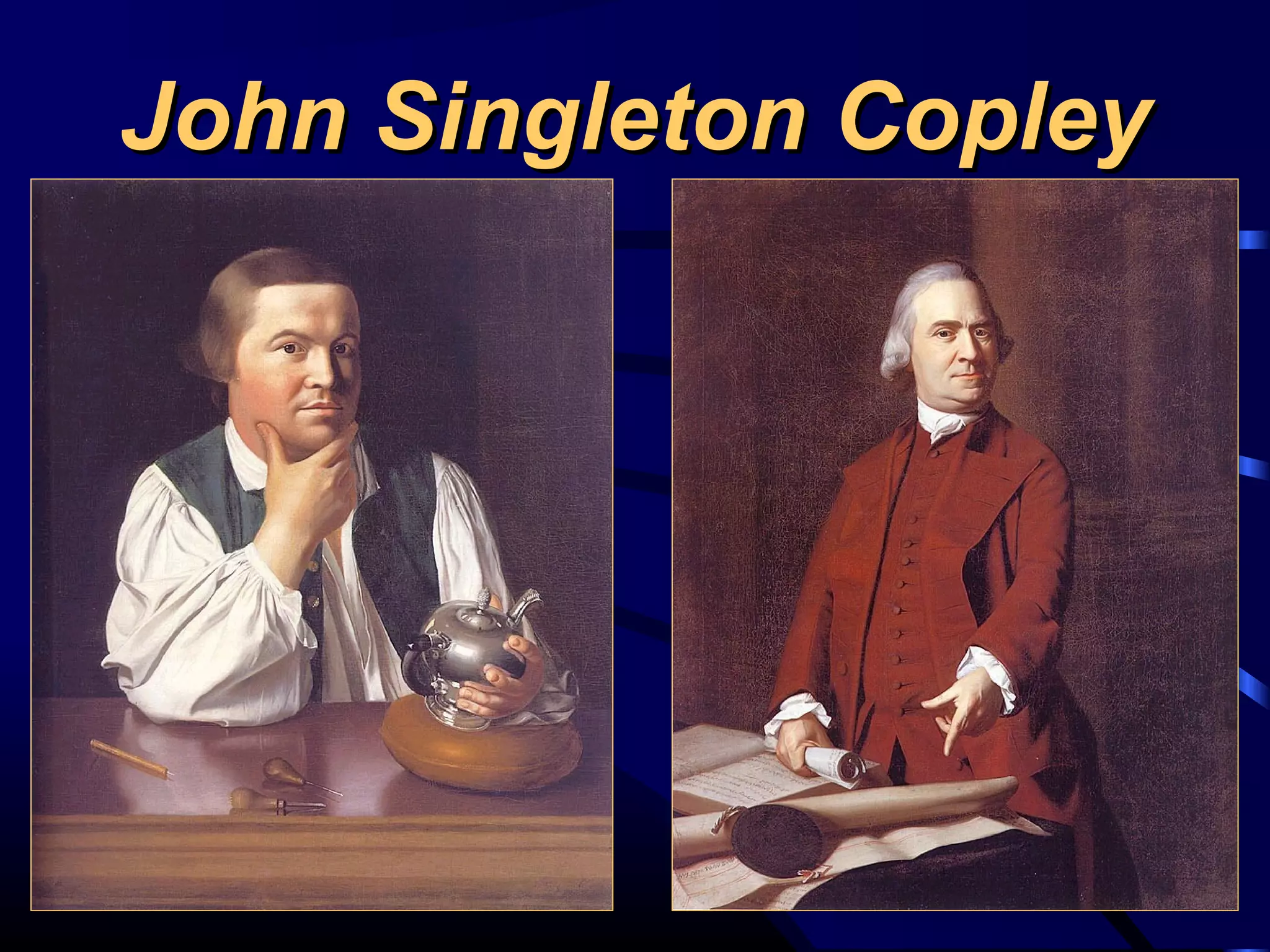
• Painting handicapped by
lack of wealthy class &
Puritanism roots
• Moved from portraits to
landscapes
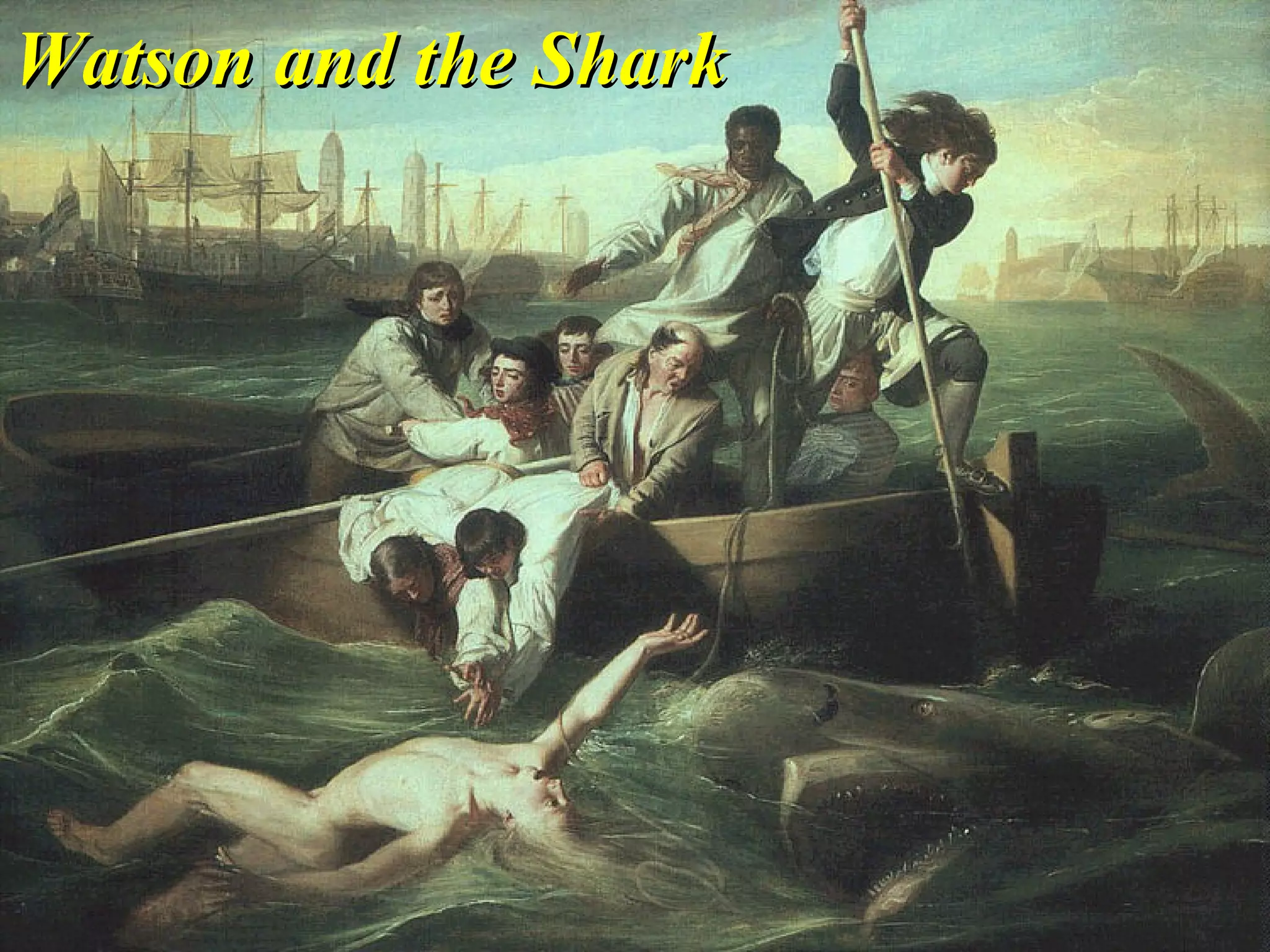
John Singleton CopleyJohn Singleton Copley
Watson and the SharkWatson and the Shark
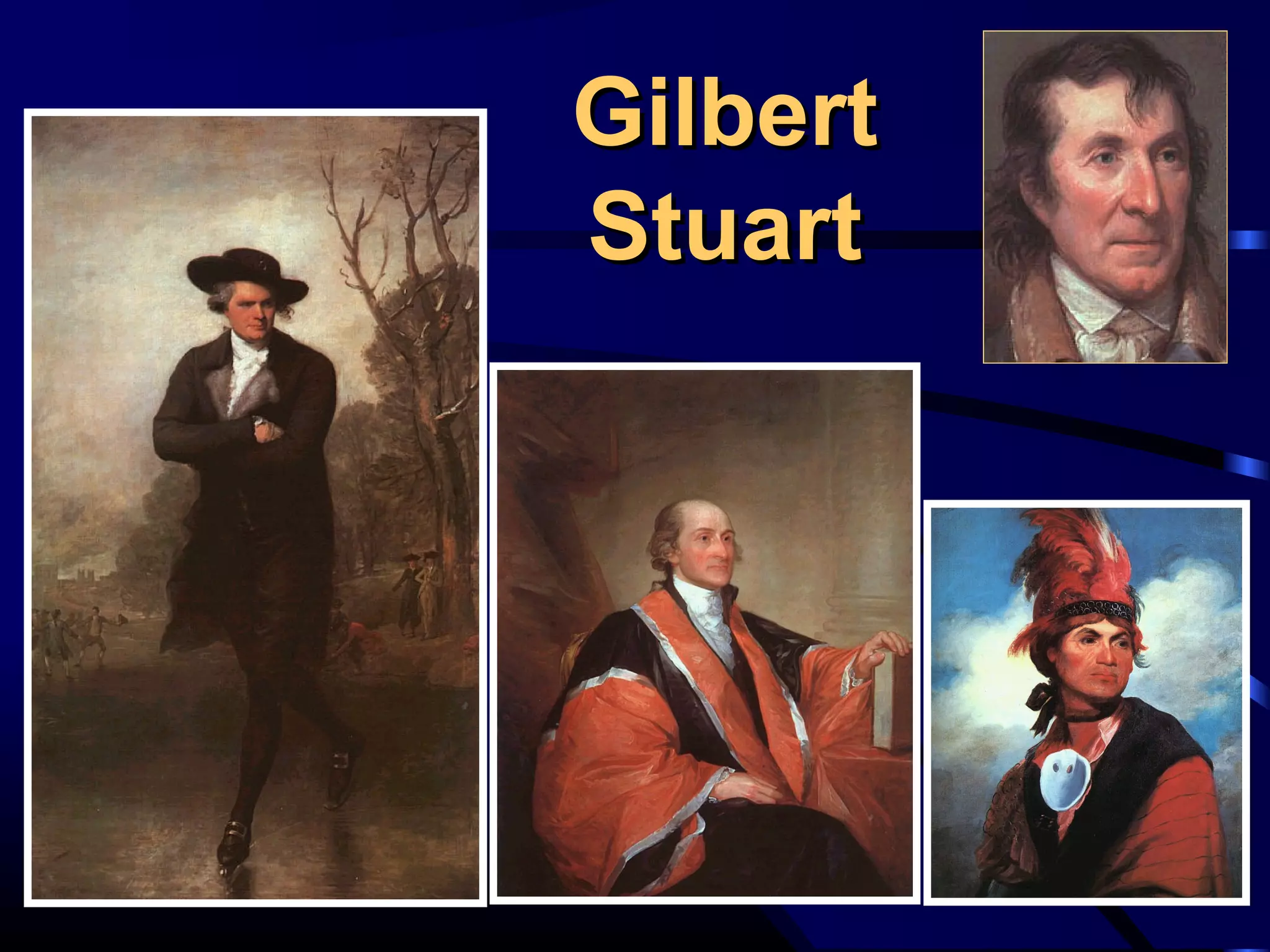
GilbertGilbert
StuartStuart
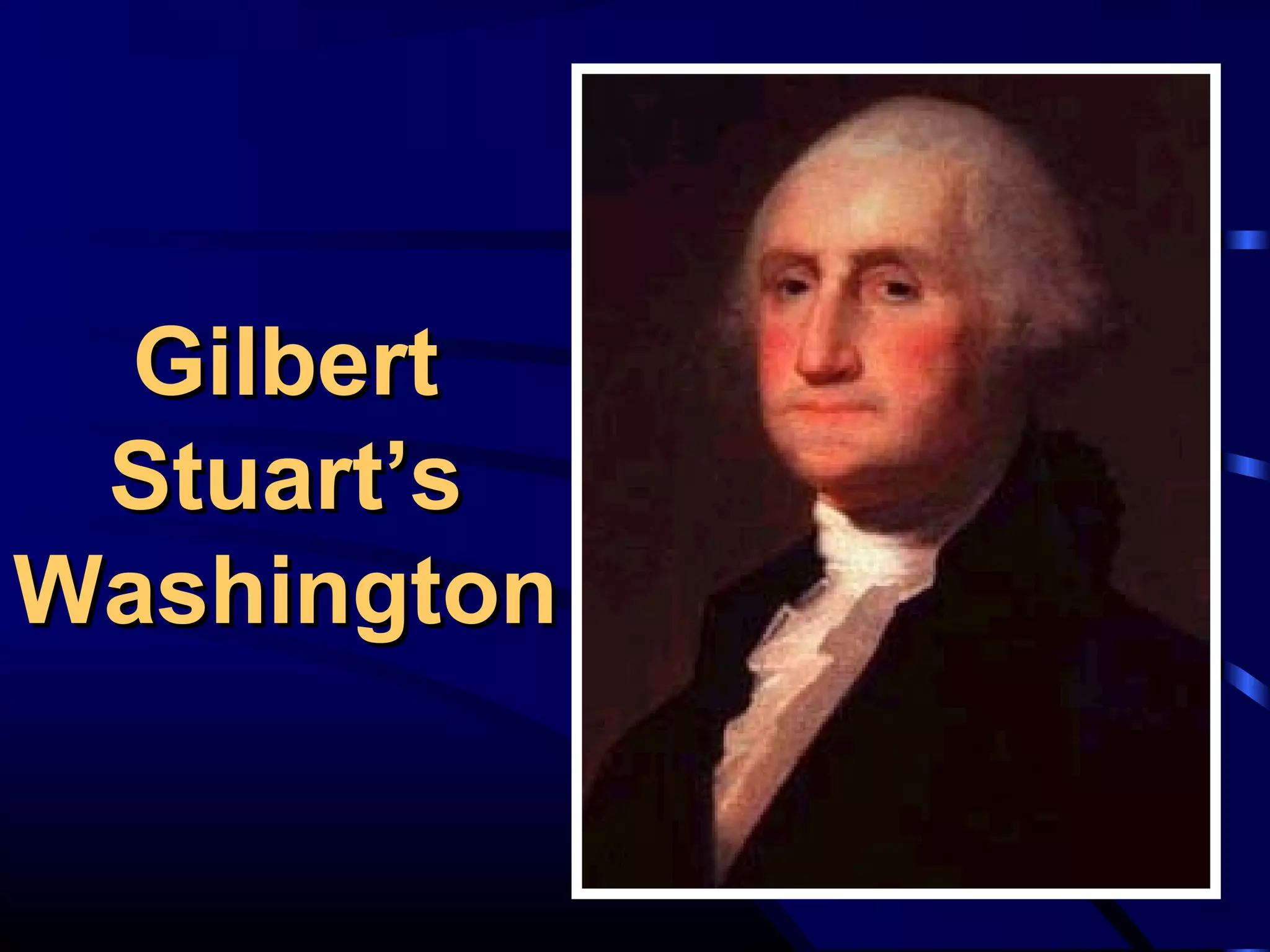
GilbertGilbert
Stuart’sStuart’s
WashingtonWashington
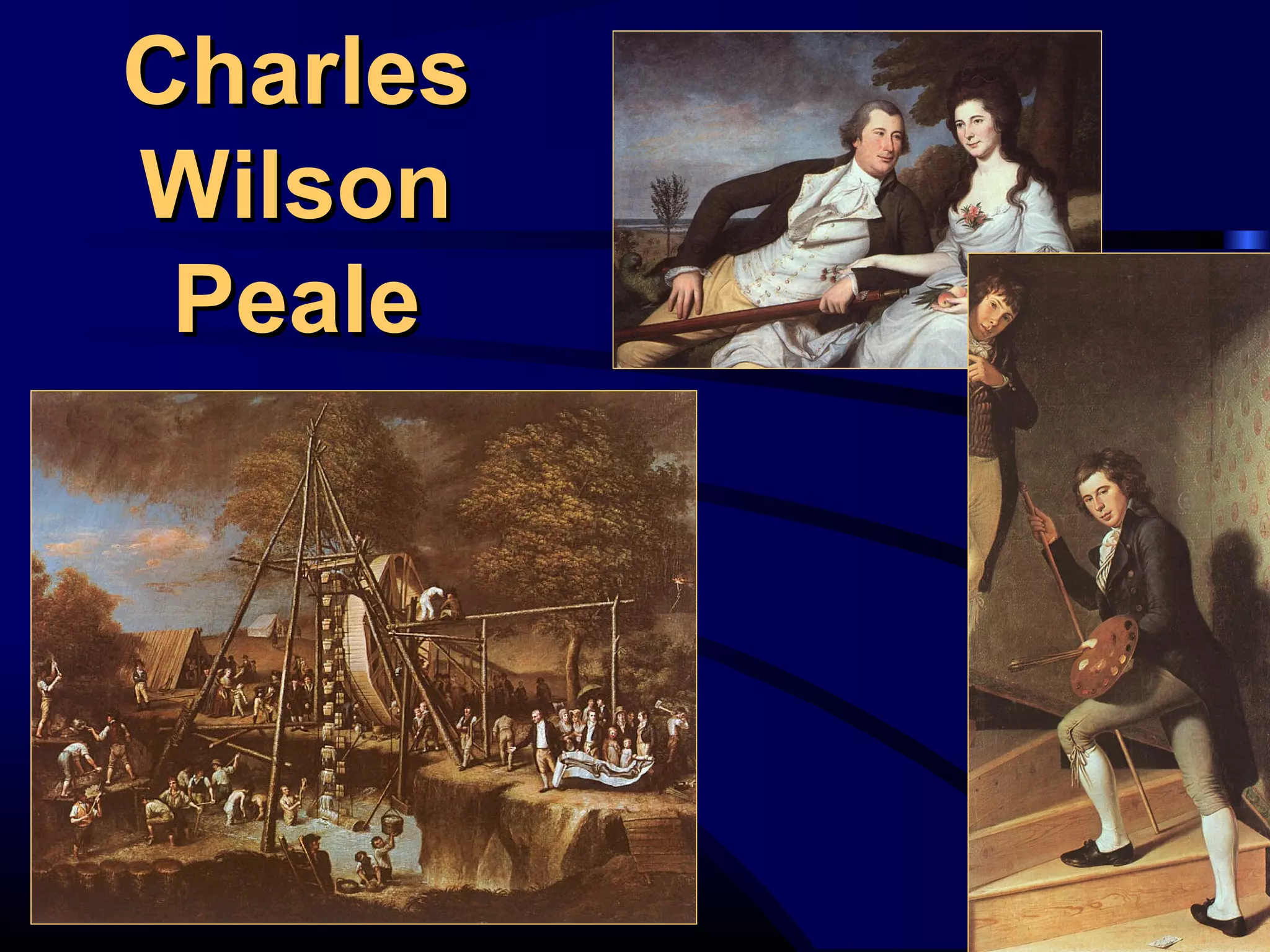
CharlesCharles
WilsonWilson
PealePeale
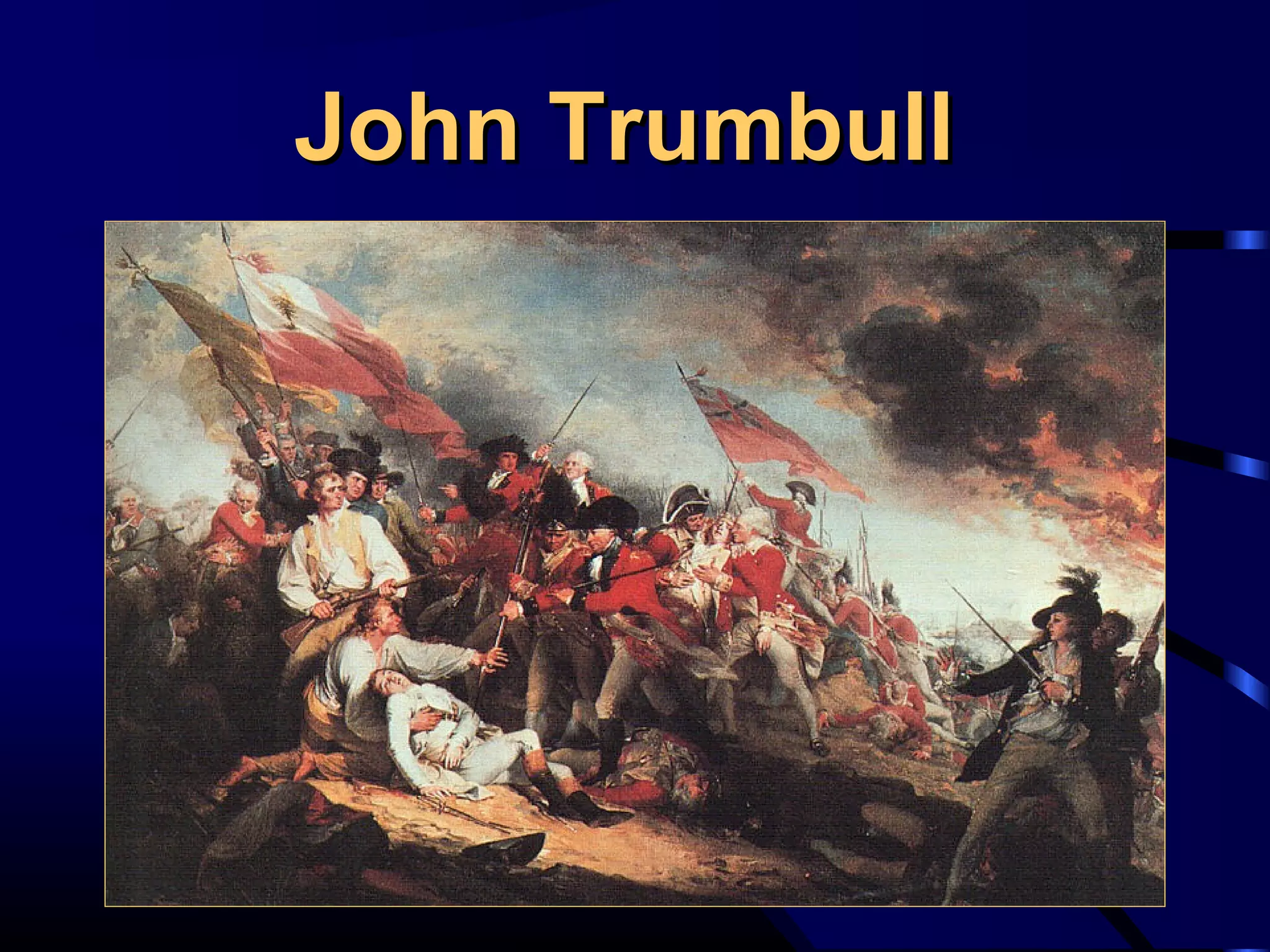
John TrumbullJohn Trumbull
MusicMusic
• Minstrels in “blackface”
sang “darky tunes”
• Stephen Foster - “Old
Folks at Home”
LiteratureLiterature
• Essays - The Federalist,
Common Sense.
• Ben Franklin's -
Autobiography
• The Knickerbocker Group
–Washington Irving
•1st
to gain international
recognition
•Rip Van Winkle
–James Fenimore Cooper
•1st
American novelist to gain
world fame
•Last of the Mohicans
–William Cullen Bryant
•Poet (“Thanatopsis”)
•Editor of the New York
Evening Post
TranscendentalismTranscendentalism
• Truth “transcends” the
senses & cannot be found
by observation alone
• Believed people have an
inner light that allows
direct contact with God
• Emphasized individualism
& self-reliance
• Hostile to formal
institutions & conventional
wisdom
Ralph Waldo EmersonRalph Waldo Emerson
• Famous address to Phi
Beta Kappa “The American
Scholar”
• Stressed self-reliance, self-
improvement, optimism &
freedom as a practical
philosopher
RalphRalph
WaldoWaldo
EmersonEmerson
Henry David ThoreauHenry David Thoreau
• Poet & non-conformist
• Walden: Or Life in the
Woods
• Refused to pay taxes to
support war in Mexico
• Civil Disobedience
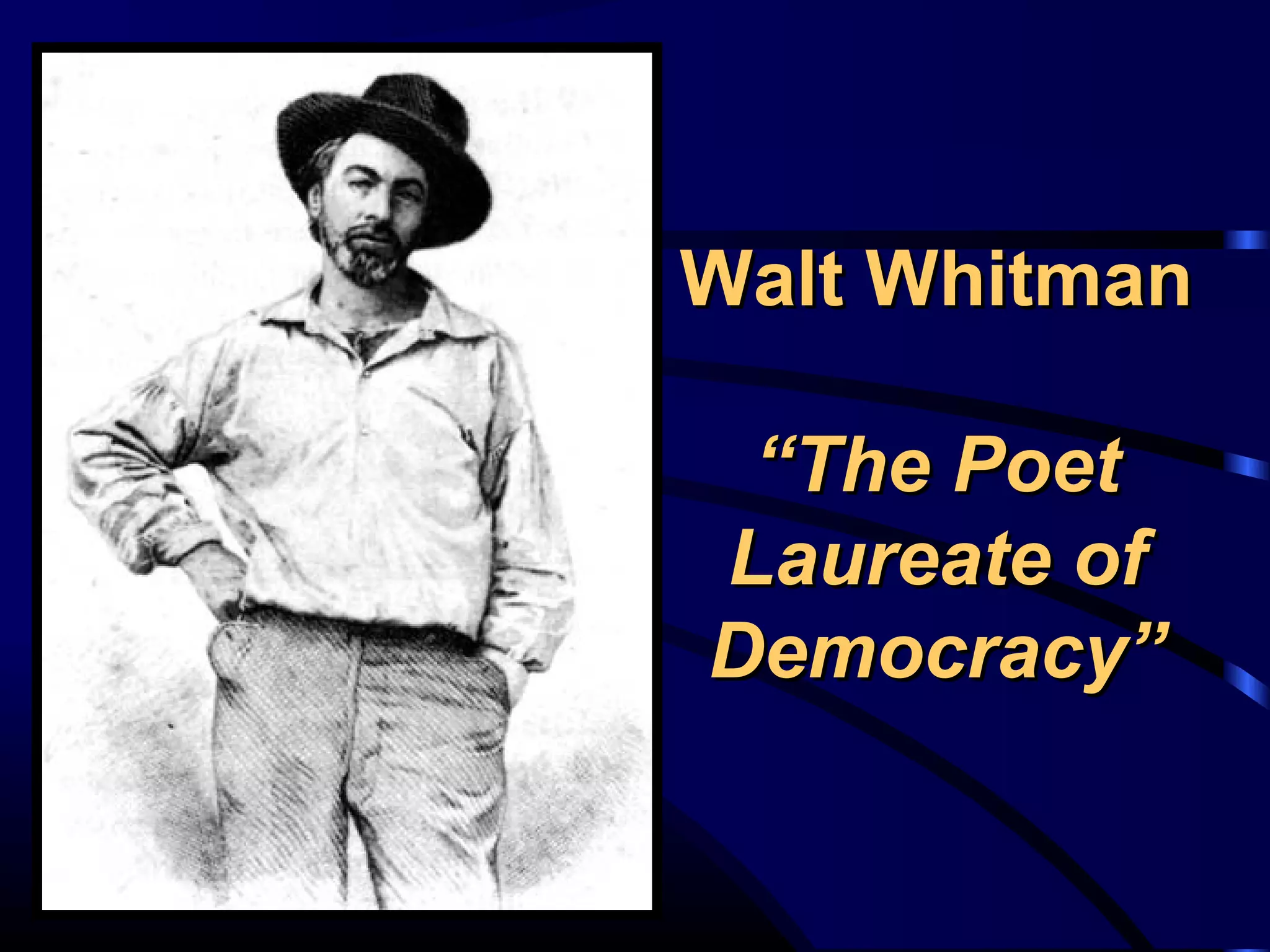
Walt WhitmanWalt Whitman
“The Poet“The Poet
Laureate ofLaureate of
Democracy”Democracy”
• Romantic, emotional
• Leaves of Grass (1855)
• Wrote of enthusiasm of
expanding America
Literary LightsLiterary Lights
• Henry Wadsworth Longfellow
–Historically-based poems
• John Greenleaf Whittier
–Influenced social action
• James Russell Lowell
–Political satirist
• Dr. Oliver Wendell Holmes
–Poet
• William Gilmore Simms
–Southern novelist
• Edgar Allan Poe
–Short story author
• Nathaniel Hawthorne
–The Scarlet Letter
• Herman Melville
–Moby Dick
Daily DiversionsDaily Diversions
• Stage plays: Uncle Tom’s
Cabin & Ten Nights in a
Barroom
• Famous Actors: Edwin
Forrest, Junius Brutus
Booth (sons Edwin Booth
& John W. Booth)
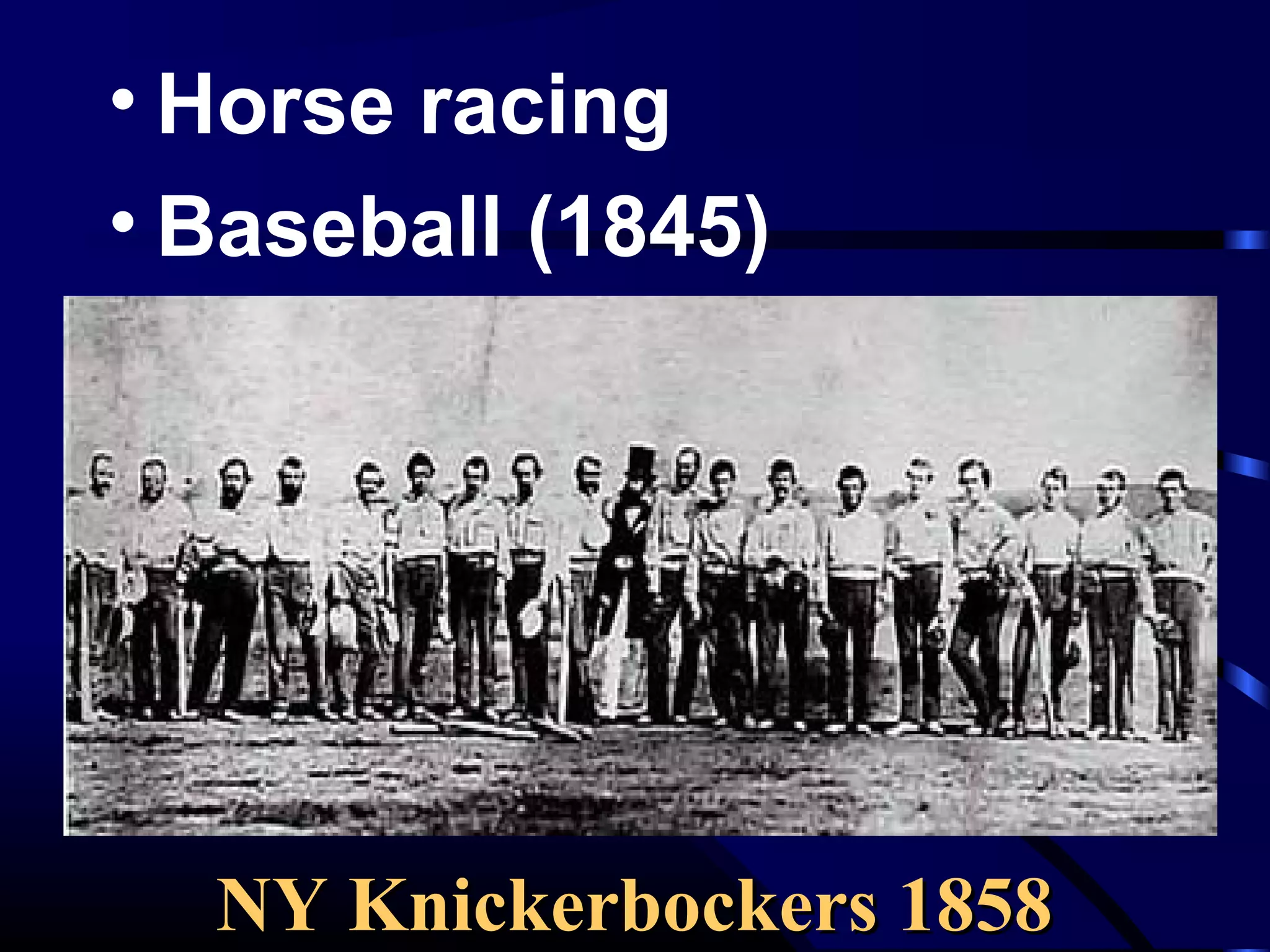
• Horse racing
• Baseball (1845)
NY Knickerbockers 1858NY Knickerbockers 1858
• Showboats
• Circuses
–Phineas T. Barnum “a
sucker is born every
minute”
• Upper class crowd
“summered” at resorts
like Saratoga Springs &
Newport, RI
• Rich often made the
“Grand Tour” of Europe
Alexis de ToquevilleAlexis de Toqueville
• Democracy in America
(1835)
• Individualism & equality
characterized antebellum
America
The Frontier ExperienceThe Frontier Experience
• Frederick Jackson Turner
• “Significance of the
Frontier in American
History”
• 1893 essay described that
the frontier forged the
American character

Lecture 16