HIV AND HPV
HIV/AIDS
• AIDS: acquired

immunodeficiency syndrome
• Syndrome: a collection of

symptoms
• Opportunistic infections

• caused by HIV (HIV-1):

human immunodeficiency
virus
• HIV causes AIDS by directly

causing the death of CD4+ Tcells (immune cells that fight
infections) or interfering with
the cells' normal functions, and
by triggering other events that
deteriorate a person's immune
system (Ois)
AIDS considered an “emerging disease”
• HIV mutated in 1930s from a form exclusive to apes to

one that could live in humans.
• Such diseases that move from one species to another are
known as zoonoses.
Ebola and tuberculosis are both examples of other zoonoses.

Where did HIV come from?
• http://youtu.be/UF3JGrt9Zvo
HIV/AIDS
• HIV is a virus
• All viruses unable to multiply outside a host cell, and therefore, are classified
as intracellular, obligate parasites
• Most often causes some type of cell damage or death
• Many viruses exist within host at a low enough level that the host is not aware of this

• Since viruses‟ survival depends entirely on host, most viruses tend to cause

mild infections
• Death in host = death of virus
• this is not the usual mode of action for most viruses because their existence would

cease to be
• Exceptions human immunodeficiency virus, ebola virus, pandemic influenza

• HIV is lentivirus, a class of retroviruses
• Unlike other retroviruses, which typically bud from infected cell for a long period
of time, HIV can lyze cell or lie dormant for many years, especially in resting T4
(CD4) lymphocytes;
• while HIV may disappear from cells of circulation, viral replication and budding

continues to occur in other tissues.
• recrudescence of viral production occurs that ultimately destroys the cell.
Short hx
• AIDS 1st described in 1981 by physicians in U.S.- saw

healthy patients become sickly and develop opportunistic
infections and cancers
• described AIDS in the medical literature.

• Public health officials (PHOs) started with this information

and amassed additional data about the patients, hoping to
identify a cause for the new disease.
• By mid-1982, epidemiologists had data demonstrating that
AIDS was transmissible. A virus was suspect.
• 1983, a candidate retrovirus isolated and in 1984, it was
demonstrated to be causative pathogen.
• This retrovirus destroyed helper T-cells, the master cells of the body‟s

immune response.
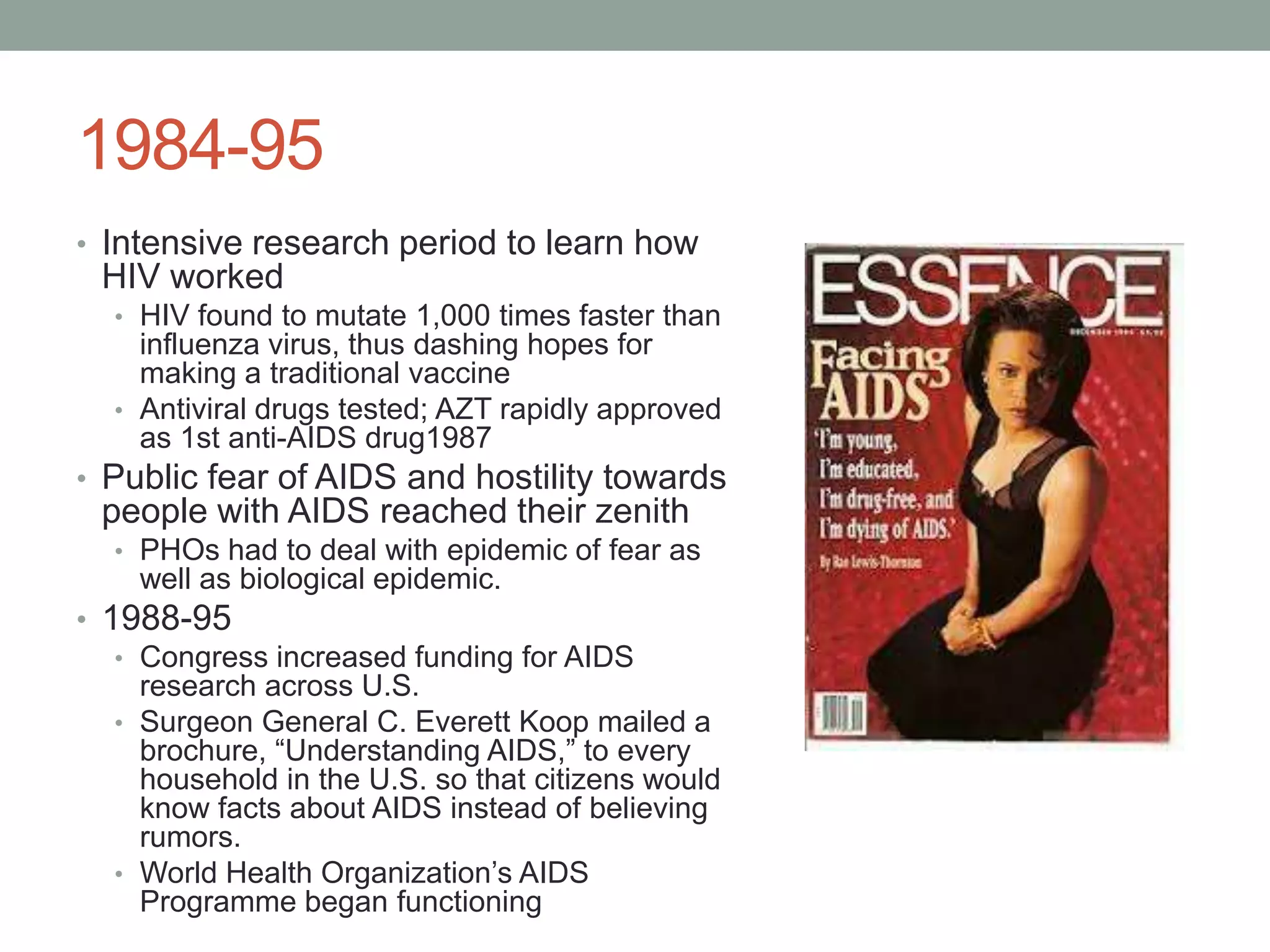
1984-95
• Intensive research period to learn how

HIV worked
• HIV found to mutate 1,000 times faster than

influenza virus, thus dashing hopes for
making a traditional vaccine
• Antiviral drugs tested; AZT rapidly approved
as 1st anti-AIDS drug1987
• Public fear of AIDS and hostility towards

people with AIDS reached their zenith
• PHOs had to deal with epidemic of fear as

well as biological epidemic.
• 1988-95
• Congress increased funding for AIDS
research across U.S.
• Surgeon General C. Everett Koop mailed a
brochure, “Understanding AIDS,” to every
household in the U.S. so that citizens would
know facts about AIDS instead of believing
rumors.
• World Health Organization‟s AIDS
Programme began functioning
1995-2006
• With introduction of first protease inhibitor drug in

1995, Highly Active Anti-Retroviral Therapy
(HAART) transformed AIDS into a chronic
disease.
• epidemiological focus of epidemic shifted to
developing countries and marginalized
populations in U.S.
• 2006, universal screening guidelines for HIV
infection aimed to make AIDS a routinely reported
disease in U.S.
• 2013 UN agency reports „dramatic‟ progress on
reducing new HIV infections
8

HIV/AIDS Key driver of change in public
health
• Enormous impact because
• no biological control mechanism
• enormous cost
• many are vulnerable
• Effect on other infectious disease programs
• TB surveillance and control programs were successful public health
interventions, until HIV/AIDS epidemic reversed this achievement
• rise in active cases

• Effect on maternal child health programs and reproductive

health programs
• Changes to program planning and infrastructure due to:
• use of antiretroviral drugs for treatment
• prophylactic treatment for exposed babies
• breast feeding
HIV/AIDS epidemiology
• 2.3 million adults and children newly

infected with HIV in 2012,
• represents 33 % reduction in annual new

cases compared to 2001.
• new HIV infections among children fell 52 %
to 260,000 in 2012.
• greater access to antiretroviral TX led to a
30 per cent drop in AIDS-related deaths from
the peak in 2005.

• In the U.S., deaths typically through

Pneumocystis carinii
• In other parts of the world, it is TB
• > 90% of new HIV infections are in
developing countries.
• In Africa (mostly sub Saharan), > 24 million

people with HIV infection and about 1 million
new cases of AIDS per year

• .
HIV/AIDS epidemiology
• Of adult infections, 40% are in

women and 15% in individuals of
15-25 years of age.
• Perinatal infection resulting in a
large # of children being born with
HIV.
• 30-50% of mother to child

transmissions of HIV results from
breast feeding and about a ¼ of
babies born to HIV-infected mothers
are themselves infected.
• Reduced through HAART

Figure 1. Prenatal Antiretroviral
Therapy and Impact on
Perinatal HIV Transmission
HIV Transmission
• Sexual Transmission

• Blood Transmission

• Mother to Child
HIV/AIDS Risk Groups
• Paid/commercial sex workers (CSWs)
• Men who have sex with men (MSM)
• Injecting drug users (IDUs)
• Prisoners
• Any sexually active person who does not assume she/he is at

risk and take preventive measures
• Women
• HIV/AIDS Mother-to-child transmission
• Risk of
•
•
•
•

acquiring HIV during delivery without intervention: 15% to 30%
HIV transmission during delivery if the mother is taking ARVs: <2%
acquiring HIV from breastfeeding without intervention: 25% to 45%
HIV transmission during breastfeeding if the mother is taking ARVs: much
lower
Testing for HIV
• Antibody tests: Once infected, takes 3-6 months

for enough antibodies to be formed for screening
tests to be positive
• If test negative, person should be retested in 6 months

• ELISA (also called EIA)
• Western blot or indirect immunofluorescence assay

(IFA).
• Rapid assessment tests

• PCR tests.
• Once positive additional tests may be done for
• CD4 count. Important because healthy person's CD4
count can vary from 500 to more than 1,000. Even if a
person has no symptoms, HIV infection progresses to
AIDS when CD4 count becomes < 200.
• Viral load. measures amount of virus in blood; people
with higher viral loads generally fare more poorly than
do those with a lower viral load.
• Drug resistance. determines whether strain of HIV will
be resistant to certain anti-HIV medications and which
ones work better
The Course of the disease
From HIV Infection to AIDS
Acute infection (acute retroviral
syndrome)
• Initially, HIV infection produces a
mild disease
• . This is not seen in all patients.

• In period immediately after

infection, virus titer rises (about 4 to
11 days after infection) and
continues at a high level over a
period of a few weeks.
• Mononucleosis-like symptoms
(fever, rash, swollen lymph glands
but none of these are lifethreatening.
•

may mimic the flu

• result is an initial fall in the number

of CD4+ cells but the numbers
quickly return to near normal.
The Course of the disease
From HIV Infection to AIDS
• No other symptoms may occur until enough CD4 cells

have been destroyed by HIV
• With loss of CD4 cells, the immune system cannot protect
• When CD4 count reaches 200 – person considered to have AIDS
• Without therapy, time from infection to AIDS = approximately 8-10

years
• Despite possible co-factors associated with lifestyle, HIV infected

persons progress to AIDS at a remarkably similar rate

• Antiretroviral therapy can prolong this time span
• Some people naturally have not progressed from HIV

infection to AIDS
• Referred to as long-term nonprogressors
Preventive interventions for HIV/AIDS
• Safe sex, including condom use
• Unused needles for drug users
• Male circumcision
• Treatment of other sexually transmitted infections (STIs)
• Safe, screened blood supplies

• Antiretrovirals (ARVs) in pregnancy to prevent mother-to-

child transmission (MTCT) and after occupational
exposure
Treatment Interventions for HIV/AIDS
• Antitretroviral drugs (ARVs)
• Highly active antiretroviral therapy (HAART): combination of
antiretroviral drugs that are used as medications to control
retroviruses
• Extend years between infection and onset of clinical AIDS
• Extend years between onset of AIDS and death
• works against HIV by using drugs in combination to suppress HIV replication
as many times as possible.
• problems for HIV replication, keeps HIV offspring low, and reduces the possibility of
HIV mutating.

• must be used in combination to suppress HIV for long periods of time

• Treatment of opportunistic infections (OIs)
• Palliative care (pain management)
High Costs of HIV Medication Cause
'Terrible Dilemma' in Mozambique
• http://www.youtube.com/watch?v=sETtnySexxy
• 10:30
• In Mozambique, where 1 in 8 adults is living with HIV, the

number of patients on antiretroviral drugs has expanded
thanks to international AIDS funding, but a debate is
emerging over whether foreign donors can continue to
fund an ever-expanding pool of patients.
Role of Advocacy and Activism
• International response to epidemic
• U.S. PEPFAR program
• Global Fund to treat AIDS, TB, and Malaria
• Bill and Melinda Gates Foundation
• World Bank

20
HIV/AIDS Critical Challenges
• Developing a vaccine to prevent the 2.6 million new

infections per year
• Cost-effective approaches to prevention in different
settings
• Universal treatment for all those who are eligible
• Management of TB and HIV coinfection

HIV/HPV

  • 1.
  • 2.
    HIV/AIDS • AIDS: acquired immunodeficiencysyndrome • Syndrome: a collection of symptoms • Opportunistic infections • caused by HIV (HIV-1): human immunodeficiency virus • HIV causes AIDS by directly causing the death of CD4+ Tcells (immune cells that fight infections) or interfering with the cells' normal functions, and by triggering other events that deteriorate a person's immune system (Ois)
  • 3.
    AIDS considered an“emerging disease” • HIV mutated in 1930s from a form exclusive to apes to one that could live in humans. • Such diseases that move from one species to another are known as zoonoses. Ebola and tuberculosis are both examples of other zoonoses. Where did HIV come from? • http://youtu.be/UF3JGrt9Zvo
  • 4.
    HIV/AIDS • HIV isa virus • All viruses unable to multiply outside a host cell, and therefore, are classified as intracellular, obligate parasites • Most often causes some type of cell damage or death • Many viruses exist within host at a low enough level that the host is not aware of this • Since viruses‟ survival depends entirely on host, most viruses tend to cause mild infections • Death in host = death of virus • this is not the usual mode of action for most viruses because their existence would cease to be • Exceptions human immunodeficiency virus, ebola virus, pandemic influenza • HIV is lentivirus, a class of retroviruses • Unlike other retroviruses, which typically bud from infected cell for a long period of time, HIV can lyze cell or lie dormant for many years, especially in resting T4 (CD4) lymphocytes; • while HIV may disappear from cells of circulation, viral replication and budding continues to occur in other tissues. • recrudescence of viral production occurs that ultimately destroys the cell.
  • 5.
    Short hx • AIDS1st described in 1981 by physicians in U.S.- saw healthy patients become sickly and develop opportunistic infections and cancers • described AIDS in the medical literature. • Public health officials (PHOs) started with this information and amassed additional data about the patients, hoping to identify a cause for the new disease. • By mid-1982, epidemiologists had data demonstrating that AIDS was transmissible. A virus was suspect. • 1983, a candidate retrovirus isolated and in 1984, it was demonstrated to be causative pathogen. • This retrovirus destroyed helper T-cells, the master cells of the body‟s immune response.
  • 6.
    1984-95 • Intensive researchperiod to learn how HIV worked • HIV found to mutate 1,000 times faster than influenza virus, thus dashing hopes for making a traditional vaccine • Antiviral drugs tested; AZT rapidly approved as 1st anti-AIDS drug1987 • Public fear of AIDS and hostility towards people with AIDS reached their zenith • PHOs had to deal with epidemic of fear as well as biological epidemic. • 1988-95 • Congress increased funding for AIDS research across U.S. • Surgeon General C. Everett Koop mailed a brochure, “Understanding AIDS,” to every household in the U.S. so that citizens would know facts about AIDS instead of believing rumors. • World Health Organization‟s AIDS Programme began functioning
  • 7.
    1995-2006 • With introductionof first protease inhibitor drug in 1995, Highly Active Anti-Retroviral Therapy (HAART) transformed AIDS into a chronic disease. • epidemiological focus of epidemic shifted to developing countries and marginalized populations in U.S. • 2006, universal screening guidelines for HIV infection aimed to make AIDS a routinely reported disease in U.S. • 2013 UN agency reports „dramatic‟ progress on reducing new HIV infections
  • 8.
    8 HIV/AIDS Key driverof change in public health • Enormous impact because • no biological control mechanism • enormous cost • many are vulnerable • Effect on other infectious disease programs • TB surveillance and control programs were successful public health interventions, until HIV/AIDS epidemic reversed this achievement • rise in active cases • Effect on maternal child health programs and reproductive health programs • Changes to program planning and infrastructure due to: • use of antiretroviral drugs for treatment • prophylactic treatment for exposed babies • breast feeding
  • 9.
    HIV/AIDS epidemiology • 2.3million adults and children newly infected with HIV in 2012, • represents 33 % reduction in annual new cases compared to 2001. • new HIV infections among children fell 52 % to 260,000 in 2012. • greater access to antiretroviral TX led to a 30 per cent drop in AIDS-related deaths from the peak in 2005. • In the U.S., deaths typically through Pneumocystis carinii • In other parts of the world, it is TB • > 90% of new HIV infections are in developing countries. • In Africa (mostly sub Saharan), > 24 million people with HIV infection and about 1 million new cases of AIDS per year • .
  • 10.
    HIV/AIDS epidemiology • Ofadult infections, 40% are in women and 15% in individuals of 15-25 years of age. • Perinatal infection resulting in a large # of children being born with HIV. • 30-50% of mother to child transmissions of HIV results from breast feeding and about a ¼ of babies born to HIV-infected mothers are themselves infected. • Reduced through HAART Figure 1. Prenatal Antiretroviral Therapy and Impact on Perinatal HIV Transmission
  • 12.
    HIV Transmission • SexualTransmission • Blood Transmission • Mother to Child
  • 13.
    HIV/AIDS Risk Groups •Paid/commercial sex workers (CSWs) • Men who have sex with men (MSM) • Injecting drug users (IDUs) • Prisoners • Any sexually active person who does not assume she/he is at risk and take preventive measures • Women • HIV/AIDS Mother-to-child transmission • Risk of • • • • acquiring HIV during delivery without intervention: 15% to 30% HIV transmission during delivery if the mother is taking ARVs: <2% acquiring HIV from breastfeeding without intervention: 25% to 45% HIV transmission during breastfeeding if the mother is taking ARVs: much lower
  • 14.
    Testing for HIV •Antibody tests: Once infected, takes 3-6 months for enough antibodies to be formed for screening tests to be positive • If test negative, person should be retested in 6 months • ELISA (also called EIA) • Western blot or indirect immunofluorescence assay (IFA). • Rapid assessment tests • PCR tests. • Once positive additional tests may be done for • CD4 count. Important because healthy person's CD4 count can vary from 500 to more than 1,000. Even if a person has no symptoms, HIV infection progresses to AIDS when CD4 count becomes < 200. • Viral load. measures amount of virus in blood; people with higher viral loads generally fare more poorly than do those with a lower viral load. • Drug resistance. determines whether strain of HIV will be resistant to certain anti-HIV medications and which ones work better
  • 15.
    The Course ofthe disease From HIV Infection to AIDS Acute infection (acute retroviral syndrome) • Initially, HIV infection produces a mild disease • . This is not seen in all patients. • In period immediately after infection, virus titer rises (about 4 to 11 days after infection) and continues at a high level over a period of a few weeks. • Mononucleosis-like symptoms (fever, rash, swollen lymph glands but none of these are lifethreatening. • may mimic the flu • result is an initial fall in the number of CD4+ cells but the numbers quickly return to near normal.
  • 16.
    The Course ofthe disease From HIV Infection to AIDS • No other symptoms may occur until enough CD4 cells have been destroyed by HIV • With loss of CD4 cells, the immune system cannot protect • When CD4 count reaches 200 – person considered to have AIDS • Without therapy, time from infection to AIDS = approximately 8-10 years • Despite possible co-factors associated with lifestyle, HIV infected persons progress to AIDS at a remarkably similar rate • Antiretroviral therapy can prolong this time span • Some people naturally have not progressed from HIV infection to AIDS • Referred to as long-term nonprogressors
  • 17.
    Preventive interventions forHIV/AIDS • Safe sex, including condom use • Unused needles for drug users • Male circumcision • Treatment of other sexually transmitted infections (STIs) • Safe, screened blood supplies • Antiretrovirals (ARVs) in pregnancy to prevent mother-to- child transmission (MTCT) and after occupational exposure
  • 18.
    Treatment Interventions forHIV/AIDS • Antitretroviral drugs (ARVs) • Highly active antiretroviral therapy (HAART): combination of antiretroviral drugs that are used as medications to control retroviruses • Extend years between infection and onset of clinical AIDS • Extend years between onset of AIDS and death • works against HIV by using drugs in combination to suppress HIV replication as many times as possible. • problems for HIV replication, keeps HIV offspring low, and reduces the possibility of HIV mutating. • must be used in combination to suppress HIV for long periods of time • Treatment of opportunistic infections (OIs) • Palliative care (pain management)
  • 19.
    High Costs ofHIV Medication Cause 'Terrible Dilemma' in Mozambique • http://www.youtube.com/watch?v=sETtnySexxy • 10:30 • In Mozambique, where 1 in 8 adults is living with HIV, the number of patients on antiretroviral drugs has expanded thanks to international AIDS funding, but a debate is emerging over whether foreign donors can continue to fund an ever-expanding pool of patients.
  • 20.
    Role of Advocacyand Activism • International response to epidemic • U.S. PEPFAR program • Global Fund to treat AIDS, TB, and Malaria • Bill and Melinda Gates Foundation • World Bank 20
  • 21.
    HIV/AIDS Critical Challenges •Developing a vaccine to prevent the 2.6 million new infections per year • Cost-effective approaches to prevention in different settings • Universal treatment for all those who are eligible • Management of TB and HIV coinfection