MENINGOCOCCAL
DISEASE
12/8/2013

2

Clinical description: Meningitis
• Meningitis is a disease caused by inflammation of the

protective membranes covering the brain and spinal cord
known as the meninges.
• The inflammation is usually caused by an infection of the
fluid surrounding the brain and spinal cord. Meningitis is
also referred to as spinal meningitis.
• Can be Viral Or Bacterial
• Meningococcus Meningitis (Neisseria meningitidis )
• Leading cause of bacti meningitis in children in US and other parts

of works
3

12/8/2013

Causes of Meningitis
• Bacterial

• Viral

- Meningococcus
- Neisseria meningitidis

- Arboviral (mosquitoborne) diseases
- Influenza
- LaCrosse Encephalitis
virus
- West Nile Virus
- Also enteroviral

Haemophilus influenzae
- Listeria
- Mumps
- Pneumococcus
- Group A Streptococcus
- Group B Streptococcus
HISTORY of Meningococcal meningitis
• 1805 1st described in Sweden by Vieusseaux ;

called episodic cerebrospinal fever.
• Throughout 19th century, episodic fever cases
, mostly among children and military recruits.
• 1887, bacterium isolated from cerebrospinal
fluid (CSF) in 6 fatal cases by Weichselbaum
• originally named Neisseria intracellularis.

• 1893, lumbar puncture technique for collecting

CSF, making DX of meningococcal disease
possible
• early 1900s 1st tx for meningococcal disease German & U.S. scientists developed anti-sera
that could be injected intrathecally (directly into
cerebrospinal space)
• Resulted in mortality rate decreased to 25 %.
• However serum sickness & 2ndry meningitis

inhibited utility

• Around WW 1 Preliminary vaccine trials

began, led to major vaccine trails in 20th
century, now have a vaccine for 2 types
Neisseria Meningitidis
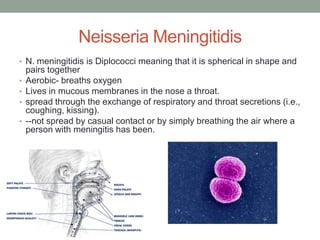
• N. meningitidis is Diplococci meaning that it is spherical in shape and

•
•
•
•

pairs together
Aerobic- breaths oxygen
Lives in mucous membranes in the nose a throat.
spread through the exchange of respiratory and throat secretions (i.e.,
coughing, kissing).
--not spread by casual contact or by simply breathing the air where a
person with meningitis has been.
Epidemiology – U.S.
• Carried by 5%-10% of population
• 3000 people in the United States become infected with the bacteria, and as many

as 1 in 10 of those people die.
• Common among college freshman and Military recruits
• Both have several common characteristics (e.g., age, diverse geographic backgrounds, crowded

living conditions).

•
•
•
•

97% of cases sporadic (background endemic disease), 3% outbreaks
Seasonal – peak in December/January
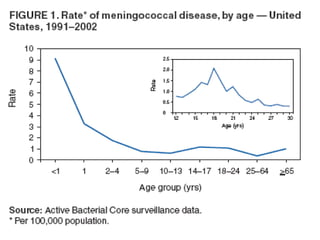
Highest rate of disease among infants <1 yr of age (9.2/100,000 from 1992-2001)
Louisiana has some of highest
Meningococcal Disease Worldwide
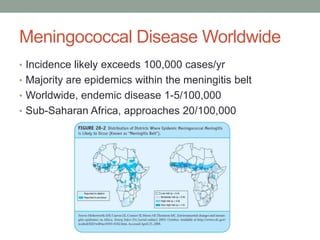
• Incidence likely exceeds 100,000 cases/yr
• Majority are epidemics within the meningitis belt
• Worldwide, endemic disease 1-5/100,000
• Sub-Saharan Africa, approaches 20/100,000
Serotypes of MD
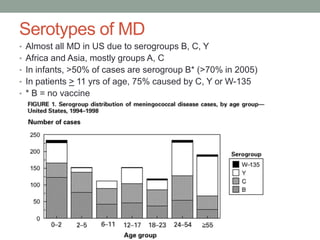
• Almost all MD in US due to serogroups B, C, Y
• Africa and Asia, mostly groups A, C
• In infants, >50% of cases are serogroup B* (>70% in 2005)

• In patients > 11 yrs of age, 75% caused by C, Y or W-135
• * B = no vaccine
Risk Factors
• Military recruits

• College students, especially freshmen in dorms
• Travel to endemic area, sub-Saharan Africa,

Saudi Arabia during the Hajj
• Terminal complement component deficiency
• Recent URI
• Active/passive smoking
• Microbiology techs
MD and the Military
• WWI: 150 cases/100,000 troops per year w/

39% mortality
• greatest # of cases occurred during winter months and was

assoc. w/ over-crowding of military barracks.
• disease rates remained high despite disease control efforts:
using prophylactic nasal sprays, spacing between beds,
sequestering of troops,.

• Pre 1971, MD rates elevated among U.S.

military recruits.
• Outbreaks frequently followed large-scale
mobilizations
• Recruits in initial training camps at substantially
> risk for disease than regular troops
• 1964--1970, rate of hospitalizations resulting
from MD among all active duty service
members : 25.2 per 100,000 person- years
• This led to development of MD vaccines

• Field trials of group C polysaccharide vaccine

among U.S. Army recruits demonstrated an
89.5% reduction in rate of serogroup C versus
nonvaccinated recruits
MD and the Military
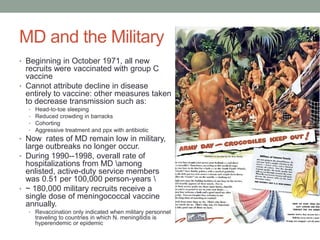
• Beginning in October 1971, all new

recruits were vaccinated with group C
vaccine
• Cannot attribute decline in disease
entirely to vaccine: other measures taken
to decrease transmission such as:
•
•
•
•

Head-to-toe sleeping
Reduced crowding in barracks
Cohorting
Aggressive treatment and ppx with antibiotic

• Now rates of MD remain low in military,

large outbreaks no longer occur.
• During 1990--1998, overall rate of
hospitalizations from MD among
enlisted, active-duty service members
was 0.51 per 100,000 person-years 
• ~ 180,000 military recruits receive a
single dose of meningococcal vaccine
annually.
• Revaccination only indicated when military personnel

traveling to countries in which N. meningitidis is
hyperendemic or epidemic
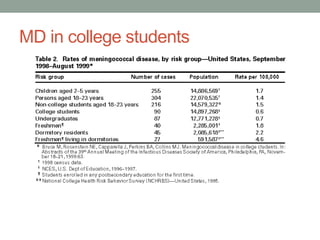
MD in college students
14

12/8/2013

Meningitis Symptoms can be the same for
Viral and Bacterial
•
•
•
•
•
•
•
•

Headache
Fever
Vomiting
Photophobia
Lethargy
Neck stiffness
Rash (more than 50% of cases)
Seizures (20% of patients at presentation
and an additional 10% of patients within 72
hours)
• Early nonspecific symptoms (especially in
infants):

S/S of MD meningitis can appear
quickly or over several days. Typically
they develop within 3-7 days after
exposure.
s/s vary may include :
• Nonspecific prodrome of cough,
headache, and sore throat
• After a few days of upper
respiratory symptoms, rising
temperature, often after a chill
• Malaise, weakness,, headache,
nausea, vomiting, and arthralgias
(joint pain)
• Neck pain (touch chin to chest)
• Skin rash (characteristic
manifestation of meningococcemia),
often rapidly progressive

Glass test: ordinary glass placed on rashaffected skin of a patient and rolled for a
while. If the bright red spots do not
undergo a color change then patient is
possibly affected with meningitis
Complications of MD
• Bloodstream infection (Septicemia or

bacteremia)
• Purpura fulminans severe complication of
meningococcal septicaemia.
• Appears in 15-25% of people with MD

• presents as a petechial rash spreading

rapidly in extent and depth, evolving into fullthickness skin necrosis.
• Can be fatal.
• In fatal cases, deaths can occur in as little as a

few hours.
• In non-fatal cases, permanent disabilities can
include hearing loss and brain damage

• Needs early aggressive tx w/ antibiotics
• Even with tx may have disfigurement,

amputation, death
• About 11 % of people of any age who are infected

will die, even with appropriate tx .
• Among adolescents & young adults, case fatality
rate is 10 - 14%.
• Up to 19 % of survivors have permanent damage,
such as hearing loss, brain damage, kidney,
amputations

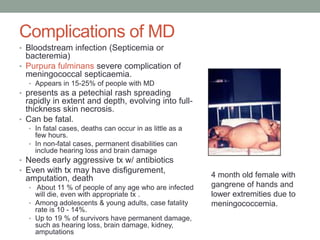
4 month old female with
gangrene of hands and
lower extremities due to
meningococcemia.
Meningitis survivor
• http://www.youtube.com/watch?v=6QVkB_r4Zx4&feature=

youtu.be
• Tulane U requires meningococcal (Menactra) vaccine
given within past 5 years is required for dorm residentsprior to move-in day
DX Meningococcal meningitis
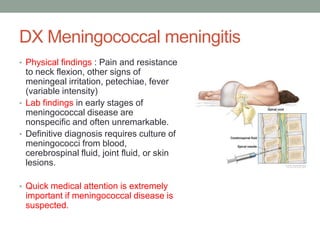
• Physical findings : Pain and resistance

to neck flexion, other signs of
meningeal irritation, petechiae, fever
(variable intensity)
• Lab findings in early stages of
meningococcal disease are
nonspecific and often unremarkable.
• Definitive diagnosis requires culture of
meningococci from blood,
cerebrospinal fluid, joint fluid, or skin
lesions.
• Quick medical attention is extremely

important if meningococcal disease is
suspected.
TX
Antibiotics
• Penicillin G
• Third-generation cephalosporins
• Severe cases may be hospitalized
Meningococcal Vaccines
• 2 vaccines available in US .

• Menomune/MPSV4 (Meningococcal polysaccharide vaccine)
• 85-100% effective at preventing subtypes A,C,Y, and W-135.
• does not protect against subgroup B. The protection offered is
short term. – need booster
• Safe for ages > 2
• Serogroups A, C, Y, W135
• Menactra/MCV4 (meningococcal conjugated vaccine)*
• Ages 11-55
• Conjugated with diphtheria toxin variant
• Serogroups A, C, Y, W135
It is been difficult to develop an effective vaccine for serogroup B.
Meningococcal B vaccines exist but more tests are needed to
determine the safety and effectiveness.
* req. for Tulane dorm residents
Who should get MCV4?
CDC’s Advisory Committee on Immunization Practices
(ACIP) recommendations
• Routine vaccination to adolescents aged 11 - 18 years
• single dose of vaccine @ age 11 or 12 years, w/ booster dose @

age 16 for persons who receive 1st dose before age 16 years

• Persons aged ≥2 months at increased risk for

meningococcal disease should also be vaccinated, :
• Persons with certain medical conditions such as anatomical or

functional asplenia (absence of normal spleen function )
• Special populations such as unvaccinated or incompletely
vaccinated first-year college students living in residence halls,
military recruits, or microbiologists with occupational exposure
• Persons aged ≥9 months who travel to or reside in countries in
which meningococcal disease is hyperendemic or epidemic,
particularly if contact with the local population will be prolonged.
MD vaccine and college students
• September 30, 1997, American College Health

Association (ACHA), which represents about half of
colleges that have student health services, released a
statement recommending that "college health services
[take] a more proactive role in alerting students and their
parents about the dangers of meningococcal disease,"
that "college students consider vaccination against
potentially fatal MD ," and that "colleges and universities
ensure all students have access to a vaccination program
for those who want to be vaccinated"
• Varies by state
12/8/2013

22

Prevention
• Keeping up to date with recommended

immunizations is the best defense.
• Good hygiene.
• Rifampin, ceftriaxone, and ciprofloxacin are
appropriate drugs for chemoprophylaxis in adults.
The drug of choice for most children is rifampin.
• Chemoprophylaxis may be administered in
conjunction with vaccinations.

Meningococcal disease

  • 1.
  • 2.
    12/8/2013 2 Clinical description: Meningitis •Meningitis is a disease caused by inflammation of the protective membranes covering the brain and spinal cord known as the meninges. • The inflammation is usually caused by an infection of the fluid surrounding the brain and spinal cord. Meningitis is also referred to as spinal meningitis. • Can be Viral Or Bacterial • Meningococcus Meningitis (Neisseria meningitidis ) • Leading cause of bacti meningitis in children in US and other parts of works
  • 3.
    3 12/8/2013 Causes of Meningitis •Bacterial • Viral - Meningococcus - Neisseria meningitidis - Arboviral (mosquitoborne) diseases - Influenza - LaCrosse Encephalitis virus - West Nile Virus - Also enteroviral Haemophilus influenzae - Listeria - Mumps - Pneumococcus - Group A Streptococcus - Group B Streptococcus
  • 4.
    HISTORY of Meningococcalmeningitis • 1805 1st described in Sweden by Vieusseaux ; called episodic cerebrospinal fever. • Throughout 19th century, episodic fever cases , mostly among children and military recruits. • 1887, bacterium isolated from cerebrospinal fluid (CSF) in 6 fatal cases by Weichselbaum • originally named Neisseria intracellularis. • 1893, lumbar puncture technique for collecting CSF, making DX of meningococcal disease possible • early 1900s 1st tx for meningococcal disease German & U.S. scientists developed anti-sera that could be injected intrathecally (directly into cerebrospinal space) • Resulted in mortality rate decreased to 25 %. • However serum sickness & 2ndry meningitis inhibited utility • Around WW 1 Preliminary vaccine trials began, led to major vaccine trails in 20th century, now have a vaccine for 2 types
  • 5.
    Neisseria Meningitidis • N.meningitidis is Diplococci meaning that it is spherical in shape and • • • • pairs together Aerobic- breaths oxygen Lives in mucous membranes in the nose a throat. spread through the exchange of respiratory and throat secretions (i.e., coughing, kissing). --not spread by casual contact or by simply breathing the air where a person with meningitis has been.
  • 6.
    Epidemiology – U.S. •Carried by 5%-10% of population • 3000 people in the United States become infected with the bacteria, and as many as 1 in 10 of those people die. • Common among college freshman and Military recruits • Both have several common characteristics (e.g., age, diverse geographic backgrounds, crowded living conditions). • • • • 97% of cases sporadic (background endemic disease), 3% outbreaks Seasonal – peak in December/January Highest rate of disease among infants <1 yr of age (9.2/100,000 from 1992-2001) Louisiana has some of highest
  • 8.
    Meningococcal Disease Worldwide •Incidence likely exceeds 100,000 cases/yr • Majority are epidemics within the meningitis belt • Worldwide, endemic disease 1-5/100,000 • Sub-Saharan Africa, approaches 20/100,000
  • 9.
    Serotypes of MD •Almost all MD in US due to serogroups B, C, Y • Africa and Asia, mostly groups A, C • In infants, >50% of cases are serogroup B* (>70% in 2005) • In patients > 11 yrs of age, 75% caused by C, Y or W-135 • * B = no vaccine
  • 10.
    Risk Factors • Militaryrecruits • College students, especially freshmen in dorms • Travel to endemic area, sub-Saharan Africa, Saudi Arabia during the Hajj • Terminal complement component deficiency • Recent URI • Active/passive smoking • Microbiology techs
  • 11.
    MD and theMilitary • WWI: 150 cases/100,000 troops per year w/ 39% mortality • greatest # of cases occurred during winter months and was assoc. w/ over-crowding of military barracks. • disease rates remained high despite disease control efforts: using prophylactic nasal sprays, spacing between beds, sequestering of troops,. • Pre 1971, MD rates elevated among U.S. military recruits. • Outbreaks frequently followed large-scale mobilizations • Recruits in initial training camps at substantially > risk for disease than regular troops • 1964--1970, rate of hospitalizations resulting from MD among all active duty service members : 25.2 per 100,000 person- years • This led to development of MD vaccines • Field trials of group C polysaccharide vaccine among U.S. Army recruits demonstrated an 89.5% reduction in rate of serogroup C versus nonvaccinated recruits
  • 12.
    MD and theMilitary • Beginning in October 1971, all new recruits were vaccinated with group C vaccine • Cannot attribute decline in disease entirely to vaccine: other measures taken to decrease transmission such as: • • • • Head-to-toe sleeping Reduced crowding in barracks Cohorting Aggressive treatment and ppx with antibiotic • Now rates of MD remain low in military, large outbreaks no longer occur. • During 1990--1998, overall rate of hospitalizations from MD among enlisted, active-duty service members was 0.51 per 100,000 person-years • ~ 180,000 military recruits receive a single dose of meningococcal vaccine annually. • Revaccination only indicated when military personnel traveling to countries in which N. meningitidis is hyperendemic or epidemic
  • 13.
    MD in collegestudents
  • 14.
    14 12/8/2013 Meningitis Symptoms canbe the same for Viral and Bacterial • • • • • • • • Headache Fever Vomiting Photophobia Lethargy Neck stiffness Rash (more than 50% of cases) Seizures (20% of patients at presentation and an additional 10% of patients within 72 hours) • Early nonspecific symptoms (especially in infants): S/S of MD meningitis can appear quickly or over several days. Typically they develop within 3-7 days after exposure. s/s vary may include : • Nonspecific prodrome of cough, headache, and sore throat • After a few days of upper respiratory symptoms, rising temperature, often after a chill • Malaise, weakness,, headache, nausea, vomiting, and arthralgias (joint pain) • Neck pain (touch chin to chest) • Skin rash (characteristic manifestation of meningococcemia), often rapidly progressive Glass test: ordinary glass placed on rashaffected skin of a patient and rolled for a while. If the bright red spots do not undergo a color change then patient is possibly affected with meningitis
  • 15.
    Complications of MD •Bloodstream infection (Septicemia or bacteremia) • Purpura fulminans severe complication of meningococcal septicaemia. • Appears in 15-25% of people with MD • presents as a petechial rash spreading rapidly in extent and depth, evolving into fullthickness skin necrosis. • Can be fatal. • In fatal cases, deaths can occur in as little as a few hours. • In non-fatal cases, permanent disabilities can include hearing loss and brain damage • Needs early aggressive tx w/ antibiotics • Even with tx may have disfigurement, amputation, death • About 11 % of people of any age who are infected will die, even with appropriate tx . • Among adolescents & young adults, case fatality rate is 10 - 14%. • Up to 19 % of survivors have permanent damage, such as hearing loss, brain damage, kidney, amputations 4 month old female with gangrene of hands and lower extremities due to meningococcemia.
  • 16.
    Meningitis survivor • http://www.youtube.com/watch?v=6QVkB_r4Zx4&feature= youtu.be •Tulane U requires meningococcal (Menactra) vaccine given within past 5 years is required for dorm residentsprior to move-in day
  • 17.
    DX Meningococcal meningitis •Physical findings : Pain and resistance to neck flexion, other signs of meningeal irritation, petechiae, fever (variable intensity) • Lab findings in early stages of meningococcal disease are nonspecific and often unremarkable. • Definitive diagnosis requires culture of meningococci from blood, cerebrospinal fluid, joint fluid, or skin lesions. • Quick medical attention is extremely important if meningococcal disease is suspected.
  • 18.
    TX Antibiotics • Penicillin G •Third-generation cephalosporins • Severe cases may be hospitalized
  • 19.
    Meningococcal Vaccines • 2vaccines available in US . • Menomune/MPSV4 (Meningococcal polysaccharide vaccine) • 85-100% effective at preventing subtypes A,C,Y, and W-135. • does not protect against subgroup B. The protection offered is short term. – need booster • Safe for ages > 2 • Serogroups A, C, Y, W135 • Menactra/MCV4 (meningococcal conjugated vaccine)* • Ages 11-55 • Conjugated with diphtheria toxin variant • Serogroups A, C, Y, W135 It is been difficult to develop an effective vaccine for serogroup B. Meningococcal B vaccines exist but more tests are needed to determine the safety and effectiveness. * req. for Tulane dorm residents
  • 20.
    Who should getMCV4? CDC’s Advisory Committee on Immunization Practices (ACIP) recommendations • Routine vaccination to adolescents aged 11 - 18 years • single dose of vaccine @ age 11 or 12 years, w/ booster dose @ age 16 for persons who receive 1st dose before age 16 years • Persons aged ≥2 months at increased risk for meningococcal disease should also be vaccinated, : • Persons with certain medical conditions such as anatomical or functional asplenia (absence of normal spleen function ) • Special populations such as unvaccinated or incompletely vaccinated first-year college students living in residence halls, military recruits, or microbiologists with occupational exposure • Persons aged ≥9 months who travel to or reside in countries in which meningococcal disease is hyperendemic or epidemic, particularly if contact with the local population will be prolonged.
  • 21.
    MD vaccine andcollege students • September 30, 1997, American College Health Association (ACHA), which represents about half of colleges that have student health services, released a statement recommending that "college health services [take] a more proactive role in alerting students and their parents about the dangers of meningococcal disease," that "college students consider vaccination against potentially fatal MD ," and that "colleges and universities ensure all students have access to a vaccination program for those who want to be vaccinated" • Varies by state
  • 22.
    12/8/2013 22 Prevention • Keeping upto date with recommended immunizations is the best defense. • Good hygiene. • Rifampin, ceftriaxone, and ciprofloxacin are appropriate drugs for chemoprophylaxis in adults. The drug of choice for most children is rifampin. • Chemoprophylaxis may be administered in conjunction with vaccinations.