Aim: Did Andrew Jackson
advance or inhibit the cause of
democracy?
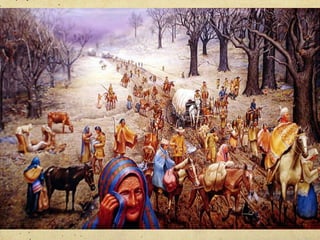
Do Now: Examine your image and
write down a title for your image that
is related to what you see.
• Then, look at the number in the
back of your image and go to the
section of the room with your
number
1. Combine all of your images and come
up with a title for all of them
2. Have you been forced to leave your
home permanently?
3. What items would you take with you if
you were only allowed to take what
you could carry?
Think-Square-Share
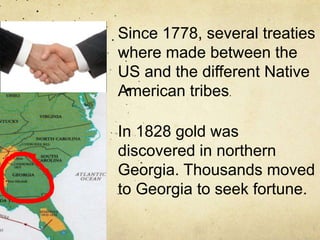
Since 1778, several treaties
where made between the
US and the different Native
American tribes.
In 1828 gold was
discovered in northern
Georgia. Thousands moved
to Georgia to seek fortune.
• By 1829 the state of Georgia passed an act to
remove the Cherokees from the state.
• The Cherokees tried to fight by taking their case to
the Supreme Court.
• Cherokee v. Georgia (1831): Native
Americans are “domestic nations” and
states cannot make treaties/laws affecting
other nations.
• Worcester v. Georgia (1832): the state of
Georgia cannot make laws regarding
Indian land.
The Supreme Court made its rulings… who is
in charge of making sure that the law is
followed???
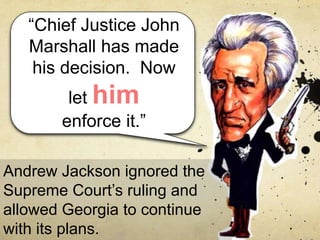
“Chief Justice John
Marshall has made
his decision. Now
let him
enforce it.”
Andrew Jackson ignored the
Supreme Court’s ruling and
allowed Georgia to continue
with its plans.
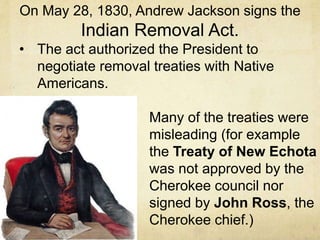
On May 28, 1830, Andrew Jackson signs the
Indian Removal Act.
• The act authorized the President to
negotiate removal treaties with Native
Americans.
• Many of the treaties were
misleading (for example
the Treaty of New Echota
was not approved by the
Cherokee council nor
signed by John Ross, the
Cherokee chief.)
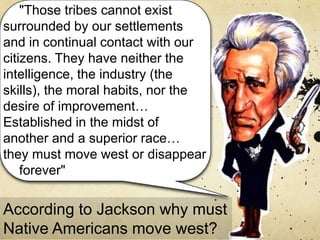
"Those tribes cannot exist
surrounded by our settlements
and in continual contact with our
citizens. They have neither the
intelligence, the industry (the
skills), the moral habits, nor the
desire of improvement…
Established in the midst of
another and a superior race…
they must move west or disappear
forever"
According to Jackson why must
Native Americans move west?
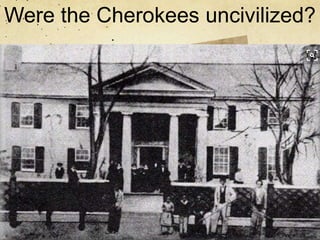
Were the Cherokees uncivilized?
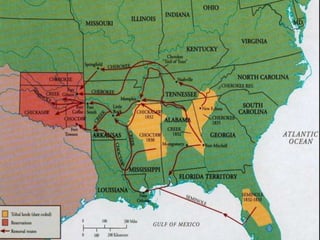
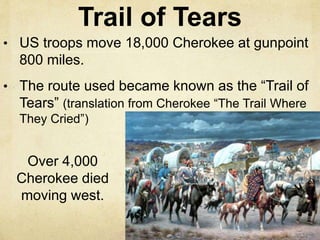
Trail of Tears
• US troops move 18,000 Cherokee at gunpoint
800 miles.
• The route used became known as the “Trail of
Tears” (translation from Cherokee “The Trail Where
They Cried”)
Over 4,000
Cherokee died
moving west.
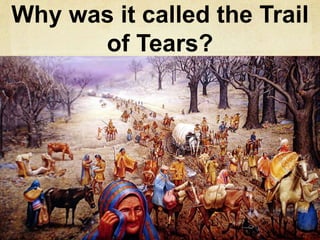
Why was it called the Trail
of Tears?
 In your groups, close read
the primary sources and
answer the questions.
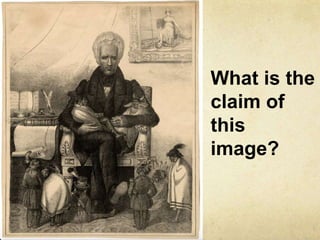
What is the
claim of
this
image?
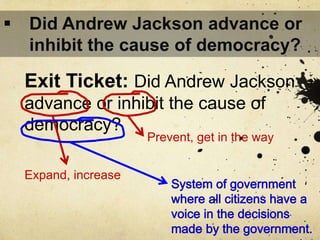
Exit Ticket: Did Andrew Jackson
advance or inhibit the cause of
democracy?
Prevent, get in the way
Expand, increase
 Did Andrew Jackson advance or
inhibit the cause of democracy?

Indian Removal

  • 1.
    Aim: Did AndrewJackson advance or inhibit the cause of democracy? Do Now: Examine your image and write down a title for your image that is related to what you see. • Then, look at the number in the back of your image and go to the section of the room with your number
  • 2.
    1. Combine allof your images and come up with a title for all of them 2. Have you been forced to leave your home permanently? 3. What items would you take with you if you were only allowed to take what you could carry? Think-Square-Share
  • 4.
    Since 1778, severaltreaties where made between the US and the different Native American tribes. In 1828 gold was discovered in northern Georgia. Thousands moved to Georgia to seek fortune.
  • 5.
    • By 1829the state of Georgia passed an act to remove the Cherokees from the state. • The Cherokees tried to fight by taking their case to the Supreme Court. • Cherokee v. Georgia (1831): Native Americans are “domestic nations” and states cannot make treaties/laws affecting other nations. • Worcester v. Georgia (1832): the state of Georgia cannot make laws regarding Indian land. The Supreme Court made its rulings… who is in charge of making sure that the law is followed???
  • 6.
    “Chief Justice John Marshallhas made his decision. Now let him enforce it.” Andrew Jackson ignored the Supreme Court’s ruling and allowed Georgia to continue with its plans.
  • 7.
    On May 28,1830, Andrew Jackson signs the Indian Removal Act. • The act authorized the President to negotiate removal treaties with Native Americans. • Many of the treaties were misleading (for example the Treaty of New Echota was not approved by the Cherokee council nor signed by John Ross, the Cherokee chief.)
  • 9.
    "Those tribes cannotexist surrounded by our settlements and in continual contact with our citizens. They have neither the intelligence, the industry (the skills), the moral habits, nor the desire of improvement… Established in the midst of another and a superior race… they must move west or disappear forever" According to Jackson why must Native Americans move west?
  • 10.
    Were the Cherokeesuncivilized?
  • 11.
    Trail of Tears •US troops move 18,000 Cherokee at gunpoint 800 miles. • The route used became known as the “Trail of Tears” (translation from Cherokee “The Trail Where They Cried”) Over 4,000 Cherokee died moving west.
  • 12.
    Why was itcalled the Trail of Tears?
  • 13.
     In yourgroups, close read the primary sources and answer the questions.
  • 14.
    What is the claimof this image?
  • 15.
    Exit Ticket: DidAndrew Jackson advance or inhibit the cause of democracy? Prevent, get in the way Expand, increase  Did Andrew Jackson advance or inhibit the cause of democracy?