Vector-Borne
Disease Research
at Tulane
SPHU-1020
Dawn Wesson, PhD
Department of Tropical Medicine
Overview
• Introduction
• General Concepts: vectors, types of vector-borne
transmission, vector incrimination, zoonoses,
surveillance
• Specific Pathogen-Arthropod-Vertebrate
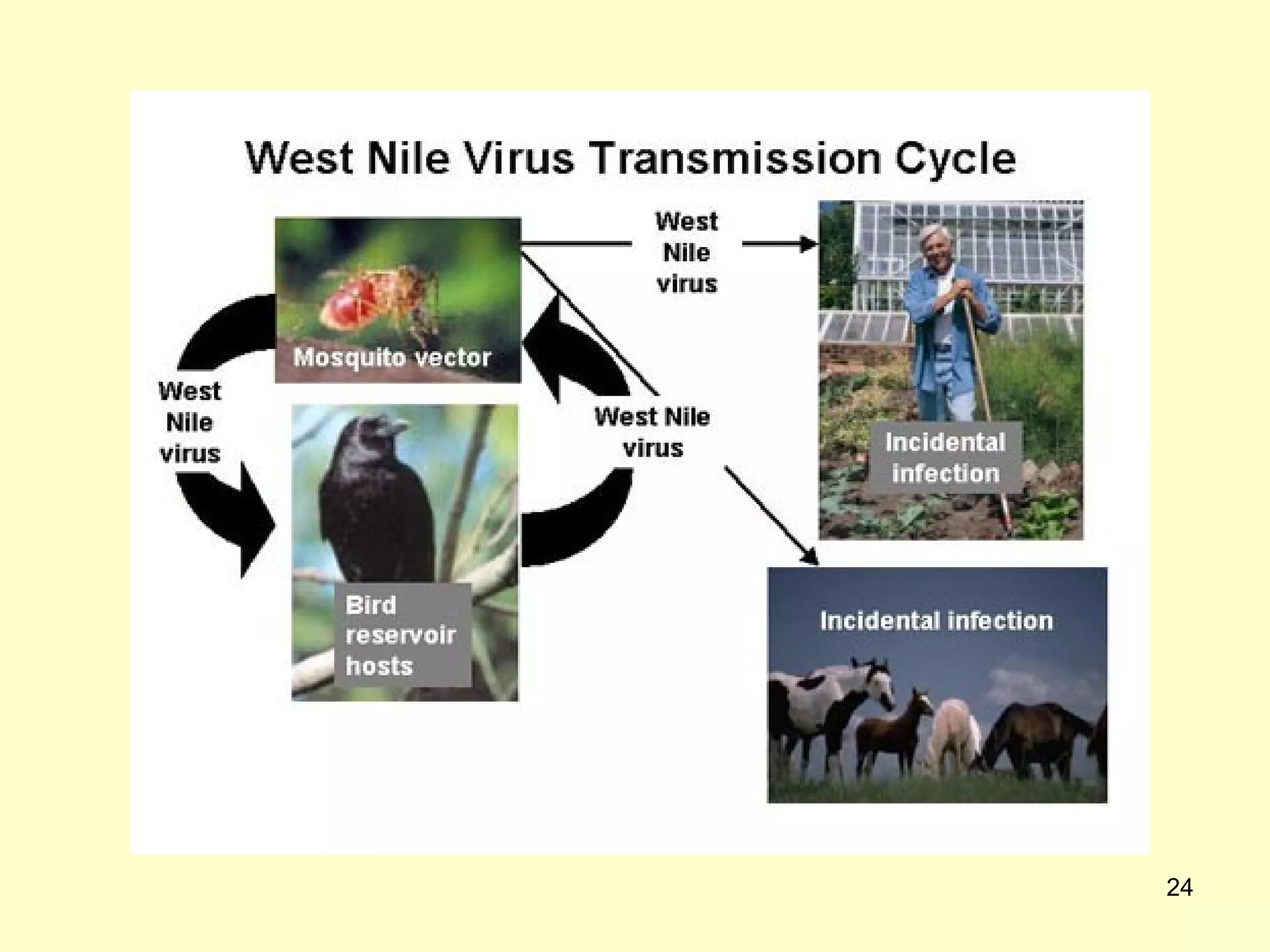
Transmission Cycles: dengue virus, West Nile
virus, American trypanosomiasis (Chagas disease)
Introduction
• Training for VBD research
• VBD at Tulane (dengue, WNV, malaria,
chikungunya, Chagas dz, Lyme dz)
• Local vs. International research
• Funding sources (NIH, NSF, BMGF,
BORSF, etc.)
How do we define a vector?
An arthropod* responsible
for transmission of parasites
among vertebrate hosts.
* Arthropods include insects (mosquitoes, tsetse
flies, sandflies, blackflies, lice, fleas, kissing bugs)
and arachnids (mites, ticks, spiders and scorpions).
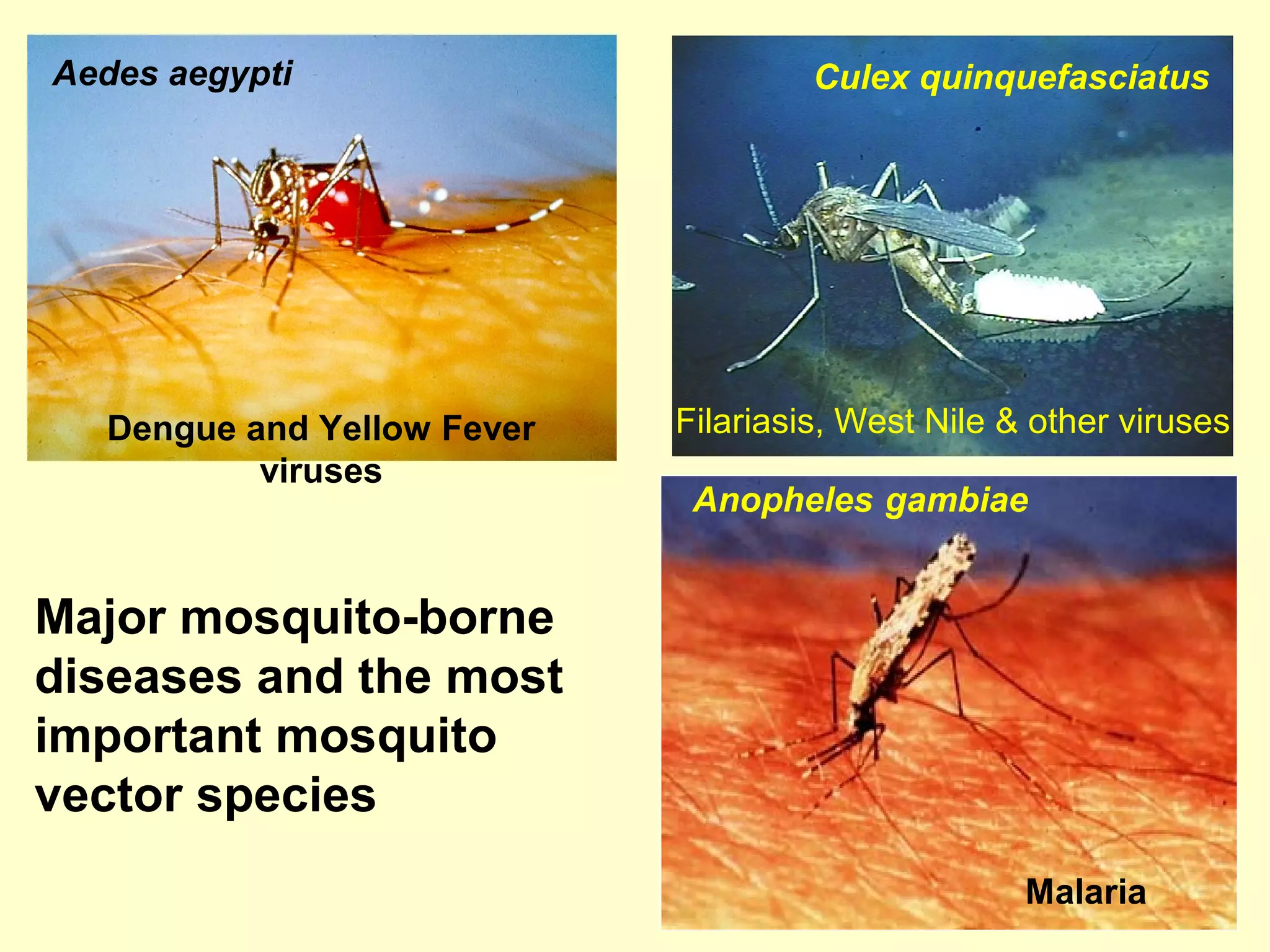
Aedes aegypti

Dengue and Yellow Fever
viruses

Culex quinquefasciatus

Filariasis, West Nile & other viruses
Anopheles gambiae

Major mosquito-borne
diseases and the most
important mosquito
vector species
Malaria
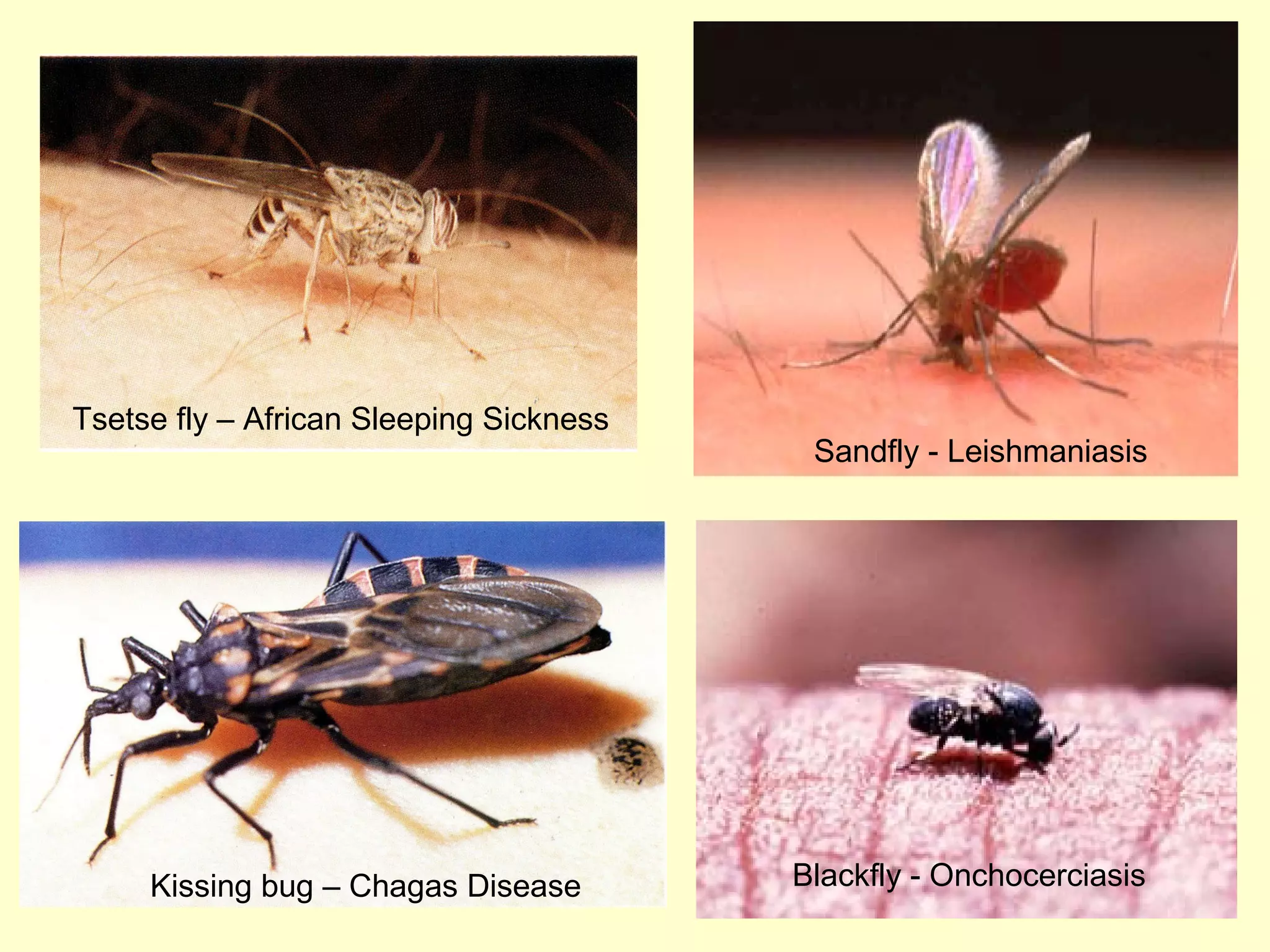
Tsetse fly – African Sleeping Sickness

Kissing bug – Chagas Disease

Sandfly - Leishmaniasis

Blackfly - Onchocerciasis
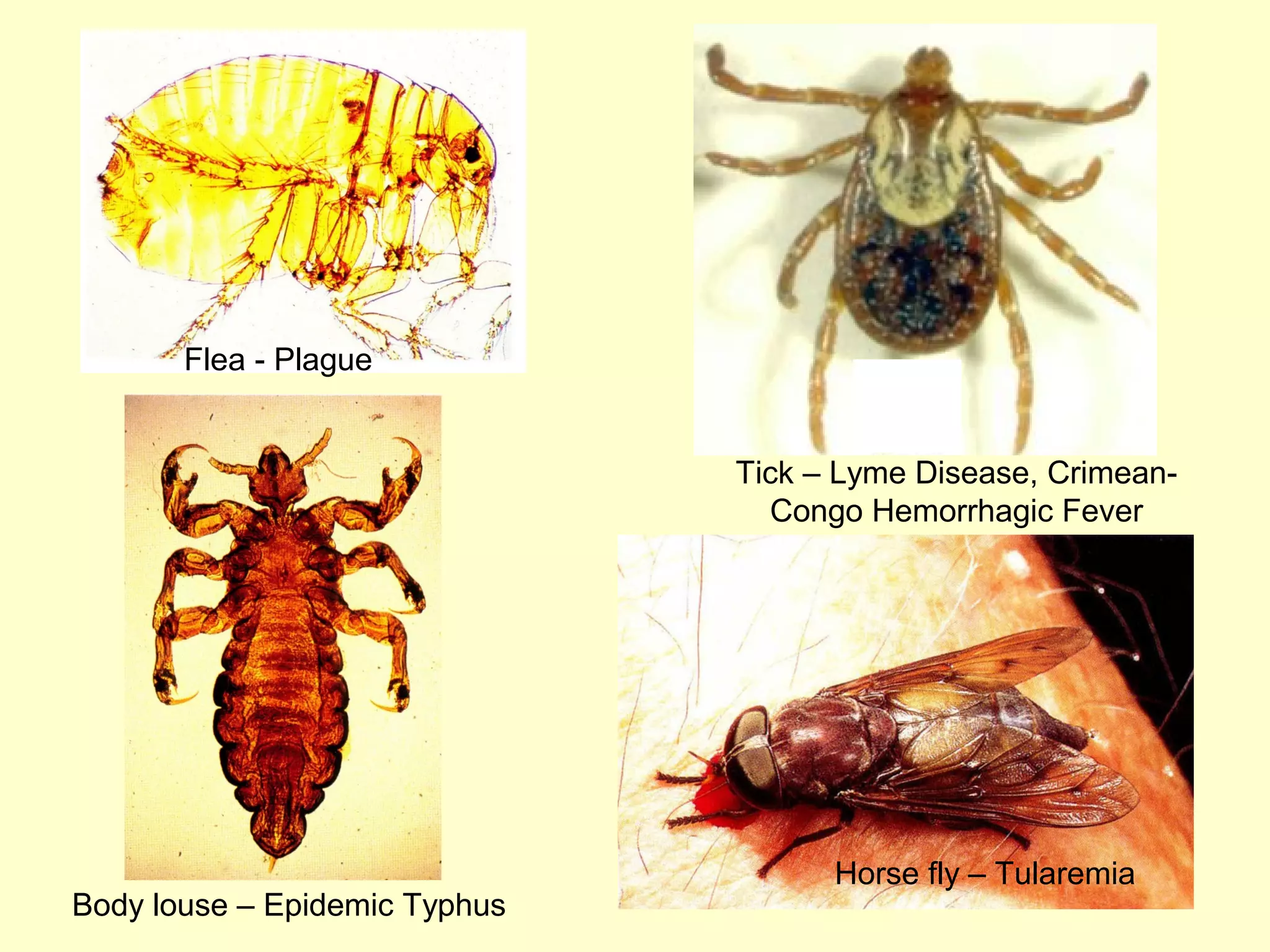
Flea - Plague
Tick – Lyme Disease, CrimeanCongo Hemorrhagic Fever

Body louse – Epidemic Typhus

Horse fly – Tularemia
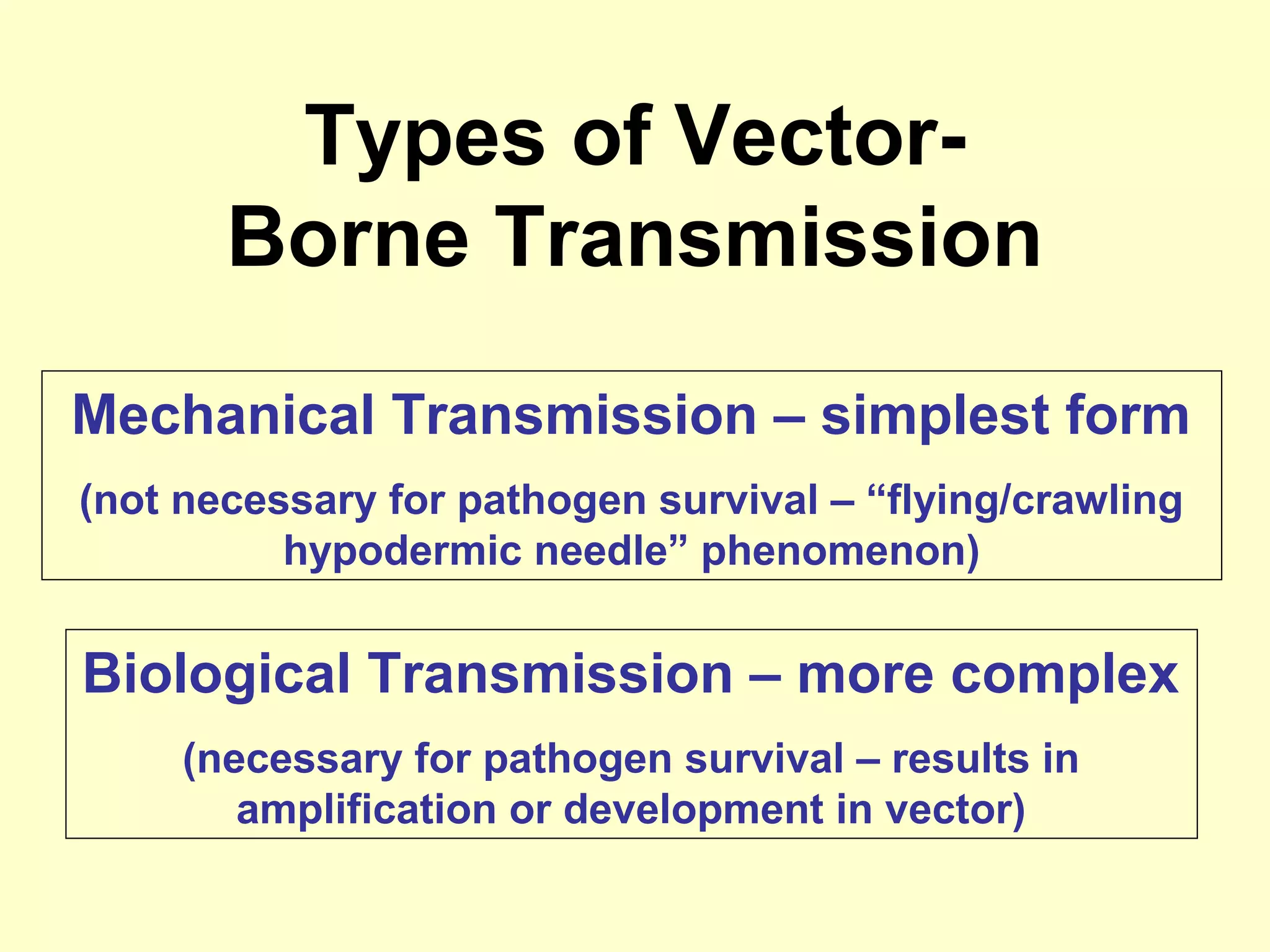
Types of VectorBorne Transmission
Mechanical Transmission – simplest form
(not necessary for pathogen survival – “flying/crawling
hypodermic needle” phenomenon)

Biological Transmission – more complex
(necessary for pathogen survival – results in
amplification or development in vector)
General Types of
Biological Transmission
Vertical
Horizontal
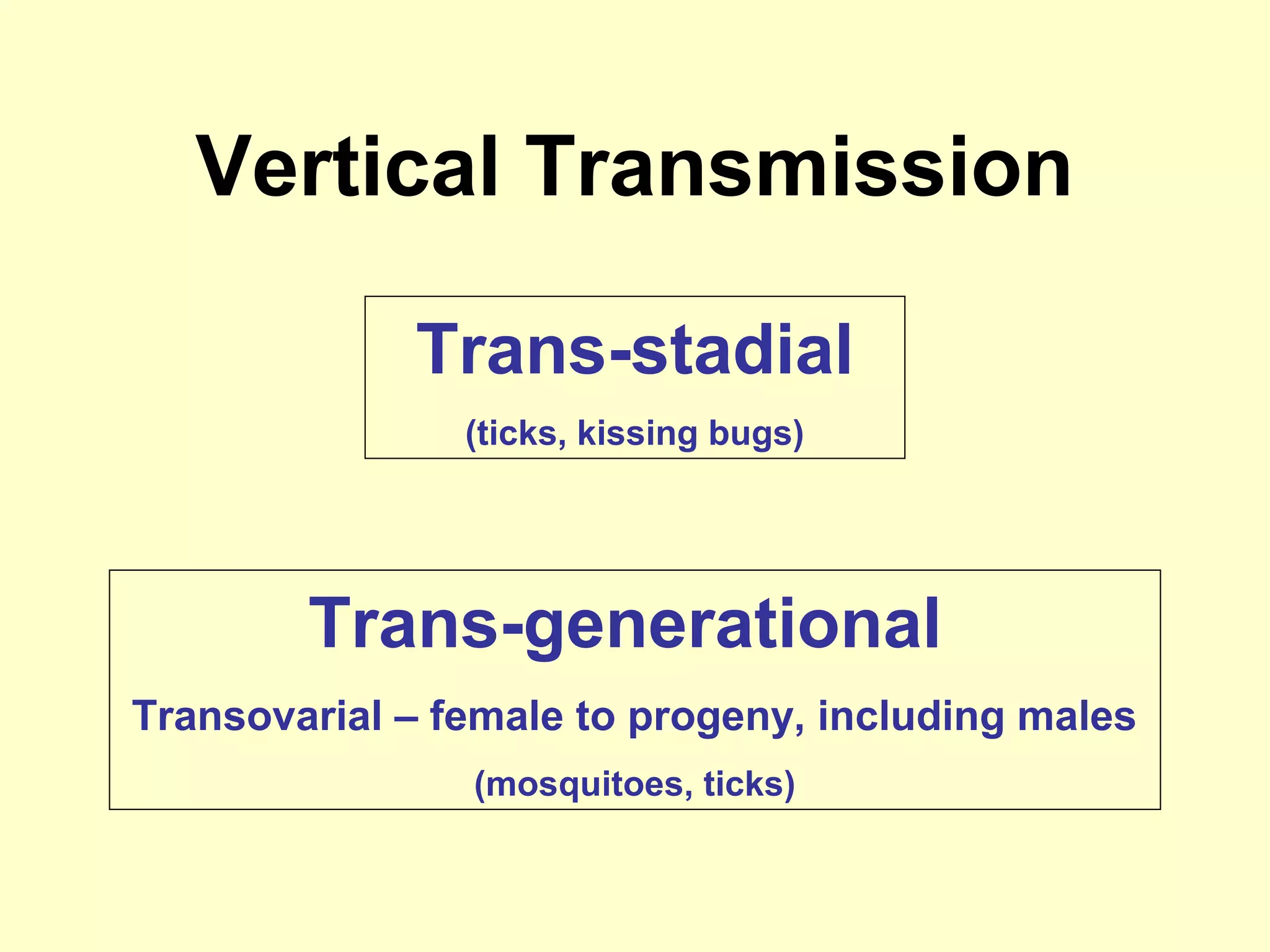
Vertical Transmission
Trans-stadial
(ticks, kissing bugs)

Trans-generational
Transovarial – female to progeny, including males
(mosquitoes, ticks)
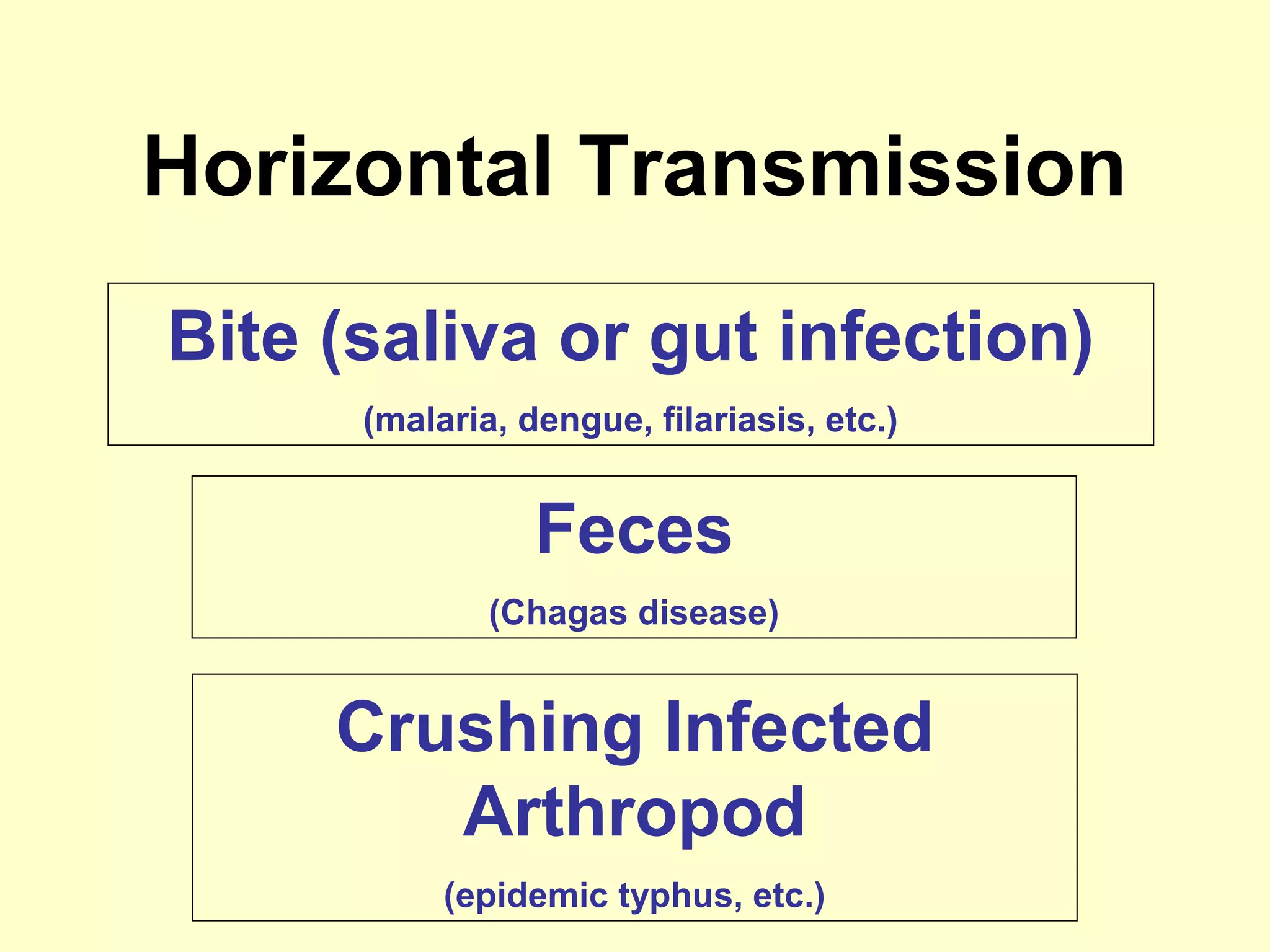
Horizontal Transmission
Bite (saliva or gut infection)
(malaria, dengue, filariasis, etc.)

Feces
(Chagas disease)

Crushing Infected
Arthropod
(epidemic typhus, etc.)
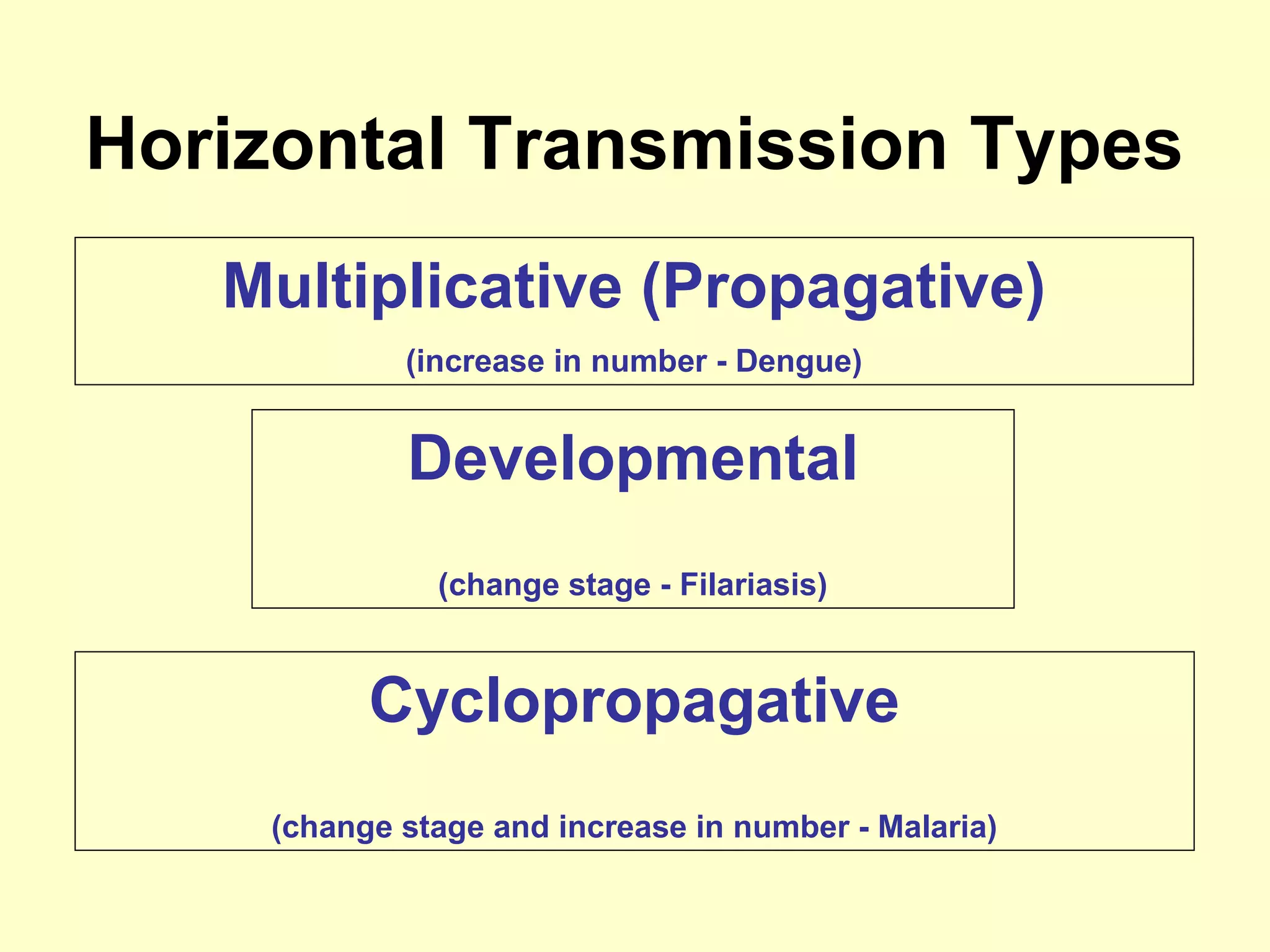
Horizontal Transmission Types
Multiplicative (Propagative)
(increase in number - Dengue)

Developmental
(change stage - Filariasis)

Cyclopropagative
(change stage and increase in number - Malaria)
Pathogen Infection in Arthropods
Extrinsic Incubation Period - EIP
Time interval between vector infection and
potential for pathogen transmission to
vertebrate host (determined by controlled
experimental studies)
If vector dies (is killed) before EIP is
completed, transmission will not occur.
Ecological Parameters Affecting
Vector Populations:
Availability of food
Space

(What do they eat, and when?)

(Where do they occur, and when?)

Water (Is their appearance seasonal – wet/dry?)
Temperature (Is their appearance seasonal – warm/cold?)
Predation ( Can we enhance or introduce predators to control them?)
Disease ( Can we identify pathogens to control them?)
Vector Incrimination
• Demonstrate an association in time and space
between arthropod and disease
• Demonstrate direct contact between the
arthropod and humans
• Demonstrate natural occurrence of the
infectious agent in the insect
• Demonstrate “transmission” of the agent by the
insect (laboratory-based vector competence)
How are these pathogen transmission
parameters determined?
Laboratory Experimentation
(vector competence, EIP)
Field Surveillance
(temporal and spatial association between
pathogen, vector and humans; other factors
affecting disease prevention – insecticide or
antibiotic resistance)
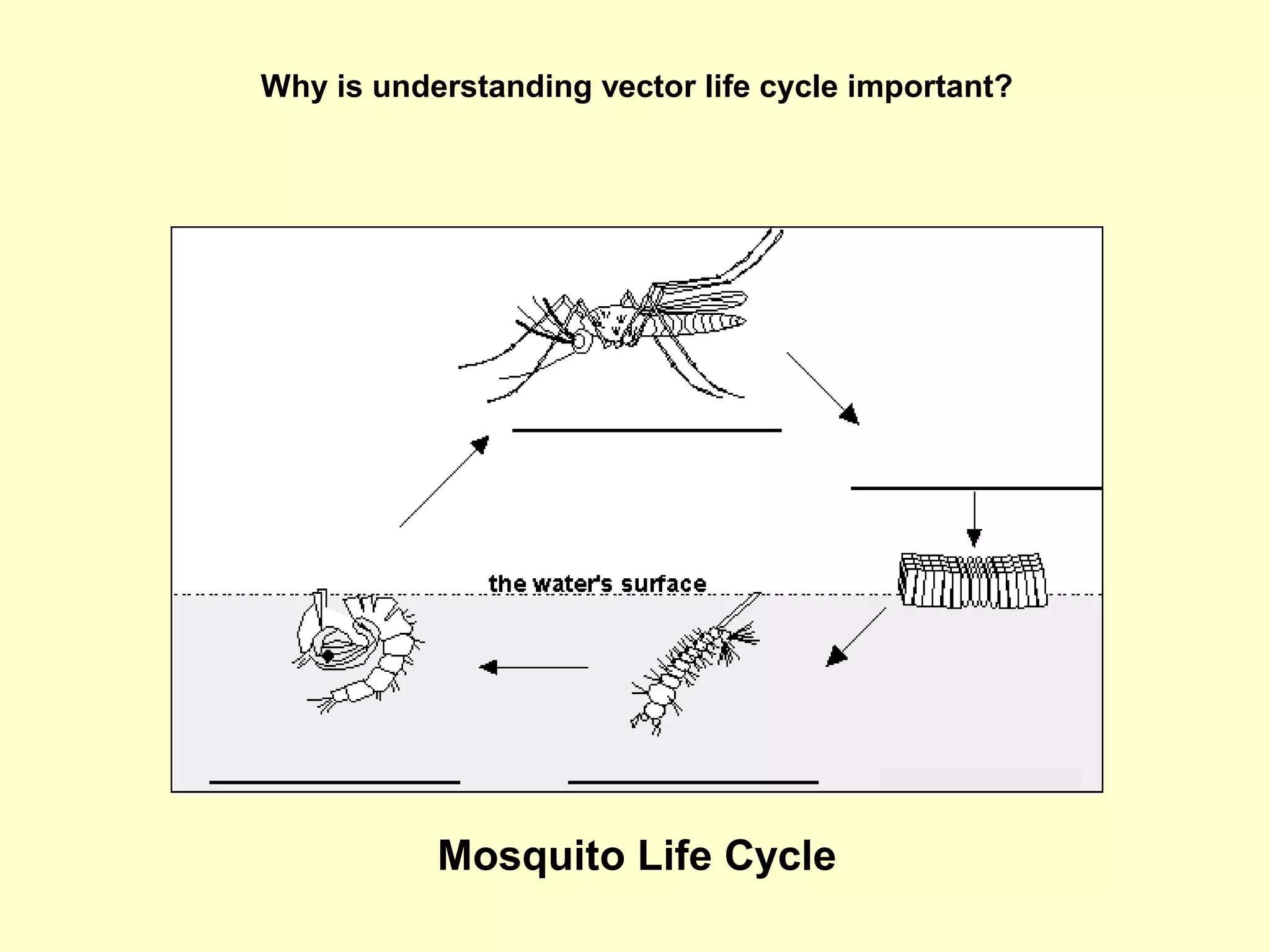
Why is understanding vector life cycle important?

Mosquito Life Cycle
Specific Pathogen-ArthropodVertebrate Transmission Cycles

Highlighted Transmission Cycles
Mosquito-borne pathogens - arboviruses
(dengue and West Nile virus)
Bug-transmitted pathogens – Chagas disease
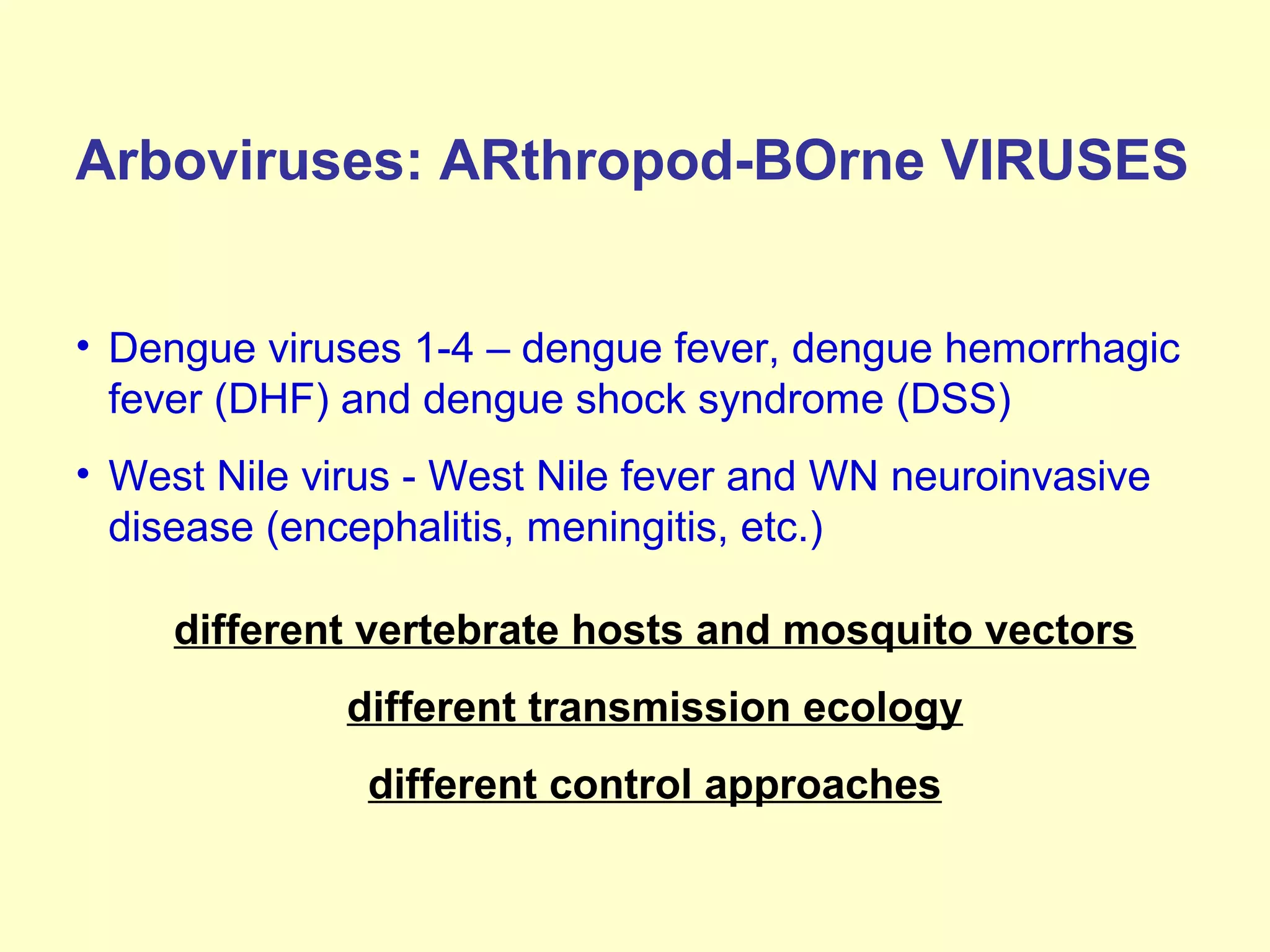
Arboviruses: ARthropod-BOrne VIRUSES
• Dengue viruses 1-4 – dengue fever, dengue hemorrhagic
fever (DHF) and dengue shock syndrome (DSS)
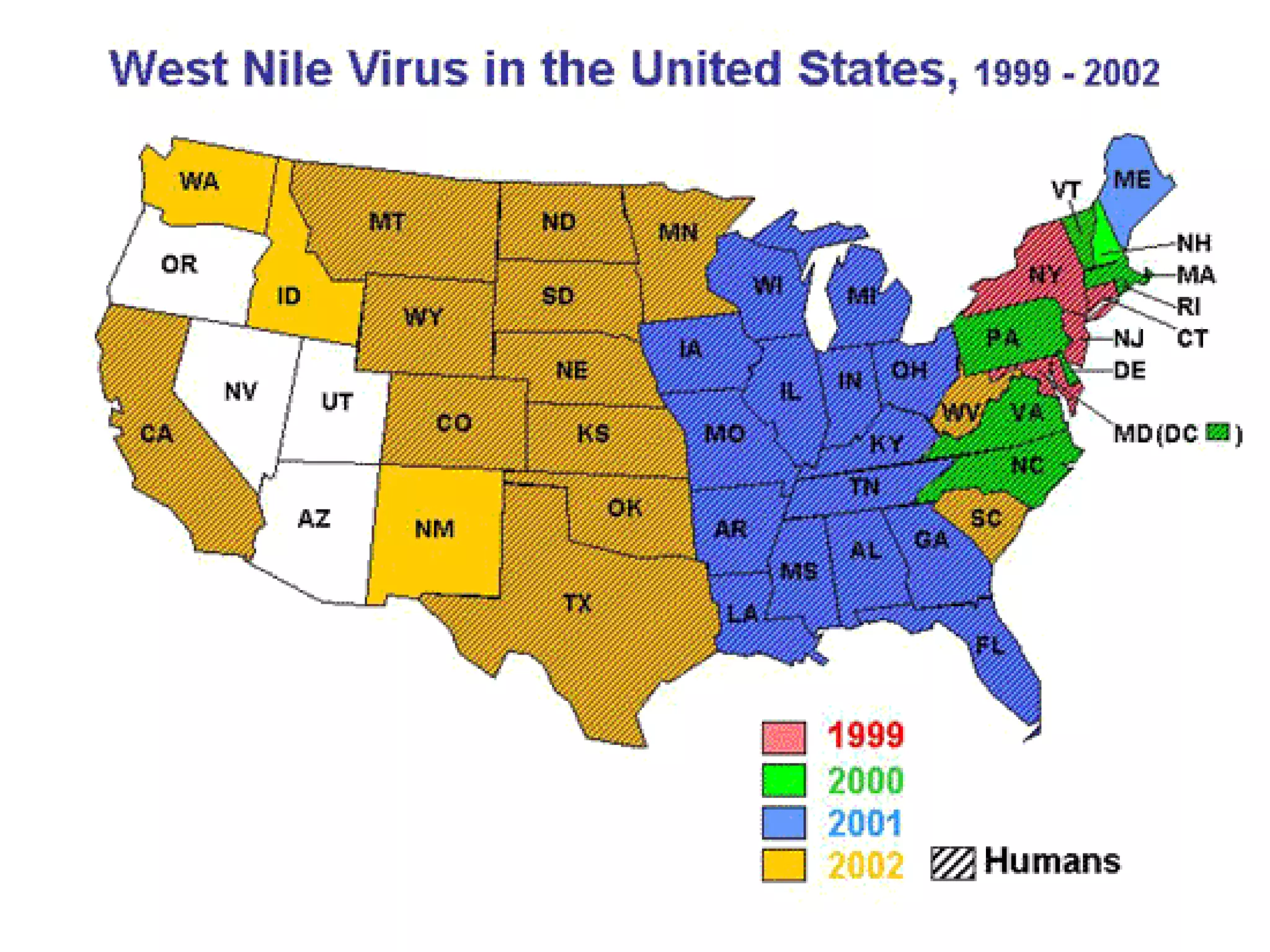
• West Nile virus - West Nile fever and WN neuroinvasive
disease (encephalitis, meningitis, etc.)
different vertebrate hosts and mosquito vectors
different transmission ecology
different control approaches
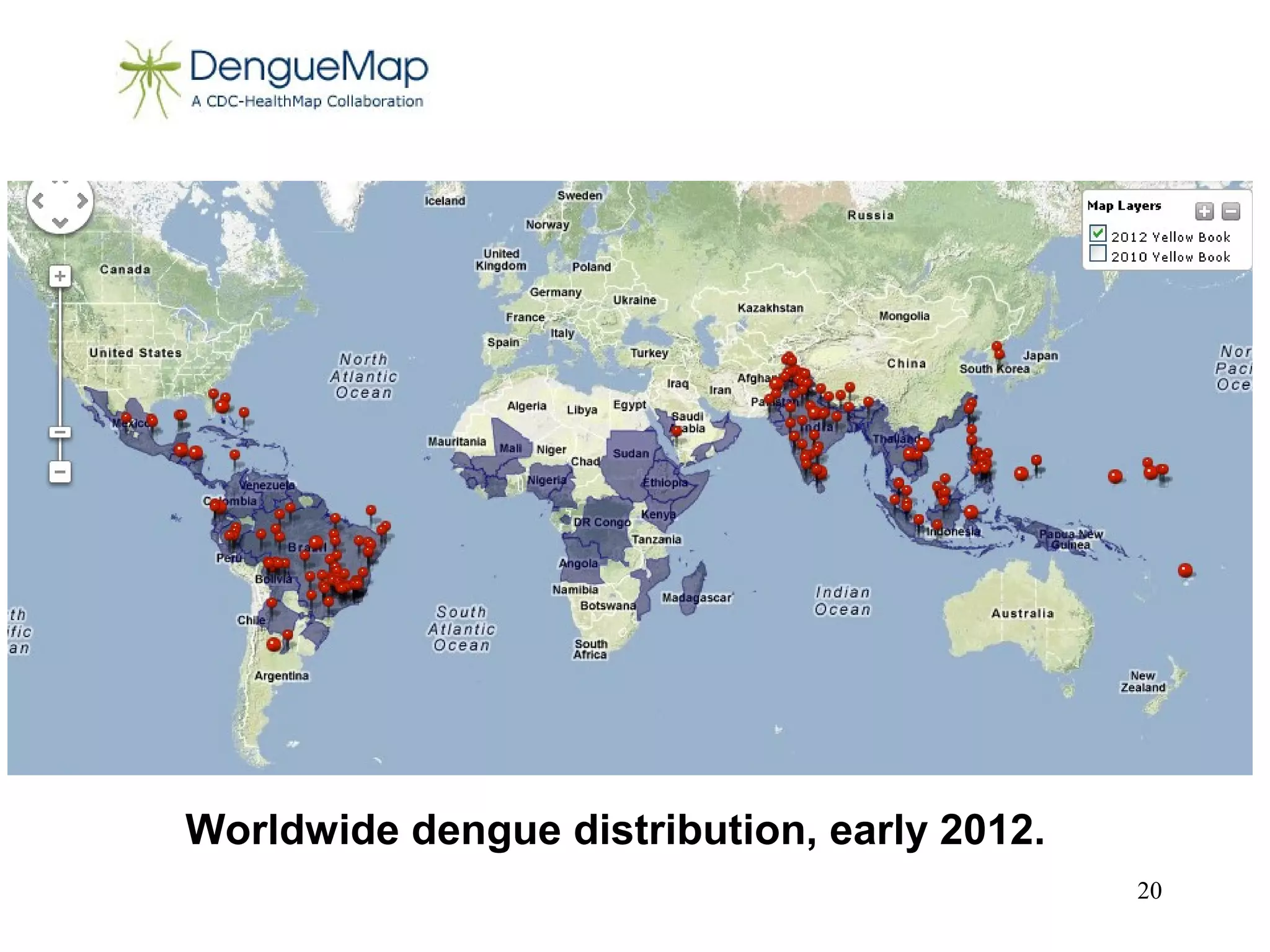
Worldwide dengue distribution, early 2012.
20
Dengue Viruses
• 40% of the world’s population is at risk
for dengue infection
• Each serotype provides specific lifetime
immunity, and short-term crossimmunity
• All serotypes can cause severe and
fatal disease
• Genetic variation within serotypes
Aedes aegypti
• Dengue transmitted by female
mosquitoes between humans
• Primarily a daytime feeder
• Lives in and around human
habitation
• Prefers to take blood from humans
• Lays eggs and produces larvae
preferentially in artificial containers
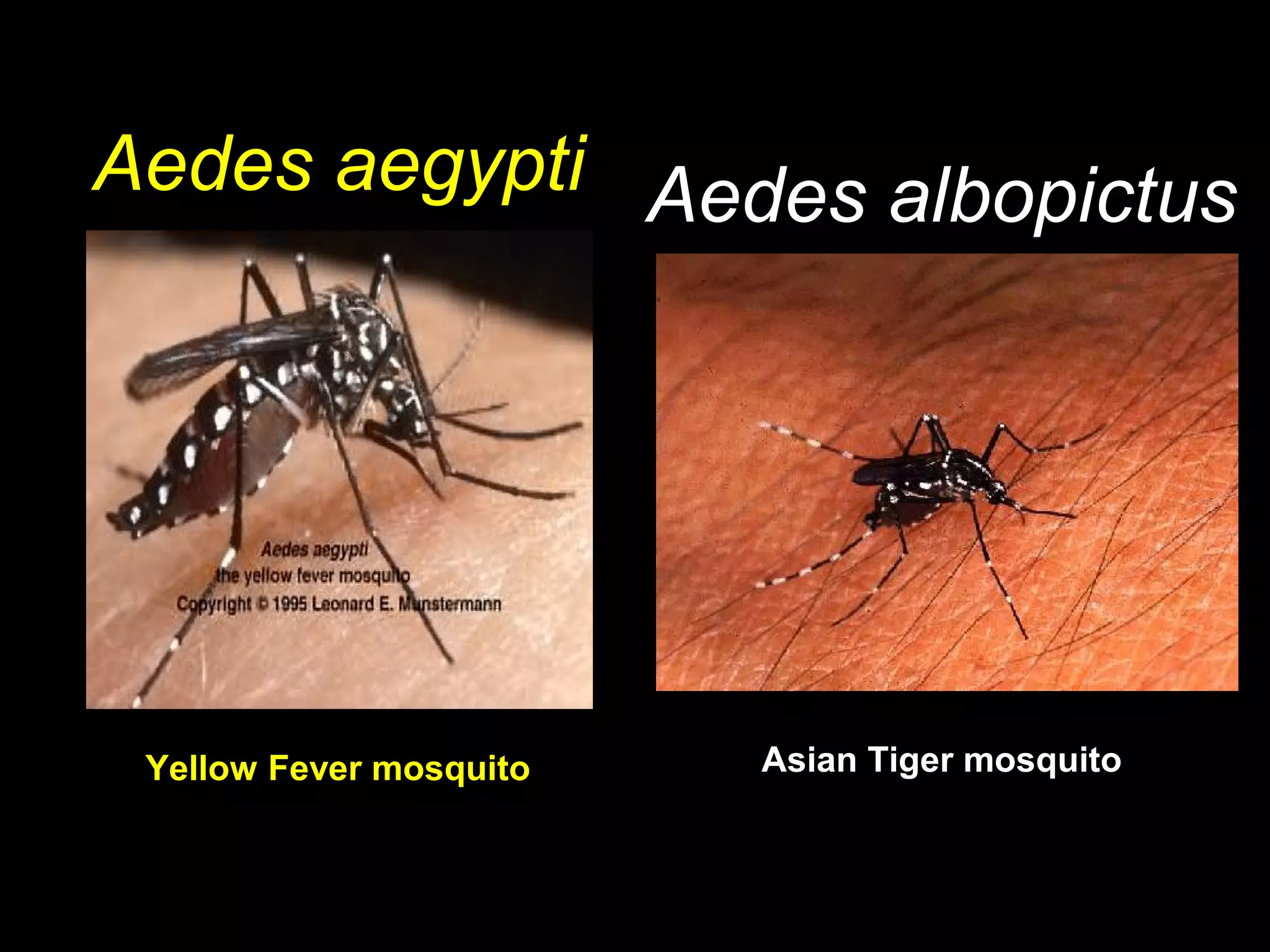
Aedes aegypti Aedes albopictus

Yellow Fever mosquito

Asian Tiger mosquito
24
25
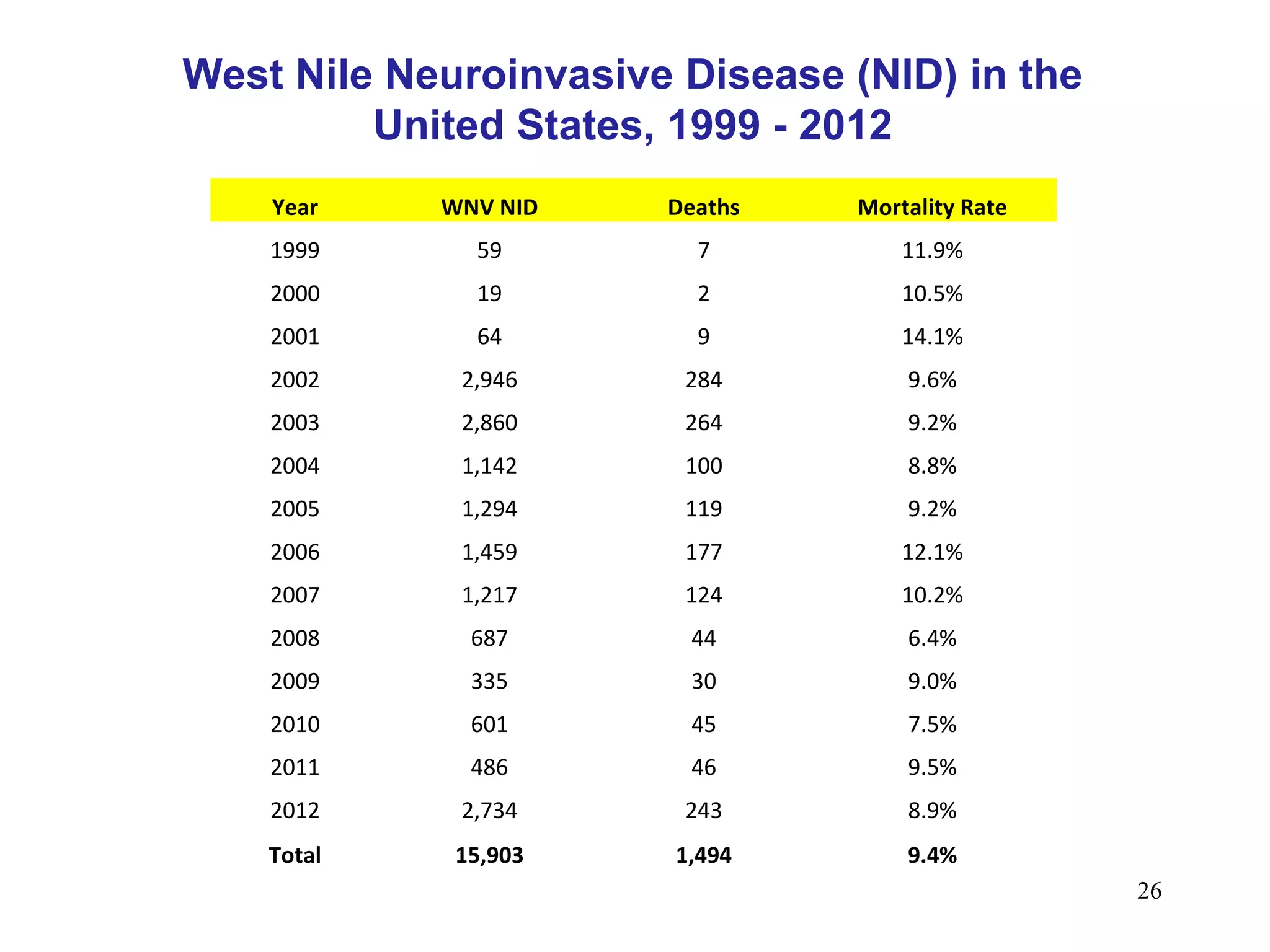
West Nile Neuroinvasive Disease (NID) in the
United States, 1999 - 2012
Year

WNV NID

Deaths

Mortality Rate

1999

59

7

11.9%

2000

19

2

10.5%

2001

64

9

14.1%

2002

2,946

284

9.6%

2003

2,860

264

9.2%

2004

1,142

100

8.8%

2005

1,294

119

9.2%

2006

1,459

177

12.1%

2007

1,217

124

10.2%

2008

687

44

6.4%

2009

335

30

9.0%

2010

601

45

7.5%

2011

486

46

9.5%

2012

2,734

243

8.9%

Total

15,903

1,494

9.4%
26
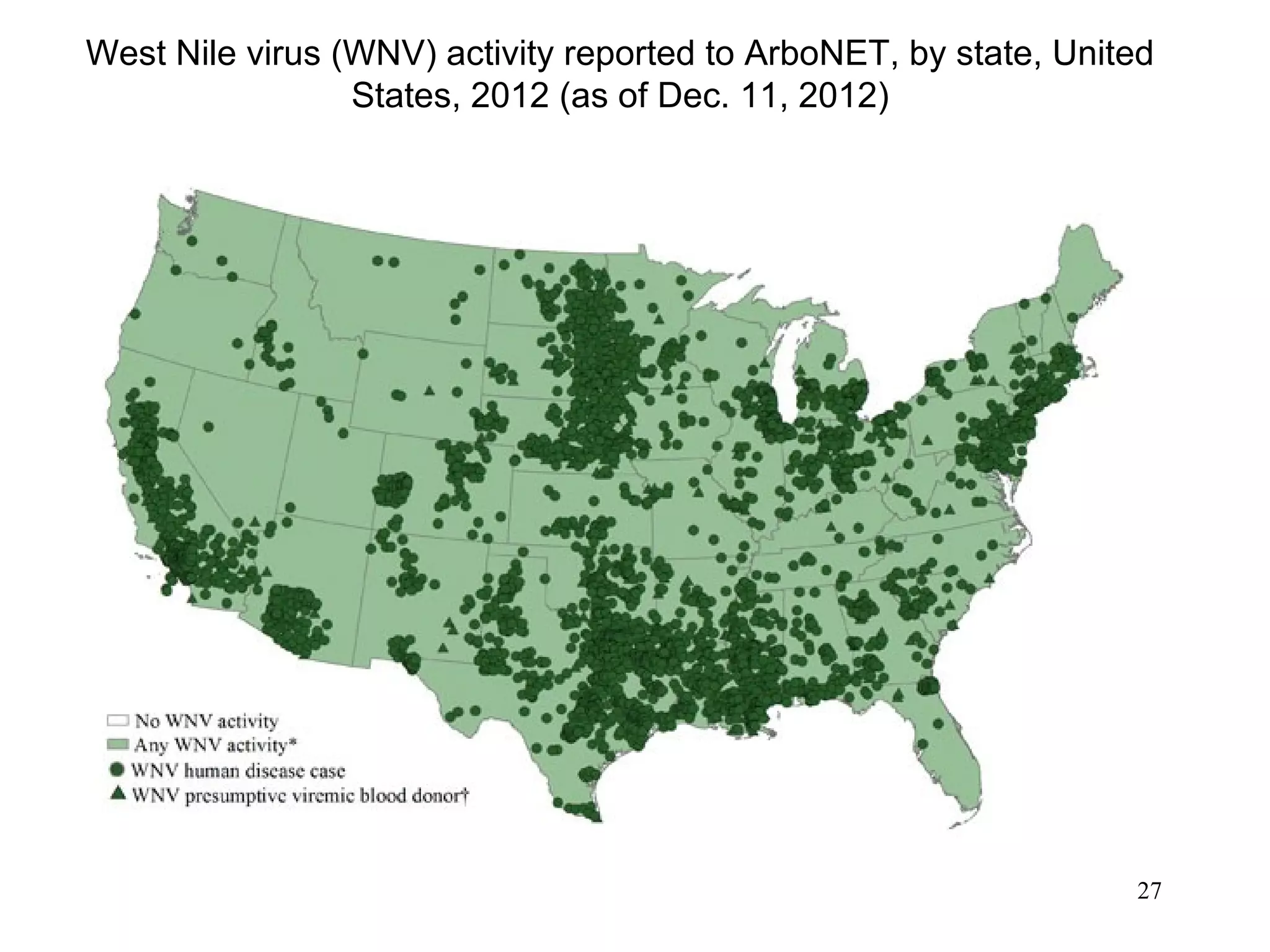
West Nile virus (WNV) activity reported to ArboNET, by state, United
States, 2012 (as of Dec. 11, 2012)

27
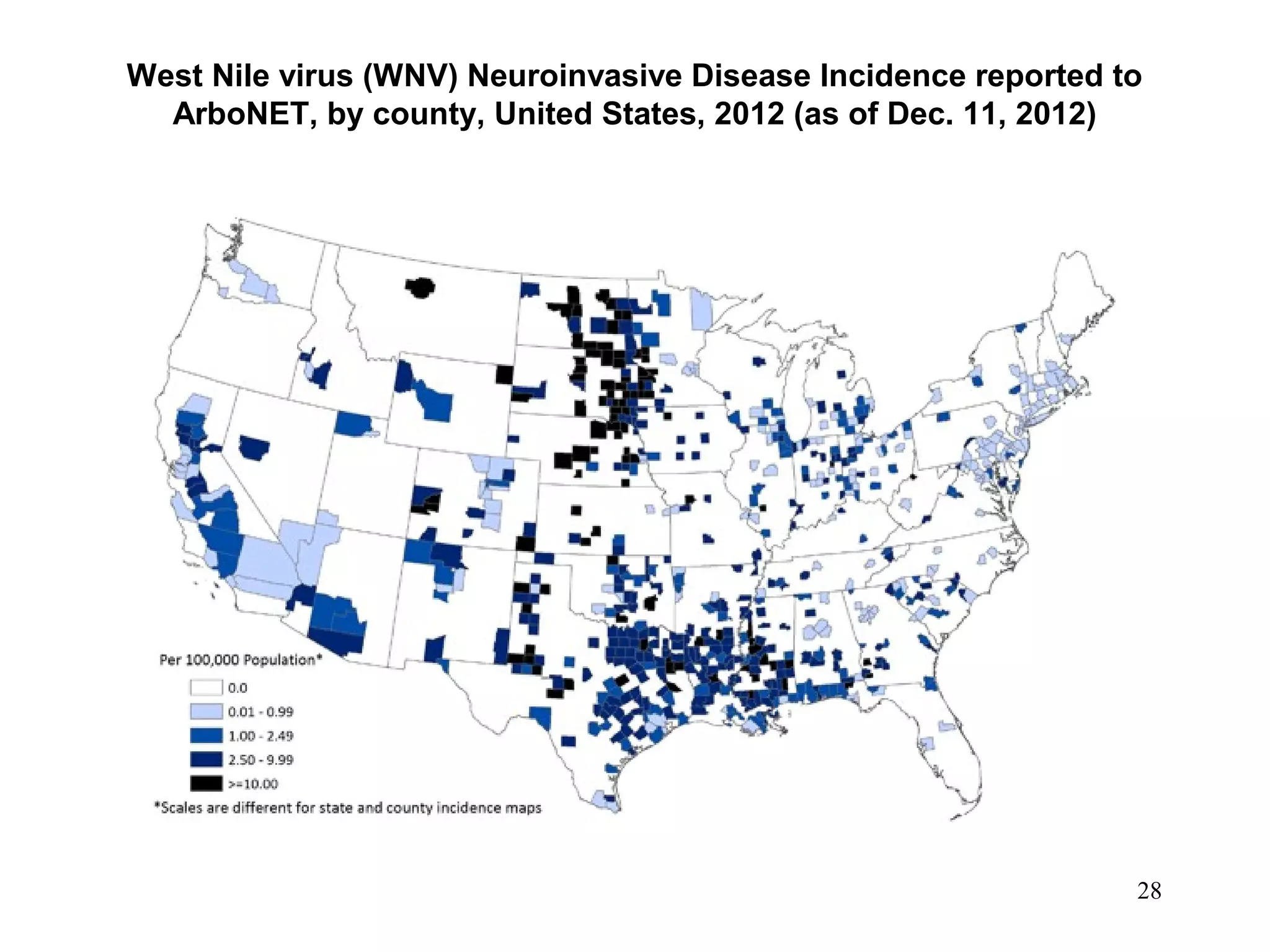
West Nile virus (WNV) Neuroinvasive Disease Incidence reported to
ArboNET, by county, United States, 2012 (as of Dec. 11, 2012)

28
•
•
•

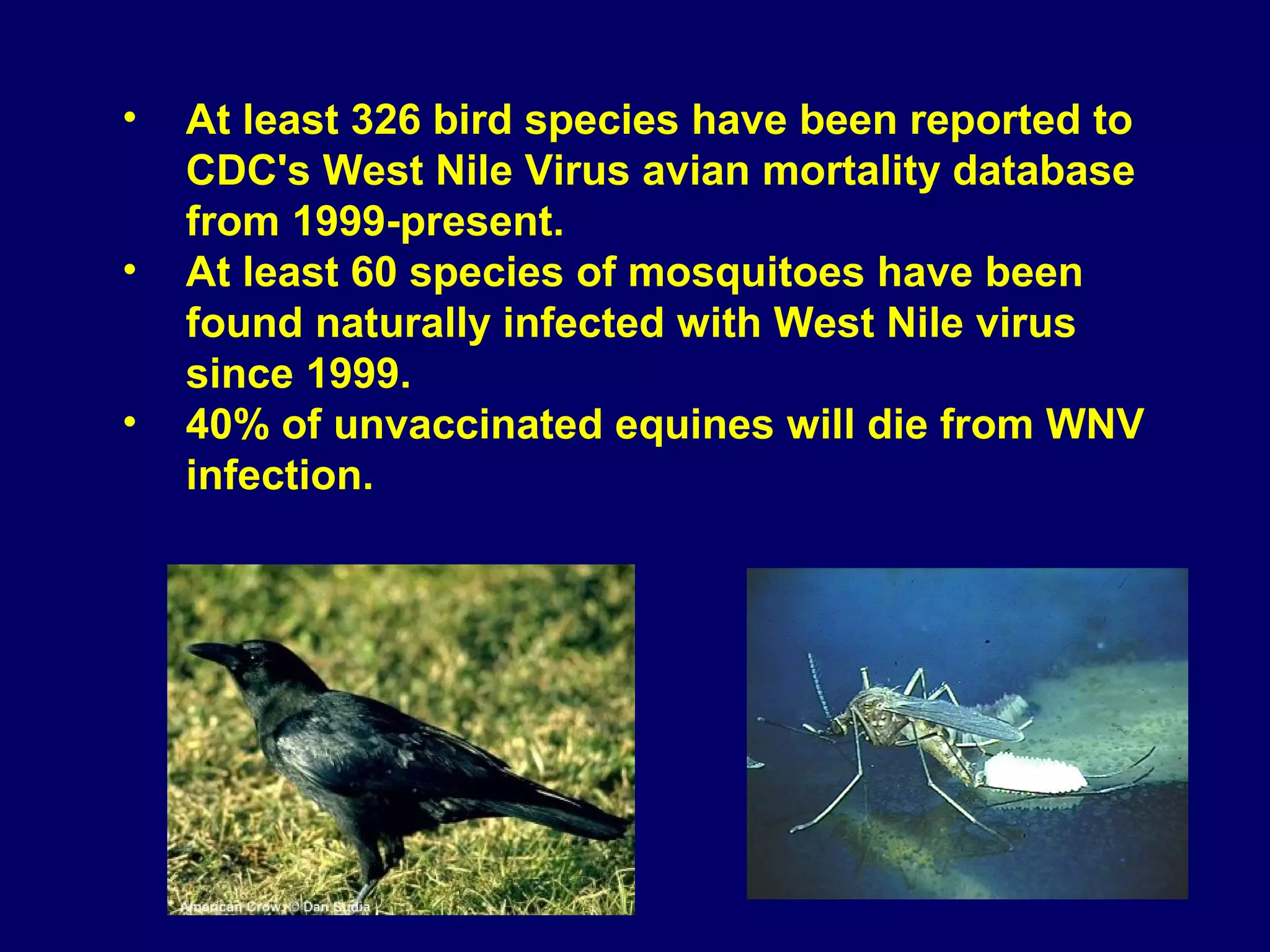
At least 326 bird species have been reported to
CDC's West Nile Virus avian mortality database
from 1999-present.
At least 60 species of mosquitoes have been
found naturally infected with West Nile virus
since 1999.
40% of unvaccinated equines will die from WNV
infection.

29
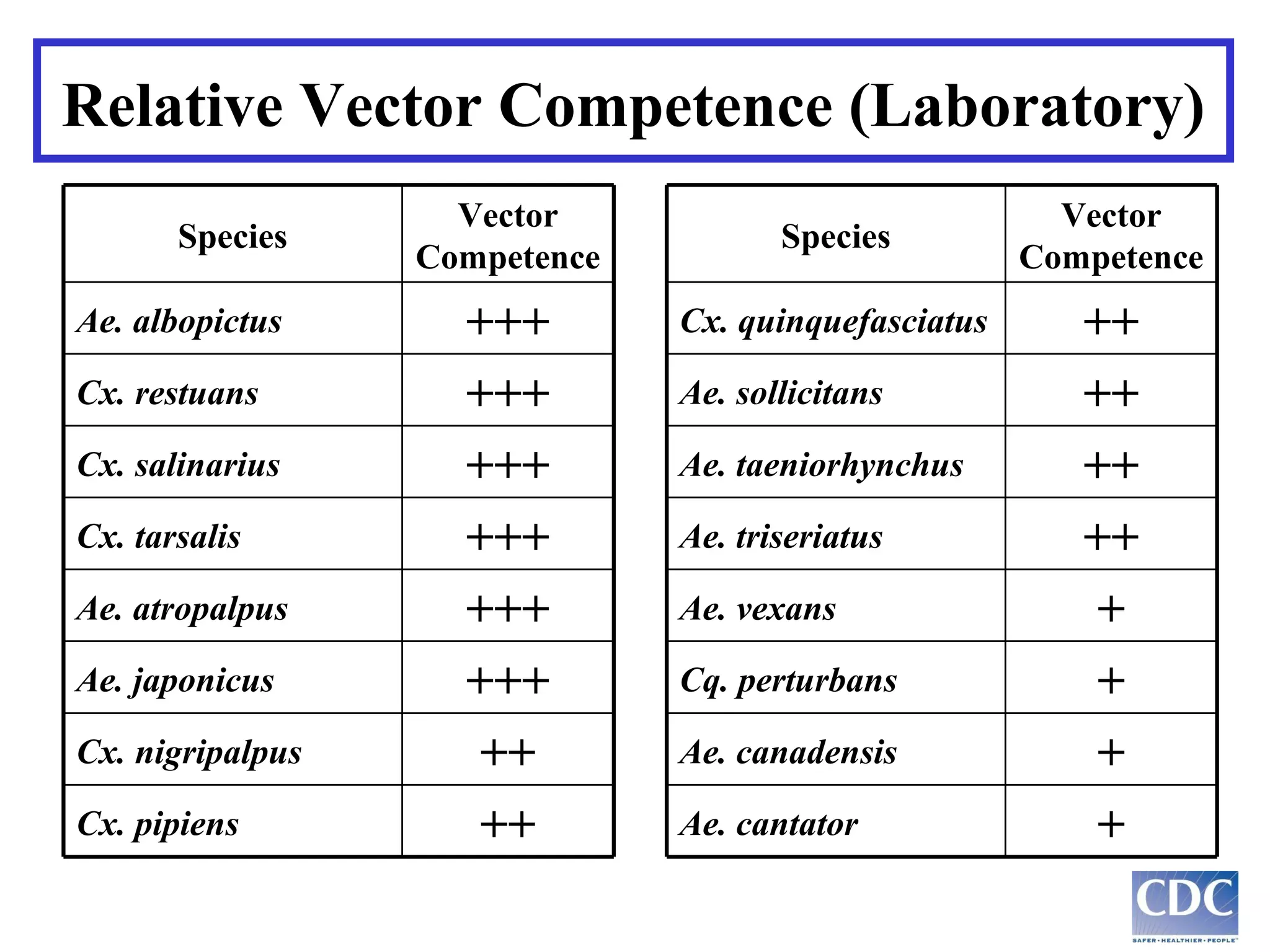
Relative Vector Competence (Laboratory)
Species
Ae. albopictus
Cx. restuans
Cx. salinarius
Cx. tarsalis
Ae. atropalpus
Ae. japonicus
Cx. nigripalpus
Cx. pipiens

Vector
Competence

+++
+++
+++
+++
+++
+++
++
++

Species
Cx. quinquefasciatus
Ae. sollicitans
Ae. taeniorhynchus
Ae. triseriatus
Ae. vexans
Cq. perturbans
Ae. canadensis
Ae. cantator

Vector
Competence

++
++
++
++
+
+
+
+
30
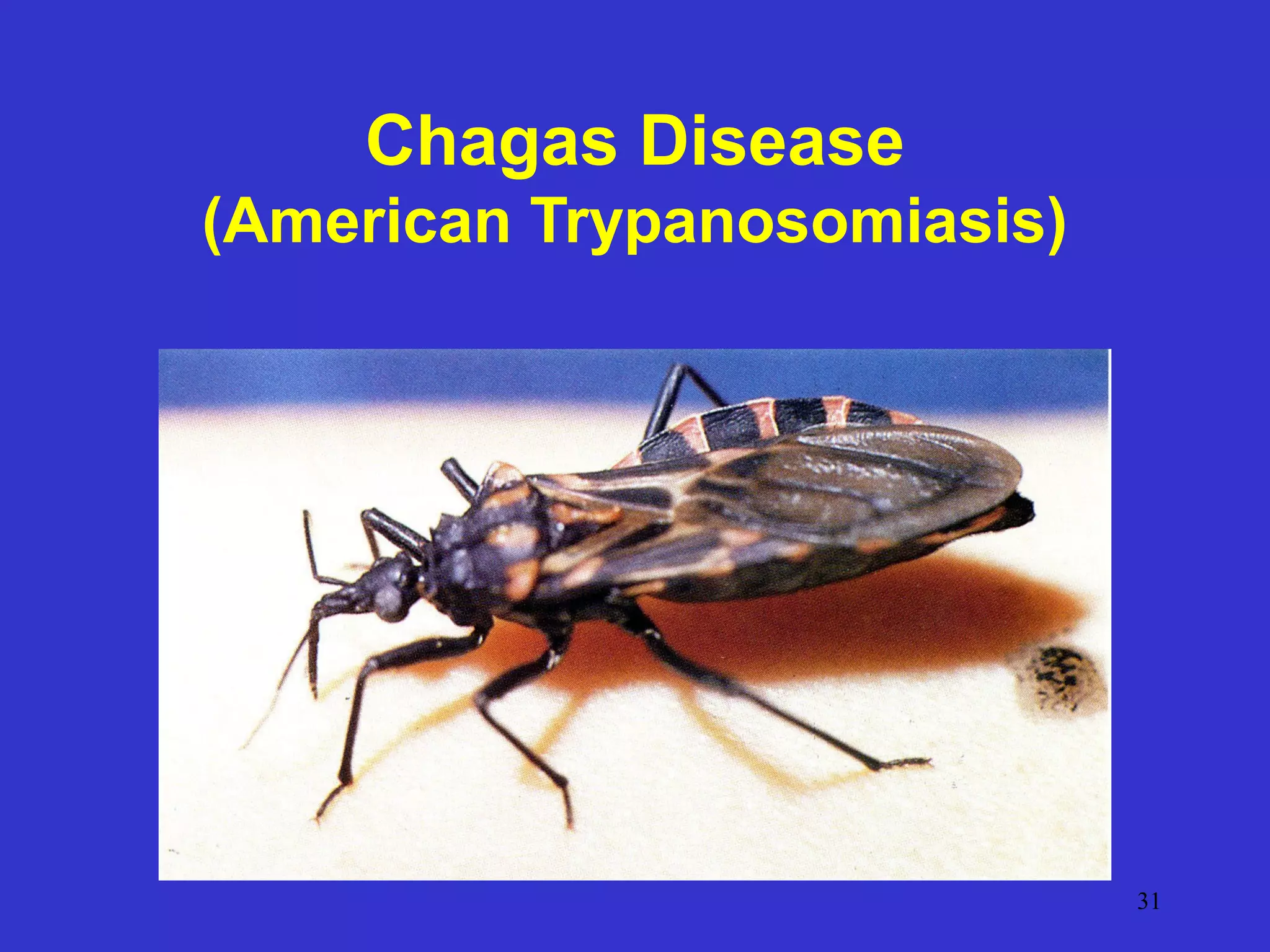
Chagas Disease
(American Trypanosomiasis)

31
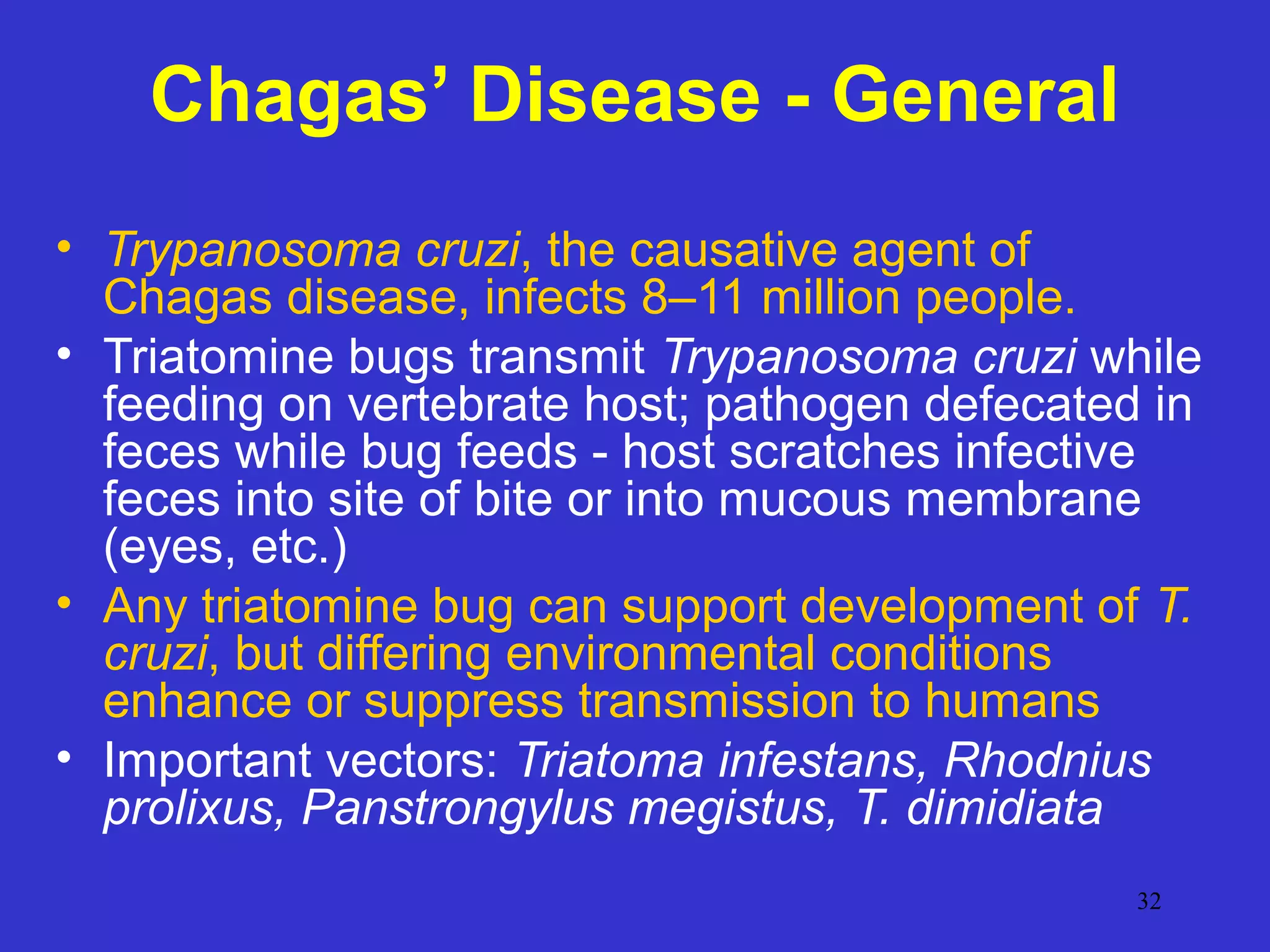
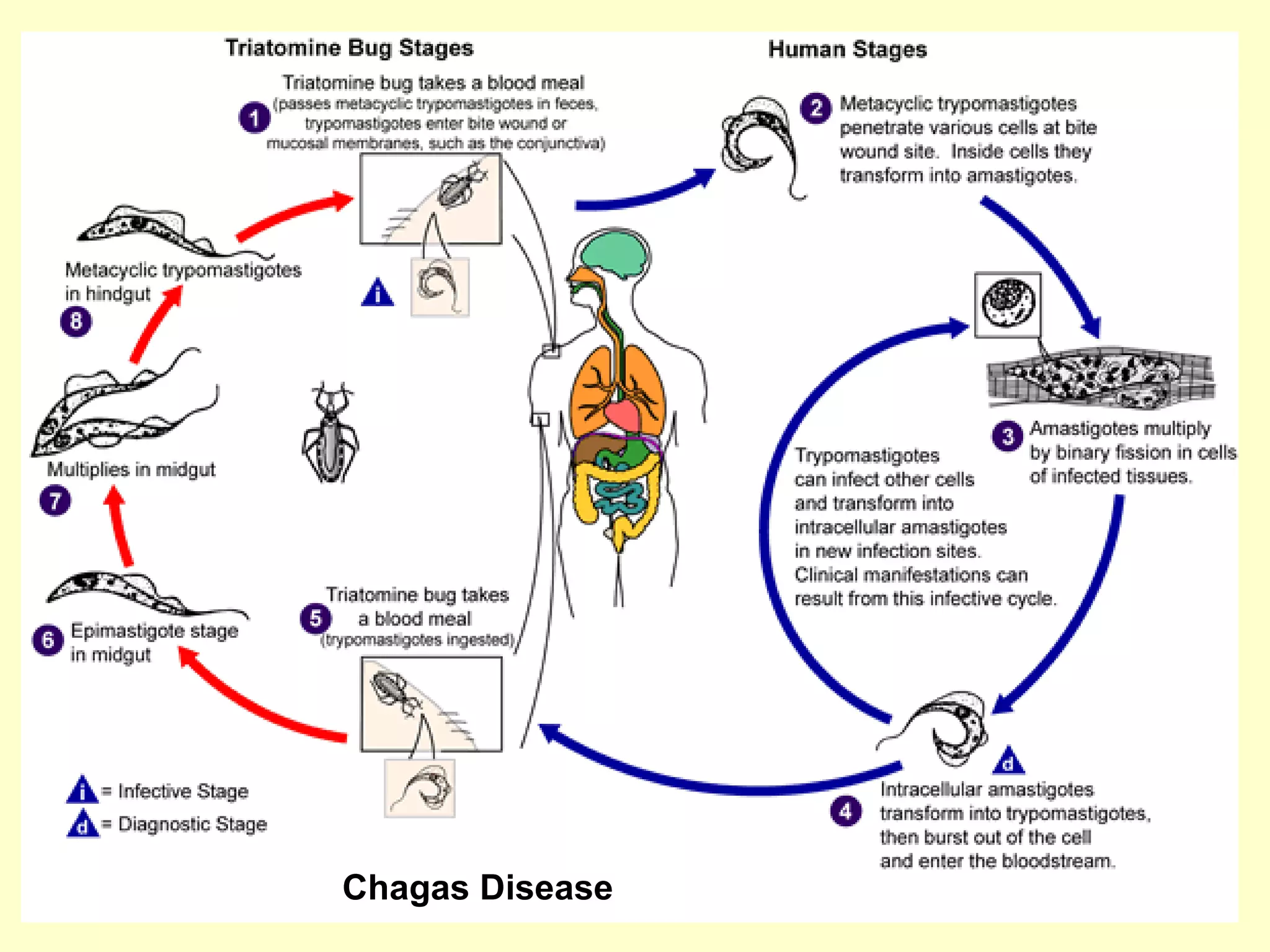
Chagas’ Disease - General
• Trypanosoma cruzi, the causative agent of
Chagas disease, infects 8–11 million people.
• Triatomine bugs transmit Trypanosoma cruzi while
feeding on vertebrate host; pathogen defecated in
feces while bug feeds - host scratches infective
feces into site of bite or into mucous membrane
(eyes, etc.)
• Any triatomine bug can support development of T.
cruzi, but differing environmental conditions
enhance or suppress transmission to humans
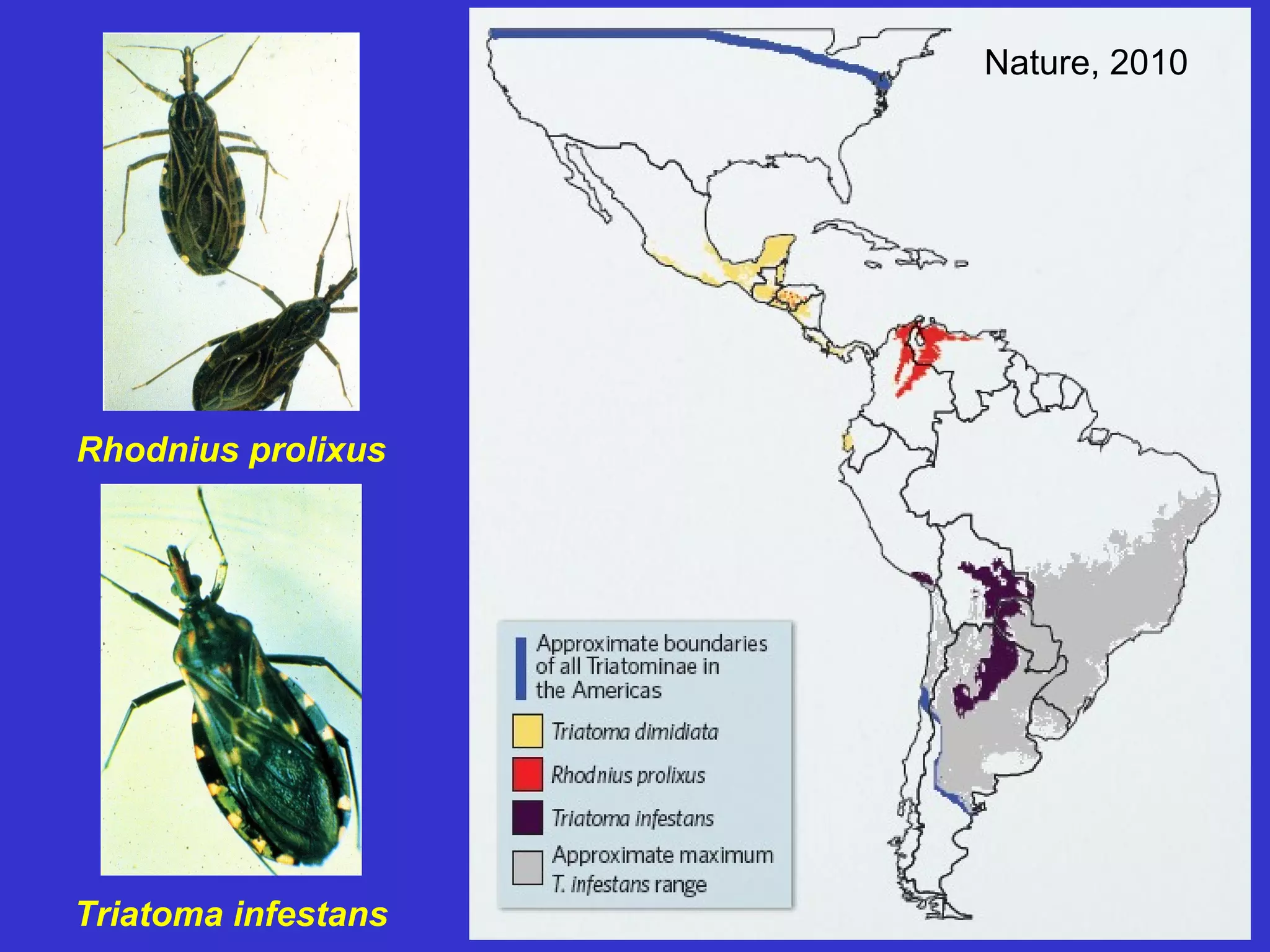
• Important vectors: Triatoma infestans, Rhodnius
prolixus, Panstrongylus megistus, T. dimidiata
32
Chagas Disease Control
Plague
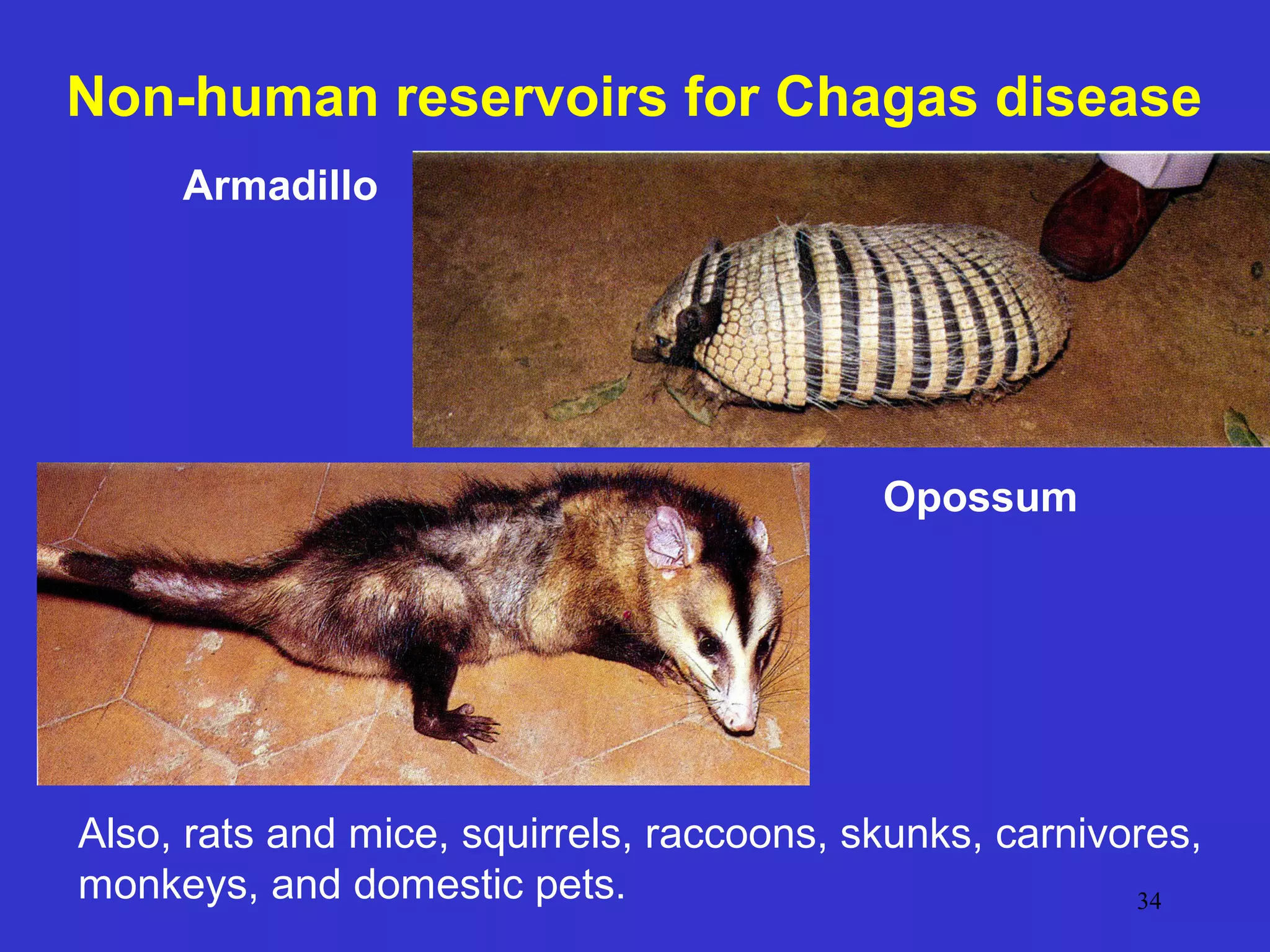
Non-human reservoirs for Chagas disease
Armadillo

Opossum

Also, rats and mice, squirrels, raccoons, skunks, carnivores,
monkeys, and domestic pets.
34
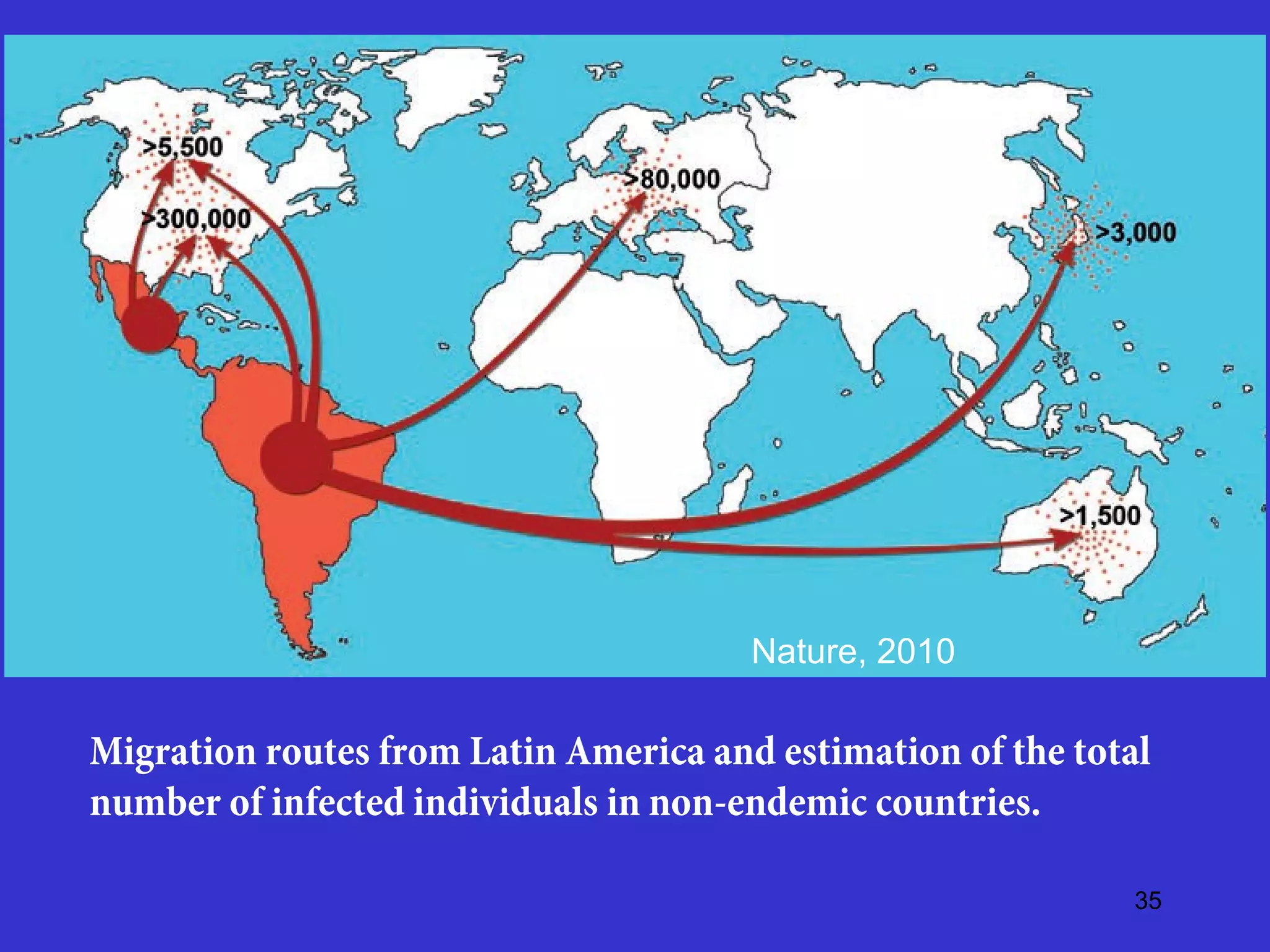
Nature, 2010

Migration routes from Latin America and estimation of the total
number of infected individuals in non-endemic countries.
35
Chagas in the United States
• In the United States, the disease exists almost exclusively
as a zoonosis.
• Only six autochthonous insect-borne cases have been
reported in humans. The most recent was documented in
New Orleans in 2006.
• The distribution of Chagas disease in the United States
includes approximately the southern half of the country.
• Twelve species of triatomines are known to occur in the
United States, the most important being Triatoma
sanguisuga in the eastern United States, Triatoma
gerstaeckeri in the region of Texas and New Mexico, and
Triatoma rubida and Triatoma protracta in Arizona and
36
California .
Nature, 2010

Rhodnius prolixus

Triatoma infestans

37
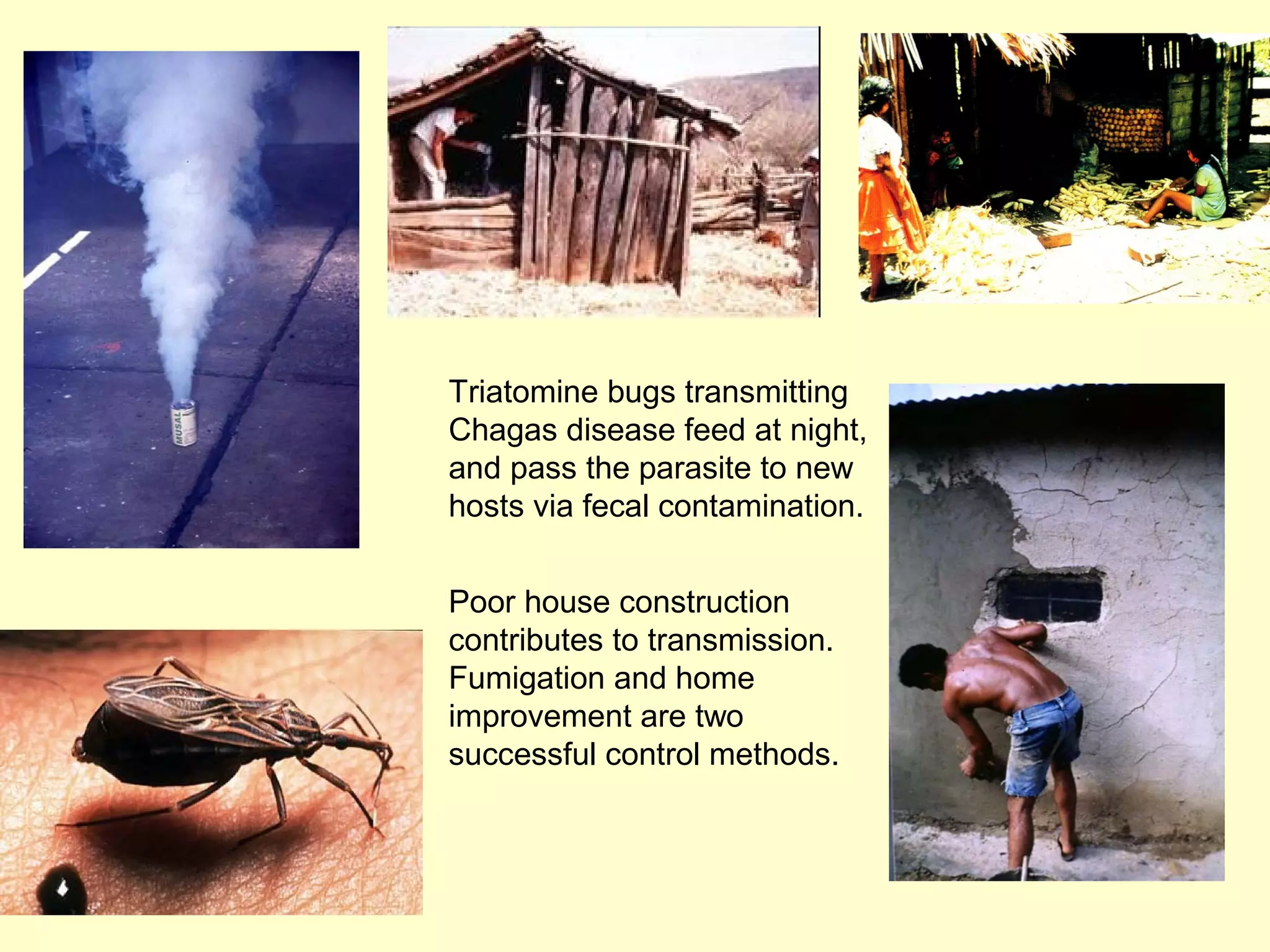
Triatomine bugs transmitting
Chagas disease feed at night,
and pass the parasite to new
hosts via fecal contamination.
Poor house construction
contributes to transmission.
Fumigation and home
improvement are two
successful control methods.
Careers in VBD
•
•
•
•

Research (academic, industry)
Vector control programs (municipal)
Pest control operator (industry)
International, national, regional, state
level surveillance, epidemiology, policy
• Monitoring and assessment
• NGO’s
• Funding agencies

Vector Borne Diseases

  • 1.
    Vector-Borne Disease Research at Tulane SPHU-1020 DawnWesson, PhD Department of Tropical Medicine
  • 2.
    Overview • Introduction • GeneralConcepts: vectors, types of vector-borne transmission, vector incrimination, zoonoses, surveillance • Specific Pathogen-Arthropod-Vertebrate Transmission Cycles: dengue virus, West Nile virus, American trypanosomiasis (Chagas disease)
  • 3.
    Introduction • Training forVBD research • VBD at Tulane (dengue, WNV, malaria, chikungunya, Chagas dz, Lyme dz) • Local vs. International research • Funding sources (NIH, NSF, BMGF, BORSF, etc.)
  • 4.
    How do wedefine a vector? An arthropod* responsible for transmission of parasites among vertebrate hosts. * Arthropods include insects (mosquitoes, tsetse flies, sandflies, blackflies, lice, fleas, kissing bugs) and arachnids (mites, ticks, spiders and scorpions).
  • 5.
    Aedes aegypti Dengue andYellow Fever viruses Culex quinquefasciatus Filariasis, West Nile & other viruses Anopheles gambiae Major mosquito-borne diseases and the most important mosquito vector species Malaria
  • 6.
    Tsetse fly –African Sleeping Sickness Kissing bug – Chagas Disease Sandfly - Leishmaniasis Blackfly - Onchocerciasis
  • 7.
    Flea - Plague Tick– Lyme Disease, CrimeanCongo Hemorrhagic Fever Body louse – Epidemic Typhus Horse fly – Tularemia
  • 8.
    Types of VectorBorneTransmission Mechanical Transmission – simplest form (not necessary for pathogen survival – “flying/crawling hypodermic needle” phenomenon) Biological Transmission – more complex (necessary for pathogen survival – results in amplification or development in vector)
  • 9.
    General Types of BiologicalTransmission Vertical Horizontal
  • 10.
    Vertical Transmission Trans-stadial (ticks, kissingbugs) Trans-generational Transovarial – female to progeny, including males (mosquitoes, ticks)
  • 11.
    Horizontal Transmission Bite (salivaor gut infection) (malaria, dengue, filariasis, etc.) Feces (Chagas disease) Crushing Infected Arthropod (epidemic typhus, etc.)
  • 12.
    Horizontal Transmission Types Multiplicative(Propagative) (increase in number - Dengue) Developmental (change stage - Filariasis) Cyclopropagative (change stage and increase in number - Malaria)
  • 13.
    Pathogen Infection inArthropods Extrinsic Incubation Period - EIP Time interval between vector infection and potential for pathogen transmission to vertebrate host (determined by controlled experimental studies) If vector dies (is killed) before EIP is completed, transmission will not occur.
  • 14.
    Ecological Parameters Affecting VectorPopulations: Availability of food Space (What do they eat, and when?) (Where do they occur, and when?) Water (Is their appearance seasonal – wet/dry?) Temperature (Is their appearance seasonal – warm/cold?) Predation ( Can we enhance or introduce predators to control them?) Disease ( Can we identify pathogens to control them?)
  • 15.
    Vector Incrimination • Demonstratean association in time and space between arthropod and disease • Demonstrate direct contact between the arthropod and humans • Demonstrate natural occurrence of the infectious agent in the insect • Demonstrate “transmission” of the agent by the insect (laboratory-based vector competence)
  • 16.
    How are thesepathogen transmission parameters determined? Laboratory Experimentation (vector competence, EIP) Field Surveillance (temporal and spatial association between pathogen, vector and humans; other factors affecting disease prevention – insecticide or antibiotic resistance)
  • 17.
    Why is understandingvector life cycle important? Mosquito Life Cycle
  • 18.
    Specific Pathogen-ArthropodVertebrate TransmissionCycles Highlighted Transmission Cycles Mosquito-borne pathogens - arboviruses (dengue and West Nile virus) Bug-transmitted pathogens – Chagas disease
  • 19.
    Arboviruses: ARthropod-BOrne VIRUSES •Dengue viruses 1-4 – dengue fever, dengue hemorrhagic fever (DHF) and dengue shock syndrome (DSS) • West Nile virus - West Nile fever and WN neuroinvasive disease (encephalitis, meningitis, etc.) different vertebrate hosts and mosquito vectors different transmission ecology different control approaches
  • 20.
  • 21.
    Dengue Viruses • 40%of the world’s population is at risk for dengue infection • Each serotype provides specific lifetime immunity, and short-term crossimmunity • All serotypes can cause severe and fatal disease • Genetic variation within serotypes
  • 22.
    Aedes aegypti • Denguetransmitted by female mosquitoes between humans • Primarily a daytime feeder • Lives in and around human habitation • Prefers to take blood from humans • Lays eggs and produces larvae preferentially in artificial containers
  • 23.
    Aedes aegypti Aedesalbopictus Yellow Fever mosquito Asian Tiger mosquito
  • 24.
  • 25.
  • 26.
    West Nile NeuroinvasiveDisease (NID) in the United States, 1999 - 2012 Year WNV NID Deaths Mortality Rate 1999 59 7 11.9% 2000 19 2 10.5% 2001 64 9 14.1% 2002 2,946 284 9.6% 2003 2,860 264 9.2% 2004 1,142 100 8.8% 2005 1,294 119 9.2% 2006 1,459 177 12.1% 2007 1,217 124 10.2% 2008 687 44 6.4% 2009 335 30 9.0% 2010 601 45 7.5% 2011 486 46 9.5% 2012 2,734 243 8.9% Total 15,903 1,494 9.4% 26
  • 27.
    West Nile virus(WNV) activity reported to ArboNET, by state, United States, 2012 (as of Dec. 11, 2012) 27
  • 28.
    West Nile virus(WNV) Neuroinvasive Disease Incidence reported to ArboNET, by county, United States, 2012 (as of Dec. 11, 2012) 28
  • 29.
    • • • At least 326bird species have been reported to CDC's West Nile Virus avian mortality database from 1999-present. At least 60 species of mosquitoes have been found naturally infected with West Nile virus since 1999. 40% of unvaccinated equines will die from WNV infection. 29
  • 30.
    Relative Vector Competence(Laboratory) Species Ae. albopictus Cx. restuans Cx. salinarius Cx. tarsalis Ae. atropalpus Ae. japonicus Cx. nigripalpus Cx. pipiens Vector Competence +++ +++ +++ +++ +++ +++ ++ ++ Species Cx. quinquefasciatus Ae. sollicitans Ae. taeniorhynchus Ae. triseriatus Ae. vexans Cq. perturbans Ae. canadensis Ae. cantator Vector Competence ++ ++ ++ ++ + + + + 30
  • 31.
  • 32.
    Chagas’ Disease -General • Trypanosoma cruzi, the causative agent of Chagas disease, infects 8–11 million people. • Triatomine bugs transmit Trypanosoma cruzi while feeding on vertebrate host; pathogen defecated in feces while bug feeds - host scratches infective feces into site of bite or into mucous membrane (eyes, etc.) • Any triatomine bug can support development of T. cruzi, but differing environmental conditions enhance or suppress transmission to humans • Important vectors: Triatoma infestans, Rhodnius prolixus, Panstrongylus megistus, T. dimidiata 32
  • 33.
  • 34.
    Non-human reservoirs forChagas disease Armadillo Opossum Also, rats and mice, squirrels, raccoons, skunks, carnivores, monkeys, and domestic pets. 34
  • 35.
    Nature, 2010 Migration routesfrom Latin America and estimation of the total number of infected individuals in non-endemic countries. 35
  • 36.
    Chagas in theUnited States • In the United States, the disease exists almost exclusively as a zoonosis. • Only six autochthonous insect-borne cases have been reported in humans. The most recent was documented in New Orleans in 2006. • The distribution of Chagas disease in the United States includes approximately the southern half of the country. • Twelve species of triatomines are known to occur in the United States, the most important being Triatoma sanguisuga in the eastern United States, Triatoma gerstaeckeri in the region of Texas and New Mexico, and Triatoma rubida and Triatoma protracta in Arizona and 36 California .
  • 37.
  • 38.
    Triatomine bugs transmitting Chagasdisease feed at night, and pass the parasite to new hosts via fecal contamination. Poor house construction contributes to transmission. Fumigation and home improvement are two successful control methods.
  • 39.
    Careers in VBD • • • • Research(academic, industry) Vector control programs (municipal) Pest control operator (industry) International, national, regional, state level surveillance, epidemiology, policy • Monitoring and assessment • NGO’s • Funding agencies