ORGANIZATIONAL BEHAVIOR S T E P H E N  P.  R O B B I N S W W W . P R E N H A L L . C O M / R O B B I N S T  E  N  T  H  E  D  I  T  I  O  N © 2003 Prentice Hall Inc. All rights reserved. PowerPoint Presentation by Charlie Cook
AFTER STUDYING THIS CHAPTER, YOU SHOULD BE ABLE TO: Define conflict. Differentiate between the traditional, human relations, and interactionist views of conflict. Contrast task, relationship, and process conflict. Outline the conflict process. Describe the five conflict-handling intentions. Contrast distributive and integrative bargaining. L E A R N I N G  O B J E C T I V E S
AFTER STUDYING THIS CHAPTER, YOU SHOULD BE ABLE TO: Identify the five steps in the negotiating process. Describe cultural differences in negotiations. L E A R N I N G  O B J E C T I V E S (cont’d)
Transitions in Conflict Thought Causes: Poor communication Lack of openness Failure to respond to employee needs
Transitions in Conflict Thought (cont’d)
Functional versus Dysfunctional Conflict
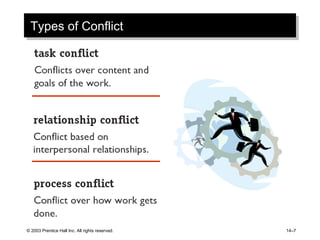
Types of Conflict
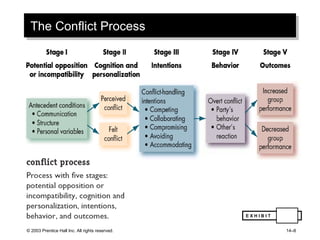
The Conflict Process E X H I B I T 14-1
Stage I: Potential Opposition or Incompatibility Communication Semantic difficulties, misunderstandings, and “noise” Structure Size and specialization of jobs Jurisdictional clarity/ambiguity Member/goal incompatibility Leadership styles (close or participative) Reward systems (win-lose) Dependence/interdependence of groups Personal Variables Differing individual value systems Personality types
Stage II: Cognition and Personalization Conflict Definition Positive Feelings Negative Emotions
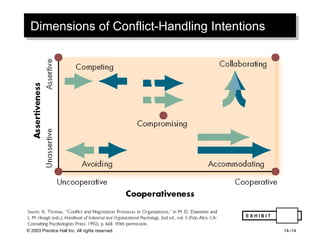
Stage III: Intentions Cooperativeness: Attempting to satisfy the other party’s concerns. Assertiveness: Attempting to satisfy one’s own concerns.
Stage III: Intentions (cont’d)
Dimensions of Conflict-Handling Intentions E X H I B I T 14-2
Stage IV: Behavior
Stage IV: Conflict Resolution Techniques Problem solving Superordinate goals Expansion of resources Avoidance Smoothing Compromise Authoritative command Altering the human variable Altering the structural variables
Stage IV: Conflict Stimulation Techniques Communication Bringing in outsiders Restructuring the organization Appointing a devil’s advocate
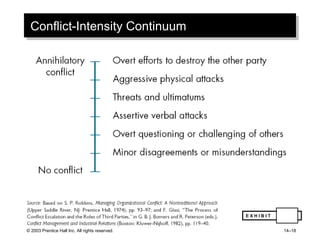
Conflict-Intensity Continuum E X H I B I T 14-3
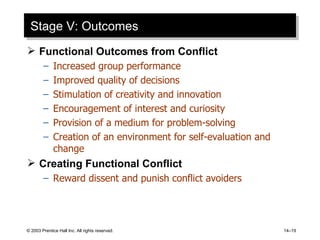
Stage V: Outcomes Functional Outcomes from Conflict Increased group performance Improved quality of decisions Stimulation of creativity and innovation Encouragement of interest and curiosity Provision of a medium for problem-solving Creation of an environment for self-evaluation and change Creating Functional Conflict Reward dissent and punish conflict avoiders
Stage V: Outcomes (cont’d) Dysfunctional Outcomes from Conflict Development of discontent Reduced group effectiveness Retarded communication Reduced group cohesiveness Infighting among group members overcomes group goals
Negotiation
Bargaining Strategies
Distributive versus Integrative Bargaining E X H I B I T 14-5
Staking Out the Bargaining Zone E X H I B I T 14-6
The Negotiation Process E X H I B I T 14-7
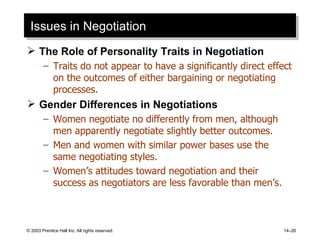
Issues in Negotiation The Role of Personality Traits in Negotiation Traits do not appear to have a significantly direct effect on the outcomes of either bargaining or negotiating processes. Gender Differences in Negotiations Women negotiate no differently from men, although men apparently negotiate slightly better outcomes. Men and women with similar power bases use the same negotiating styles. Women’s attitudes toward negotiation and their success as negotiators are less favorable than men’s.
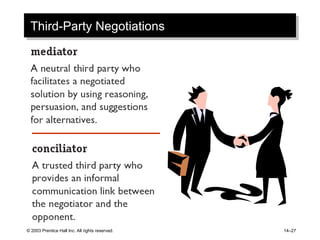
Third-Party Negotiations
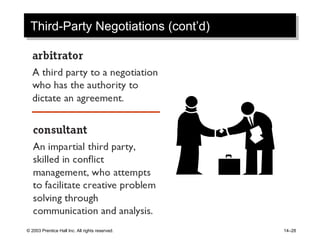
Third-Party Negotiations (cont’d)
Why U.S. Managers Might Have Trouble in Cross-Cultural Negotiations E X H I B I T 14-8
Conflict and Unit Performance E X H I B I T 14-9a
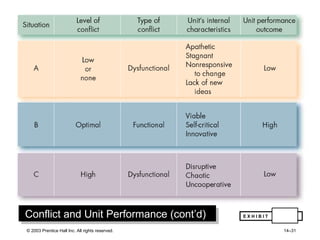
Conflict and Unit Performance (cont’d) E X H I B I T 14-9b

Ch14 Conflict & Negotiation

  • 1.
    ORGANIZATIONAL BEHAVIOR ST E P H E N P. R O B B I N S W W W . P R E N H A L L . C O M / R O B B I N S T E N T H E D I T I O N © 2003 Prentice Hall Inc. All rights reserved. PowerPoint Presentation by Charlie Cook
  • 2.
    AFTER STUDYING THISCHAPTER, YOU SHOULD BE ABLE TO: Define conflict. Differentiate between the traditional, human relations, and interactionist views of conflict. Contrast task, relationship, and process conflict. Outline the conflict process. Describe the five conflict-handling intentions. Contrast distributive and integrative bargaining. L E A R N I N G O B J E C T I V E S
  • 3.
    AFTER STUDYING THISCHAPTER, YOU SHOULD BE ABLE TO: Identify the five steps in the negotiating process. Describe cultural differences in negotiations. L E A R N I N G O B J E C T I V E S (cont’d)
  • 4.
    Transitions in ConflictThought Causes: Poor communication Lack of openness Failure to respond to employee needs
  • 5.
    Transitions in ConflictThought (cont’d)
  • 6.
  • 7.
  • 8.
    The Conflict ProcessE X H I B I T 14-1
  • 9.
    Stage I: PotentialOpposition or Incompatibility Communication Semantic difficulties, misunderstandings, and “noise” Structure Size and specialization of jobs Jurisdictional clarity/ambiguity Member/goal incompatibility Leadership styles (close or participative) Reward systems (win-lose) Dependence/interdependence of groups Personal Variables Differing individual value systems Personality types
  • 10.
    Stage II: Cognitionand Personalization Conflict Definition Positive Feelings Negative Emotions
  • 11.
    Stage III: IntentionsCooperativeness: Attempting to satisfy the other party’s concerns. Assertiveness: Attempting to satisfy one’s own concerns.
  • 12.
  • 13.
  • 14.
    Dimensions of Conflict-HandlingIntentions E X H I B I T 14-2
  • 15.
  • 16.
    Stage IV: ConflictResolution Techniques Problem solving Superordinate goals Expansion of resources Avoidance Smoothing Compromise Authoritative command Altering the human variable Altering the structural variables
  • 17.
    Stage IV: ConflictStimulation Techniques Communication Bringing in outsiders Restructuring the organization Appointing a devil’s advocate
  • 18.
  • 19.
    Stage V: OutcomesFunctional Outcomes from Conflict Increased group performance Improved quality of decisions Stimulation of creativity and innovation Encouragement of interest and curiosity Provision of a medium for problem-solving Creation of an environment for self-evaluation and change Creating Functional Conflict Reward dissent and punish conflict avoiders
  • 20.
    Stage V: Outcomes(cont’d) Dysfunctional Outcomes from Conflict Development of discontent Reduced group effectiveness Retarded communication Reduced group cohesiveness Infighting among group members overcomes group goals
  • 21.
  • 22.
  • 23.
    Distributive versus IntegrativeBargaining E X H I B I T 14-5
  • 24.
    Staking Out theBargaining Zone E X H I B I T 14-6
  • 25.
    The Negotiation ProcessE X H I B I T 14-7
  • 26.
    Issues in NegotiationThe Role of Personality Traits in Negotiation Traits do not appear to have a significantly direct effect on the outcomes of either bargaining or negotiating processes. Gender Differences in Negotiations Women negotiate no differently from men, although men apparently negotiate slightly better outcomes. Men and women with similar power bases use the same negotiating styles. Women’s attitudes toward negotiation and their success as negotiators are less favorable than men’s.
  • 27.
  • 28.
  • 29.
    Why U.S. ManagersMight Have Trouble in Cross-Cultural Negotiations E X H I B I T 14-8
  • 30.
    Conflict and UnitPerformance E X H I B I T 14-9a
  • 31.
    Conflict and UnitPerformance (cont’d) E X H I B I T 14-9b