Changing Retail Landscape in India
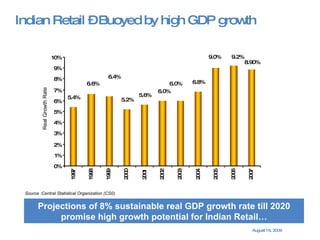
Indian Retail – Buoyed by high GDP growth Projections of 8% sustainable real GDP growth rate till 2020 promise high growth potential for Indian Retail… Real Growth Rate Source :Central Statistical Organization (CS0)
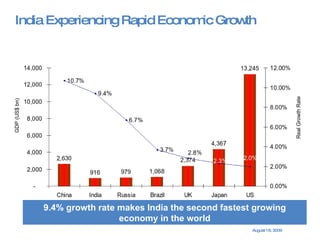
India Experiencing Rapid Economic Growth  9.4% growth rate makes India the second fastest growing economy in the world GDP (US$ bn)  Real Growth Rate
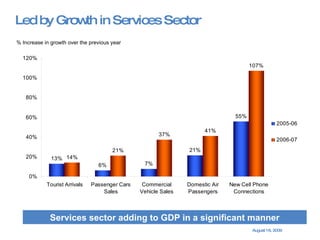
Led by Growth in Services Sector % Increase in growth over the previous year  Services sector adding to GDP in a significant manner
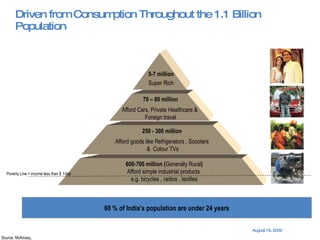
Driven from Consumption Throughout the 1.1 Billion Population 5-7 million Super Rich 70 – 80 million Afford Cars, Private Healthcare &  Foreign travel 250 - 300 million  Afford goods like Refrigerators , Scooters  &  Colour TVs 600-700 million ( Generally Rural ) Afford simple industrial products  e.g. bicycles , radios , textiles Poverty Line = income less than $ 1/day Source: McKinsey,  60 % of India’s population are under 24 years
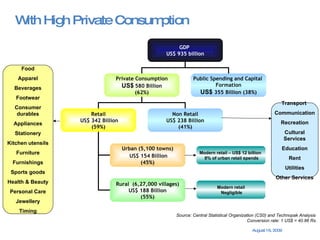
With High Private Consumption GDP  US$ 935 billion Private Consumption US$   580 Billion (62%) Public Spending and Capital  Formation US$  355   Billion (38%) Retail US$ 342 Billion (59%) Non Retail US$ 238 Billion (41%) Urban (5,100 towns) US$ 154 Billion (45%) Rural  (6,27,000 villages) US$ 188 Billion (55%) Modern retail – US$ 12 billion  8% of urban retail spends Modern retail Negligible Food Apparel Beverages Footwear Consumer durables Appliances Stationery Kitchen utensils Furniture Furnishings Sports goods Health & Beauty Personal Care Jewellery Timing Transport  Communication Recreation Cultural Services Education Rent Utilities Other Services Source: Central Statistical Organization (CS0) and Technopak Analysis  Conversion rate: 1 US$ = 40.86 Rs.
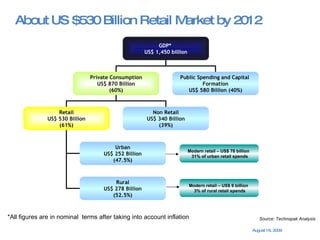
About US $530 Billion Retail Market by 2012 GDP*  US$ 1,450 billion Private Consumption US$ 870 Billion (60%) Public Spending and Capital  Formation US$ 580 Billion (40%) Retail US$ 530 Billion (61%) Non Retail US$ 340 Billion (39%) Urban US$ 252 Billion (47.5%) Rural US$ 278 Billion (52.5%) Modern retail – US$ 78 billion  31% of urban retail spends Modern retail – US$ 9 billion  3% of rural retail spends Source: Technopak Analysis   *All figures are in nominal  terms after taking into account inflation
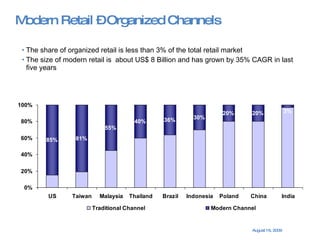
Modern Retail – Organized Channels The share of organized retail is less than 3% of the total retail market  The size of modern retail is  about US$ 8 Billion and has grown by 35% CAGR in last five years
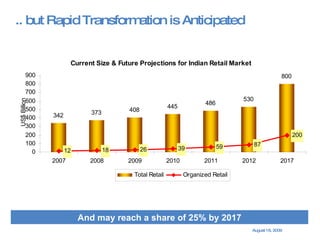
.. but Rapid Transformation is Anticipated And may reach a share of 25% by 2017
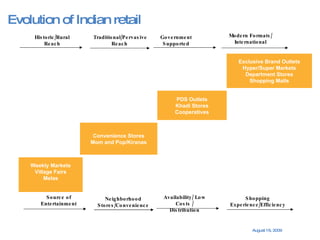
Weekly Markets Village Fairs Melas Convenience Stores Mom and Pop/Kiranas PDS Outlets Khadi Stores Cooperatives Exclusive Brand Outlets Hyper/Super Markets Department Stores Shopping Malls Traditional/Pervasive Reach  Government Supported Historic/Rural Reach Modern Formats/ International Evolution of Indian retail Source of Entertainment Neighborhood Stores/Convenience Availability/ Low Costs / Distribution Shopping Experience/Efficiency
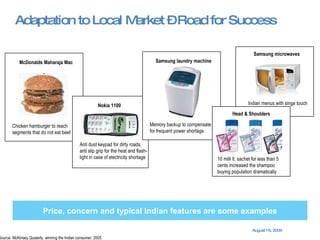
Adaptation to Local Market – Road for Success Price, concern and typical Indian features are some examples Source: McKinsey Quaterly, winning the Indian consumer, 2005 Chicken hamburger to reach segments that do not eat beef McDonalds Maharaja Mac Nokia 1100 Anti dust keypad for dirty roads,  anti slip grip for the heat and flash-light in case of electricity shortage Indian menus with singe touch Samsung microwaves Memory backup to compensate for frequent power shortage Samsung laundry machine 10 milli lt. sachet for less than 5 cents increased the shampoo buying population dramatically Head & Shoulders
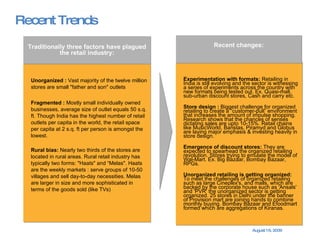
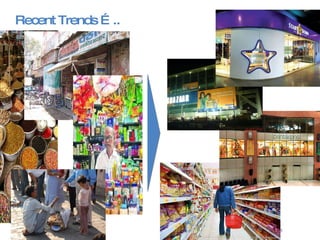
Recent Trends Experimentation with formats:  Retailing in India is still evolving and the sector is witnessing a series of experiments across the country with new formats being tested out. Ex. Quasi-mall, sub-urban discount stores, Cash and carry etc. Store design :  Biggest challenge for organized retailing to create a “customer-pull” environment that increases the amount of impulse shopping. Research shows that the chances of senses dictating sales are upto 10-15%. Retail chains like MusicWorld, Baristas, Piramyd and Globus are laying major emphasis & investing heavily in store design. Emergence of discount stores:  They are expected to spearhead the organized retailing revolution. Stores trying to emulate the model of Wal-Mart. Ex. Big Bazaar, Bombay Bazaar, RPGs.  Unorganized retailing is getting organized:  To meet the challenges of organized retailing such as large Cineplex's, and malls, which are backed by the corporate house such as 'Ansals' and 'PVR‘ the unorganized sector is getting organized. 25 stores in Delhi under the banner of Provision mart are joining hands to combine monthly buying. Bombay Bazaar and Efoodmart formed which are aggregations of Kiranas. Recent changes: Unorganized   :  Vast majority of the twelve million stores are small "father and son" outlets Fragmented   :  Mostly small individually owned businesses, average size of outlet equals 50 s.q. ft. Though India has the highest number of retail outlets per capita in the world, the retail space per capita at 2 s.q. ft per person is amongst the lowest. Rural bias:  Nearly two thirds of the stores are located in rural areas. Rural retail industry has typically two forms: "Haats" and “Melas". Haats are the weekly markets : serve groups of 10-50 villages and sell day-to-day necessities. Melas are larger in size and more sophisticated in terms of the goods sold (like TVs) Traditionally three factors have plagued the retail industry:
Recent Trends …..
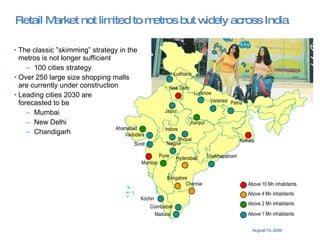
Retail Market not limited to metros but widely across India The classic ”skimming” strategy in the  metros is not longer sufficient 100 cities strategy Over 250 large size shopping malls  are currently under construction Leading cities 2030 are  forecasted to be Mumbai New Delhi Chandigarh New Delhi Bangalore Mumbai Chennai Kolkata Ahamabad Hyderabad Pune Above 10 Mn inhabitants Above 4 Mn inhabitants Above 2 Mn inhabitants Above 1 Mn inhabitants Kanpur Lucknow Jaipur Nagpur Coimbatore Bhopal Madurai Kochin Varanasi Visakhapatnam Patna Indore Surat Vadodara Ludhiana
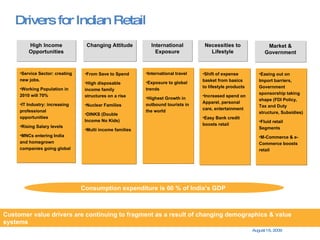
Drivers for Indian Retail High Income Opportunities Changing Attitude International Exposure Necessities to Lifestyle Service Sector: creating new jobs.  Working Population in 2010 will 70% IT Industry: increasing professional opportunities Rising Salary levels MNCs entering India and homegrown companies going global From Save to Spend High disposable income family structures on a rise  Nuclear Families DINKS (Double Income No Kids) Multi income families International travel Exposure to global trends Highest Growth in outbound tourists in the world Shift of expense basket from basics to lifestyle products Increased spend on Apparel, personal care, entertainment  Easy Bank credit boosts retail Customer value drivers are continuing to fragment as a result of changing demographics & value systems Consumption expenditure is 60 % of India’s GDP   Market & Government Easing out on Import barriers, Government sponsorship taking shape (FDI Policy, Tax and Duty structure, Subsidies) Fluid retail Segments M-Commerce & e-Commerce boosts retail
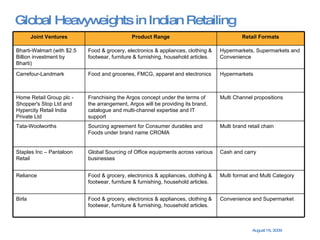
Global Heavyweights in Indian Retailing Convenience and Supermarket Food & grocery, electronics & appliances, clothing & footwear, furniture & furnishing, household articles. Birla Multi format and Multi Category Food & grocery, electronics & appliances, clothing & footwear, furniture & furnishing, household articles. Reliance Multi brand retail chain Sourcing agreement for Consumer durables and Foods under brand name CROMA Tata-Woolworths Cash and carry Global Sourcing of Office equipments across various businesses Staples Inc – Pantaloon Retail Multi Channel propositions Franchising the Argos concept under the terms of the arrangement, Argos will be providing its brand, catalogue and multi-channel expertise and IT support  Home Retail Group plc - Shopper's Stop Ltd and Hypercity Retail India Private Ltd  Hypermarkets Food and groceries, FMCG, apparel and electronics  Carrefour-Landmark Hypermarkets, Supermarkets and Convenience Food & grocery, electronics & appliances, clothing & footwear, furniture & furnishing, household articles.  Bharti-Walmart (with $2.5 Billion investment by Bharti) Retail Formats Product Range Joint Ventures
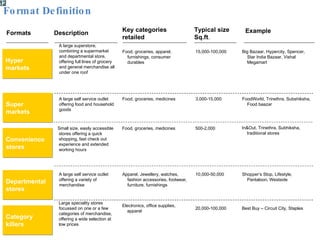
Format Definition 12 Formats Description Key categories retailed Typical size Sq.ft . Example A large superstore, combining a supermarket and departmental store, offering full lines of grocery and general merchandise all under one roof Food, groceries, apparel, furnishings, consumer durables 15,000-100,000 Big Bazaar, Hypercity, Spencer, Star India Bazaar, Vishal Megamart A large self service outlet offering food and household goods Food, groceries, medicines 3,000-15,000 FoodWorld, Trinethra, Subshiksha, Food baazar A large self service outlet offering a variety of merchandise Apparel, Jewellery, watches, fashion accessories, footwear, furniture, furnishings 10,000-50,000 Shopper’s Stop, Lifestyle, Pantaloon, Westside Large speciality stores focussed on one or a few categories of merchandise, offering a wide selection at low prices  Electronics, office supplies, apparel 20,000-100,000 Best Buy – Circuit City, Staples Small size, easily accessible stores offering a quick shopping, fast check out experience and extended working hours Food, groceries, medicines 500-2,000 In&Out, Trinethra, Subhiksha, traditional stores Hyper markets Super markets Departmental stores Category killers Convenience stores
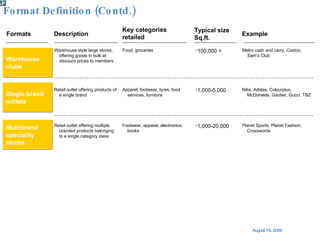
Format Definition (Contd.) 12 Formats Description Typical size Sq.ft. Example Retail outlet offering products of a single brand Apparel, footwear, tyres, food services, furniture 1,000-5,000 Nike, Adidas, Colourplus, McDonalds, Gautier, Gucci, TBZ Retail outlet offering multiple branded products belonging to a single category class Footwear, apparel, electronics, books 1,000-20,000 Planet Sports, Planet Fashion, Crosswords Warehouse style large stores, offering goods in bulk at discount prices to members Food, groceries 100,000 + Metro cash and carry, Costco, Sam’s Club Key categories retailed Single brand outlets Multibrand speciality stores Warehouse clubs
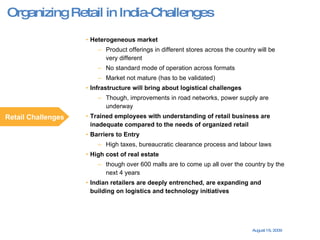
Heterogeneous market Product offerings in different stores across the country will be very different No standard mode of operation across formats Market not mature (has to be validated) Infrastructure will bring about logistical challenges  Though, improvements in road networks, power supply are underway Trained employees with understanding of retail business are inadequate compared to the needs of organized retail  Barriers to Entry High taxes, bureaucratic clearance process and labour laws High cost of real estate  though over 600 malls are to come up all over the country by the next 4 years Indian retailers are deeply entrenched, are expanding and building on logistics and technology initiatives Retail Challenges Organizing Retail in India-Challenges
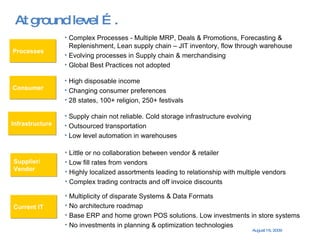
At ground level ….  Processes Complex Processes - Multiple MRP, Deals & Promotions, Forecasting & Replenishment, Lean supply chain – JIT inventory, flow through warehouse Evolving processes in Supply chain & merchandising Global Best Practices not adopted Consumer Infrastructure High disposable income Changing consumer preferences 28 states, 100+ religion, 250+ festivals Supply chain not reliable. Cold storage infrastructure evolving Outsourced transportation Low level automation in warehouses Supplier/ Vendor Current IT Little or no collaboration between vendor & retailer Low fill rates from vendors Highly localized assortments leading to relationship with multiple vendors  Complex trading contracts and off invoice discounts Multiplicity of disparate Systems & Data Formats No architecture roadmap Base ERP and home grown POS solutions. Low investments in store systems No investments in planning & optimization technologies
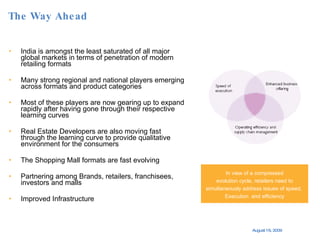
The Way Ahead India is amongst the least saturated of all major global markets in terms of penetration of modern retailing formats  Many strong regional and national players emerging across formats and product categories Most of these players are now gearing up to expand rapidly after having gone through their respective learning curves Real Estate Developers are also moving fast through the learning curve to provide qualitative environment for the consumers The Shopping Mall formats are fast evolving Partnering among Brands, retailers, franchisees, investors and malls Improved Infrastructure In view of a compressed evolution cycle, retailers need to  simultaneously address issues of speed,  Execution  and efficiency
Thank You

Evolution,Drivers Of Indian Retail

  • 1.
  • 2.
    Indian Retail –Buoyed by high GDP growth Projections of 8% sustainable real GDP growth rate till 2020 promise high growth potential for Indian Retail… Real Growth Rate Source :Central Statistical Organization (CS0)
  • 3.
    India Experiencing RapidEconomic Growth 9.4% growth rate makes India the second fastest growing economy in the world GDP (US$ bn) Real Growth Rate
  • 4.
    Led by Growthin Services Sector % Increase in growth over the previous year Services sector adding to GDP in a significant manner
  • 5.
    Driven from ConsumptionThroughout the 1.1 Billion Population 5-7 million Super Rich 70 – 80 million Afford Cars, Private Healthcare & Foreign travel 250 - 300 million Afford goods like Refrigerators , Scooters & Colour TVs 600-700 million ( Generally Rural ) Afford simple industrial products e.g. bicycles , radios , textiles Poverty Line = income less than $ 1/day Source: McKinsey, 60 % of India’s population are under 24 years
  • 6.
    With High PrivateConsumption GDP US$ 935 billion Private Consumption US$ 580 Billion (62%) Public Spending and Capital Formation US$ 355 Billion (38%) Retail US$ 342 Billion (59%) Non Retail US$ 238 Billion (41%) Urban (5,100 towns) US$ 154 Billion (45%) Rural (6,27,000 villages) US$ 188 Billion (55%) Modern retail – US$ 12 billion 8% of urban retail spends Modern retail Negligible Food Apparel Beverages Footwear Consumer durables Appliances Stationery Kitchen utensils Furniture Furnishings Sports goods Health & Beauty Personal Care Jewellery Timing Transport Communication Recreation Cultural Services Education Rent Utilities Other Services Source: Central Statistical Organization (CS0) and Technopak Analysis Conversion rate: 1 US$ = 40.86 Rs.
  • 7.
    About US $530Billion Retail Market by 2012 GDP* US$ 1,450 billion Private Consumption US$ 870 Billion (60%) Public Spending and Capital Formation US$ 580 Billion (40%) Retail US$ 530 Billion (61%) Non Retail US$ 340 Billion (39%) Urban US$ 252 Billion (47.5%) Rural US$ 278 Billion (52.5%) Modern retail – US$ 78 billion 31% of urban retail spends Modern retail – US$ 9 billion 3% of rural retail spends Source: Technopak Analysis *All figures are in nominal terms after taking into account inflation
  • 8.
    Modern Retail –Organized Channels The share of organized retail is less than 3% of the total retail market The size of modern retail is about US$ 8 Billion and has grown by 35% CAGR in last five years
  • 9.
    .. but RapidTransformation is Anticipated And may reach a share of 25% by 2017
  • 10.
    Weekly Markets VillageFairs Melas Convenience Stores Mom and Pop/Kiranas PDS Outlets Khadi Stores Cooperatives Exclusive Brand Outlets Hyper/Super Markets Department Stores Shopping Malls Traditional/Pervasive Reach Government Supported Historic/Rural Reach Modern Formats/ International Evolution of Indian retail Source of Entertainment Neighborhood Stores/Convenience Availability/ Low Costs / Distribution Shopping Experience/Efficiency
  • 11.
    Adaptation to LocalMarket – Road for Success Price, concern and typical Indian features are some examples Source: McKinsey Quaterly, winning the Indian consumer, 2005 Chicken hamburger to reach segments that do not eat beef McDonalds Maharaja Mac Nokia 1100 Anti dust keypad for dirty roads, anti slip grip for the heat and flash-light in case of electricity shortage Indian menus with singe touch Samsung microwaves Memory backup to compensate for frequent power shortage Samsung laundry machine 10 milli lt. sachet for less than 5 cents increased the shampoo buying population dramatically Head & Shoulders
  • 12.
    Recent Trends Experimentationwith formats: Retailing in India is still evolving and the sector is witnessing a series of experiments across the country with new formats being tested out. Ex. Quasi-mall, sub-urban discount stores, Cash and carry etc. Store design : Biggest challenge for organized retailing to create a “customer-pull” environment that increases the amount of impulse shopping. Research shows that the chances of senses dictating sales are upto 10-15%. Retail chains like MusicWorld, Baristas, Piramyd and Globus are laying major emphasis & investing heavily in store design. Emergence of discount stores: They are expected to spearhead the organized retailing revolution. Stores trying to emulate the model of Wal-Mart. Ex. Big Bazaar, Bombay Bazaar, RPGs. Unorganized retailing is getting organized: To meet the challenges of organized retailing such as large Cineplex's, and malls, which are backed by the corporate house such as 'Ansals' and 'PVR‘ the unorganized sector is getting organized. 25 stores in Delhi under the banner of Provision mart are joining hands to combine monthly buying. Bombay Bazaar and Efoodmart formed which are aggregations of Kiranas. Recent changes: Unorganized : Vast majority of the twelve million stores are small "father and son" outlets Fragmented : Mostly small individually owned businesses, average size of outlet equals 50 s.q. ft. Though India has the highest number of retail outlets per capita in the world, the retail space per capita at 2 s.q. ft per person is amongst the lowest. Rural bias: Nearly two thirds of the stores are located in rural areas. Rural retail industry has typically two forms: "Haats" and “Melas". Haats are the weekly markets : serve groups of 10-50 villages and sell day-to-day necessities. Melas are larger in size and more sophisticated in terms of the goods sold (like TVs) Traditionally three factors have plagued the retail industry:
  • 13.
  • 14.
    Retail Market notlimited to metros but widely across India The classic ”skimming” strategy in the metros is not longer sufficient 100 cities strategy Over 250 large size shopping malls are currently under construction Leading cities 2030 are forecasted to be Mumbai New Delhi Chandigarh New Delhi Bangalore Mumbai Chennai Kolkata Ahamabad Hyderabad Pune Above 10 Mn inhabitants Above 4 Mn inhabitants Above 2 Mn inhabitants Above 1 Mn inhabitants Kanpur Lucknow Jaipur Nagpur Coimbatore Bhopal Madurai Kochin Varanasi Visakhapatnam Patna Indore Surat Vadodara Ludhiana
  • 15.
    Drivers for IndianRetail High Income Opportunities Changing Attitude International Exposure Necessities to Lifestyle Service Sector: creating new jobs. Working Population in 2010 will 70% IT Industry: increasing professional opportunities Rising Salary levels MNCs entering India and homegrown companies going global From Save to Spend High disposable income family structures on a rise Nuclear Families DINKS (Double Income No Kids) Multi income families International travel Exposure to global trends Highest Growth in outbound tourists in the world Shift of expense basket from basics to lifestyle products Increased spend on Apparel, personal care, entertainment Easy Bank credit boosts retail Customer value drivers are continuing to fragment as a result of changing demographics & value systems Consumption expenditure is 60 % of India’s GDP Market & Government Easing out on Import barriers, Government sponsorship taking shape (FDI Policy, Tax and Duty structure, Subsidies) Fluid retail Segments M-Commerce & e-Commerce boosts retail
  • 16.
    Global Heavyweights inIndian Retailing Convenience and Supermarket Food & grocery, electronics & appliances, clothing & footwear, furniture & furnishing, household articles. Birla Multi format and Multi Category Food & grocery, electronics & appliances, clothing & footwear, furniture & furnishing, household articles. Reliance Multi brand retail chain Sourcing agreement for Consumer durables and Foods under brand name CROMA Tata-Woolworths Cash and carry Global Sourcing of Office equipments across various businesses Staples Inc – Pantaloon Retail Multi Channel propositions Franchising the Argos concept under the terms of the arrangement, Argos will be providing its brand, catalogue and multi-channel expertise and IT support Home Retail Group plc - Shopper's Stop Ltd and Hypercity Retail India Private Ltd Hypermarkets Food and groceries, FMCG, apparel and electronics Carrefour-Landmark Hypermarkets, Supermarkets and Convenience Food & grocery, electronics & appliances, clothing & footwear, furniture & furnishing, household articles. Bharti-Walmart (with $2.5 Billion investment by Bharti) Retail Formats Product Range Joint Ventures
  • 17.
    Format Definition 12Formats Description Key categories retailed Typical size Sq.ft . Example A large superstore, combining a supermarket and departmental store, offering full lines of grocery and general merchandise all under one roof Food, groceries, apparel, furnishings, consumer durables 15,000-100,000 Big Bazaar, Hypercity, Spencer, Star India Bazaar, Vishal Megamart A large self service outlet offering food and household goods Food, groceries, medicines 3,000-15,000 FoodWorld, Trinethra, Subshiksha, Food baazar A large self service outlet offering a variety of merchandise Apparel, Jewellery, watches, fashion accessories, footwear, furniture, furnishings 10,000-50,000 Shopper’s Stop, Lifestyle, Pantaloon, Westside Large speciality stores focussed on one or a few categories of merchandise, offering a wide selection at low prices Electronics, office supplies, apparel 20,000-100,000 Best Buy – Circuit City, Staples Small size, easily accessible stores offering a quick shopping, fast check out experience and extended working hours Food, groceries, medicines 500-2,000 In&Out, Trinethra, Subhiksha, traditional stores Hyper markets Super markets Departmental stores Category killers Convenience stores
  • 18.
    Format Definition (Contd.)12 Formats Description Typical size Sq.ft. Example Retail outlet offering products of a single brand Apparel, footwear, tyres, food services, furniture 1,000-5,000 Nike, Adidas, Colourplus, McDonalds, Gautier, Gucci, TBZ Retail outlet offering multiple branded products belonging to a single category class Footwear, apparel, electronics, books 1,000-20,000 Planet Sports, Planet Fashion, Crosswords Warehouse style large stores, offering goods in bulk at discount prices to members Food, groceries 100,000 + Metro cash and carry, Costco, Sam’s Club Key categories retailed Single brand outlets Multibrand speciality stores Warehouse clubs
  • 19.
    Heterogeneous market Productofferings in different stores across the country will be very different No standard mode of operation across formats Market not mature (has to be validated) Infrastructure will bring about logistical challenges Though, improvements in road networks, power supply are underway Trained employees with understanding of retail business are inadequate compared to the needs of organized retail Barriers to Entry High taxes, bureaucratic clearance process and labour laws High cost of real estate though over 600 malls are to come up all over the country by the next 4 years Indian retailers are deeply entrenched, are expanding and building on logistics and technology initiatives Retail Challenges Organizing Retail in India-Challenges
  • 20.
    At ground level…. Processes Complex Processes - Multiple MRP, Deals & Promotions, Forecasting & Replenishment, Lean supply chain – JIT inventory, flow through warehouse Evolving processes in Supply chain & merchandising Global Best Practices not adopted Consumer Infrastructure High disposable income Changing consumer preferences 28 states, 100+ religion, 250+ festivals Supply chain not reliable. Cold storage infrastructure evolving Outsourced transportation Low level automation in warehouses Supplier/ Vendor Current IT Little or no collaboration between vendor & retailer Low fill rates from vendors Highly localized assortments leading to relationship with multiple vendors Complex trading contracts and off invoice discounts Multiplicity of disparate Systems & Data Formats No architecture roadmap Base ERP and home grown POS solutions. Low investments in store systems No investments in planning & optimization technologies
  • 21.
    The Way AheadIndia is amongst the least saturated of all major global markets in terms of penetration of modern retailing formats Many strong regional and national players emerging across formats and product categories Most of these players are now gearing up to expand rapidly after having gone through their respective learning curves Real Estate Developers are also moving fast through the learning curve to provide qualitative environment for the consumers The Shopping Mall formats are fast evolving Partnering among Brands, retailers, franchisees, investors and malls Improved Infrastructure In view of a compressed evolution cycle, retailers need to simultaneously address issues of speed, Execution and efficiency
  • 22.