Datu Jatmiko
Gigih Wahyu P
Hamdan Hamdani
Luly Triningsih
Nanda Harda P.M
Rima N. Banurea
1
Peace and Conflict (Nanda)
How to stops conflicts
Traditional approach, there

are some methods;
1. Surrendering
2. Running away
3. Overpowering the opponents
with violence
4. Compromise
But all of them only produce
zero sum situations

Conflict’s resolution
methods
1.

2.
3.
4.

Negotiation
Mediation
Arbitration
Stakeholder Dialogue

2
Interest/Rights/ Power Model
(Nanda)
We can see conflict from 3 perspectives (interest,

rights, and power) (Furlong, 2005:110).
Interest-based tries to find solutions of conflict from
the interests between the parties.
Right-based tries to find solutions of conflict using
the superiority of one party to another party.
Power-based tries to find solutions of conflict using
all power that the parties have to achieve “win”.
(semakin memunculkan konflik)
3
Violence and Non-Violence
(Nanda)
Types of violence
1. Direct violence
2. Structural violence
3. Cultural violence
But there are another options with using non violence

strategies;
1. Protest and persuasion
2. Social, economic, and political non cooperation

4
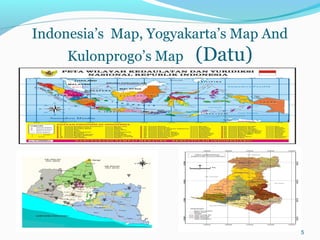
Indonesia’s Map, Yogyakarta’s Map And
Kulonprogo’s Map

(Datu)

5
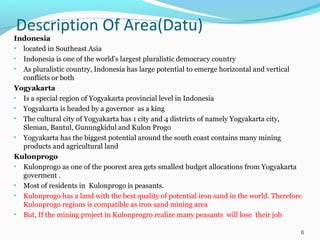
Description Of Area(Datu)

Indonesia
• located in Southeast Asia
• Indonesia is one of the world's largest pluralistic democracy country
• As pluralistic country, Indonesia has large potential to emerge horizontal and vertical
conflicts or both
Yogyakarta
• Is a special region of Yogyakarta provincial level in Indonesia
• Yogyakarta is headed by a governor as a king
• The cultural city of Yogyakarta has 1 city and 4 districts of namely Yogyakarta city,
Sleman, Bantul, Gunungkidul and Kulon Progo
• Yogyakarta has the biggest potential around the south coast contains many mining
products and agricultural land
Kulonprogo
• Kulonprogo as one of the poorest area gets smallest budget allocations from Yogyakarta
goverment .
• Most of residents in Kulonprogo is peasants.
• Kulonprogo has a land with the best quality of potential iron sand in the world. Therefore
Kulonprogo regions is compatible as iron sand mining area
• But, If the mining project in Kulonprogro realize many peasants will lose their job
6
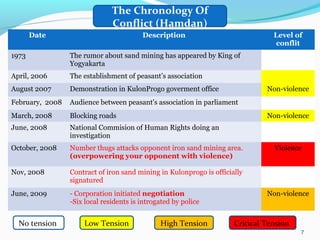
The Chronology Of
Conflict (Hamdan)
Date

Description

Level of
conflit

1973

The rumor about sand mining has appeared by King of
Yogyakarta

April, 2006

The establishment of peasant’s association

August 2007

Demonstration in KulonProgo goverment office

February, 2008

Audience between peasant's association in parliament

March, 2008

Blocking roads

June, 2008

National Commision of Human Rights doing an
investigation

October, 2008

Number thugs attacks opponent iron sand mining area.
(overpowering your opponent with violence)

Nov, 2008

Contract of iron sand mining in Kulonprogo is officially
signatured

June, 2009

- Corporation initiated neg0tiation
-Six local residents is introgated by police

No tension

Low Tension

Non-violence

Non-violence

High Tension

Violence

Non-violence

Critical Tension
7
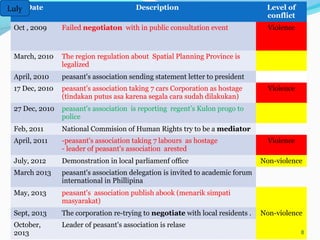
Luly Date

Description

Oct , 2009

Failed negotiaton with in public consultation event

March, 2010

The region regulation about Spatial Planning Province is
legalized

April, 2010

peasant's association sending statement letter to president

17 Dec, 2010

peasant's association taking 7 cars Corporation as hostage
(tindakan putus asa karena segala cara sudah dilakukan)

27 Dec, 2010

peasant's association is reporting regent’s Kulon progo to
police

Feb, 2011

National Commision of Human Rights try to be a mediator

April, 2011

-peasant's association taking 7 labours as hostage
- leader of peasant's association arested

July, 2012

Demonstration in local parliamenf office

March 2013

peasant's association delegation is invited to academic forum
international in Phillipina

May, 2013

peasant's association publish abook (menarik simpati
masyarakat)

Sept, 2013

The corporation re-trying to negotiate with local residents .

October,
2013

Level of
conflict
Violence

Leader of peasant's association is relase

Violence

Violence
Non-violence

Non-violence
8
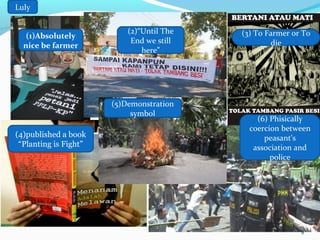
Luly
(1)Absolutely
nice be farmer

(2)“Until The
End we still
here”

(5)Demonstration
symbol
(4)published a book
“Planting is Fight”

(3) To Farmer or To
die

(6) Phisically
coercion between
peasant's
association and
police

9
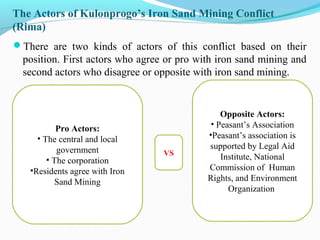
The Actors of Kulonprogo’s Iron Sand Mining Conflict
(Rima)
There are two kinds of actors of this conflict based on their

position. First actors who agree or pro with iron sand mining and
second actors who disagree or opposite with iron sand mining.

Pro Actors:
• The central and local
government
• The corporation
•Residents agree with Iron
Sand Mining

VS

Opposite Actors:
• Peasant’s Association
•Peasant’s association is
supported by Legal Aid
Institute, National
Commission of Human
Rights, and Environment
Organization
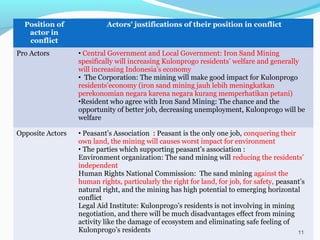
Position of
actor in
conflict

Actors’ justifications of their position in conflict

Pro Actors

• Central Government and Local Government: Iron Sand Mining
spesifically will increasing Kulonprogo residents’ welfare and generally
will increasing Indonesia’s economy
• The Corporation: The mining will make good impact for Kulonprogo
residents’economy (iron sand mining jauh lebih meningkatkan
perekonomian negara karena negara kurang memperhatikan petani)
•Resident who agree with Iron Sand Mining: The chance and the
opportunity of better job, decreasing unemployment, Kulonprogo will be
welfare

Opposite Actors

• Peasant’s Association : Peasant is the only one job, conquering their
own land, the mining will causes worst impact for environment
• The parties which supporting peasant’s association :
Environment organization: The sand mining will reducing the residents’
independent
Human Rights National Commission: The sand mining against the
human rights, particularly the right for land, for job, for safety, peasant’s
natural right, and the mining has high potential to emerging horizontal
conflict
Legal Aid Institute: Kulonprogo’s residents is not involving in mining
negotiation, and there will be much disadvantages effect from mining
activity like the damage of ecosystem and eliminating safe feeling of
Kulonprogo’s residents
11
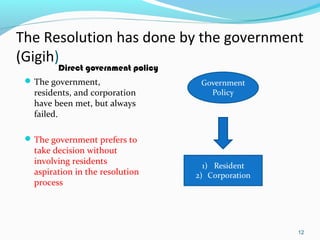
The Resolution has done by the government
(Gigih)
Direct government policy

 The government,

residents, and corporation
have been met, but always
failed.

 The government prefers to

take decision without
involving residents
aspiration in the resolution
process

12
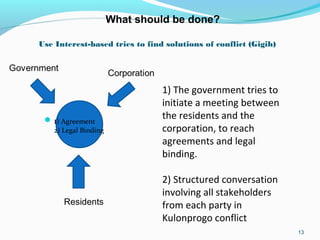
What should be done?
Use Interest-based tries to find solutions of conflict (Gigih)

 1) Agreement

2) Legal Binding

Residents

1) The government tries to
initiate a meeting between
the residents and the
corporation, to reach
agreements and legal
binding.
2) Structured conversation
involving all stakeholders
from each party in
Kulonprogo conflict
13
Final Remark (Gigih)
It’s necessary and important to make policy which

regulate the rights of local residents in short and long
term, with considering all dimensions of the conflict.
Not using threats, violence, authoritarian, as a ways of
handling problems, to resolve issues of conflict, and
prioritized dialogue.

14
References
 Book:

Furlong, Gary T. 2005. The Conflict Resolution Toolbox. Canada: John Wiley &
Sons Canada Ltd.
 Website:
kulonprogokab.go.id
jogjaprov.go.id
Tempointeraktif.com
Nasional.kompas.com
Independent.academia.edu/abwidyanta
Suaramerdeka.com
 Picture:
Petacitra.blospot.com

15
16

Konflik Pasir Besi Kulonprogo

  • 1.
    Datu Jatmiko Gigih WahyuP Hamdan Hamdani Luly Triningsih Nanda Harda P.M Rima N. Banurea 1
  • 2.
    Peace and Conflict(Nanda) How to stops conflicts Traditional approach, there are some methods; 1. Surrendering 2. Running away 3. Overpowering the opponents with violence 4. Compromise But all of them only produce zero sum situations Conflict’s resolution methods 1. 2. 3. 4. Negotiation Mediation Arbitration Stakeholder Dialogue 2
  • 3.
    Interest/Rights/ Power Model (Nanda) Wecan see conflict from 3 perspectives (interest, rights, and power) (Furlong, 2005:110). Interest-based tries to find solutions of conflict from the interests between the parties. Right-based tries to find solutions of conflict using the superiority of one party to another party. Power-based tries to find solutions of conflict using all power that the parties have to achieve “win”. (semakin memunculkan konflik) 3
  • 4.
    Violence and Non-Violence (Nanda) Typesof violence 1. Direct violence 2. Structural violence 3. Cultural violence But there are another options with using non violence strategies; 1. Protest and persuasion 2. Social, economic, and political non cooperation 4
  • 5.
    Indonesia’s Map, Yogyakarta’sMap And Kulonprogo’s Map (Datu) 5
  • 6.
    Description Of Area(Datu) Indonesia •located in Southeast Asia • Indonesia is one of the world's largest pluralistic democracy country • As pluralistic country, Indonesia has large potential to emerge horizontal and vertical conflicts or both Yogyakarta • Is a special region of Yogyakarta provincial level in Indonesia • Yogyakarta is headed by a governor as a king • The cultural city of Yogyakarta has 1 city and 4 districts of namely Yogyakarta city, Sleman, Bantul, Gunungkidul and Kulon Progo • Yogyakarta has the biggest potential around the south coast contains many mining products and agricultural land Kulonprogo • Kulonprogo as one of the poorest area gets smallest budget allocations from Yogyakarta goverment . • Most of residents in Kulonprogo is peasants. • Kulonprogo has a land with the best quality of potential iron sand in the world. Therefore Kulonprogo regions is compatible as iron sand mining area • But, If the mining project in Kulonprogro realize many peasants will lose their job 6
  • 7.
    The Chronology Of Conflict(Hamdan) Date Description Level of conflit 1973 The rumor about sand mining has appeared by King of Yogyakarta April, 2006 The establishment of peasant’s association August 2007 Demonstration in KulonProgo goverment office February, 2008 Audience between peasant's association in parliament March, 2008 Blocking roads June, 2008 National Commision of Human Rights doing an investigation October, 2008 Number thugs attacks opponent iron sand mining area. (overpowering your opponent with violence) Nov, 2008 Contract of iron sand mining in Kulonprogo is officially signatured June, 2009 - Corporation initiated neg0tiation -Six local residents is introgated by police No tension Low Tension Non-violence Non-violence High Tension Violence Non-violence Critical Tension 7
  • 8.
    Luly Date Description Oct ,2009 Failed negotiaton with in public consultation event March, 2010 The region regulation about Spatial Planning Province is legalized April, 2010 peasant's association sending statement letter to president 17 Dec, 2010 peasant's association taking 7 cars Corporation as hostage (tindakan putus asa karena segala cara sudah dilakukan) 27 Dec, 2010 peasant's association is reporting regent’s Kulon progo to police Feb, 2011 National Commision of Human Rights try to be a mediator April, 2011 -peasant's association taking 7 labours as hostage - leader of peasant's association arested July, 2012 Demonstration in local parliamenf office March 2013 peasant's association delegation is invited to academic forum international in Phillipina May, 2013 peasant's association publish abook (menarik simpati masyarakat) Sept, 2013 The corporation re-trying to negotiate with local residents . October, 2013 Level of conflict Violence Leader of peasant's association is relase Violence Violence Non-violence Non-violence 8
  • 9.
    Luly (1)Absolutely nice be farmer (2)“UntilThe End we still here” (5)Demonstration symbol (4)published a book “Planting is Fight” (3) To Farmer or To die (6) Phisically coercion between peasant's association and police 9
  • 10.
    The Actors ofKulonprogo’s Iron Sand Mining Conflict (Rima) There are two kinds of actors of this conflict based on their position. First actors who agree or pro with iron sand mining and second actors who disagree or opposite with iron sand mining. Pro Actors: • The central and local government • The corporation •Residents agree with Iron Sand Mining VS Opposite Actors: • Peasant’s Association •Peasant’s association is supported by Legal Aid Institute, National Commission of Human Rights, and Environment Organization
  • 11.
    Position of actor in conflict Actors’justifications of their position in conflict Pro Actors • Central Government and Local Government: Iron Sand Mining spesifically will increasing Kulonprogo residents’ welfare and generally will increasing Indonesia’s economy • The Corporation: The mining will make good impact for Kulonprogo residents’economy (iron sand mining jauh lebih meningkatkan perekonomian negara karena negara kurang memperhatikan petani) •Resident who agree with Iron Sand Mining: The chance and the opportunity of better job, decreasing unemployment, Kulonprogo will be welfare Opposite Actors • Peasant’s Association : Peasant is the only one job, conquering their own land, the mining will causes worst impact for environment • The parties which supporting peasant’s association : Environment organization: The sand mining will reducing the residents’ independent Human Rights National Commission: The sand mining against the human rights, particularly the right for land, for job, for safety, peasant’s natural right, and the mining has high potential to emerging horizontal conflict Legal Aid Institute: Kulonprogo’s residents is not involving in mining negotiation, and there will be much disadvantages effect from mining activity like the damage of ecosystem and eliminating safe feeling of Kulonprogo’s residents 11
  • 12.
    The Resolution hasdone by the government (Gigih) Direct government policy  The government, residents, and corporation have been met, but always failed.  The government prefers to take decision without involving residents aspiration in the resolution process 12
  • 13.
    What should bedone? Use Interest-based tries to find solutions of conflict (Gigih)  1) Agreement 2) Legal Binding Residents 1) The government tries to initiate a meeting between the residents and the corporation, to reach agreements and legal binding. 2) Structured conversation involving all stakeholders from each party in Kulonprogo conflict 13
  • 14.
    Final Remark (Gigih) It’snecessary and important to make policy which regulate the rights of local residents in short and long term, with considering all dimensions of the conflict. Not using threats, violence, authoritarian, as a ways of handling problems, to resolve issues of conflict, and prioritized dialogue. 14
  • 15.
    References  Book: Furlong, GaryT. 2005. The Conflict Resolution Toolbox. Canada: John Wiley & Sons Canada Ltd.  Website: kulonprogokab.go.id jogjaprov.go.id Tempointeraktif.com Nasional.kompas.com Independent.academia.edu/abwidyanta Suaramerdeka.com  Picture: Petacitra.blospot.com 15
  • 16.

Editor's Notes