
Presented By :
 Agnes K.
 Azka M.
 M. Rizqo
* Chapter 14 : Conflict and Negotiation
Our Discussion ???
Definition of Conflict
Transitions in Conflict Thought
Type of Conflict
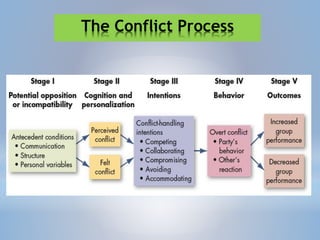
The Conflict Process
Definition of Negotiation
Bargaining Strategies
The Negotiation Process
Third-Party Negotiations
Definition of Conflict
Conflict is A process that begins when one party
perceives that another party has negatively affected, or is
about to negatively affect, something that the first party
cares about.
Point of conflict occurs when the interaction
"crosses over" to become an interparty conflict.
Encompasses a wide range of conflicts that people
experience in organizations :
*Incompatibility of goals
*Differences over interpretations of facts
*Disagreements based on behavioral expectations
Transitions in Conflict Thought
a) Traditional view of conflict is The belief
that all conflict is harmful and must be
avoided.
This conflict is also called the
“dysfunctional conflict “ or
negative conflict
This conflict is viewed negatively,
Example: violence, destruction, irrationality to
reinforce negative connotations.
Transitions in Conflict Thought
b) Interactionist view of conflict is The belief
that conflict is not only a positive force in
a group but also an absolute necessity for a
group to perform effectively.
This conflict is also called the
“functional conflict “ or
positive conflict
This conflict is viewed positively,
Example: harmonious, peaceful, calm and not
responsive to the need for change and
innovation.
Type of Conflict
*Task Conflict
Conflicts over content and goals of the work
*Relationship Conflict
Conflict based on interpersonal relationships
*Process Conflict
Conflict over how work gets done
The Conflict Process
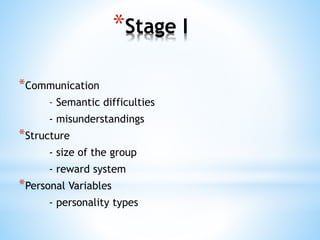
*Stage I
*Communication
- Semantic difficulties
- misunderstandings
*Structure
- size of the group
- reward system
*Personal Variables
- personality types
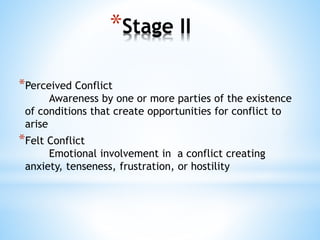
*Stage II
*Perceived Conflict
Awareness by one or more parties of the existence
of conditions that create opportunities for conflict to
arise
*Felt Conflict
Emotional involvement in a conflict creating
anxiety, tenseness, frustration, or hostility
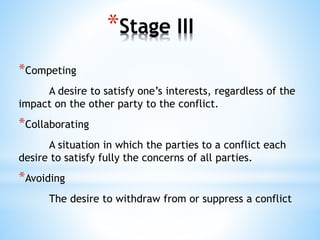
*Stage III
*Competing
A desire to satisfy one’s interests, regardless of the
impact on the other party to the conflict.
*Collaborating
A situation in which the parties to a conflict each
desire to satisfy fully the concerns of all parties.
*Avoiding
The desire to withdraw from or suppress a conflict
*Accommodating
The willingness of one party in a conflict to place
the opponent’s interests above his or her own.
*Compromising
A situation in which each party to a conflict is willing
to give up something
*Stage IV
*Party’s behaviour
*Other reactions
*Stage V
*Functional Outcomes from Conflict
*Improved the quality of decisions
*Stimulates creativity and innovation
*Dysfunctional Outcomes from Conflict
*Reduced group effectiveness
*Reduced group cohesiveness
Definition of Negotiation
Negotiation is A process in which two or more
parties exchange goods or services and attempt to agree
on the exchange rate for them.
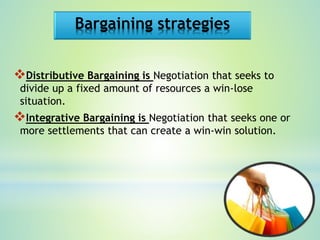
Bargaining strategies
Distributive Bargaining is Negotiation that seeks to
divide up a fixed amount of resources a win-lose
situation.
Integrative Bargaining is Negotiation that seeks one or
more settlements that can create a win-win solution.
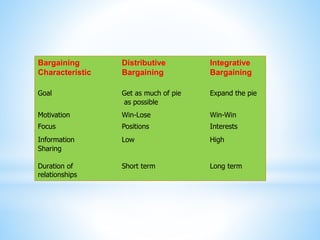
Bargaining Distributive Integrative
Characteristic Bargaining Bargaining
Goal Get as much of pie Expand the pie
as possible
Motivation Win-Lose Win-Win
Focus Positions Interests
Information Low High
Sharing
Duration of Short term Long term
relationships
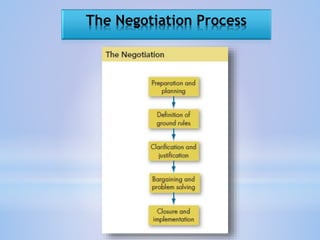
The Negotiation Process
Third-Party Negotiations
Mediator is A neutral third party who facilitates a
negotiated solution by using reasoning, persuasion, and
suggestions for alternatives.
Arbitrator is A third party to a negotiation who has the
authority to dictate an agreement.
Conciliator A trusted third party who provides an informal
communication link between the negotiator and the
opponent.
Organization Behavior - Ch 14 Conflict & Negotiation

Organization Behavior - Ch 14 Conflict & Negotiation

  • 1.
    Presented By : Agnes K.  Azka M.  M. Rizqo * Chapter 14 : Conflict and Negotiation
  • 2.
    Our Discussion ??? Definitionof Conflict Transitions in Conflict Thought Type of Conflict The Conflict Process Definition of Negotiation Bargaining Strategies The Negotiation Process Third-Party Negotiations
  • 3.
    Definition of Conflict Conflictis A process that begins when one party perceives that another party has negatively affected, or is about to negatively affect, something that the first party cares about.
  • 4.
    Point of conflictoccurs when the interaction "crosses over" to become an interparty conflict. Encompasses a wide range of conflicts that people experience in organizations : *Incompatibility of goals *Differences over interpretations of facts *Disagreements based on behavioral expectations
  • 5.
    Transitions in ConflictThought a) Traditional view of conflict is The belief that all conflict is harmful and must be avoided. This conflict is also called the “dysfunctional conflict “ or negative conflict This conflict is viewed negatively, Example: violence, destruction, irrationality to reinforce negative connotations.
  • 6.
    Transitions in ConflictThought b) Interactionist view of conflict is The belief that conflict is not only a positive force in a group but also an absolute necessity for a group to perform effectively. This conflict is also called the “functional conflict “ or positive conflict This conflict is viewed positively, Example: harmonious, peaceful, calm and not responsive to the need for change and innovation.
  • 7.
    Type of Conflict *TaskConflict Conflicts over content and goals of the work *Relationship Conflict Conflict based on interpersonal relationships *Process Conflict Conflict over how work gets done
  • 8.
  • 9.
    *Stage I *Communication - Semanticdifficulties - misunderstandings *Structure - size of the group - reward system *Personal Variables - personality types
  • 10.
    *Stage II *Perceived Conflict Awarenessby one or more parties of the existence of conditions that create opportunities for conflict to arise *Felt Conflict Emotional involvement in a conflict creating anxiety, tenseness, frustration, or hostility
  • 11.
    *Stage III *Competing A desireto satisfy one’s interests, regardless of the impact on the other party to the conflict. *Collaborating A situation in which the parties to a conflict each desire to satisfy fully the concerns of all parties. *Avoiding The desire to withdraw from or suppress a conflict
  • 12.
    *Accommodating The willingness ofone party in a conflict to place the opponent’s interests above his or her own. *Compromising A situation in which each party to a conflict is willing to give up something
  • 13.
  • 14.
    *Stage V *Functional Outcomesfrom Conflict *Improved the quality of decisions *Stimulates creativity and innovation *Dysfunctional Outcomes from Conflict *Reduced group effectiveness *Reduced group cohesiveness
  • 15.
    Definition of Negotiation Negotiationis A process in which two or more parties exchange goods or services and attempt to agree on the exchange rate for them.
  • 16.
    Bargaining strategies Distributive Bargainingis Negotiation that seeks to divide up a fixed amount of resources a win-lose situation. Integrative Bargaining is Negotiation that seeks one or more settlements that can create a win-win solution.
  • 17.
    Bargaining Distributive Integrative CharacteristicBargaining Bargaining Goal Get as much of pie Expand the pie as possible Motivation Win-Lose Win-Win Focus Positions Interests Information Low High Sharing Duration of Short term Long term relationships
  • 18.
  • 19.
    Third-Party Negotiations Mediator isA neutral third party who facilitates a negotiated solution by using reasoning, persuasion, and suggestions for alternatives. Arbitrator is A third party to a negotiation who has the authority to dictate an agreement. Conciliator A trusted third party who provides an informal communication link between the negotiator and the opponent.