TRANSPORTATION PROBLEM
       Transportation problem is one of the subclasses of LPP’s in which the objective is to
transport various quantities of a single homogeneous commodity, that are initially stored at
various origins to different destinations in such a way that the total transportation cost is
minimum. To achieve this objective we must know the amount and location of available
supplies and the quantities demanded. In addition, we must know the costs that result from
transporting one unit of commodity from various origins to various destinations.

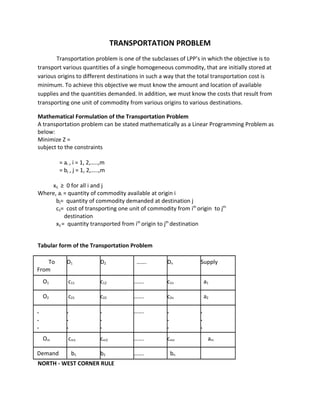
Mathematical Formulation of the Transportation Problem
A transportation problem can be stated mathematically as a Linear Programming Problem as
below:
Minimize Z =
subject to the constraints

         = ai , i = 1, 2,…..,m
         = bj , j = 1, 2,…..,m

    xij ≥ 0 for all i and j
Where, ai = quantity of commodity available at origin i
      bj= quantity of commodity demanded at destination j
      cij= cost of transporting one unit of commodity from ith origin to jth
           destination
      xij = quantity transported from ith origin to jth destination


Tabular form of the Transportation Problem

    To      D1             D2          …….          Dn           Supply
From
    O1       c11           c12        …….           c1n              a1

    O2       c21           c22        …….           c2n              a2

.           .              .          …….           .            .
.           .              .                        .            .
.           .              .                        .            .
    Om       cm1           cm2        …….           cmn               am

Demand          b1         b2         …….               bn
NORTH - WEST CORNER RULE
Step1:Identify the cell at North-West corner of the transportation        matrix.
Step2:Allocate as many units as possible to that cell without      exceeding      supply or
demand; then cross out the row       or column that is exhausted by this assignment
Step3:Reduce the amount of corresponding supply or          demand which is more by allocated
amount.
Step4:Again identify the North-West corner cell of reduced         transportation matrix.
Step5:Repeat Step2 and Step3 until all the rim       requirements are satisfied.

Vogel’s Approximation Method (VAM)

Step-I: Compute the penalty values for each row and each column. The penalty will be
        equal to the difference between the two smallest shipping costs in the row or column.
Step-II: Identify the row or column with the largest penalty. Find the first basic variable which
        has the smallest shipping cost in that row or        column. Then assign the highest
possible        value to that variable, and cross-out the row       or column which is
exhausted.
Step-III: Compute new penalties and repeat the        same procedure until all the rim
        requirements are satisfied.


An example for Vogel’s Method
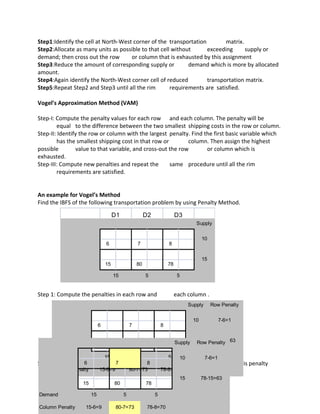
Find the IBFS of the following transportation problem by using Penalty Method.

                                      D1                 D2                 D3
                                                                                      Supply


                                                                                         10
                                 6                  7                  8


                                                                                         15
                                 15                 80                 78

                                      15                 5                   5


Step 1: Compute the penalties in each row and                               each column .
                                                                                   Supply     Row Penalty


                                                                                    10              7-6=1
                            6                  7                  8


                                                                            Supply 15     78-15=63
                                                                                    Row Penalty
                            15                 80                 78

      Demand                     15                 5                  5      10            7-6=1
Step 2: Identify the largest penalty and choose least cost cell to corresponding this penalty
                   6            7           8
      Column Penalty        15-6=9             80-7=73            78-8=70
                                                                              15         78-15=63
                  15                  80                 78

Demand                 15                  5                  5

Column Penalty     15-6=9              80-7=73            78-8=70
Step-3: Allocate the amount 5 which is minimum of corresponding row supply and column
demand and then cross out column2
                                                                                       Supply        Row Penalty

                                                       5
                                                                                          10            7-6=1
                           6                  7                     8


                                                                                          15          78-15=63
                           15              80                       78

  Demand                        15                 5                     5

  Column Penalty            15-6=9            80-7=73               78-8=70


Step-4: Recalculate the penalties
                                                                             Supply   Row Penalty
                                                   5
                                                                               5         8-6=2
                                6         7                8

                                                                              15       78-15=63
                                15        80               78

          Demand                     15        X                5

          Column Penalty        15-6=9                     78-8=70


                                                                                      Supply        Row Penalty

                                                       5
                                                                                         5             8-6=2
Step-5: Identify the6largest penalty and choose least cost cell to corresponding this penalty
                                7           8


                                                                                        15           78-15=63
                      15                  80                    78

 Demand                        15                 X                      5

 Column Penalty            15-6=9                                   78-8=70
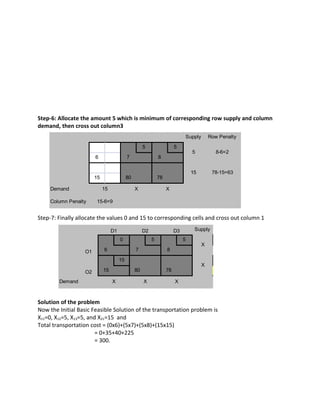
Step-6: Allocate the amount 5 which is minimum of corresponding row supply and column
demand, then cross out column3
                                                                             Supply       Row Penalty

                                                     5                  5
                                                                                 5           8-6=2
                       6                   7                  8


                                                                                 15        78-15=63
                       15                  80                 78

     Demand                 15                  X                  X

     Column Penalty    15-6=9


Step-7: Finally allocate the values 0 and 15 to corresponding cells and cross out column 1

                                 D1                  D2                 D3        Supply

                                      0                   5                  5
                                                                                      X
                  O1        6                   7                  8

                                      15
                                                                                      X
                  O2        15                  80                 78

        Demand                   X                   X                  X


Solution of the problem
Now the Initial Basic Feasible Solution of the transportation problem is
X11=0, X12=5, X13=5, and X21=15 and
Total transportation cost = (0x6)+(5x7)+(5x8)+(15x15)
                        = 0+35+40+225
                        = 300.

Transportation Problem

  • 1.
    TRANSPORTATION PROBLEM Transportation problem is one of the subclasses of LPP’s in which the objective is to transport various quantities of a single homogeneous commodity, that are initially stored at various origins to different destinations in such a way that the total transportation cost is minimum. To achieve this objective we must know the amount and location of available supplies and the quantities demanded. In addition, we must know the costs that result from transporting one unit of commodity from various origins to various destinations. Mathematical Formulation of the Transportation Problem A transportation problem can be stated mathematically as a Linear Programming Problem as below: Minimize Z = subject to the constraints = ai , i = 1, 2,…..,m = bj , j = 1, 2,…..,m xij ≥ 0 for all i and j Where, ai = quantity of commodity available at origin i bj= quantity of commodity demanded at destination j cij= cost of transporting one unit of commodity from ith origin to jth destination xij = quantity transported from ith origin to jth destination Tabular form of the Transportation Problem To D1 D2 ……. Dn Supply From O1 c11 c12 ……. c1n a1 O2 c21 c22 ……. c2n a2 . . . ……. . . . . . . . . . . . . Om cm1 cm2 ……. cmn am Demand b1 b2 ……. bn NORTH - WEST CORNER RULE
  • 2.
    Step1:Identify the cellat North-West corner of the transportation matrix. Step2:Allocate as many units as possible to that cell without exceeding supply or demand; then cross out the row or column that is exhausted by this assignment Step3:Reduce the amount of corresponding supply or demand which is more by allocated amount. Step4:Again identify the North-West corner cell of reduced transportation matrix. Step5:Repeat Step2 and Step3 until all the rim requirements are satisfied. Vogel’s Approximation Method (VAM) Step-I: Compute the penalty values for each row and each column. The penalty will be equal to the difference between the two smallest shipping costs in the row or column. Step-II: Identify the row or column with the largest penalty. Find the first basic variable which has the smallest shipping cost in that row or column. Then assign the highest possible value to that variable, and cross-out the row or column which is exhausted. Step-III: Compute new penalties and repeat the same procedure until all the rim requirements are satisfied. An example for Vogel’s Method Find the IBFS of the following transportation problem by using Penalty Method. D1 D2 D3 Supply 10 6 7 8 15 15 80 78 15 5 5 Step 1: Compute the penalties in each row and each column . Supply Row Penalty 10 7-6=1 6 7 8 Supply 15 78-15=63 Row Penalty 15 80 78 Demand 15 5 5 10 7-6=1 Step 2: Identify the largest penalty and choose least cost cell to corresponding this penalty 6 7 8 Column Penalty 15-6=9 80-7=73 78-8=70 15 78-15=63 15 80 78 Demand 15 5 5 Column Penalty 15-6=9 80-7=73 78-8=70
  • 3.
    Step-3: Allocate theamount 5 which is minimum of corresponding row supply and column demand and then cross out column2 Supply Row Penalty 5 10 7-6=1 6 7 8 15 78-15=63 15 80 78 Demand 15 5 5 Column Penalty 15-6=9 80-7=73 78-8=70 Step-4: Recalculate the penalties Supply Row Penalty 5 5 8-6=2 6 7 8 15 78-15=63 15 80 78 Demand 15 X 5 Column Penalty 15-6=9 78-8=70 Supply Row Penalty 5 5 8-6=2 Step-5: Identify the6largest penalty and choose least cost cell to corresponding this penalty 7 8 15 78-15=63 15 80 78 Demand 15 X 5 Column Penalty 15-6=9 78-8=70
  • 4.
    Step-6: Allocate theamount 5 which is minimum of corresponding row supply and column demand, then cross out column3 Supply Row Penalty 5 5 5 8-6=2 6 7 8 15 78-15=63 15 80 78 Demand 15 X X Column Penalty 15-6=9 Step-7: Finally allocate the values 0 and 15 to corresponding cells and cross out column 1 D1 D2 D3 Supply 0 5 5 X O1 6 7 8 15 X O2 15 80 78 Demand X X X Solution of the problem Now the Initial Basic Feasible Solution of the transportation problem is X11=0, X12=5, X13=5, and X21=15 and Total transportation cost = (0x6)+(5x7)+(5x8)+(15x15) = 0+35+40+225 = 300.