Robbins & Judge
Organizational Behavior
13th Edition
Perception and Individual
Decision Making
Perception and Individual
Decision Making
Copyright © 2011 Pearson Education, Inc. publishing as Prentice Hall
6-1
Robbins & Judge
Organizational Behavior
13th Edition
Copyright © 2011 Pearson Education, Inc. publishing as Prentice Hall 6-2
Robbins & Judge
Organizational Behavior
13th Edition
Copyright © 2011 Pearson Education, Inc. publishing as Prentice Hall 6-3
5
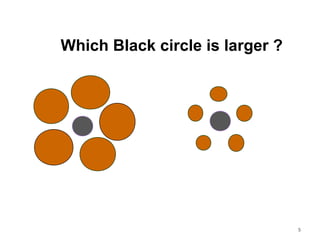
Which Black circle is larger ?
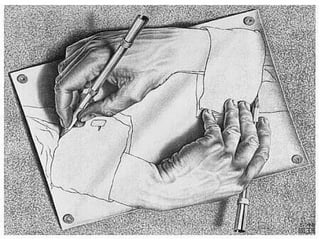
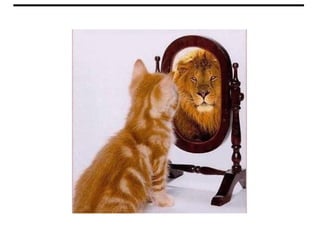
What is Perception?What is Perception?
 A process by which individuals organize and interpret their
sensory impressions in order to give meaning to their
environment.
 People’s behavior is based on their perception of what
reality is, not on reality itself.
 The world as it is perceived is the world that is
behaviorally important.
Copyright © 2011 Pearson Education, Inc. publishing as Prentice Hall 6-6
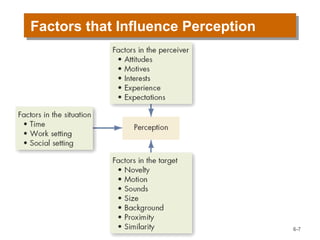
Factors that Influence PerceptionFactors that Influence Perception
6-7
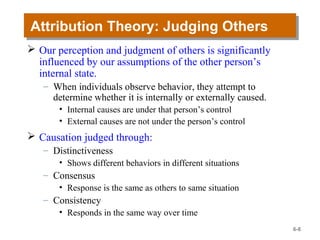
Attribution Theory: Judging OthersAttribution Theory: Judging Others
 Our perception and judgment of others is significantly
influenced by our assumptions of the other person’s
internal state.
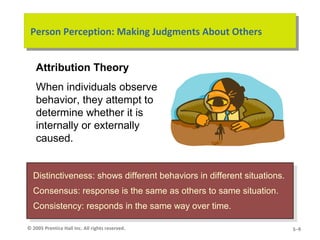
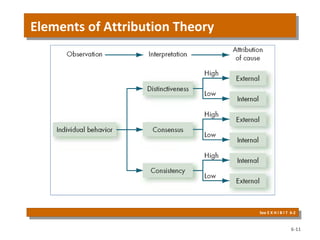
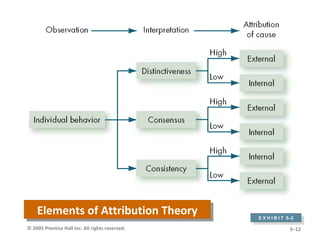
– When individuals observe behavior, they attempt to
determine whether it is internally or externally caused.
• Internal causes are under that person’s control
• External causes are not under the person’s control
 Causation judged through:
– Distinctiveness
• Shows different behaviors in different situations
– Consensus
• Response is the same as others to same situation
– Consistency
• Responds in the same way over time
6-8
© 2005 Prentice Hall Inc. All rights reserved. 5–9
Person Perception: Making Judgments About OthersPerson Perception: Making Judgments About Others
Distinctiveness: shows different behaviors in different situations.
Consensus: response is the same as others to same situation.
Consistency: responds in the same way over time.
Distinctiveness: shows different behaviors in different situations.
Consensus: response is the same as others to same situation.
Consistency: responds in the same way over time.
Attribution Theory
When individuals observe
behavior, they attempt to
determine whether it is
internally or externally
caused.
10
Attribution TheoryAttribution Theory
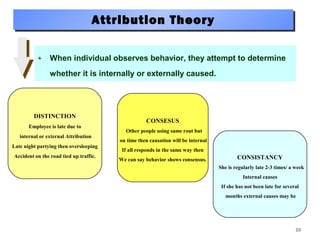
When individual observes behavior, they attempt to determine
whether it is internally or externally caused.
DISTINCTION
Employee is late due to
internal or external Attribution
Late night partying then oversleeping
Accident on the road tied up traffic.
CONSESUS
Other people using same rout but
on time then causation will be internal
If all responds in the same way then
We can say behavior shows consensus. CONSISTANCY
She is regularly late 2-3 times/ a week
Internal causes
If she has not been late for several
months external causes may be
Elements of Attribution TheoryElements of Attribution Theory
6-11
See E X H I B I T 6-2
© 2005 Prentice Hall Inc. All rights reserved. 5–12
Elements of Attribution TheoryElements of Attribution Theory
E X H I B I T 5–2
E X H I B I T 5–2
Errors and Biases in AttributionsErrors and Biases in Attributions
 Fundamental Attribution Error
– The tendency to underestimate the influence of
external factors and overestimate the influence of
internal factors when making judgments about the
behavior of others
– We blame people first, not the situation
 Self-Serving Bias
– The tendency for individuals to attribute their own
successes to internal factors while putting the blame
for failures on external factors
– It is “our” success but “their” failure
Copyright © 2011 Pearson Education, Inc. publishing as Prentice Hall 6-13
Frequently Used Shortcuts in Judging OthersFrequently Used Shortcuts in Judging Others
 Selective Perception
– People selectively interpret what they
see on the basis of their interests,
background, experience, and attitudes
 Halo Effect
– Drawing a general impression about an
individual on the basis of a single
characteristic
 Contrast Effects
– Evaluation of a person’s characteristics
that are affected by comparisons with
other people recently encountered who
rank higher or lower on the same
characteristics
6-14
Another Shortcut: StereotypingAnother Shortcut: Stereotyping
Judging someone on the basis of one’s
perception of the group to which that person
belongs – a prevalent and often useful, if not
always accurate, generalization
Profiling
– A form of stereotyping in which members of a
group are singled out for intense scrutiny based on
a single, often racial, trait.
6-15
Specific Shortcut Applications in OrganizationsSpecific Shortcut Applications in Organizations
 Employment Interview
– Perceptual biases of raters affect the accuracy of
interviewers’ judgments of applicants
– Formed in a single glance – 1/10 of a second!
 Performance Expectations
– Self-fulfilling prophecy (Pygmalion effect): The lower or
higher performance of employees reflects preconceived
leader expectations about employee capabilities
 Performance Evaluations
– Appraisals are often the subjective (judgmental)
perceptions of appraisers of another employee’s job
performance
– Critical impact on employees
6-16
Perceptions and Individual Decision MakingPerceptions and Individual Decision Making
 Problem
– A perceived discrepancy between the
current state of affairs and a desired state
 Decisions
– Choices made from among alternatives
developed from data
 Perception Linkage:
– All elements of problem identification and
the decision-making process are influenced
by perception.
• Problems must be recognized
• Data must be selected and evaluated
6-17
Decision-Making Models in OrganizationsDecision-Making Models in Organizations
 Rational Decision Making
– The “perfect world” model: assumes complete
information, all options known, and maximum payoff
– Six-step decision-making process
 Bounded Reality
– The “real world” model: seeks satisfactory and
sufficient solutions from limited data and alternatives
 Intuition
– A non-conscious process created from distilled
experience that results in quick decisions
• Relies on holistic associations
• Affectively charged – engaging the emotions
6-18
Common Biases and Errors in Decision MakingCommon Biases and Errors in Decision Making
 Overconfidence Bias
– Believing too much in our own ability to make good
decisions – especially when outside of own expertise
 Anchoring Bias
– Using early, first received information as the basis for
making subsequent judgments
 Confirmation Bias
– Selecting and using only facts that support our decision
 Availability Bias
– Emphasizing information that is most readily at hand
• Recent
• Vivid (bright)
6-19
More Common Decision-Making ErrorsMore Common Decision-Making Errors
 Escalation of Commitment
– Increasing commitment to a decision in spite of evidence
that it is wrong – especially if responsible for the decision!
 Randomness Error
– Creating meaning out of random events – superstitions
 Winner’s Curse
– The winner’s curse is when the value of something is
overestimated
– Highest bidder pays too much due to value overestimation
 Hindsight Bias
– After an outcome is already known, believing it could have
been accurately predicted beforehand
6-20
Individual Differences in Decision MakingIndividual Differences in Decision Making
 Personality
– Conscientiousness may effect escalation of commitment
• Achievement strivers are likely to increase commitment
• Dutiful people are less likely to have this bias
– Self-Esteem
• High self-esteem people are susceptible to self-serving bias
• Women analyze decisions more than men – rumination
• Differences develop early
 Mental Ability
6-21
 Gender
Organizational ConstraintsOrganizational Constraints
 Performance Evaluation
– Managerial evaluation criteria influence actions
 Reward Systems
– Managers will make the decision with the greatest
personal payoff for them
 Formal Regulations
– Limit the alternative choices of decision makers
 System-Imposed Time Constraints
– Restrict ability to gather or evaluate information
 Historical Precedents
– Past decisions influence current decisions
6-22
Ethics in Decision MakingEthics in Decision Making
 Ethical Decision Criteria
– Utilitarianism
• Decisions made based solely on the outcome
• Seeking the greatest good for the greatest number
• Dominant method for businesspeople
– Rights
• Decisions consistent with fundamental liberties and
privileges
• Respecting and protecting basic rights of individuals
such as whistleblowers
– Justice
• Imposing and enforcing rules fairly and impartially
• Equitable distribution of benefits and costs
6-23
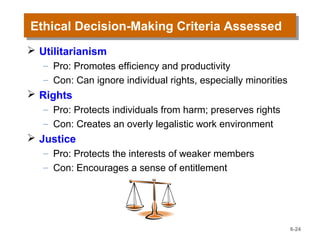
Ethical Decision-Making Criteria AssessedEthical Decision-Making Criteria Assessed
 Utilitarianism
– Pro: Promotes efficiency and productivity
– Con: Can ignore individual rights, especially minorities
 Rights
– Pro: Protects individuals from harm; preserves rights
– Con: Creates an overly legalistic work environment
 Justice
– Pro: Protects the interests of weaker members
– Con: Encourages a sense of entitlement
6-24
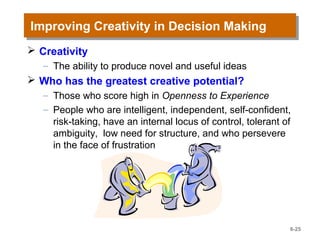
Improving Creativity in Decision MakingImproving Creativity in Decision Making
 Creativity
– The ability to produce novel and useful ideas
 Who has the greatest creative potential?
– Those who score high in Openness to Experience
– People who are intelligent, independent, self-confident,
risk-taking, have an internal locus of control, tolerant of
ambiguity, low need for structure, and who persevere
in the face of frustration
6-25
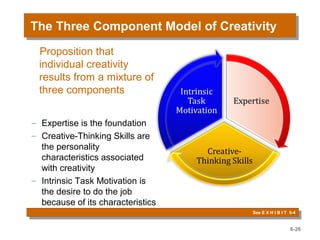
The Three Component Model of CreativityThe Three Component Model of Creativity
Proposition that
individual creativity
results from a mixture of
three components
– Expertise is the foundation
– Creative-Thinking Skills are
the personality
characteristics associated
with creativity
– Intrinsic Task Motivation is
the desire to do the job
because of its characteristics
6-26
See E X H I B I T 5-4
Global ImplicationsGlobal Implications
 Attributions
– There are cultural differences in the ways people
attribute cause to observed behavior
 Decision Making
– No research on the topic: assumption of “no difference”
– Based on our awareness of cultural differences in traits
that affect decision making, this assumption is suspect
 Ethics
– No global ethical standards exist
– Asian countries tend not to see ethical issues in “black
and white” but as shades of gray
– Global companies need global standards for managers
6-27
Summary and Managerial ImplicationsSummary and Managerial Implications
 Perception:
– People act based on how they view their world
– What exists is not as important as what is believed
– Managers must also manage perception
 Individual Decision Making
– Most use bounded rationality: they satisfy
– Combine traditional methods with intuition and
creativity for better decisions
• Analyze the situation and adjust to culture and
organizational reward criteria
• Be aware of, and minimize, biases
6-28
6-29
ThanksThanks

Organizational Behaviour Stephen Robbins 14Ed. Chapter 6

  • 1.
    Robbins & Judge OrganizationalBehavior 13th Edition Perception and Individual Decision Making Perception and Individual Decision Making Copyright © 2011 Pearson Education, Inc. publishing as Prentice Hall 6-1
  • 2.
    Robbins & Judge OrganizationalBehavior 13th Edition Copyright © 2011 Pearson Education, Inc. publishing as Prentice Hall 6-2
  • 3.
    Robbins & Judge OrganizationalBehavior 13th Edition Copyright © 2011 Pearson Education, Inc. publishing as Prentice Hall 6-3
  • 5.
  • 6.
    What is Perception?Whatis Perception?  A process by which individuals organize and interpret their sensory impressions in order to give meaning to their environment.  People’s behavior is based on their perception of what reality is, not on reality itself.  The world as it is perceived is the world that is behaviorally important. Copyright © 2011 Pearson Education, Inc. publishing as Prentice Hall 6-6
  • 7.
    Factors that InfluencePerceptionFactors that Influence Perception 6-7
  • 8.
    Attribution Theory: JudgingOthersAttribution Theory: Judging Others  Our perception and judgment of others is significantly influenced by our assumptions of the other person’s internal state. – When individuals observe behavior, they attempt to determine whether it is internally or externally caused. • Internal causes are under that person’s control • External causes are not under the person’s control  Causation judged through: – Distinctiveness • Shows different behaviors in different situations – Consensus • Response is the same as others to same situation – Consistency • Responds in the same way over time 6-8
  • 9.
    © 2005 PrenticeHall Inc. All rights reserved. 5–9 Person Perception: Making Judgments About OthersPerson Perception: Making Judgments About Others Distinctiveness: shows different behaviors in different situations. Consensus: response is the same as others to same situation. Consistency: responds in the same way over time. Distinctiveness: shows different behaviors in different situations. Consensus: response is the same as others to same situation. Consistency: responds in the same way over time. Attribution Theory When individuals observe behavior, they attempt to determine whether it is internally or externally caused.
  • 10.
    10 Attribution TheoryAttribution Theory Whenindividual observes behavior, they attempt to determine whether it is internally or externally caused. DISTINCTION Employee is late due to internal or external Attribution Late night partying then oversleeping Accident on the road tied up traffic. CONSESUS Other people using same rout but on time then causation will be internal If all responds in the same way then We can say behavior shows consensus. CONSISTANCY She is regularly late 2-3 times/ a week Internal causes If she has not been late for several months external causes may be
  • 11.
    Elements of AttributionTheoryElements of Attribution Theory 6-11 See E X H I B I T 6-2 See E X H I B I T 6-2
  • 12.
    © 2005 PrenticeHall Inc. All rights reserved. 5–12 Elements of Attribution TheoryElements of Attribution Theory E X H I B I T 5–2 E X H I B I T 5–2
  • 13.
    Errors and Biasesin AttributionsErrors and Biases in Attributions  Fundamental Attribution Error – The tendency to underestimate the influence of external factors and overestimate the influence of internal factors when making judgments about the behavior of others – We blame people first, not the situation  Self-Serving Bias – The tendency for individuals to attribute their own successes to internal factors while putting the blame for failures on external factors – It is “our” success but “their” failure Copyright © 2011 Pearson Education, Inc. publishing as Prentice Hall 6-13
  • 14.
    Frequently Used Shortcutsin Judging OthersFrequently Used Shortcuts in Judging Others  Selective Perception – People selectively interpret what they see on the basis of their interests, background, experience, and attitudes  Halo Effect – Drawing a general impression about an individual on the basis of a single characteristic  Contrast Effects – Evaluation of a person’s characteristics that are affected by comparisons with other people recently encountered who rank higher or lower on the same characteristics 6-14
  • 15.
    Another Shortcut: StereotypingAnotherShortcut: Stereotyping Judging someone on the basis of one’s perception of the group to which that person belongs – a prevalent and often useful, if not always accurate, generalization Profiling – A form of stereotyping in which members of a group are singled out for intense scrutiny based on a single, often racial, trait. 6-15
  • 16.
    Specific Shortcut Applicationsin OrganizationsSpecific Shortcut Applications in Organizations  Employment Interview – Perceptual biases of raters affect the accuracy of interviewers’ judgments of applicants – Formed in a single glance – 1/10 of a second!  Performance Expectations – Self-fulfilling prophecy (Pygmalion effect): The lower or higher performance of employees reflects preconceived leader expectations about employee capabilities  Performance Evaluations – Appraisals are often the subjective (judgmental) perceptions of appraisers of another employee’s job performance – Critical impact on employees 6-16
  • 17.
    Perceptions and IndividualDecision MakingPerceptions and Individual Decision Making  Problem – A perceived discrepancy between the current state of affairs and a desired state  Decisions – Choices made from among alternatives developed from data  Perception Linkage: – All elements of problem identification and the decision-making process are influenced by perception. • Problems must be recognized • Data must be selected and evaluated 6-17
  • 18.
    Decision-Making Models inOrganizationsDecision-Making Models in Organizations  Rational Decision Making – The “perfect world” model: assumes complete information, all options known, and maximum payoff – Six-step decision-making process  Bounded Reality – The “real world” model: seeks satisfactory and sufficient solutions from limited data and alternatives  Intuition – A non-conscious process created from distilled experience that results in quick decisions • Relies on holistic associations • Affectively charged – engaging the emotions 6-18
  • 19.
    Common Biases andErrors in Decision MakingCommon Biases and Errors in Decision Making  Overconfidence Bias – Believing too much in our own ability to make good decisions – especially when outside of own expertise  Anchoring Bias – Using early, first received information as the basis for making subsequent judgments  Confirmation Bias – Selecting and using only facts that support our decision  Availability Bias – Emphasizing information that is most readily at hand • Recent • Vivid (bright) 6-19
  • 20.
    More Common Decision-MakingErrorsMore Common Decision-Making Errors  Escalation of Commitment – Increasing commitment to a decision in spite of evidence that it is wrong – especially if responsible for the decision!  Randomness Error – Creating meaning out of random events – superstitions  Winner’s Curse – The winner’s curse is when the value of something is overestimated – Highest bidder pays too much due to value overestimation  Hindsight Bias – After an outcome is already known, believing it could have been accurately predicted beforehand 6-20
  • 21.
    Individual Differences inDecision MakingIndividual Differences in Decision Making  Personality – Conscientiousness may effect escalation of commitment • Achievement strivers are likely to increase commitment • Dutiful people are less likely to have this bias – Self-Esteem • High self-esteem people are susceptible to self-serving bias • Women analyze decisions more than men – rumination • Differences develop early  Mental Ability 6-21  Gender
  • 22.
    Organizational ConstraintsOrganizational Constraints Performance Evaluation – Managerial evaluation criteria influence actions  Reward Systems – Managers will make the decision with the greatest personal payoff for them  Formal Regulations – Limit the alternative choices of decision makers  System-Imposed Time Constraints – Restrict ability to gather or evaluate information  Historical Precedents – Past decisions influence current decisions 6-22
  • 23.
    Ethics in DecisionMakingEthics in Decision Making  Ethical Decision Criteria – Utilitarianism • Decisions made based solely on the outcome • Seeking the greatest good for the greatest number • Dominant method for businesspeople – Rights • Decisions consistent with fundamental liberties and privileges • Respecting and protecting basic rights of individuals such as whistleblowers – Justice • Imposing and enforcing rules fairly and impartially • Equitable distribution of benefits and costs 6-23
  • 24.
    Ethical Decision-Making CriteriaAssessedEthical Decision-Making Criteria Assessed  Utilitarianism – Pro: Promotes efficiency and productivity – Con: Can ignore individual rights, especially minorities  Rights – Pro: Protects individuals from harm; preserves rights – Con: Creates an overly legalistic work environment  Justice – Pro: Protects the interests of weaker members – Con: Encourages a sense of entitlement 6-24
  • 25.
    Improving Creativity inDecision MakingImproving Creativity in Decision Making  Creativity – The ability to produce novel and useful ideas  Who has the greatest creative potential? – Those who score high in Openness to Experience – People who are intelligent, independent, self-confident, risk-taking, have an internal locus of control, tolerant of ambiguity, low need for structure, and who persevere in the face of frustration 6-25
  • 26.
    The Three ComponentModel of CreativityThe Three Component Model of Creativity Proposition that individual creativity results from a mixture of three components – Expertise is the foundation – Creative-Thinking Skills are the personality characteristics associated with creativity – Intrinsic Task Motivation is the desire to do the job because of its characteristics 6-26 See E X H I B I T 5-4 See E X H I B I T 5-4
  • 27.
    Global ImplicationsGlobal Implications Attributions – There are cultural differences in the ways people attribute cause to observed behavior  Decision Making – No research on the topic: assumption of “no difference” – Based on our awareness of cultural differences in traits that affect decision making, this assumption is suspect  Ethics – No global ethical standards exist – Asian countries tend not to see ethical issues in “black and white” but as shades of gray – Global companies need global standards for managers 6-27
  • 28.
    Summary and ManagerialImplicationsSummary and Managerial Implications  Perception: – People act based on how they view their world – What exists is not as important as what is believed – Managers must also manage perception  Individual Decision Making – Most use bounded rationality: they satisfy – Combine traditional methods with intuition and creativity for better decisions • Analyze the situation and adjust to culture and organizational reward criteria • Be aware of, and minimize, biases 6-28
  • 29.