eleventh editio
                                 n


organizational         behavio
           r


           stephen p. robbins
Chapter 9


                            Understanding
                            Work Teams

              ORGANIZATIONAL BEHAVIOR
                             S T E P H E N P. R O B B I N S
                                 E L E V E N T H   E D I T I O N
© 2005 Prentice Hall Inc.        WWW.PRENHALL.COM/ROBBINS          PowerPoint Presentation
All rights reserved.                                                      by Charlie Cook
After studying this chapter,
O B J E C T I V E S


                       you should be able to:

                        1. Explain the growing popularity of teams in
                           organizations.
                        2. Contrast teams with groups.
L E A R N I N G


                        3. Identify four types of teams.
                        4. Specify the characteristics of effective teams.
                        5. Explain how organizations can create team
                           players.
                        6. Describe conditions under which teams are
                             preferred over individuals.
                      © 2005 Prentice Hall Inc.
                      All rights reserved.                           9–3
Why Have Teams Become So Popular

 Teams typically outperform individuals.
 Teams use employee talents better.
 Teams are more flexible and responsive to
  changes in the environment.
 Teams facilitate employee involvement.
 Teams are an effective way to democratize and
  organization and increase motivation.


© 2005 Prentice Hall Inc.
All rights reserved.                          9–4
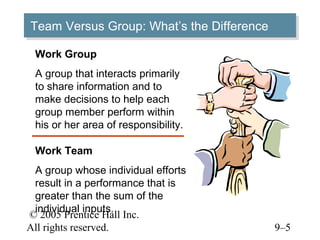
Team Versus Group: What’s the Difference
 Work Group
 A group that interacts primarily
 to share information and to
 make decisions to help each
 group member perform within
 his or her area of responsibility.

 Work Team
 A group whose individual efforts
 result in a performance that is
 greater than the sum of the
 individual inputs.
© 2005 Prentice Hall Inc.
All rights reserved.                       9–5
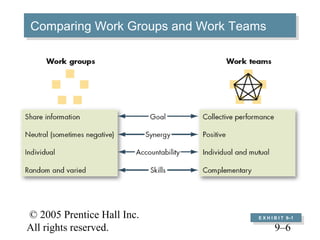
Comparing Work Groups and Work Teams


© 2005 Prentice Hall Inc.         E X H I B I T 9–1
                                   E X H I B I T 9–1
All rights reserved.                     9–6
Types of Teams
Types of Teams

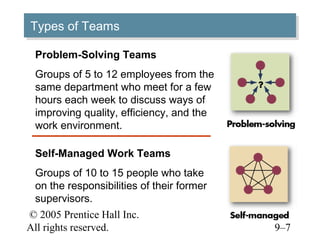
 Problem-Solving Teams
 Groups of 5 to 12 employees from the
 same department who meet for a few
 hours each week to discuss ways of
 improving quality, efficiency, and the
 work environment.

 Self-Managed Work Teams
 Groups of 10 to 15 people who take
 on the responsibilities of their former
 supervisors.
© 2005 Prentice Hall Inc.
All rights reserved.                       9–7
Types of Teams (cont’d)
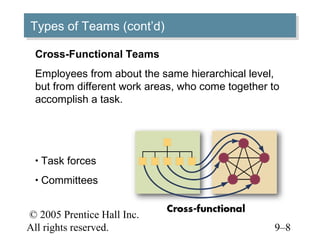
 Cross-Functional Teams
 Employees from about the same hierarchical level,
 but from different work areas, who come together to
 accomplish a task.


 • Task forces

 • Committees


© 2005 Prentice Hall Inc.
All rights reserved.                               9–8
Types of Teams (cont’d)

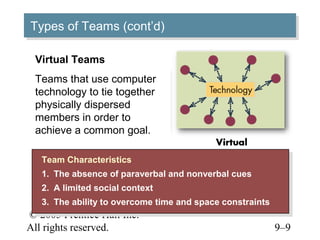
 Virtual Teams
 Teams that use computer
 technology to tie together
 physically dispersed
 members in order to
 achieve a common goal.

   Team Characteristics
    Team Characteristics
   1. The absence of paraverbal and nonverbal cues
    1. The absence of paraverbal and nonverbal cues
   2. A limited social context
    2. A limited social context
   3. The ability to overcome time and space constraints
    3. The ability to overcome time and space constraints
© 2005 Prentice Hall Inc.
All rights reserved.                                        9–9
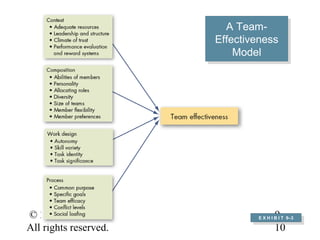
A Team-
                               A Team-
                            Effectiveness
                            Effectiveness
                                Model
                                Model


© 2005 Prentice Hall Inc.                  9–
                                    E X H I B I T 9–3
                                     E X H I B I T 9–3
All rights reserved.                       10
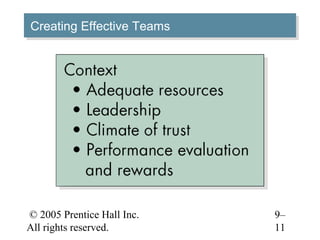
Creating Effective Teams


© 2005 Prentice Hall Inc.   9–
All rights reserved.        11
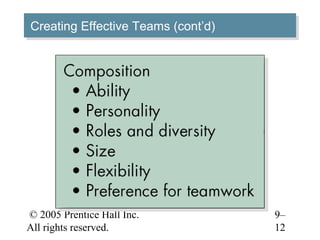
Creating Effective Teams (cont’d)


© 2005 Prentice Hall Inc.           9–
All rights reserved.                12
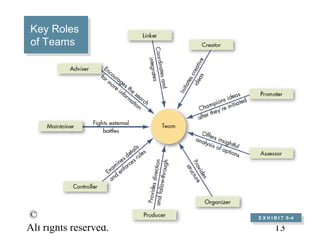
Key Roles
Key Roles
of Teams
of Teams


© 2005 Prentice Hall Inc.          9–
                            E X H I B I T 9–4
                             E X H I B I T 9–4
All rights reserved.               13
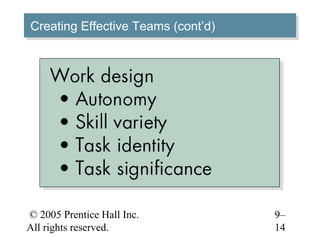
Creating Effective Teams (cont’d)


© 2005 Prentice Hall Inc.           9–
All rights reserved.                14
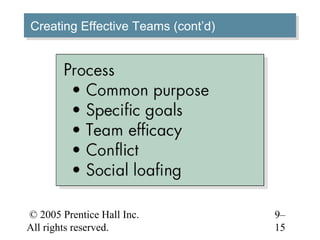
Creating Effective Teams (cont’d)


© 2005 Prentice Hall Inc.           9–
All rights reserved.                15
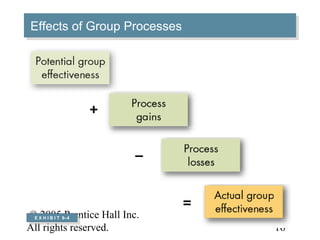
Effects of Group Processes
 Effects of Group Processes


                 +


                              –


                                  =
©EX2005T9–4
 E H I B I T Prentice Hall Inc.
   X H I B I 9–4
                                      9–
All rights reserved.                  16
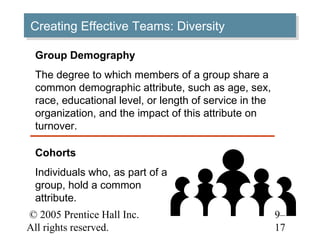
Creating Effective Teams: Diversity

 Group Demography
 The degree to which members of a group share a
 common demographic attribute, such as age, sex,
 race, educational level, or length of service in the
 organization, and the impact of this attribute on
 turnover.

 Cohorts
 Individuals who, as part of a
 group, hold a common
 attribute.
© 2005 Prentice Hall Inc.                               9–
All rights reserved.                                    17
Turning Individuals Into Team Players
 The Challenges
    – Overcoming individual resistance to team membership.
    – Countering the influence of individualistic cultures.
    – Introducing teams in an organization that has
      historically valued individual achievement.
 Shaping Team Players
    – Selecting employees who can fulfill their team roles.
    – Training employees to become team players.
   – Reworking the reward system to encourage
     cooperative efforts while continuing to recognize
     individual contributions.
© 2005 Prentice Hall Inc.                                     9–
All rights reserved.                                          18
Teams and Quality Management
 Team Effectiveness and Quality Management
  Requires That Teams:
   1. Are small enough to be efficient and effective.
   2. Are properly trained in required skills.
   3. Allocated enough time to work on problems.
   4. Are given authority to resolve problems and take
      corrective action.
   5. Have a designated “champion” to call on when
      needed.


© 2005 Prentice Hall Inc.                                9–
All rights reserved.                                     19
Beware: Teams Aren’t Always the Answer
 Three tests to see if a team fits the situation:
   – Is the work complex and is there a need for different
     perspectives?
   – Does the work create a common purpose or set of
     goals for the group that is larger than the aggregate of
     the goals for individuals?
   – Are members of the group involved in interdependent
     tasks?


© 2005 Prentice Hall Inc.                                 9–
All rights reserved.                                      20

Understanding work teams

  • 1.
    eleventh editio n organizational behavio r stephen p. robbins
  • 2.
    Chapter 9 Understanding Work Teams ORGANIZATIONAL BEHAVIOR S T E P H E N P. R O B B I N S E L E V E N T H E D I T I O N © 2005 Prentice Hall Inc. WWW.PRENHALL.COM/ROBBINS PowerPoint Presentation All rights reserved. by Charlie Cook
  • 3.
    After studying thischapter, O B J E C T I V E S you should be able to: 1. Explain the growing popularity of teams in organizations. 2. Contrast teams with groups. L E A R N I N G 3. Identify four types of teams. 4. Specify the characteristics of effective teams. 5. Explain how organizations can create team players. 6. Describe conditions under which teams are preferred over individuals. © 2005 Prentice Hall Inc. All rights reserved. 9–3
  • 4.
    Why Have TeamsBecome So Popular Why Have Teams Become So Popular  Teams typically outperform individuals.  Teams use employee talents better.  Teams are more flexible and responsive to changes in the environment.  Teams facilitate employee involvement.  Teams are an effective way to democratize and organization and increase motivation. © 2005 Prentice Hall Inc. All rights reserved. 9–4
  • 5.
    Team Versus Group:What’s the Difference Team Versus Group: What’s the Difference Work Group A group that interacts primarily to share information and to make decisions to help each group member perform within his or her area of responsibility. Work Team A group whose individual efforts result in a performance that is greater than the sum of the individual inputs. © 2005 Prentice Hall Inc. All rights reserved. 9–5
  • 6.
    Comparing Work Groupsand Work Teams Comparing Work Groups and Work Teams © 2005 Prentice Hall Inc. E X H I B I T 9–1 E X H I B I T 9–1 All rights reserved. 9–6
  • 7.
    Types of Teams Typesof Teams Problem-Solving Teams Groups of 5 to 12 employees from the same department who meet for a few hours each week to discuss ways of improving quality, efficiency, and the work environment. Self-Managed Work Teams Groups of 10 to 15 people who take on the responsibilities of their former supervisors. © 2005 Prentice Hall Inc. All rights reserved. 9–7
  • 8.
    Types of Teams(cont’d) Types of Teams (cont’d) Cross-Functional Teams Employees from about the same hierarchical level, but from different work areas, who come together to accomplish a task. • Task forces • Committees © 2005 Prentice Hall Inc. All rights reserved. 9–8
  • 9.
    Types of Teams(cont’d) Types of Teams (cont’d) Virtual Teams Teams that use computer technology to tie together physically dispersed members in order to achieve a common goal. Team Characteristics Team Characteristics 1. The absence of paraverbal and nonverbal cues 1. The absence of paraverbal and nonverbal cues 2. A limited social context 2. A limited social context 3. The ability to overcome time and space constraints 3. The ability to overcome time and space constraints © 2005 Prentice Hall Inc. All rights reserved. 9–9
  • 10.
    A Team- A Team- Effectiveness Effectiveness Model Model © 2005 Prentice Hall Inc. 9– E X H I B I T 9–3 E X H I B I T 9–3 All rights reserved. 10
  • 11.
    Creating Effective Teams CreatingEffective Teams © 2005 Prentice Hall Inc. 9– All rights reserved. 11
  • 12.
    Creating Effective Teams(cont’d) Creating Effective Teams (cont’d) © 2005 Prentice Hall Inc. 9– All rights reserved. 12
  • 13.
    Key Roles Key Roles ofTeams of Teams © 2005 Prentice Hall Inc. 9– E X H I B I T 9–4 E X H I B I T 9–4 All rights reserved. 13
  • 14.
    Creating Effective Teams(cont’d) Creating Effective Teams (cont’d) © 2005 Prentice Hall Inc. 9– All rights reserved. 14
  • 15.
    Creating Effective Teams(cont’d) Creating Effective Teams (cont’d) © 2005 Prentice Hall Inc. 9– All rights reserved. 15
  • 16.
    Effects of GroupProcesses Effects of Group Processes + – = ©EX2005T9–4 E H I B I T Prentice Hall Inc. X H I B I 9–4 9– All rights reserved. 16
  • 17.
    Creating Effective Teams:Diversity Creating Effective Teams: Diversity Group Demography The degree to which members of a group share a common demographic attribute, such as age, sex, race, educational level, or length of service in the organization, and the impact of this attribute on turnover. Cohorts Individuals who, as part of a group, hold a common attribute. © 2005 Prentice Hall Inc. 9– All rights reserved. 17
  • 18.
    Turning Individuals IntoTeam Players Turning Individuals Into Team Players  The Challenges – Overcoming individual resistance to team membership. – Countering the influence of individualistic cultures. – Introducing teams in an organization that has historically valued individual achievement.  Shaping Team Players – Selecting employees who can fulfill their team roles. – Training employees to become team players. – Reworking the reward system to encourage cooperative efforts while continuing to recognize individual contributions. © 2005 Prentice Hall Inc. 9– All rights reserved. 18
  • 19.
    Teams and QualityManagement Teams and Quality Management  Team Effectiveness and Quality Management Requires That Teams: 1. Are small enough to be efficient and effective. 2. Are properly trained in required skills. 3. Allocated enough time to work on problems. 4. Are given authority to resolve problems and take corrective action. 5. Have a designated “champion” to call on when needed. © 2005 Prentice Hall Inc. 9– All rights reserved. 19
  • 20.
    Beware: Teams Aren’tAlways the Answer Beware: Teams Aren’t Always the Answer  Three tests to see if a team fits the situation: – Is the work complex and is there a need for different perspectives? – Does the work create a common purpose or set of goals for the group that is larger than the aggregate of the goals for individuals? – Are members of the group involved in interdependent tasks? © 2005 Prentice Hall Inc. 9– All rights reserved. 20