Management                                                            tenth edition


   Stephen P. Robbins                                                  Mary Coulter


                        Chapter
                                                 Managers
                        14                       and
                                                 Communications
Copyright © 2010 Pearson Education, Inc. Publishing as Prentice Hall                    14–1
Learning Outcomes
 Follow this Learning Outline as you read and study
 this chapter.
 14.1 The Nature and Function of Communication
       • Define communication, interpersonal communication and
         organizational communication
       • Discuss the functions of communication.
 14.2 Methods of Interpersonal Communication
       • Describe the components of the communication process.
       • Discuss the criteria that managers can use to evaluate
         the various communication methods.
       • List the communication methods managers might use.


Copyright © 2010 Pearson Education, Inc. Publishing as Prentice Hall   14–2
Learning Outcomes
14.3 Effective Interpersonal Communication
     • Explain the barriers to effective interpersonal
     • Discuss ways to overcome the barriers to effective
       interpersonal communication.
14.4 Organizational Communication
     • Contrast formal and informal communication.
     • Explain communication flow in an organization.
     • Describe the three common communication networks.
     • Discuss how managers should handle the grapevine.


Copyright © 2010 Pearson Education, Inc. Publishing as Prentice Hall   14–3
Learning Outcomes
 14.5 Information Technology and Communication
       • Describe how technology affects managerial communication.
       • Explain how information technology affects organizations.
 14.6 Communication Issues In Today’s Organization
       • Discuss the challenges of managing communication in an
         Internet world.
       • Explain how organizations can manage knowledge.
       • Explain why communicating with customers is an important
         managerial issue.
       • Explain how political correctness is affecting communication.


Copyright © 2010 Pearson Education, Inc. Publishing as Prentice Hall     14–4
What Is Communication?
 • Communication
        The transfer and understanding of meaning.
              Transfer means the message was received in a form that can
               be interpreted by the receiver.
              Understanding the message is not the same as the receiver
               agreeing with the message.
        Interpersonal Communication
                Communication between two or more people
        Organizational Communication
                All the patterns, network, and systems of communications
                 within an organization


Copyright © 2010 Pearson Education, Inc. Publishing as Prentice Hall        14–5
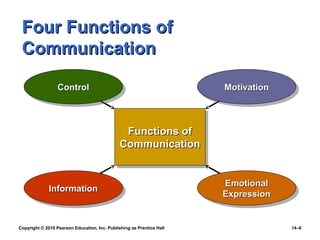
Four Functions of
 Communication

                  Control
                  Control                                              Motivation
                                                                       Motivation


                                                Functions of
                                                 Functions of
                                               Communication
                                               Communication


                                                                       Emotional
                                                                        Emotional
              Information
               Information                                             Expression
                                                                       Expression


Copyright © 2010 Pearson Education, Inc. Publishing as Prentice Hall                14–6
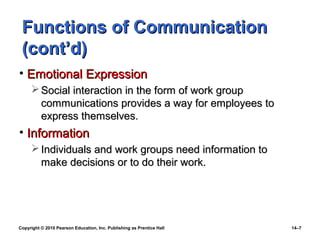
Functions of Communication
 (cont’d)
• Emotional Expression
      Social interaction in the form of work group
       communications provides a way for employees to
       express themselves.
• Information
      Individuals and work groups need information to
       make decisions or to do their work.


Copyright © 2010 Pearson Education, Inc. Publishing as Prentice Hall   14–7
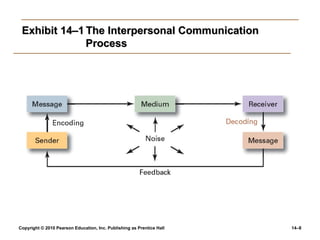
Exhibit 14–1 The Interpersonal Communication
              Process


Copyright © 2010 Pearson Education, Inc. Publishing as Prentice Hall   14–8
Interpersonal Communication
 • Message
        Source: sender’s intended meaning
 • Encoding
        The message converted to symbolic form
 • Channel
        The medium through which the message travels
 • Decoding
        The receiver’s retranslation of the message
 • Noise
        Disturbances that interfere with communications


Copyright © 2010 Pearson Education, Inc. Publishing as Prentice Hall   14–9
Distortions in Communications
 • Message Encoding
        The effect of the skills, attitudes, and knowledge of
         the sender on the process of encoding the message
        The social-cultural system of the sender
 • The Message
        Symbols used to convey the message’s meaning
        The content of the message itself
        The choice of message format
        Noise interfering with the message


Copyright © 2010 Pearson Education, Inc. Publishing as Prentice Hall   14–10
Distortions in Communications
 (cont’d)
 • The Channel
        The sender’s choice of the appropriate channel or
         multiple channels for conveying the message
 • Receiver
        The effect of skills, attitudes, and knowledge of the
         receiver on the process of decoding the message
        The social-cultural system of the receiver
 • Feedback Loop
        Communication channel distortions affecting the
         return message from receiver to sender
Copyright © 2010 Pearson Education, Inc. Publishing as Prentice Hall   14–11
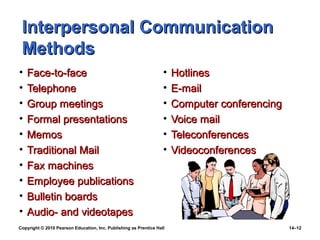
Interpersonal Communication
 Methods
•   Face-to-face                                                   •   Hotlines
•   Telephone                                                      •   E-mail
•   Group meetings                                                 •   Computer conferencing
•   Formal presentations                                           •   Voice mail
•   Memos                                                          •   Teleconferences
•   Traditional Mail                                               •   Videoconferences
•   Fax machines
•   Employee publications
•   Bulletin boards
•   Audio- and videotapes
Copyright © 2010 Pearson Education, Inc. Publishing as Prentice Hall                           14–12
Evaluating Communication
 Methods
• Feedback                                                         • Time-space constraint
• Complexity capacity                                              • Cost
• Breadth potential                                                • Interpersonal warmth
• Confidentiality                                                  • Formality
• Encoding ease                                                    • Scanability
• Decoding ease                                                    • Time consumption


Copyright © 2010 Pearson Education, Inc. Publishing as Prentice Hall                        14–13
Interpersonal Communication
 (cont’d)
• Nonverbal Communication
      Communication that is transmitted without words.
               Sounds with specific meanings or warnings
               Images that control or encourage behaviors
               Situational behaviors that convey meanings
               Clothing and physical surroundings that imply status
      Body language: gestures, facial expressions, and
       other body movements that convey meaning.
      Verbal intonation: emphasis that a speaker gives to
       certain words or phrases that conveys meaning.
Copyright © 2010 Pearson Education, Inc. Publishing as Prentice Hall   14–14
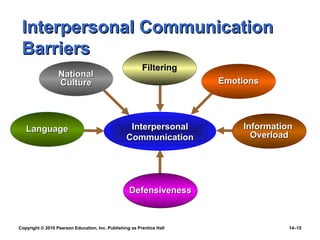
Interpersonal Communication
 Barriers
                                                         Filtering
                  National
                  Culture                                              Emotions


   Language                                        Interpersonal           Information
                                                  Communication              Overload


                                                   Defensiveness


Copyright © 2010 Pearson Education, Inc. Publishing as Prentice Hall                 14–15
Barriers to Effective
 Interpersonal Communication
 • Filtering
        The deliberate manipulation of information to make it
         appear more favorable to the receiver.
 • Emotions
        Disregarding rational and objective thinking
         processes and substituting emotional judgments
         when interpreting messages.
 • Information Overload
        Being confronted with a quantity of information that
         exceeds an individual’s capacity to process it.

Copyright © 2010 Pearson Education, Inc. Publishing as Prentice Hall   14–16
Barriers to Effective
Interpersonal Communication
(cont’d)
• Defensiveness
      When threatened, reacting in a way that reduces the
       ability to achieve mutual understanding.
• Language
      The different meanings of and specialized ways
       (jargon) in which senders use words can cause
       receivers to misinterpret their messages.
• National Culture
      Culture influences the form, formality, openness,
       patterns, and use of information in communications.
Copyright © 2010 Pearson Education, Inc. Publishing as Prentice Hall   14–17
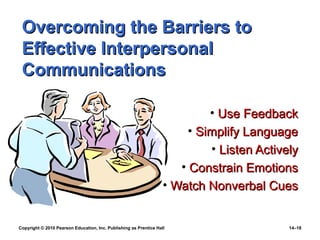
Overcoming the Barriers to
 Effective Interpersonal
 Communications

                                                                            • Use Feedback
                                                                        • Simplify Language
                                                                            • Listen Actively
                                                                       • Constrain Emotions
                                                                   • Watch Nonverbal Cues


Copyright © 2010 Pearson Education, Inc. Publishing as Prentice Hall                       14–18
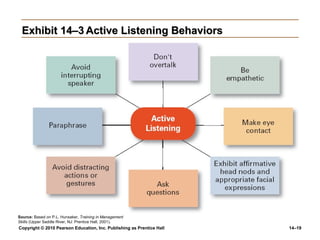
Exhibit 14–3 Active Listening Behaviors


Source: Based on P.L. Hunsaker, Training in Management
Skills (Upper Saddle River, NJ: Prentice Hall, 2001).
Copyright © 2010 Pearson Education, Inc. Publishing as Prentice Hall   14–19
Types of Organizational
 Communication
• Formal Communication
     Communication that follows the official chain of
      command or is part of the communication required to
      do one’s job.
• Informal Communication
     Communication that is not defined by the
      organization’s structural hierarchy.
              Permits employees to satisfy their need for social interaction.
              Can improve an organization’s performance by creating
               faster and more effective channels of communication.

Copyright © 2010 Pearson Education, Inc. Publishing as Prentice Hall         14–20
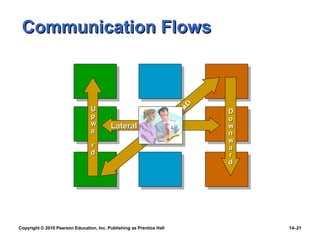
Communication Flows


                                                                             iD
                                 U                                         oga    D
                                 p                                     l an       o
                                 w         Lateral                                w
                                 a                                                n
                                                                                  w
                                 r                                                a
                                 d                                                r
                                                                                  d


Copyright © 2010 Pearson Education, Inc. Publishing as Prentice Hall                  14–21
Direction of Communication
 Flow
 • Downward
        Communications that flow from managers to
         employees to inform, direct, coordinate, and evaluate
         employees.
 • Upward
        Communications that flow from employees up to
         managers to keep them aware of employee needs
         and how things can be improved to create a climate
         of trust and respect.


Copyright © 2010 Pearson Education, Inc. Publishing as Prentice Hall   14–22
Direction of Communication
 Flow (cont’d)
• Lateral (Horizontal) Communication
      Communication that takes place among employees
       on the same level in the organization to save time and
       facilitate coordination.
• Diagonal Communication
      Communication that cuts across both work areas and
       organizational levels in the interest of efficiency and
       speed.


Copyright © 2010 Pearson Education, Inc. Publishing as Prentice Hall   14–23
Types of Organizational
 Communication Networks
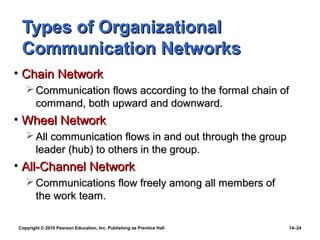
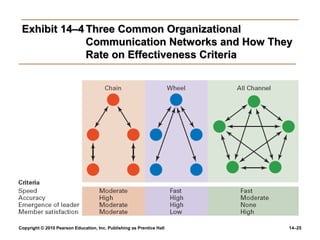
• Chain Network
    Communication flows according to the formal chain of
     command, both upward and downward.
• Wheel Network
    All communication flows in and out through the group
     leader (hub) to others in the group.
• All-Channel Network
    Communications flow freely among all members of
     the work team.

Copyright © 2010 Pearson Education, Inc. Publishing as Prentice Hall   14–24
Exhibit 14–4 Three Common Organizational
              Communication Networks and How They
              Rate on Effectiveness Criteria


Copyright © 2010 Pearson Education, Inc. Publishing as Prentice Hall   14–25
The Grapevine
 • An informal organizational communication
   network that is active in almost every
   organization.
        Provides a channel for issues not suitable for formal
         communication channels.
        The impact of information passed along the grapevine
         can be countered by open and honest communication
         with employees.


Copyright © 2010 Pearson Education, Inc. Publishing as Prentice Hall   14–26
Terms to Know
 • communication                                                       •   body language
 • interpersonal                                                       •   verbal intonation
   communication                                                       •   filtering
 • organizational                                                      •   selective perception
   communication                                                       •   information overload
 • message                                                             •   jargon
 • encoding                                                            •   active listening
 • channel                                                             •   formal communication
 • decoding                                                            •   informal communication
 • communication process                                               •   downward communication
 • noise                                                               •   upward communication
 • nonverbal communication
Copyright © 2010 Pearson Education, Inc. Publishing as Prentice Hall                           14–27
Terms to Know (cont’d)
 •   lateral communication                                             •   teleconferencing
 •   diagonal communication                                            •   videoconferencing
 •   communication networks                                            •   Web conferencing
 •   grapevine                                                         •   intranet
 •   e-mail                                                            •   extranet
 •   instant messaging (IM)                                            •   communities of practice
 •   blog
 •   wiki
 •   voicemail
 •   fax
 •   electronic data
     interchange (EDI)
Copyright © 2010 Pearson Education, Inc. Publishing as Prentice Hall                                 14–28
All rights reserved. No part of this publication may be reproduced,
                   stored in a retrieval system, or transmitted, in any form or by
                 any means, electronic, mechanical, photocopying, recording, or
                 otherwise, without the prior written permission of the publisher.
                              Printed in the United States of America.


Copyright © 2010 Pearson Education, Inc. Publishing as Prentice Hall                 14–29

Ch 14 managers and communications

  • 1.
    Management tenth edition Stephen P. Robbins Mary Coulter Chapter Managers 14 and Communications Copyright © 2010 Pearson Education, Inc. Publishing as Prentice Hall 14–1
  • 2.
    Learning Outcomes Followthis Learning Outline as you read and study this chapter. 14.1 The Nature and Function of Communication • Define communication, interpersonal communication and organizational communication • Discuss the functions of communication. 14.2 Methods of Interpersonal Communication • Describe the components of the communication process. • Discuss the criteria that managers can use to evaluate the various communication methods. • List the communication methods managers might use. Copyright © 2010 Pearson Education, Inc. Publishing as Prentice Hall 14–2
  • 3.
    Learning Outcomes 14.3 EffectiveInterpersonal Communication • Explain the barriers to effective interpersonal • Discuss ways to overcome the barriers to effective interpersonal communication. 14.4 Organizational Communication • Contrast formal and informal communication. • Explain communication flow in an organization. • Describe the three common communication networks. • Discuss how managers should handle the grapevine. Copyright © 2010 Pearson Education, Inc. Publishing as Prentice Hall 14–3
  • 4.
    Learning Outcomes 14.5Information Technology and Communication • Describe how technology affects managerial communication. • Explain how information technology affects organizations. 14.6 Communication Issues In Today’s Organization • Discuss the challenges of managing communication in an Internet world. • Explain how organizations can manage knowledge. • Explain why communicating with customers is an important managerial issue. • Explain how political correctness is affecting communication. Copyright © 2010 Pearson Education, Inc. Publishing as Prentice Hall 14–4
  • 5.
    What Is Communication? • Communication  The transfer and understanding of meaning.  Transfer means the message was received in a form that can be interpreted by the receiver.  Understanding the message is not the same as the receiver agreeing with the message.  Interpersonal Communication  Communication between two or more people  Organizational Communication  All the patterns, network, and systems of communications within an organization Copyright © 2010 Pearson Education, Inc. Publishing as Prentice Hall 14–5
  • 6.
    Four Functions of Communication Control Control Motivation Motivation Functions of Functions of Communication Communication Emotional Emotional Information Information Expression Expression Copyright © 2010 Pearson Education, Inc. Publishing as Prentice Hall 14–6
  • 7.
    Functions of Communication (cont’d) • Emotional Expression  Social interaction in the form of work group communications provides a way for employees to express themselves. • Information  Individuals and work groups need information to make decisions or to do their work. Copyright © 2010 Pearson Education, Inc. Publishing as Prentice Hall 14–7
  • 8.
    Exhibit 14–1 TheInterpersonal Communication Process Copyright © 2010 Pearson Education, Inc. Publishing as Prentice Hall 14–8
  • 9.
    Interpersonal Communication •Message  Source: sender’s intended meaning • Encoding  The message converted to symbolic form • Channel  The medium through which the message travels • Decoding  The receiver’s retranslation of the message • Noise  Disturbances that interfere with communications Copyright © 2010 Pearson Education, Inc. Publishing as Prentice Hall 14–9
  • 10.
    Distortions in Communications • Message Encoding  The effect of the skills, attitudes, and knowledge of the sender on the process of encoding the message  The social-cultural system of the sender • The Message  Symbols used to convey the message’s meaning  The content of the message itself  The choice of message format  Noise interfering with the message Copyright © 2010 Pearson Education, Inc. Publishing as Prentice Hall 14–10
  • 11.
    Distortions in Communications (cont’d) • The Channel  The sender’s choice of the appropriate channel or multiple channels for conveying the message • Receiver  The effect of skills, attitudes, and knowledge of the receiver on the process of decoding the message  The social-cultural system of the receiver • Feedback Loop  Communication channel distortions affecting the return message from receiver to sender Copyright © 2010 Pearson Education, Inc. Publishing as Prentice Hall 14–11
  • 12.
    Interpersonal Communication Methods • Face-to-face • Hotlines • Telephone • E-mail • Group meetings • Computer conferencing • Formal presentations • Voice mail • Memos • Teleconferences • Traditional Mail • Videoconferences • Fax machines • Employee publications • Bulletin boards • Audio- and videotapes Copyright © 2010 Pearson Education, Inc. Publishing as Prentice Hall 14–12
  • 13.
    Evaluating Communication Methods •Feedback • Time-space constraint • Complexity capacity • Cost • Breadth potential • Interpersonal warmth • Confidentiality • Formality • Encoding ease • Scanability • Decoding ease • Time consumption Copyright © 2010 Pearson Education, Inc. Publishing as Prentice Hall 14–13
  • 14.
    Interpersonal Communication (cont’d) •Nonverbal Communication  Communication that is transmitted without words.  Sounds with specific meanings or warnings  Images that control or encourage behaviors  Situational behaviors that convey meanings  Clothing and physical surroundings that imply status  Body language: gestures, facial expressions, and other body movements that convey meaning.  Verbal intonation: emphasis that a speaker gives to certain words or phrases that conveys meaning. Copyright © 2010 Pearson Education, Inc. Publishing as Prentice Hall 14–14
  • 15.
    Interpersonal Communication Barriers Filtering National Culture Emotions Language Interpersonal Information Communication Overload Defensiveness Copyright © 2010 Pearson Education, Inc. Publishing as Prentice Hall 14–15
  • 16.
    Barriers to Effective Interpersonal Communication • Filtering  The deliberate manipulation of information to make it appear more favorable to the receiver. • Emotions  Disregarding rational and objective thinking processes and substituting emotional judgments when interpreting messages. • Information Overload  Being confronted with a quantity of information that exceeds an individual’s capacity to process it. Copyright © 2010 Pearson Education, Inc. Publishing as Prentice Hall 14–16
  • 17.
    Barriers to Effective InterpersonalCommunication (cont’d) • Defensiveness  When threatened, reacting in a way that reduces the ability to achieve mutual understanding. • Language  The different meanings of and specialized ways (jargon) in which senders use words can cause receivers to misinterpret their messages. • National Culture  Culture influences the form, formality, openness, patterns, and use of information in communications. Copyright © 2010 Pearson Education, Inc. Publishing as Prentice Hall 14–17
  • 18.
    Overcoming the Barriersto Effective Interpersonal Communications • Use Feedback • Simplify Language • Listen Actively • Constrain Emotions • Watch Nonverbal Cues Copyright © 2010 Pearson Education, Inc. Publishing as Prentice Hall 14–18
  • 19.
    Exhibit 14–3 ActiveListening Behaviors Source: Based on P.L. Hunsaker, Training in Management Skills (Upper Saddle River, NJ: Prentice Hall, 2001). Copyright © 2010 Pearson Education, Inc. Publishing as Prentice Hall 14–19
  • 20.
    Types of Organizational Communication • Formal Communication  Communication that follows the official chain of command or is part of the communication required to do one’s job. • Informal Communication  Communication that is not defined by the organization’s structural hierarchy.  Permits employees to satisfy their need for social interaction.  Can improve an organization’s performance by creating faster and more effective channels of communication. Copyright © 2010 Pearson Education, Inc. Publishing as Prentice Hall 14–20
  • 21.
    Communication Flows iD U oga D p l an o w Lateral w a n w r a d r d Copyright © 2010 Pearson Education, Inc. Publishing as Prentice Hall 14–21
  • 22.
    Direction of Communication Flow • Downward  Communications that flow from managers to employees to inform, direct, coordinate, and evaluate employees. • Upward  Communications that flow from employees up to managers to keep them aware of employee needs and how things can be improved to create a climate of trust and respect. Copyright © 2010 Pearson Education, Inc. Publishing as Prentice Hall 14–22
  • 23.
    Direction of Communication Flow (cont’d) • Lateral (Horizontal) Communication  Communication that takes place among employees on the same level in the organization to save time and facilitate coordination. • Diagonal Communication  Communication that cuts across both work areas and organizational levels in the interest of efficiency and speed. Copyright © 2010 Pearson Education, Inc. Publishing as Prentice Hall 14–23
  • 24.
    Types of Organizational Communication Networks • Chain Network  Communication flows according to the formal chain of command, both upward and downward. • Wheel Network  All communication flows in and out through the group leader (hub) to others in the group. • All-Channel Network  Communications flow freely among all members of the work team. Copyright © 2010 Pearson Education, Inc. Publishing as Prentice Hall 14–24
  • 25.
    Exhibit 14–4 ThreeCommon Organizational Communication Networks and How They Rate on Effectiveness Criteria Copyright © 2010 Pearson Education, Inc. Publishing as Prentice Hall 14–25
  • 26.
    The Grapevine •An informal organizational communication network that is active in almost every organization.  Provides a channel for issues not suitable for formal communication channels.  The impact of information passed along the grapevine can be countered by open and honest communication with employees. Copyright © 2010 Pearson Education, Inc. Publishing as Prentice Hall 14–26
  • 27.
    Terms to Know • communication • body language • interpersonal • verbal intonation communication • filtering • organizational • selective perception communication • information overload • message • jargon • encoding • active listening • channel • formal communication • decoding • informal communication • communication process • downward communication • noise • upward communication • nonverbal communication Copyright © 2010 Pearson Education, Inc. Publishing as Prentice Hall 14–27
  • 28.
    Terms to Know(cont’d) • lateral communication • teleconferencing • diagonal communication • videoconferencing • communication networks • Web conferencing • grapevine • intranet • e-mail • extranet • instant messaging (IM) • communities of practice • blog • wiki • voicemail • fax • electronic data interchange (EDI) Copyright © 2010 Pearson Education, Inc. Publishing as Prentice Hall 14–28
  • 29.
    All rights reserved.No part of this publication may be reproduced, stored in a retrieval system, or transmitted, in any form or by any means, electronic, mechanical, photocopying, recording, or otherwise, without the prior written permission of the publisher. Printed in the United States of America. Copyright © 2010 Pearson Education, Inc. Publishing as Prentice Hall 14–29