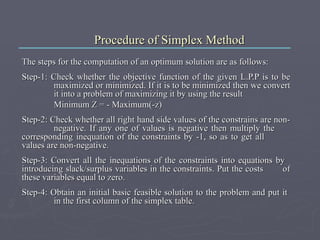
Procedure of Simplex Method The steps for the computation of an optimum solution are as follows: Step-1: Check whether the objective function of the given L.P.P is to be  maximized or minimized. If it is to be minimized then we convert  it into a problem of maximizing it by using the result Minimum Z = - Maximum(-z) Step-2: Check whether all right hand side values of the constrains are non- negative. If any one of values is negative then multiply the  corresponding inequation of the constraints by -1, so as to get all  values are non-negative.  Step-3: Convert all the inequations of the constraints into equations by  introducing slack/surplus variables in the constraints. Put the costs  of these variables equal to zero. Step-4: Obtain an initial basic feasible solution to the problem and put it  in the first column of the simplex table.
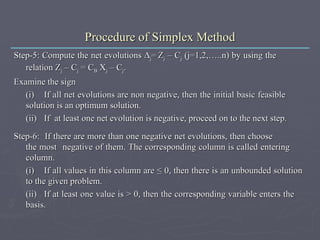
Procedure of Simplex Method Step-5: Compute the net evolutions  Δ j =   Z j  – C j  (j=1,2,…..n) by using the  relation Z j  – C j  = C B  X j  – C j .  Examine the sign (i) If all net evolutions are non negative, then the initial basic feasible  solution is an optimum solution. (ii) If  at least one net evolution is negative, proceed on to the next step. Step-6:  If there are more than one negative net evolutions, then choose  the most  negative of them. The corresponding column is called entering  column.  (i) If all values in this column are  ≤ 0, then there is an unbounded solution  to the given problem. (ii) If at least one value is  > 0, then the corresponding variable enters the  basis.
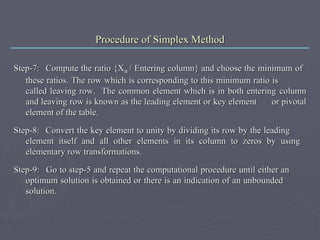
Procedure of Simplex Method Step-7: Compute the ratio {X B  / Entering column} and choose the minimum of  these ratios. The row which is corresponding to this minimum ratio is  called leaving row.  The common element which is in both entering  column and leaving row is known as the leading element or key element  or pivotal element of the table. Step-8: Convert the key element to unity by dividing its row by the leading  element itself and all other elements in its column to zeros by using  elementary row transformations.  Step-9:  Go to step-5 and repeat the computational procedure until either an  optimum solution is obtained or there is an indication of an unbounded  solution.

Simplex Method

  • 1.
    Procedure of SimplexMethod The steps for the computation of an optimum solution are as follows: Step-1: Check whether the objective function of the given L.P.P is to be maximized or minimized. If it is to be minimized then we convert it into a problem of maximizing it by using the result Minimum Z = - Maximum(-z) Step-2: Check whether all right hand side values of the constrains are non- negative. If any one of values is negative then multiply the corresponding inequation of the constraints by -1, so as to get all values are non-negative. Step-3: Convert all the inequations of the constraints into equations by introducing slack/surplus variables in the constraints. Put the costs of these variables equal to zero. Step-4: Obtain an initial basic feasible solution to the problem and put it in the first column of the simplex table.
  • 2.
    Procedure of SimplexMethod Step-5: Compute the net evolutions Δ j = Z j – C j (j=1,2,…..n) by using the relation Z j – C j = C B X j – C j . Examine the sign (i) If all net evolutions are non negative, then the initial basic feasible solution is an optimum solution. (ii) If at least one net evolution is negative, proceed on to the next step. Step-6: If there are more than one negative net evolutions, then choose the most negative of them. The corresponding column is called entering column. (i) If all values in this column are ≤ 0, then there is an unbounded solution to the given problem. (ii) If at least one value is > 0, then the corresponding variable enters the basis.
  • 3.
    Procedure of SimplexMethod Step-7: Compute the ratio {X B / Entering column} and choose the minimum of these ratios. The row which is corresponding to this minimum ratio is called leaving row. The common element which is in both entering column and leaving row is known as the leading element or key element or pivotal element of the table. Step-8: Convert the key element to unity by dividing its row by the leading element itself and all other elements in its column to zeros by using elementary row transformations. Step-9: Go to step-5 and repeat the computational procedure until either an optimum solution is obtained or there is an indication of an unbounded solution.