Hypothesis  Hypothesis is a principal instrument in research Most research is carried out with the deliberate intention of testing hypothesis Decision makers need to test hypothesis to take decisions regarding alternate courses of action In Social Sciences, hypothesis testing is often used for deciding whether a sample data offers support  for certain generalizations Hypothesis-testing, thus, enables us to make probability statements about population parameters
Meaning of Hypothesis Simply, a mere assumption to be proved or disproved But for a researcher, hypothesis is a  formal question  that he intends to resolve Definition:  “A proposition or a set of propositions, set forth as an explanation for the occurrence of some specified group of phenomena asserted merely as a provisional conjecture to guide some investigation or accepted as highly probable in the light of established facts”
Meaning of Hypothesis Often hypothesis is a predictive statement capable of being tested by scientific methods, that relates an independent variable to some dependent variable Ex: students who receive counseling will show greater increase in creativity than students not receiving counseling; or Car A is performing as well as Car B In sum, hypothesis is a proposition which can be put to test to determine its validity
Characteristics of a Hypothesis Should be clear and precise Should be capable of being tested Should be limited in scope and be specific Should be stated in simple terms Should state the relationship between variables Should be consistent with most known facts Should be amenable to testing within a reasonable time Must explain the facts that gave rise to the need for explanation
Basic Concepts of Hypothesis Null Hypothesis and Alternative Hypothesis The Level of Significance Type I and Type II Errors
1. Null Hypothesis and Alternative Hypothesis In the context of statistical analysis: If we are to compare Method A with Method B about its superiority and if we proceed on the assumption that both methods are equally good, then this assumption is termed as the  Null Hypothesis As against the above, we may think that the Method A is superior  or that the Method B is inferior, we are then stating what is termed as  Alternative Hypothesis
Null Hypothesis and Alternative Hypothesis… Alternative Hypothesis is usually the one which we wish to  prove  and the Null hypothesis is the one which we wish to  disprove Thus, a null hypothesis represents the hypothesis we are trying to reject, and the alternative hypothesis represents all other possibilities
2. The Level of Significance In the context of hypothesis-testing, the  level of significance  is an important concept It is always some percentage (usually 5%) This implies that the null hypothesis will be rejected, when the sampling result (observed evidence) has less than 0.05 probability of occurring if the null hypothesis is true That is, the 5% level of significance means that the researcher is willing to take as much as a 5% risk of rejecting the null hypothesis when it happens to be true
3. Type I and Type II Errors Basically two types of errors are possible: Type I Error – we may reject the null hypothesis when it is true; and  Type II Error – we may accept the null hypothesis when in fact the null hypothesis is not true That is, Type I error means rejection of the hypothesis which should have been accepted and Type II error means accepting the hypothesis which should have been rejected
Steps in Hypothesis-testing To test a hypothesis means to state (on the basis of data the researcher has collected) whether or not the hypothesis seems  valid In hypothesis testing the main question is – whether to accept the null hypothesis or not to accept the null hypothesis? Steps for hypothesis testing refer to all the steps we take for making a choice between rejection and acceptance of the null hypothesis
Steps in Hypothesis-testing… Making a formal statement Selecting a significance level Deciding the distribution to use Selecting a random sample Calculation of the probability Comparing the probability
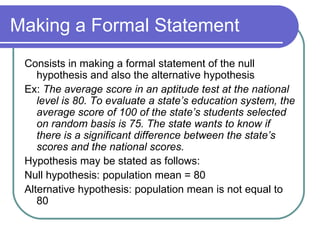
Making a Formal Statement Consists in making a formal statement of the null hypothesis and also the alternative hypothesis Ex:  The average score in an aptitude test at the national level is 80. To evaluate a state’s education system, the average score of 100 of the state’s students selected on random basis is 75. The state wants to know if there is a significant difference between the state’s scores and the national scores. Hypothesis may be stated as follows: Null hypothesis: population mean = 80 Alternative hypothesis: population mean is not equal to 80
Selecting a Significance Level The hypothesis are tested on  predetermined  level of significance and should be specified Generally, either 5% level (0.05) or 1% level (0.01) is adopted
Deciding the distribution to use The next step is to determine the appropriate sampling distribution Generally, follow the principles of Normal Distribution
Selecting the Random Sample Select the random sample and compute an appropriate value The sample should furnish the empirical data
Calculation of the Probability The next step is to calculate the probability that the sample result would diverge as it has from expectations, if the null hypothesis were in fact true
Comparing the Probability The next step is to compare the probability thus calculated with the specified value (the significance level) If the calculated probability is equal to or smaller than the significance level, then  reject  the null hypothesis (i.e. accept the alternative hypothesis); but if the calculated probability is greater, then  accept  the null hypothesis
Statistical Tests of Hypothesis Tests of hypothesis are also known as tests of significance They are classified as: Parametric Tests or Standard Tests – ex. are z-test, t-test, F-test etc. and are based on the assumption of normality Non-Parametric Tests or Distribution-free tests of hypothesis

Rm 3 Hypothesis

  • 1.
    Hypothesis Hypothesisis a principal instrument in research Most research is carried out with the deliberate intention of testing hypothesis Decision makers need to test hypothesis to take decisions regarding alternate courses of action In Social Sciences, hypothesis testing is often used for deciding whether a sample data offers support for certain generalizations Hypothesis-testing, thus, enables us to make probability statements about population parameters
  • 2.
    Meaning of HypothesisSimply, a mere assumption to be proved or disproved But for a researcher, hypothesis is a formal question that he intends to resolve Definition: “A proposition or a set of propositions, set forth as an explanation for the occurrence of some specified group of phenomena asserted merely as a provisional conjecture to guide some investigation or accepted as highly probable in the light of established facts”
  • 3.
    Meaning of HypothesisOften hypothesis is a predictive statement capable of being tested by scientific methods, that relates an independent variable to some dependent variable Ex: students who receive counseling will show greater increase in creativity than students not receiving counseling; or Car A is performing as well as Car B In sum, hypothesis is a proposition which can be put to test to determine its validity
  • 4.
    Characteristics of aHypothesis Should be clear and precise Should be capable of being tested Should be limited in scope and be specific Should be stated in simple terms Should state the relationship between variables Should be consistent with most known facts Should be amenable to testing within a reasonable time Must explain the facts that gave rise to the need for explanation
  • 5.
    Basic Concepts ofHypothesis Null Hypothesis and Alternative Hypothesis The Level of Significance Type I and Type II Errors
  • 6.
    1. Null Hypothesisand Alternative Hypothesis In the context of statistical analysis: If we are to compare Method A with Method B about its superiority and if we proceed on the assumption that both methods are equally good, then this assumption is termed as the Null Hypothesis As against the above, we may think that the Method A is superior or that the Method B is inferior, we are then stating what is termed as Alternative Hypothesis
  • 7.
    Null Hypothesis andAlternative Hypothesis… Alternative Hypothesis is usually the one which we wish to prove and the Null hypothesis is the one which we wish to disprove Thus, a null hypothesis represents the hypothesis we are trying to reject, and the alternative hypothesis represents all other possibilities
  • 8.
    2. The Levelof Significance In the context of hypothesis-testing, the level of significance is an important concept It is always some percentage (usually 5%) This implies that the null hypothesis will be rejected, when the sampling result (observed evidence) has less than 0.05 probability of occurring if the null hypothesis is true That is, the 5% level of significance means that the researcher is willing to take as much as a 5% risk of rejecting the null hypothesis when it happens to be true
  • 9.
    3. Type Iand Type II Errors Basically two types of errors are possible: Type I Error – we may reject the null hypothesis when it is true; and Type II Error – we may accept the null hypothesis when in fact the null hypothesis is not true That is, Type I error means rejection of the hypothesis which should have been accepted and Type II error means accepting the hypothesis which should have been rejected
  • 10.
    Steps in Hypothesis-testingTo test a hypothesis means to state (on the basis of data the researcher has collected) whether or not the hypothesis seems valid In hypothesis testing the main question is – whether to accept the null hypothesis or not to accept the null hypothesis? Steps for hypothesis testing refer to all the steps we take for making a choice between rejection and acceptance of the null hypothesis
  • 11.
    Steps in Hypothesis-testing…Making a formal statement Selecting a significance level Deciding the distribution to use Selecting a random sample Calculation of the probability Comparing the probability
  • 12.
    Making a FormalStatement Consists in making a formal statement of the null hypothesis and also the alternative hypothesis Ex: The average score in an aptitude test at the national level is 80. To evaluate a state’s education system, the average score of 100 of the state’s students selected on random basis is 75. The state wants to know if there is a significant difference between the state’s scores and the national scores. Hypothesis may be stated as follows: Null hypothesis: population mean = 80 Alternative hypothesis: population mean is not equal to 80
  • 13.
    Selecting a SignificanceLevel The hypothesis are tested on predetermined level of significance and should be specified Generally, either 5% level (0.05) or 1% level (0.01) is adopted
  • 14.
    Deciding the distributionto use The next step is to determine the appropriate sampling distribution Generally, follow the principles of Normal Distribution
  • 15.
    Selecting the RandomSample Select the random sample and compute an appropriate value The sample should furnish the empirical data
  • 16.
    Calculation of theProbability The next step is to calculate the probability that the sample result would diverge as it has from expectations, if the null hypothesis were in fact true
  • 17.
    Comparing the ProbabilityThe next step is to compare the probability thus calculated with the specified value (the significance level) If the calculated probability is equal to or smaller than the significance level, then reject the null hypothesis (i.e. accept the alternative hypothesis); but if the calculated probability is greater, then accept the null hypothesis
  • 18.
    Statistical Tests ofHypothesis Tests of hypothesis are also known as tests of significance They are classified as: Parametric Tests or Standard Tests – ex. are z-test, t-test, F-test etc. and are based on the assumption of normality Non-Parametric Tests or Distribution-free tests of hypothesis