Copyright ©2014 Pearson Education, Inc.
7-1
Chapter 6
Motivation Concepts
Essentials of
Organizational Behavior
12e
Stephen P. Robbins & Timothy A. Judge
Copyright ©2014 Pearson Education, Inc.
After studying this chapter,
you should be able to:
1. Describe the three key elements of motivation.
2. Identify early theories of motivation and
evaluate their applicability today.
3. Contrast goal-setting theory and management
by objectives.
4. Demonstrate how organizational justice is a
refinement of equity theory.
5. Apply the key tenets of expectancy theory to
motivating employees.
7-2
Copyright ©2014 Pearson Education, Inc.
What Is Motivation?
 Motivation: The processes
that accounts for an individual’s
intensity, direction, and
persistence of effort toward
attaining a organizational goal
 Intensity – the amount of effort put
forth to meet the goal
 Direction – efforts are channeled
toward organizational goals
 Persistence – how long the effort is
maintained 7-3
Copyright ©2014 Pearson Education, Inc.
Early Theories of Motivation
Maslow’s Hierarchy of Needs
Theory
McGregor’s Theory X and
Theory Y
Herzberg’s Two-Factor
(Motivation-Hygiene) Theory
McClellan’s Theory of Needs
(Three Needs Theory)
7-4
Copyright ©2014 Pearson Education, Inc.
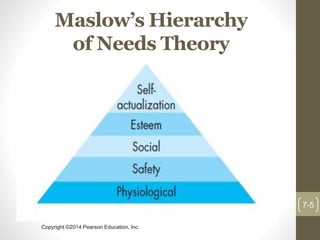
Maslow’s Hierarchy
of Needs Theory
7-5
Copyright ©2014 Pearson Education, Inc.
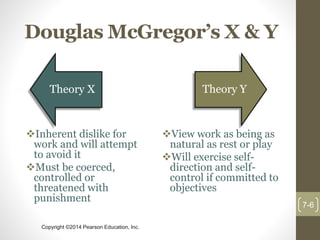
Douglas McGregor’s X & Y
Inherent dislike for
work and will attempt
to avoid it
Must be coerced,
controlled or
threatened with
punishment
View work as being as
natural as rest or play
Will exercise self-
direction and self-
control if committed to
objectives
7-6
Theory X Theory Y
Copyright ©2014 Pearson Education, Inc.
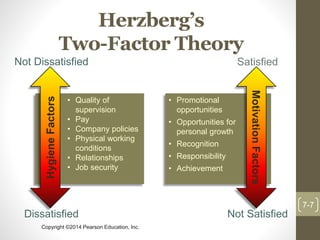
Herzberg’s
Two-Factor Theory
7-7
• Quality of
supervision
• Pay
• Company policies
• Physical working
conditions
• Relationships
• Job security
HygieneFactors
Dissatisfied
Not Dissatisfied
• Promotional
opportunities
• Opportunities for
personal growth
• Recognition
• Responsibility
• Achievement
MotivationFactors
Satisfied
Not Satisfied
Copyright ©2014 Pearson Education, Inc.
McClelland's
Theory of Needs
Need for Achievement (nAch)
The drive to excel
Need for Power (nPow)
The need to make others behave in a way they
would not have behaved otherwise
Need for Affiliation (nAff)
The desire for friendly and close interpersonal
relationships
7-8
Copyright ©2014 Pearson Education, Inc.
McClelland's High Achievers
High achievers prefer jobs with:
 Personal responsibility
 Feedback
 Intermediate degree of risk
(50/50)
High achievers are not necessarily
good managers
High nPow and low nAff is
related to managerial success 7-9
Copyright ©2014 Pearson Education, Inc.
Contemporary Theories
of Motivation
Self-Determination Theory
Job Engagement
Goal-Setting Theory
 Management by Objectives
Self-Efficacy Theory
Equity Theory
Expectancy Theory 7-10
Copyright ©2014 Pearson Education, Inc.
Self-Determination Theory
Self-determination theory: People prefer to
have control over their actions so when they feel
they are forced to do something they previously
enjoyed motivation will decrease
 Cognitive evaluation theory: Proposes that the
introduction of extrinsic rewards for work (pay) that
was previously intrinsically rewarding tends to
decrease overall motivation
 Verbal rewards increase intrinsic motivation, while
tangible rewards undermine it
7-11
Copyright ©2014 Pearson Education, Inc.
Job Engagement
 Job Engagement: The
investment of an employee’s
physical, cognitive, and
emotional energies into job
performance
 In organizations where
employees are highly engaged
 Higher levels of productivity
 Fewer safety incidents
 Lower turnover 7-12
Copyright ©2014 Pearson Education, Inc.
Goal-Setting Theory
Goals increase performance when the goals are
 Specific
 Difficult, but accepted by employees
 Accompanied by feedback (especially self-generated
feedback)
Contingencies in goal-setting theory
 Goal Commitment – public goals better
 Task Characteristics – simple & familiar better
 National Culture – Western culture suits best
7-13
Copyright ©2014 Pearson Education, Inc.
Management by Objectives
(MBO)
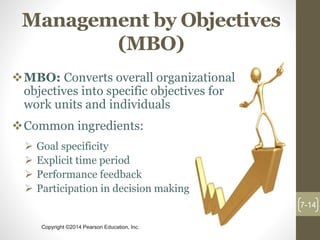
MBO: Converts overall organizational
objectives into specific objectives for
work units and individuals
Common ingredients:
 Goal specificity
 Explicit time period
 Performance feedback
 Participation in decision making
7-14
Copyright ©2014 Pearson Education, Inc.
Self-Efficacy or
Social Learning Theory
 Self-efficacy: Individual’s belief that
he or she is capable of performing a
task
 Self-efficacy increased by:
 Enactive mastery – gain
experience
 Vicarious modeling – see
someone else do the task
 Verbal persuasion – someone
convinces you that you have the
skills
 Arousal – get energized
7-15
Copyright ©2014 Pearson Education, Inc.
Equity Theory
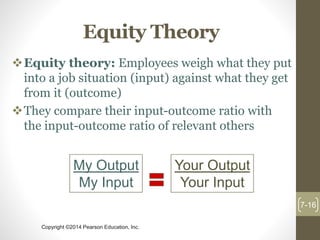
Equity theory: Employees weigh what they put
into a job situation (input) against what they get
from it (outcome)
They compare their input-outcome ratio with
the input-outcome ratio of relevant others
7-16
Your Output
Your Input
My Output
My Input
Copyright ©2014 Pearson Education, Inc.
Equity Theory and Reactions
to Inequitable Pay
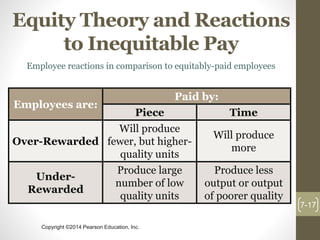
Employees are:
Paid by:
Piece Time
Over-Rewarded
Will produce
fewer, but higher-
quality units
Will produce
more
Under-
Rewarded
Produce large
number of low
quality units
Produce less
output or output
of poorer quality
7-17
Employee reactions in comparison to equitably-paid employees
Copyright ©2014 Pearson Education, Inc.
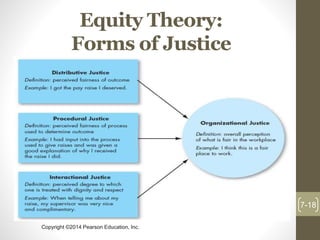
Equity Theory:
Forms of Justice
7-18
Copyright ©2014 Pearson Education, Inc.
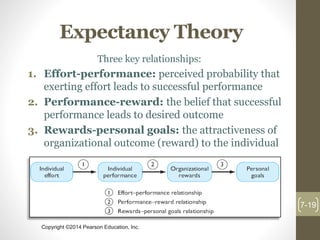
Expectancy Theory
Three key relationships:
1. Effort-performance: perceived probability that
exerting effort leads to successful performance
2. Performance-reward: the belief that successful
performance leads to desired outcome
3. Rewards-personal goals: the attractiveness of
organizational outcome (reward) to the individual
7-19

Organizational Behavior Chapter 6

  • 1.
    Copyright ©2014 PearsonEducation, Inc. 7-1 Chapter 6 Motivation Concepts Essentials of Organizational Behavior 12e Stephen P. Robbins & Timothy A. Judge
  • 2.
    Copyright ©2014 PearsonEducation, Inc. After studying this chapter, you should be able to: 1. Describe the three key elements of motivation. 2. Identify early theories of motivation and evaluate their applicability today. 3. Contrast goal-setting theory and management by objectives. 4. Demonstrate how organizational justice is a refinement of equity theory. 5. Apply the key tenets of expectancy theory to motivating employees. 7-2
  • 3.
    Copyright ©2014 PearsonEducation, Inc. What Is Motivation?  Motivation: The processes that accounts for an individual’s intensity, direction, and persistence of effort toward attaining a organizational goal  Intensity – the amount of effort put forth to meet the goal  Direction – efforts are channeled toward organizational goals  Persistence – how long the effort is maintained 7-3
  • 4.
    Copyright ©2014 PearsonEducation, Inc. Early Theories of Motivation Maslow’s Hierarchy of Needs Theory McGregor’s Theory X and Theory Y Herzberg’s Two-Factor (Motivation-Hygiene) Theory McClellan’s Theory of Needs (Three Needs Theory) 7-4
  • 5.
    Copyright ©2014 PearsonEducation, Inc. Maslow’s Hierarchy of Needs Theory 7-5
  • 6.
    Copyright ©2014 PearsonEducation, Inc. Douglas McGregor’s X & Y Inherent dislike for work and will attempt to avoid it Must be coerced, controlled or threatened with punishment View work as being as natural as rest or play Will exercise self- direction and self- control if committed to objectives 7-6 Theory X Theory Y
  • 7.
    Copyright ©2014 PearsonEducation, Inc. Herzberg’s Two-Factor Theory 7-7 • Quality of supervision • Pay • Company policies • Physical working conditions • Relationships • Job security HygieneFactors Dissatisfied Not Dissatisfied • Promotional opportunities • Opportunities for personal growth • Recognition • Responsibility • Achievement MotivationFactors Satisfied Not Satisfied
  • 8.
    Copyright ©2014 PearsonEducation, Inc. McClelland's Theory of Needs Need for Achievement (nAch) The drive to excel Need for Power (nPow) The need to make others behave in a way they would not have behaved otherwise Need for Affiliation (nAff) The desire for friendly and close interpersonal relationships 7-8
  • 9.
    Copyright ©2014 PearsonEducation, Inc. McClelland's High Achievers High achievers prefer jobs with:  Personal responsibility  Feedback  Intermediate degree of risk (50/50) High achievers are not necessarily good managers High nPow and low nAff is related to managerial success 7-9
  • 10.
    Copyright ©2014 PearsonEducation, Inc. Contemporary Theories of Motivation Self-Determination Theory Job Engagement Goal-Setting Theory  Management by Objectives Self-Efficacy Theory Equity Theory Expectancy Theory 7-10
  • 11.
    Copyright ©2014 PearsonEducation, Inc. Self-Determination Theory Self-determination theory: People prefer to have control over their actions so when they feel they are forced to do something they previously enjoyed motivation will decrease  Cognitive evaluation theory: Proposes that the introduction of extrinsic rewards for work (pay) that was previously intrinsically rewarding tends to decrease overall motivation  Verbal rewards increase intrinsic motivation, while tangible rewards undermine it 7-11
  • 12.
    Copyright ©2014 PearsonEducation, Inc. Job Engagement  Job Engagement: The investment of an employee’s physical, cognitive, and emotional energies into job performance  In organizations where employees are highly engaged  Higher levels of productivity  Fewer safety incidents  Lower turnover 7-12
  • 13.
    Copyright ©2014 PearsonEducation, Inc. Goal-Setting Theory Goals increase performance when the goals are  Specific  Difficult, but accepted by employees  Accompanied by feedback (especially self-generated feedback) Contingencies in goal-setting theory  Goal Commitment – public goals better  Task Characteristics – simple & familiar better  National Culture – Western culture suits best 7-13
  • 14.
    Copyright ©2014 PearsonEducation, Inc. Management by Objectives (MBO) MBO: Converts overall organizational objectives into specific objectives for work units and individuals Common ingredients:  Goal specificity  Explicit time period  Performance feedback  Participation in decision making 7-14
  • 15.
    Copyright ©2014 PearsonEducation, Inc. Self-Efficacy or Social Learning Theory  Self-efficacy: Individual’s belief that he or she is capable of performing a task  Self-efficacy increased by:  Enactive mastery – gain experience  Vicarious modeling – see someone else do the task  Verbal persuasion – someone convinces you that you have the skills  Arousal – get energized 7-15
  • 16.
    Copyright ©2014 PearsonEducation, Inc. Equity Theory Equity theory: Employees weigh what they put into a job situation (input) against what they get from it (outcome) They compare their input-outcome ratio with the input-outcome ratio of relevant others 7-16 Your Output Your Input My Output My Input
  • 17.
    Copyright ©2014 PearsonEducation, Inc. Equity Theory and Reactions to Inequitable Pay Employees are: Paid by: Piece Time Over-Rewarded Will produce fewer, but higher- quality units Will produce more Under- Rewarded Produce large number of low quality units Produce less output or output of poorer quality 7-17 Employee reactions in comparison to equitably-paid employees
  • 18.
    Copyright ©2014 PearsonEducation, Inc. Equity Theory: Forms of Justice 7-18
  • 19.
    Copyright ©2014 PearsonEducation, Inc. Expectancy Theory Three key relationships: 1. Effort-performance: perceived probability that exerting effort leads to successful performance 2. Performance-reward: the belief that successful performance leads to desired outcome 3. Rewards-personal goals: the attractiveness of organizational outcome (reward) to the individual 7-19

Editor's Notes

  • #4 It is easy to see that some individuals are more motivated than others. However, the reasons for that motivation are more difficult to determine. When defining motivation it is important to look at the interaction between the individual and the situation. There are three key elements that help us define motivation. The first is intensity or how hard the person tries to accomplish the task. The second element is direction and that is the effort that is channeled toward organizational goals. The final element is persistency or how long a person can maintain the effort.
  • #5 There are number of theories of motivation that help us gain a better understanding of the concept. Some of the earlier theories are not entirely valid anymore but they are still used by many managers.
  • #6 The first theory was developed by Abraham Maslow in the 1950s. His theory states that with every individual there is a hierarchy of five needs. As each need is met or satisfied the next need becomes dominant. His theory posits that individuals are stuck in their existing need level until it is satisfied and then they can move on to the next level. For example, until their safety needs are met they will not be able to move on to the social level. The organization of these need levels may vary across cultures.
  • #7 Douglas McGregor added to the motivation work done in the 1950s and developed the theory called Theory X, Theory Y. He believed that there are two distinct views of human beings that managers hold. The Theory X view is basically negative and holds that workers have little ambition, dislike work and avoid responsibility. The Theory Y view is in contrast to X and sets forth that workers tend to be self-directed, enjoy work and accept responsibility. Managers will modify their behavior toward employees based on what view they hold about them.
  • #8 Herzberg’s Two-Factor theory is another one of the earlier developed theories. This theory sets forth that satisfaction and dissatisfaction are not the opposites, but two separate ideas. There are a set of factors that when present will help to avoid dissatisfaction in workers. This group is called the hygiene factors and includes such things as salary, working conditions and company policies. There is another set of factors that when present will help to cause satisfaction in workers. This group is called motivators and includes things such as growth, responsibility and achievement. These sets are distinct and the presence of hygiene factors does not cause satisfaction, it just helps avoid dissatisfaction.
  • #9 The final earlier theory of needs we will look at is McClelland’s need theory. He bases his theory on the idea that people are motivated in the workplace by three main needs. The first need is the need for achievement or the drive to excel in relation to a set of defined standards. The second is the need for power, to make others behave in a way that they would not have behaved otherwise. The final need addressed in this theory is the need for affiliation. Affiliation looks at the relationship aspect and the desire for close relationships. People will have varying levels of these needs which make this theory difficult to measure.
  • #10 The need that has received the most attention by researchers is the need for achievement. Achievers will carefully measure the odds and try to take on activities that are challenging, but not too high-risk. They tend to be motivated in jobs that are more individualistic in nature and provide regular and effective feedback. Achievers tend to not make good managers because they have more of a personal focus. Strong managers have a higher level of need for power and a lower level of need for affiliation as they are trying to motivate a team to move towards a given direction.
  • #11 There are a number of contemporary theories of motivation that have utilized the older theories to provide us with a deeper understanding of motivation in the workplace.
  • #12 The self-determination theory states that people prefer to have control over their actions. So when they are required to do something the previously freely chose, it will diminish their motivation. An example is the Cognitive Evaluation Theory that sets forth that in the workplace intrinsic and extrinsic rewards are not independent of one another. In fact, the presence of extrinsic rewards may decrease the intrinsic rewards. In addition to extrinsic rewards, managers need to realize the importance of using goal setting and verbal rewards as a method to increase motivation.
  • #13 Research shows that highly successful organizations tend to have more engaged employees than average organizations. Highly engaged employees believe it is meaningful to work, are inspired by their leaders, and have similar values to those of the organization.
  • #14 Edwin Locke developed what is called the goal-setting theory. The idea behind this theory is that goals which are specific and effectively difficult can lead to higher performance if they include self-generated feedback. A difficult goal will help the individual to focus and direct attention as well as energize them to work harder. The difficulty of the goal will increase persistence and force people to be more effective and efficient. The relationship between goals and performance depends on how committed the individual is to the goal as well as how specific the tasks are. Most of the research has been done in the United States so the applicability of this theory to other cultures is suspect.
  • #15 An implementation of the goal-setting theory is Management by Objectives or better known as MBO. MBO is a systematic way to utilize goal setting theory in which goals are set jointly by managers and employees. The goals must be tangible, verifiable and measurable in order to be effective. The manager helps to break down the organizational goals into smaller more specific goals for the employee. In order for MBO to be effective the goals must be specific, the employees must participate in the goal setting, there must be a defined time period and feedback must be incorporated into the process.
  • #16 Another theory of motivation is the self-efficacy theory developed by Albert Bandura. This theory is based on an individual’s belief that he or she is capable of performing a task. This theory is a complement to the goal-setting theory as it incorporates goals into the process. Higher efficacy is related to greater confidence, greater persistence in the face of difficulties and responding to negative feedback with working harder, not shutting down.
  • #17 Adam’s equity theory utilizes the perception theory that we looked at in previous chapters. The idea is that employees compare their ratios of outcomes to inputs of others they see as relevant. When they see the ratios as equal there is a perceived state of equity and no tension arises. However, when they perceive the ratios to be unequal they may experience anger or guilt depending on the result of the equity analysis and then tension can arise. This tension can motivate people to act in a way to bring the situation into a more equitable state.
  • #18 People behave differently when they are over-rewarded than under-rewarded. Sensitivity to over-rewarding is less. The equity theory is often hard to apply because sensitivities differ amongst individuals and it is hard to predict how they will respond to inequities.
  • #19 Increasingly we think of equity as organizational justice, a larger perception of what is fair in the workplace. Employees perceive their organizations as just when they see that what they receive matches what they have put in. One key element of organizational justice is an individual’s perception of justice. In other words, fairness or equity can be subjective, residing in our perception. What one person sees as unfair, another may see as perfectly appropriate. The second component is procedural justice—the perceived fairness of the process used to determine the distribution of rewards. The final component is interactional justice, an individual’s perception of the degree to which she is treated with dignity, concern, and respect. These three components make up an individuals view of justice within the organization. Equity theory is popular in the United States because U.S. style reward systems assume that employees are highly sensitive to equity in reward allocation. Research shows however, that in other cultures inputs and outputs may be valued differently. Managers need to determine what is considered “fair” in a particular culture. Managers need to be transparent, consistent, and unbiased in their decision making.
  • #20 The most commonly used and widely accepted theory of motivation is Victor Vroom’s Expectancy Theory. This theory argues that the strength of a tendency to act in a certain way is dependent on the strength of the expectation that they will receive a given outcome and that the outcome is desired. Employees are willing to work harder if they believe that their actions will get them an outcome they desire. For example, employees are willing to work long and hard hours if they know that they will be rewarded through promotion, recognition or pay in response to their hard work.