Vogel’s Approximation Method (VAM) Step-I:  Compute the penalty values for each row  and each column. The penalty will be  equal  to the difference between the two smallest  shipping costs in the row or column.  Step-II:  Identify the row or column with the largest  penalty. Find the first basic variable which  has the smallest shipping cost in that row or  column. Then assign the highest possible  value to that variable, and cross-out the row  or column which is exhausted. Step-III:  Compute new penalties and repeat the  same  procedure until all the rim  requirements are satisfied.
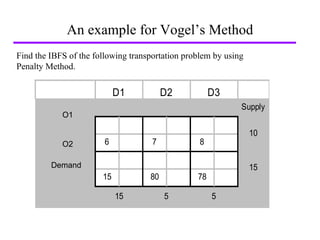
An example for Vogel’s Method Find the IBFS of the following transportation problem by using Penalty Method. O1 O2 Demand
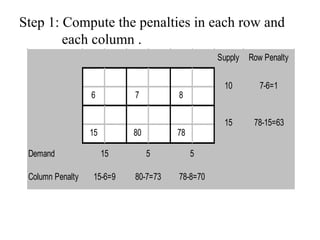
Step 1: Compute the penalties in each row and    each column .
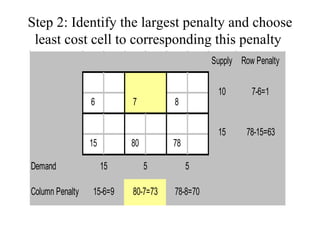
Step 2: Identify the largest penalty and choose least cost cell to corresponding this penalty
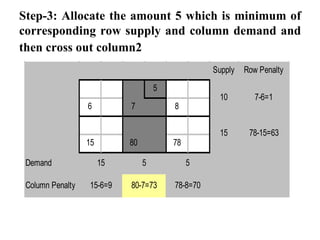
Step-3: Allocate the amount 5 which is minimum of corresponding row supply and column demand and then cross out column2
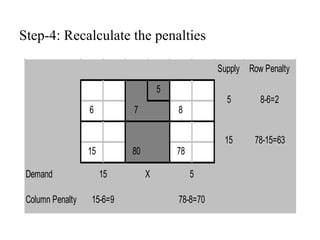
Step-4: Recalculate the penalties
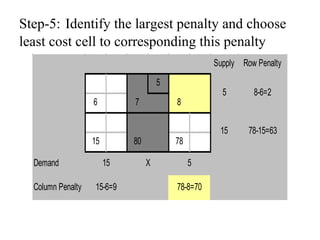
Step-5:   Identify the largest penalty and choose least cost cell to corresponding this penalty
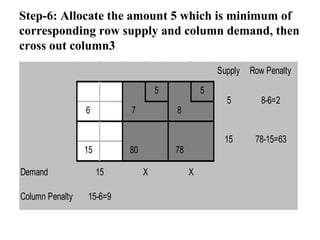
Step-6: Allocate the amount 5 which is minimum of corresponding row supply and column demand, then cross out column3
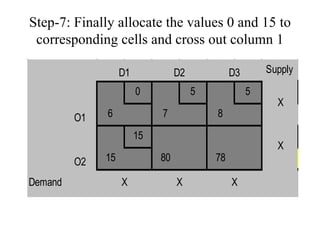
Step-7: Finally allocate the values 0 and 15 to corresponding cells and cross out column 1
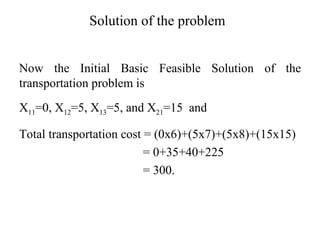
Solution of the problem Now the Initial Basic Feasible Solution of the transportation problem is  X 11 =0, X 12 =5, X 13 =5, and X 21 =15  and  Total transportation cost = (0x6)+(5x7)+(5x8)+(15x15) = 0+35+40+225 = 300.

Vam

  • 1.
    Vogel’s Approximation Method(VAM) Step-I: Compute the penalty values for each row and each column. The penalty will be equal to the difference between the two smallest shipping costs in the row or column. Step-II: Identify the row or column with the largest penalty. Find the first basic variable which has the smallest shipping cost in that row or column. Then assign the highest possible value to that variable, and cross-out the row or column which is exhausted. Step-III: Compute new penalties and repeat the same procedure until all the rim requirements are satisfied.
  • 2.
    An example forVogel’s Method Find the IBFS of the following transportation problem by using Penalty Method. O1 O2 Demand
  • 3.
    Step 1: Computethe penalties in each row and each column .
  • 4.
    Step 2: Identifythe largest penalty and choose least cost cell to corresponding this penalty
  • 5.
    Step-3: Allocate theamount 5 which is minimum of corresponding row supply and column demand and then cross out column2
  • 6.
  • 7.
    Step-5: Identify the largest penalty and choose least cost cell to corresponding this penalty
  • 8.
    Step-6: Allocate theamount 5 which is minimum of corresponding row supply and column demand, then cross out column3
  • 9.
    Step-7: Finally allocatethe values 0 and 15 to corresponding cells and cross out column 1
  • 10.
    Solution of theproblem Now the Initial Basic Feasible Solution of the transportation problem is X 11 =0, X 12 =5, X 13 =5, and X 21 =15 and Total transportation cost = (0x6)+(5x7)+(5x8)+(15x15) = 0+35+40+225 = 300.