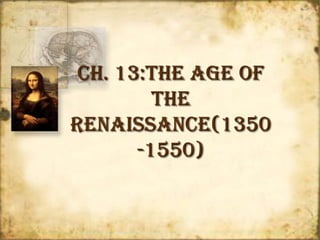
Ch. 13:The Age of the Renaissance(1350-1550)
Overview:RENAISSANCE:Meaning “rebirth”Saw the rebirth of two idealsThe belief that man should be free to develop his abilities and interests.The belief that man should seek the fullest enjoyment of life. LIVING was important!Various views of this historical period:Some see it as a continuation of the Middle Ages.Some see it as a break from the past and the beginning of modern times.Some see it as a transition as the medieval period  gave rise to the basic institutions of Europe, its laws, its languages.
	The elite culture that developed during the quattrocentro(Italian for 15th century) in the city states of the Italian peninsula, though, not only borrowed from the ancient cultures (Rome & Greece, but also expressed a new concept of mankind: HUMANISM.Why did it start in Italy?Her wealth from trade!Map of Renaissance Italy, ca. 1560
Which would least likely be studied in an humanist school?HistoryPhilosophyGrammarRhetoric Theology
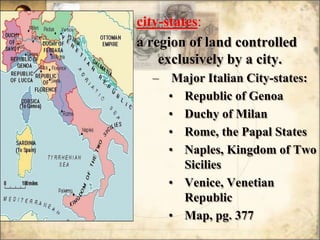
city-states: a region of land controlled exclusively by a city.Major Italian City-states:Republic of GenoaDuchy of MilanRome, the Papal StatesNaples, Kingdom of Two SiciliesVenice, Venetian RepublicMap, pg. 377
commune: associations of men in Italian cities such as Milan, Florence, Genoa, and Pisa who sought political and economic independence from local nobles; members of communes wanted self-government Self-portrait, Domenico Ghirlandaio
popolo: disenfranchised people in Italian communes who resented their exclusion from power.signori: government by despot, one man rule in Italian cities such as Milan; handed down the right to rule to his son.  Major patrons of art.courts:Magnificent households & palaces where signori & other rulers lived conducted business, & supported the arts, Signori’s transformed their household into a “court.”Oligarchies: governments by the merchant aristocracy in Italian cities, such as Venice and Florence
“The School of Europe”ITALY!From Italy came scientific, educational, political, and artistic advances.Instructed rest of Europe in power politics.Humanism developed.Petrarch proposed a new king of education to recapture the glory of the Roman Republic in which young men would study ancient Roman & Greek classics
…New Concepts  Emerged!Humanism:term first used by Florentine rhetoretician Leonard Bruni as a general word for the new learning of the critical study of Latin and Greek literature, with the goal of realized human potentialVirtuQuality esteemed by Ren. Thinkers—not a virtue in the sense of moral goodness but the ability to shape the world around them according to their will & achieve excellence
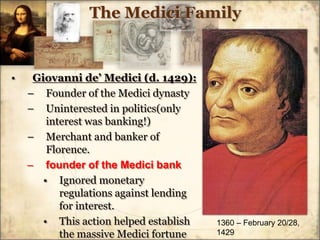
The Medici FamilyGiovanni de’ Medici (d. 1429):Founder of the Medici dynastyUninterested in politics(only interest was banking!)Merchant and banker of Florence.founder of the Medici bankIgnored monetary regulations against lending for interest.This action helped establish the massive Medici fortune1360 – February 20/28, 1429
					The Medici FamilyCosimo de’ Medici (1389-1464): Son of GiovanniCosimo represented the Medici bank and handled papal finances, becoming the wealthiest man of his timefounded the famous Medici Library and an academy for Greek studiesUsed fortune to fill the void of a national monarchy.
Medici FamilyLorenzo the Magnificent (1449-1492): Grandson of Cosimoa diplomat, politician and patron of scholars, artists, and poetsRuler of the republic and patron of the artsGenius and supportive of local creativity.He died at the dawn of "The Age of Exploration"; Christopher Columbus would reach the "New World" only six months later.
WRITERS:Humanists who wrote about the human condition.Christian humanism is the position that universal human dignity and individual freedom are essential and principal components of, or are at least compatible with, Christian doctrine and practice. It is a philosophical union of Christian and humanist principles.
Dante Alighieri (1265-1321):-Italian, from Florence -seen as one of the greatest works of world literature!!Author of The Divine Comedy.
Wrote in the vernacular.
Tells the tale of Dante’s journey through Inferno, Purgatorio, and Paradisio, or Hell, Purgatory, and Heaven.
Lead through journey by the Roman poet Virgil.Dante’s journey through Hell.
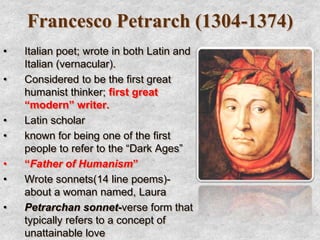
Francesco Petrarch (1304-1374)Italian poet; wrote in both Latin and Italian (vernacular).Considered to be the first great humanist thinker; first great “modern” writer.Latin scholarknown for being one of the first people to refer to the “Dark Ages”“Father of Humanism”Wrote sonnets(14 line poems)-about a woman named, LauraPetrarchan sonnet-verse form that typically refers to a concept of unattainable love
Giovanni Boccaccio (1313-1375)Italian author; wrote in the vernacular (Italian).Author of “the Decameron.”	Considered “a tale of love in all its forms.”Anti-clerical.
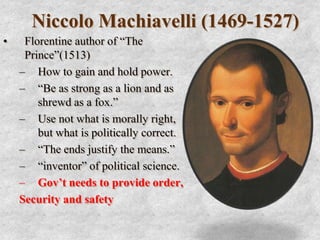
Niccolo Machiavelli (1469-1527)Florentine author of “The Prince”(1513)How to gain and hold power.“Be as strong as a lion and as shrewd as a fox.”Use not what is morally right, but what is politically correct.“The ends justify the means.”“inventor” of political science.Gov’t needs to provide order,Security and safety
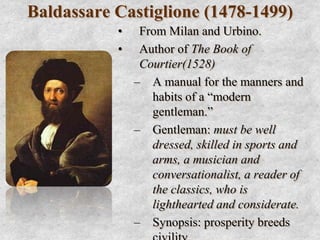
Baldassare Castiglione (1478-1499)From Milan and Urbino.Author of The Book of Courtier(1528)A manual for the manners and habits of a “modern gentleman.”Gentleman: must be well dressed, skilled in sports and arms, a musician and conversationalist, a reader of the classics, who is lighthearted and considerate.Synopsis: prosperity breeds civility.
Laura Cereta (1469-1499)One of the first female humanist authors.Feminist: fought the oppression of women.Suffered insomnia, was the basis of many of her famous letters.
Northern Renaissance Writers
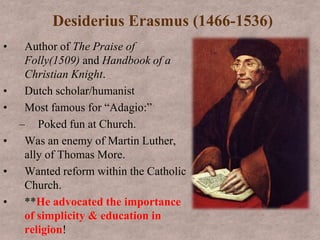
Desiderius Erasmus (1466-1536)Author of The Praise of Folly(1509) and Handbook of a Christian Knight.Dutch scholar/humanistMost famous for “Adagio:”Poked fun at Church.Was an enemy of Martin Luther, ally of Thomas More.Wanted reform within the Catholic Church.**He advocated the importance of simplicity & education in religion!
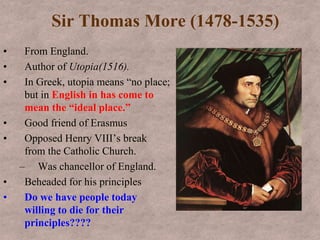
Sir Thomas More (1478-1535)From England.Author of Utopia(1516).In Greek, utopia means “no place; but in English in has come to mean the “ideal place.”Good friend of ErasmusOpposed Henry VIII’s break from the Catholic Church.Was chancellor of England.Beheaded for his principlesDo we have people today willing to die for their principles????
Francois Rabelais (1490-1553)French author; secular priest.Creator of the giants Gargantua and Pantagruel.Attacked failings of the Catholic Church.
Geoffrey Chaucer (d. 1400)Author of the Canterbury Tales:Narrations of various pilgrims who voyaged to the shrine of Thomas Becket“Father of English Literature”Stained glass mural of St.Thomas Becket, Canterbury Cathedral.
William Shakespeare (1564-1616)Considered the greatest playwright/author in history.Wrote comedies/tragedies.Wrote in Ren. EnglandContributed with creating iambic pentameter(term describes the particular rhythm that the words establish in that line)and the Elizabethan (“Shakespearean”) sonnet(poem of 14 lines, usually in iambic pentameter, restricted to a definite rhyme scheme)Built/performed in the Globe Theater.Globe Theater, London, England
Works of Shakespeare
Johann Gutenberg (1398-1468)1455- German city of Mainz, Gutenberg invented the printing press with moveable type.Created “Gutenberg Bible.”Paper production and printing press allowed mass quantities of pamphlets, books, etc. to be made.Made Church propaganda more practical, widespread.Picture, pg. 385; Map, pg. 386
What do YOU think?How did the invention of the printing presschange the world at this time??Printing spreads learning!Mass production of booksNew ideas spread quicklyAvailability of books encouraged people to read…thus, rise in literacyWriting in the vernacular increasedMore people began to read the Bible and interpret it for themselves. Now, people will demand religious reform!
How did the invention of the printing presschange the world at this time??BUT…..Gov’t & church leaders worried about printing. WHY?They attempted to censor books & authors whose ideas they thought were wrong!Officials developed lists of prohibited books & authorsEnforcement was- confiscating books, destroying printing presses, of those who disobeyed.
Art of the Renaissance
Artists andCharacteristics of 				             Renaissance Art:
Art and the ArtistC. The Renaissance Artist 	1. Concept of Genius  	2. Training  	3. Gender      4. Limits of Renaissance Culture
1. Realism & ExpressionExpulsion fromthe Garden
Masaccio
1427
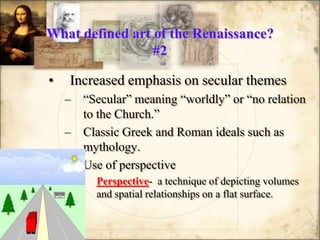
First nudes sinceclassical times.What defined art of the Renaissance?#2Increased emphasis on secular themes“Secular” meaning “worldly” or “no relation to the Church.”Classic Greek and Roman ideals such as mythology.Use of perspectivePerspective-  a technique of depicting volumes and spatial relationships on a flat surface.
3. ClassicismGreco-Roman influence.
Secularism.
Humanism.
Individualism  free standing figures.
Symmetry/BalanceThe “Classical Pose”Medici “Venus” (1c)
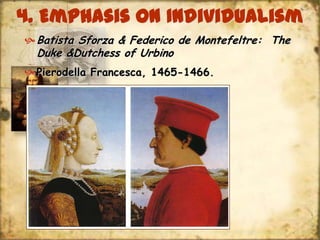
4. Emphasis on IndividualismBatista Sforza & Federico de Montefeltre:  The Duke & Dutchess of Urbino
Pierodella Francesca, 1465-1466.5. Geometrical Arrangement of FiguresThe Dreyfus Madonna with the Pomegranate
Leonardo da Vinci
1469
The figure as architecture!What defined art of the Renaissance?#6.The use of chiaroscuro.Chiaroscuro- The distribution of light and shade in a picture.---------Increased use of oil paints.Brighter colorsMore emotionReal people and real settings depicted.
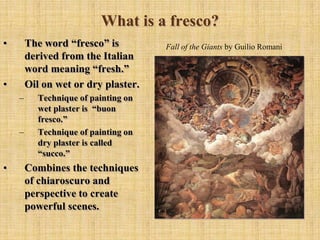
What is a fresco? The word “fresco” is derived from the Italian word meaning “fresh.”Oil on wet or dry plaster.Technique of painting on wet plaster is  “buon fresco.”Technique of painting on dry plaster is called “succo.”                                      Combines the techniques of chiaroscuro and perspective to create powerful scenes.Fall of the Giants by Guilio Romani
Artists of the RenaissanceMany wealthy families and high ranking members of the Church promoted and funded the Arts. This gave a chance for many artists to thrive.Many artists thrived during the Renaissance, but among the most popular were Leonardo da Vinci, Michelangelo Buonarroti, and Raphael Sanzio.Artists came to be acclaimed as “rare men of genius”All major artists were male! Women were exclued from institutions of Ren. Culture.  Renaissance was the work of a tiny learned male elite!
Leonardo da Vinci       Self-Portrait (c. 1515)April 15, 1452 – May 2, 1519“Ideal Renaissance Man”PainterSculptorArchitectMusicianScientistEngineerInventorMost famous works include the Mona Lisa, and the Last Supper.
Leonardo, the ArtistThe Virgin of the Rocks
Leonardo daVinci
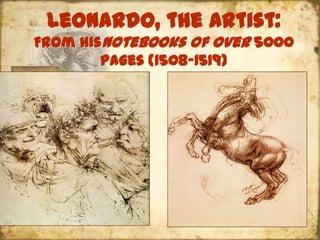
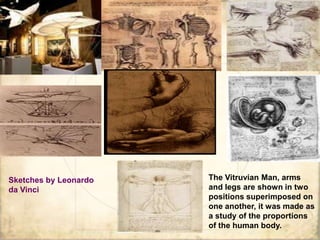
1483-1486Leonardo, the Artist:From hisNotebooks of over 5000 pages (1508-1519)
The Vitruvian Man, arms and legs are shown in two positions superimposed on one another, it was made as a study of the proportions of the human body.Sketches by Leonardo da Vinci
Vitruvian Man
Leonardo daVinci
1492TheL’uomouniversale(Universal Person)
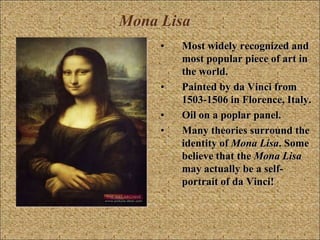
Mona Lisa – da Vinci, 1503-4?
Mona LisaMost widely recognized and most popular piece of art in the world.Painted by da Vinci from 1503-1506 in Florence, Italy.Oil on a poplar panel.Many theories surround the identity of Mona Lisa. Some believe that the Mona Lisa may actually be a self-portrait of da Vinci!
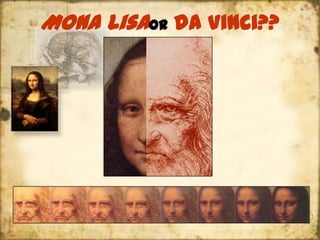
Mona Lisa= da Vinci? Mona Lisa          da Vinci’s Self-Portrait
A Picasso Mona
An Andy Warhol Mona
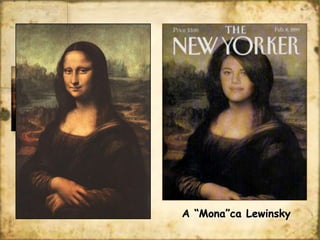
A “Mona”ca Lewinsky
Mona LisaOR da Vinci??
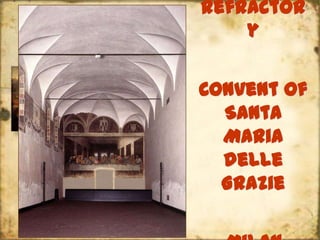
The Last SupperCourtesy of the Web Gallery of Art*The spots of decay are not results of digital distortion.  The decay is actually a result of da Vinci’s experimental technique that  he practiced on the Last Supper!
The Last SupperPainted from 1495-1498 in Milan, Italy.Depiction of the Last Supper in which Jesus informs his disciples he will be betrayed.Many believe that the Last Supper contains clues which pertain to a secret bloodline of Jesus Christ. This painting is the basis of many theories which speculate about a marriage between Jesus Christ and Mary Magdalene.
RefractoryConvent of Santa Maria delle GrazieMilan
The Last Supper - da Vinci, 1498& Geometry
Truth vs. SpeculationTheories surrounding da Vinci’s painting are far and many, but one theory seems to stand out above the rest: the theory that the person sitting at the right hand of Jesus Christ is Mary Magdalene, his alleged wife and confidante. The Last Supper and da Vinci have recently been the key pieces of evidence in a best-selling novel known as “the Da Vinci Code.”Though it is claimed that the person sitting at the right hand of Jesus Christ is a young John, many suggest that the person is not male at all, but the wife of Jesus Christ, Mary Magdalene.
Leonardo, the SculptorAn Equestrian Statue
1516-1518Leonardo, the Engineer:                                Pages from his NotebookStudies of water-lifting devices.A study of siege defenses.
Leonardo, the Scientist (Biology):Pages from his NotebookAn example of the humanist desire to unlock the secrets of nature.Michelangelo BuonarrotiBorn March 6th, 1475 at Caprese in Tuscany, Italy. Lived most of his life in Florentine, Italy.Painter, sculptor, and architect.Studied human anatomyCreated intricate sculptures and paintings which almost flawlessly imitated the human body.Works include the Creation of Adam, the ceiling of the Sistine Chapel, the statue of David, the statue of Moses, and the Last Judgement.
David #1David by Donatello
1430
First free-form bronze since Roman times!David(pg. 388)Created from 1501-1504Originally located in Palazzo dellaSignoria in Florence, Italy.Very “human”Statue of King David, contemplating his upcoming battle with Goliath.Over 14’ tall!Michelangelo's David was sculpted during almost the same years that da Vinci was painting the Mona Lisa.
 15cWhatadifferenceacenturymakes!16c 
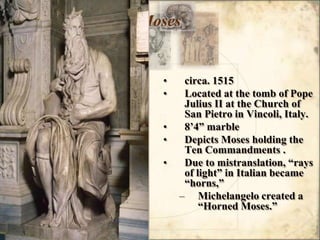
Mosescirca. 1515Located at the tomb of Pope Julius II at the Church of San Pietro in Vincoli, Italy.8’4” marbleDepicts Moses holding the Ten Commandments .Due to mistranslation, “rays of light” in Italian became “horns,”Michelangelo created a “Horned Moses.”
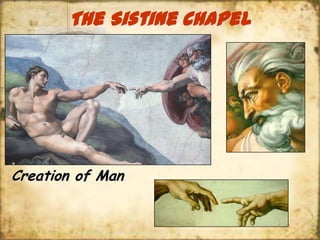
The Sistine ChapelMichelangelo Buonarroti1508 - 1512
Sistine Chapel(1508-12)
The Sistine Chapel DetailsCreation of Man
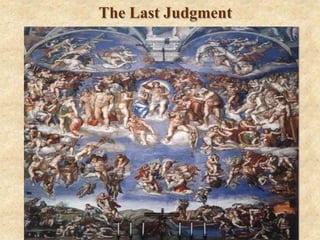
The Last Judgment
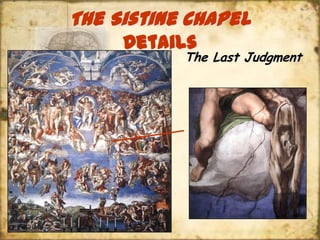
The Sistine Chapel DetailsThe Last Judgment
Hell’s Mouth7 Angels from the Book of Revelation
In the swirling mass of doom that is Last Judgment, Michelangelo chose to focus on a small number of people caught in an unresolved struggle between eternal suffering and eternal life. Minos, the king of hell, with a serpent wound tightly around him, an indicator of the circle of hell to which each damned soul must descend
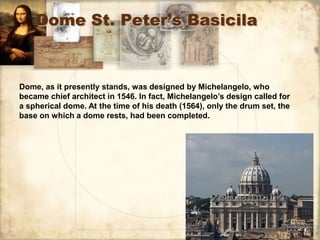
Dome St. Peter’s BasicilaDome, as it presently stands, was designed by Michelangelo, who became chief architect in 1546. In fact, Michelangelo’s design called for a spherical dome. At the time of his death (1564), only the drum set, the base on which a dome rests, had been completed.
Other Famous DomesIl Duomo      St. Peter’s       St. Paul’s        US capital (Florence)          (Rome)         (London)      (Washington)
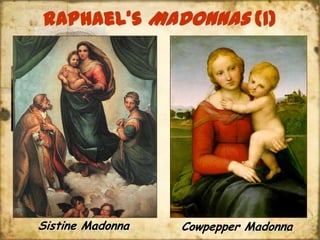
Raphael SanzioConsidered “the Perfect Painter.”Protégé of both Michelangelo and da VinciMost enjoyed painting Madonnas, or paintings of the Virgin Mary.was extremely influential in his lifetimeHe was still seen by 20th century critics like Bernard Berenson as the "most famous and most loved" master of the High Renaissance but it would seem he has since been overtaken by Michelangelo and Leonardo in this respect
Madonna and the Goldfinch

Ch.13 ren. ap

  • 1.
    Ch. 13:The Ageof the Renaissance(1350-1550)
  • 2.
    Overview:RENAISSANCE:Meaning “rebirth”Saw therebirth of two idealsThe belief that man should be free to develop his abilities and interests.The belief that man should seek the fullest enjoyment of life. LIVING was important!Various views of this historical period:Some see it as a continuation of the Middle Ages.Some see it as a break from the past and the beginning of modern times.Some see it as a transition as the medieval period gave rise to the basic institutions of Europe, its laws, its languages.
  • 3.
    The elite culturethat developed during the quattrocentro(Italian for 15th century) in the city states of the Italian peninsula, though, not only borrowed from the ancient cultures (Rome & Greece, but also expressed a new concept of mankind: HUMANISM.Why did it start in Italy?Her wealth from trade!Map of Renaissance Italy, ca. 1560
  • 4.
    Which would leastlikely be studied in an humanist school?HistoryPhilosophyGrammarRhetoric Theology
  • 5.
    city-states: a regionof land controlled exclusively by a city.Major Italian City-states:Republic of GenoaDuchy of MilanRome, the Papal StatesNaples, Kingdom of Two SiciliesVenice, Venetian RepublicMap, pg. 377
  • 6.
    commune: associations ofmen in Italian cities such as Milan, Florence, Genoa, and Pisa who sought political and economic independence from local nobles; members of communes wanted self-government Self-portrait, Domenico Ghirlandaio
  • 7.
    popolo: disenfranchised peoplein Italian communes who resented their exclusion from power.signori: government by despot, one man rule in Italian cities such as Milan; handed down the right to rule to his son. Major patrons of art.courts:Magnificent households & palaces where signori & other rulers lived conducted business, & supported the arts, Signori’s transformed their household into a “court.”Oligarchies: governments by the merchant aristocracy in Italian cities, such as Venice and Florence
  • 8.
    “The School ofEurope”ITALY!From Italy came scientific, educational, political, and artistic advances.Instructed rest of Europe in power politics.Humanism developed.Petrarch proposed a new king of education to recapture the glory of the Roman Republic in which young men would study ancient Roman & Greek classics
  • 9.
    …New Concepts Emerged!Humanism:term first used by Florentine rhetoretician Leonard Bruni as a general word for the new learning of the critical study of Latin and Greek literature, with the goal of realized human potentialVirtuQuality esteemed by Ren. Thinkers—not a virtue in the sense of moral goodness but the ability to shape the world around them according to their will & achieve excellence
  • 10.
    The Medici FamilyGiovannide’ Medici (d. 1429):Founder of the Medici dynastyUninterested in politics(only interest was banking!)Merchant and banker of Florence.founder of the Medici bankIgnored monetary regulations against lending for interest.This action helped establish the massive Medici fortune1360 – February 20/28, 1429
  • 11.
    The Medici FamilyCosimode’ Medici (1389-1464): Son of GiovanniCosimo represented the Medici bank and handled papal finances, becoming the wealthiest man of his timefounded the famous Medici Library and an academy for Greek studiesUsed fortune to fill the void of a national monarchy.
  • 12.
    Medici FamilyLorenzo theMagnificent (1449-1492): Grandson of Cosimoa diplomat, politician and patron of scholars, artists, and poetsRuler of the republic and patron of the artsGenius and supportive of local creativity.He died at the dawn of "The Age of Exploration"; Christopher Columbus would reach the "New World" only six months later.
  • 13.
    WRITERS:Humanists who wroteabout the human condition.Christian humanism is the position that universal human dignity and individual freedom are essential and principal components of, or are at least compatible with, Christian doctrine and practice. It is a philosophical union of Christian and humanist principles.
  • 14.
    Dante Alighieri (1265-1321):-Italian,from Florence -seen as one of the greatest works of world literature!!Author of The Divine Comedy.
  • 15.
    Wrote in thevernacular.
  • 16.
    Tells the taleof Dante’s journey through Inferno, Purgatorio, and Paradisio, or Hell, Purgatory, and Heaven.
  • 17.
    Lead through journeyby the Roman poet Virgil.Dante’s journey through Hell.
  • 18.
    Francesco Petrarch (1304-1374)Italianpoet; wrote in both Latin and Italian (vernacular).Considered to be the first great humanist thinker; first great “modern” writer.Latin scholarknown for being one of the first people to refer to the “Dark Ages”“Father of Humanism”Wrote sonnets(14 line poems)-about a woman named, LauraPetrarchan sonnet-verse form that typically refers to a concept of unattainable love
  • 19.
    Giovanni Boccaccio (1313-1375)Italianauthor; wrote in the vernacular (Italian).Author of “the Decameron.” Considered “a tale of love in all its forms.”Anti-clerical.
  • 20.
    Niccolo Machiavelli (1469-1527)Florentineauthor of “The Prince”(1513)How to gain and hold power.“Be as strong as a lion and as shrewd as a fox.”Use not what is morally right, but what is politically correct.“The ends justify the means.”“inventor” of political science.Gov’t needs to provide order,Security and safety
  • 21.
    Baldassare Castiglione (1478-1499)FromMilan and Urbino.Author of The Book of Courtier(1528)A manual for the manners and habits of a “modern gentleman.”Gentleman: must be well dressed, skilled in sports and arms, a musician and conversationalist, a reader of the classics, who is lighthearted and considerate.Synopsis: prosperity breeds civility.
  • 22.
    Laura Cereta (1469-1499)Oneof the first female humanist authors.Feminist: fought the oppression of women.Suffered insomnia, was the basis of many of her famous letters.
  • 23.
  • 24.
    Desiderius Erasmus (1466-1536)Authorof The Praise of Folly(1509) and Handbook of a Christian Knight.Dutch scholar/humanistMost famous for “Adagio:”Poked fun at Church.Was an enemy of Martin Luther, ally of Thomas More.Wanted reform within the Catholic Church.**He advocated the importance of simplicity & education in religion!
  • 25.
    Sir Thomas More(1478-1535)From England.Author of Utopia(1516).In Greek, utopia means “no place; but in English in has come to mean the “ideal place.”Good friend of ErasmusOpposed Henry VIII’s break from the Catholic Church.Was chancellor of England.Beheaded for his principlesDo we have people today willing to die for their principles????
  • 26.
    Francois Rabelais (1490-1553)Frenchauthor; secular priest.Creator of the giants Gargantua and Pantagruel.Attacked failings of the Catholic Church.
  • 27.
    Geoffrey Chaucer (d.1400)Author of the Canterbury Tales:Narrations of various pilgrims who voyaged to the shrine of Thomas Becket“Father of English Literature”Stained glass mural of St.Thomas Becket, Canterbury Cathedral.
  • 28.
    William Shakespeare (1564-1616)Consideredthe greatest playwright/author in history.Wrote comedies/tragedies.Wrote in Ren. EnglandContributed with creating iambic pentameter(term describes the particular rhythm that the words establish in that line)and the Elizabethan (“Shakespearean”) sonnet(poem of 14 lines, usually in iambic pentameter, restricted to a definite rhyme scheme)Built/performed in the Globe Theater.Globe Theater, London, England
  • 29.
  • 30.
    Johann Gutenberg (1398-1468)1455-German city of Mainz, Gutenberg invented the printing press with moveable type.Created “Gutenberg Bible.”Paper production and printing press allowed mass quantities of pamphlets, books, etc. to be made.Made Church propaganda more practical, widespread.Picture, pg. 385; Map, pg. 386
  • 31.
    What do YOUthink?How did the invention of the printing presschange the world at this time??Printing spreads learning!Mass production of booksNew ideas spread quicklyAvailability of books encouraged people to read…thus, rise in literacyWriting in the vernacular increasedMore people began to read the Bible and interpret it for themselves. Now, people will demand religious reform!
  • 32.
    How did theinvention of the printing presschange the world at this time??BUT…..Gov’t & church leaders worried about printing. WHY?They attempted to censor books & authors whose ideas they thought were wrong!Officials developed lists of prohibited books & authorsEnforcement was- confiscating books, destroying printing presses, of those who disobeyed.
  • 33.
    Art of theRenaissance
  • 34.
  • 35.
    Art and theArtistC. The Renaissance Artist 1. Concept of Genius 2. Training 3. Gender 4. Limits of Renaissance Culture
  • 36.
    1. Realism &ExpressionExpulsion fromthe Garden
  • 37.
  • 38.
  • 39.
    First nudes sinceclassicaltimes.What defined art of the Renaissance?#2Increased emphasis on secular themes“Secular” meaning “worldly” or “no relation to the Church.”Classic Greek and Roman ideals such as mythology.Use of perspectivePerspective- a technique of depicting volumes and spatial relationships on a flat surface.
  • 40.
  • 41.
  • 42.
  • 43.
    Individualism  freestanding figures.
  • 44.
  • 45.
    4. Emphasis onIndividualismBatista Sforza & Federico de Montefeltre: The Duke & Dutchess of Urbino
  • 46.
    Pierodella Francesca, 1465-1466.5.Geometrical Arrangement of FiguresThe Dreyfus Madonna with the Pomegranate
  • 47.
  • 48.
  • 49.
    The figure asarchitecture!What defined art of the Renaissance?#6.The use of chiaroscuro.Chiaroscuro- The distribution of light and shade in a picture.---------Increased use of oil paints.Brighter colorsMore emotionReal people and real settings depicted.
  • 50.
    What is afresco? The word “fresco” is derived from the Italian word meaning “fresh.”Oil on wet or dry plaster.Technique of painting on wet plaster is “buon fresco.”Technique of painting on dry plaster is called “succo.” Combines the techniques of chiaroscuro and perspective to create powerful scenes.Fall of the Giants by Guilio Romani
  • 51.
    Artists of theRenaissanceMany wealthy families and high ranking members of the Church promoted and funded the Arts. This gave a chance for many artists to thrive.Many artists thrived during the Renaissance, but among the most popular were Leonardo da Vinci, Michelangelo Buonarroti, and Raphael Sanzio.Artists came to be acclaimed as “rare men of genius”All major artists were male! Women were exclued from institutions of Ren. Culture. Renaissance was the work of a tiny learned male elite!
  • 52.
    Leonardo da Vinci Self-Portrait (c. 1515)April 15, 1452 – May 2, 1519“Ideal Renaissance Man”PainterSculptorArchitectMusicianScientistEngineerInventorMost famous works include the Mona Lisa, and the Last Supper.
  • 53.
    Leonardo, the ArtistTheVirgin of the Rocks
  • 54.
  • 55.
    1483-1486Leonardo, the Artist:FromhisNotebooks of over 5000 pages (1508-1519)
  • 56.
    The Vitruvian Man,arms and legs are shown in two positions superimposed on one another, it was made as a study of the proportions of the human body.Sketches by Leonardo da Vinci
  • 57.
  • 58.
  • 59.
  • 60.
    Mona Lisa –da Vinci, 1503-4?
  • 61.
    Mona LisaMost widelyrecognized and most popular piece of art in the world.Painted by da Vinci from 1503-1506 in Florence, Italy.Oil on a poplar panel.Many theories surround the identity of Mona Lisa. Some believe that the Mona Lisa may actually be a self-portrait of da Vinci!
  • 62.
    Mona Lisa= daVinci? Mona Lisa da Vinci’s Self-Portrait
  • 63.
  • 64.
  • 65.
  • 66.
  • 67.
    The Last SupperCourtesyof the Web Gallery of Art*The spots of decay are not results of digital distortion. The decay is actually a result of da Vinci’s experimental technique that he practiced on the Last Supper!
  • 68.
    The Last SupperPaintedfrom 1495-1498 in Milan, Italy.Depiction of the Last Supper in which Jesus informs his disciples he will be betrayed.Many believe that the Last Supper contains clues which pertain to a secret bloodline of Jesus Christ. This painting is the basis of many theories which speculate about a marriage between Jesus Christ and Mary Magdalene.
  • 69.
    RefractoryConvent of SantaMaria delle GrazieMilan
  • 70.
    The Last Supper- da Vinci, 1498& Geometry
  • 72.
    Truth vs. SpeculationTheoriessurrounding da Vinci’s painting are far and many, but one theory seems to stand out above the rest: the theory that the person sitting at the right hand of Jesus Christ is Mary Magdalene, his alleged wife and confidante. The Last Supper and da Vinci have recently been the key pieces of evidence in a best-selling novel known as “the Da Vinci Code.”Though it is claimed that the person sitting at the right hand of Jesus Christ is a young John, many suggest that the person is not male at all, but the wife of Jesus Christ, Mary Magdalene.
  • 73.
    Leonardo, the SculptorAnEquestrian Statue
  • 74.
    1516-1518Leonardo, the Engineer: Pages from his NotebookStudies of water-lifting devices.A study of siege defenses.
  • 75.
    Leonardo, the Scientist(Biology):Pages from his NotebookAn example of the humanist desire to unlock the secrets of nature.Michelangelo BuonarrotiBorn March 6th, 1475 at Caprese in Tuscany, Italy. Lived most of his life in Florentine, Italy.Painter, sculptor, and architect.Studied human anatomyCreated intricate sculptures and paintings which almost flawlessly imitated the human body.Works include the Creation of Adam, the ceiling of the Sistine Chapel, the statue of David, the statue of Moses, and the Last Judgement.
  • 76.
  • 77.
  • 78.
    First free-form bronzesince Roman times!David(pg. 388)Created from 1501-1504Originally located in Palazzo dellaSignoria in Florence, Italy.Very “human”Statue of King David, contemplating his upcoming battle with Goliath.Over 14’ tall!Michelangelo's David was sculpted during almost the same years that da Vinci was painting the Mona Lisa.
  • 79.
  • 80.
    Mosescirca. 1515Located atthe tomb of Pope Julius II at the Church of San Pietro in Vincoli, Italy.8’4” marbleDepicts Moses holding the Ten Commandments .Due to mistranslation, “rays of light” in Italian became “horns,”Michelangelo created a “Horned Moses.”
  • 81.
    The Sistine ChapelMichelangeloBuonarroti1508 - 1512
  • 82.
  • 83.
    The Sistine ChapelDetailsCreation of Man
  • 84.
  • 85.
    The Sistine ChapelDetailsThe Last Judgment
  • 86.
    Hell’s Mouth7 Angelsfrom the Book of Revelation
  • 87.
    In the swirlingmass of doom that is Last Judgment, Michelangelo chose to focus on a small number of people caught in an unresolved struggle between eternal suffering and eternal life. Minos, the king of hell, with a serpent wound tightly around him, an indicator of the circle of hell to which each damned soul must descend
  • 88.
    Dome St. Peter’sBasicilaDome, as it presently stands, was designed by Michelangelo, who became chief architect in 1546. In fact, Michelangelo’s design called for a spherical dome. At the time of his death (1564), only the drum set, the base on which a dome rests, had been completed.
  • 89.
    Other Famous DomesIlDuomo St. Peter’s St. Paul’s US capital (Florence) (Rome) (London) (Washington)
  • 90.
    Raphael SanzioConsidered “thePerfect Painter.”Protégé of both Michelangelo and da VinciMost enjoyed painting Madonnas, or paintings of the Virgin Mary.was extremely influential in his lifetimeHe was still seen by 20th century critics like Bernard Berenson as the "most famous and most loved" master of the High Renaissance but it would seem he has since been overtaken by Michelangelo and Leonardo in this respect
  • 91.