The document summarizes the key individuals and events involved in the unification of Italy from the 18th century to 1871. It describes the roles of nationalist leaders Giuseppe Mazzini, Camillo Benso di Cavour, and Giuseppe Garibaldi in inspiring nationalist sentiment and military campaigns that helped unify the Italian states. It outlines how Cavour allied with France and fought Austria, and how Garibaldi led volunteers to take control of Sicily and southern Italy. By 1871, Italy was unified under King Victor Emmanuel II, though tensions remained with the Papal States over control of Rome.
Introduction to key individuals in the Unification of Italy, including Mazzini, Cavour, and Garibaldi.
Mazzini's life, aims for a democratic republic, methods of education and revolution, impact on Italian unification, and his critique of post-unification Italy.
Cavour's background, foreign policy initiatives, the Crimean War, and the importance of foreign diplomacy for Italian unification.
Cavour's relationship with Napoleon III, the Orsini Bomb Plot, war with Austria, and his collaboration with Garibaldi for unification.
Garibaldi's role, his 'Red Shirts', achievements in Sicily, and the unification cartoon symbolizing the success of Italian unity.
Formal unification of Italy in 1861, establishment of monarchy under Victor Emmanuel II, subsequent political challenges and regional issues.
Governance of the Papacy post-unification, the Lateran Treaty, and Vatican City's sovereignty issues till 1929.
Count Cavour [The“Head”/”Architect” Giuseppi Garibaldi [The “Sword”/Cavalier” King Victor Emmanuel II Giuseppi Mazzini [The “Heart”/Poet” Italian Nationalist Leaders Risorgimento-The period of, or the movement for, the liberation and political unification of Italy, beginning about 1750 and lasting until 1870.
3.
Giuseppe Mazzini Bornin Genoa Studied to be a lawyer Became member of the Carbonari in 1827 "charcoal burners” were groups of secret revolutionary societies founded in early 19th-century Italy Led failed attempts at revolution during the 1830s Founded ‘Young Italy’ Criticized new Italian state after 1870
4.
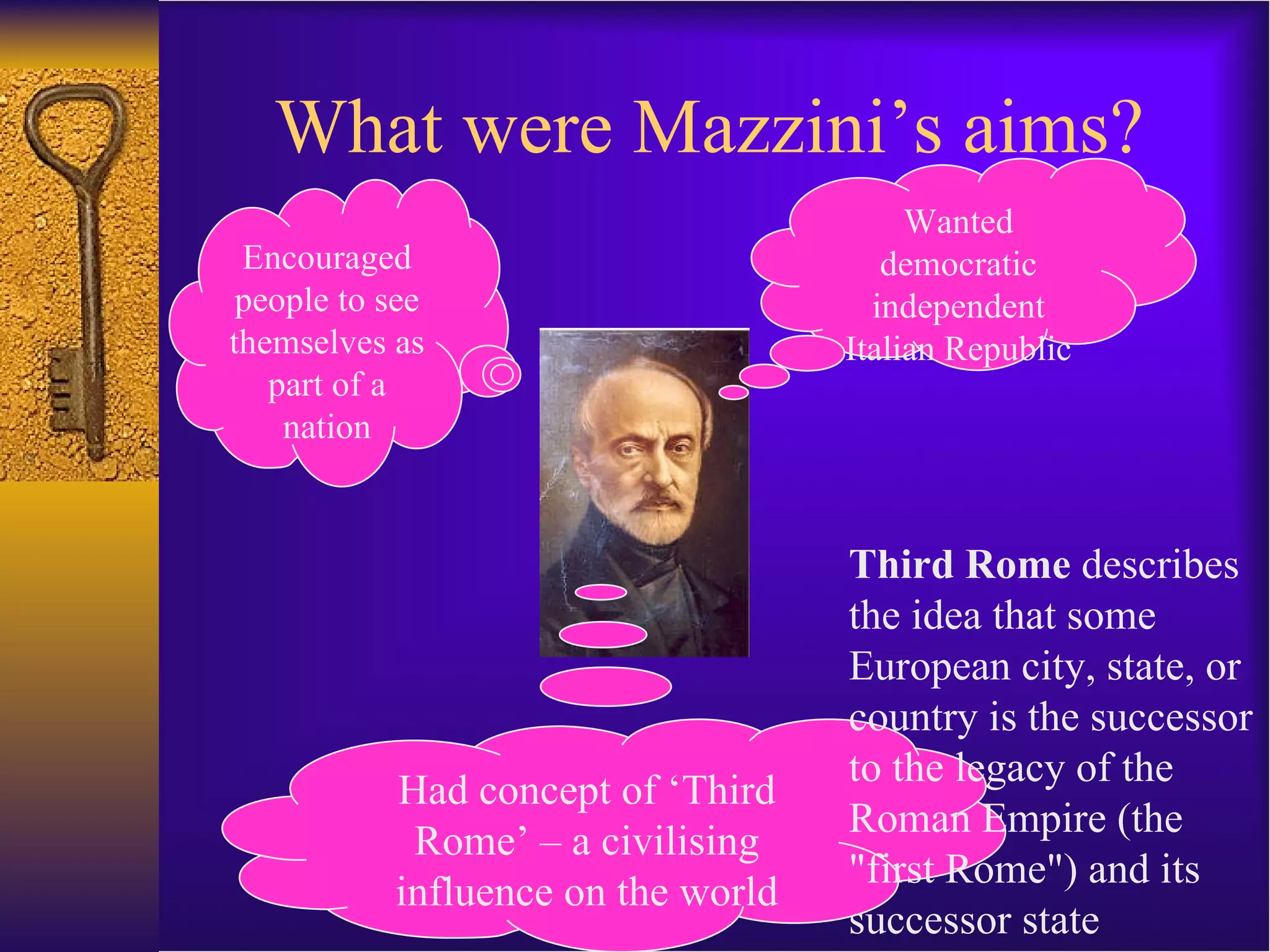
What were Mazzini’saims? Encouraged people to see themselves as part of a nation Wanted democratic independent Italian Republic Had concept of ‘Third Rome’ – a civilising influence on the world Third Rome describes the idea that some European city, state, or country is the successor to the legacy of the Roman Empire (the "first Rome") and its successor state
5.
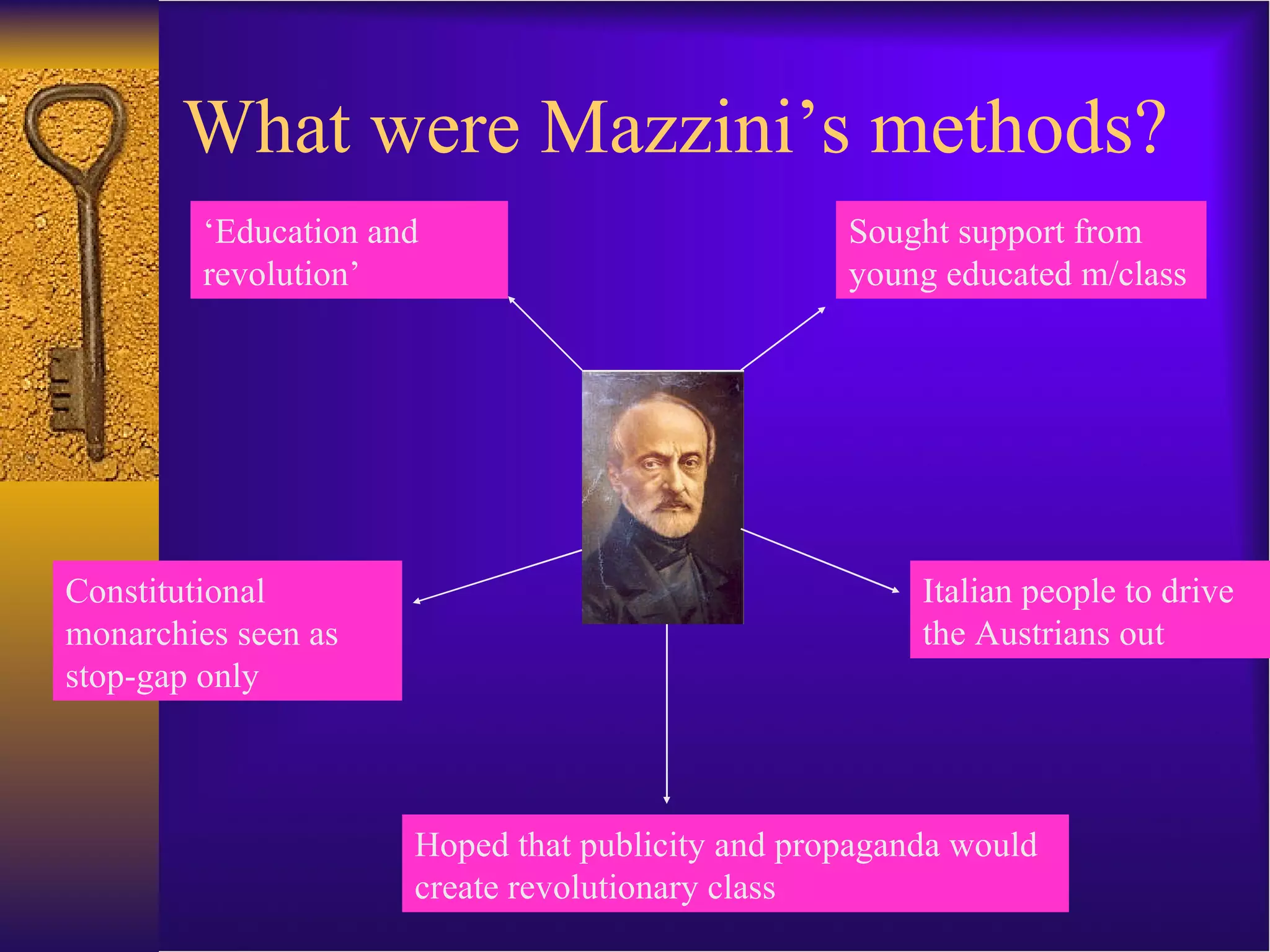
What were Mazzini’smethods? ‘ Education and revolution’ Sought support from young educated m/class Italian people to drive the Austrians out Hoped that publicity and propaganda would create revolutionary class Constitutional monarchies seen as stop-gap only
How big animpact did Mazzini have on the Unification of Italy? Gave encouragement to Italian patriotism Presented new view of Italy Inspired Garibaldi to join movement Helped to win international publicity for Italian freedom. Defence of Rome in 1849 was heroic failure By his actions put pressure on Cavour and others to act more positively
8.
How successful wasMazzini? Had little practical experience Overestimated level of support – ignored problems of the peasants Support was limited All his plots failed! Some middle class alienated by his revolutionary stance Made no attempt to win support from peasants and town workers
9.
Mazzini’s verdict onItaly, 1871 Italian territory under foreign control Foreigners had played too important a role in unification Unhappy with new constitution
10.
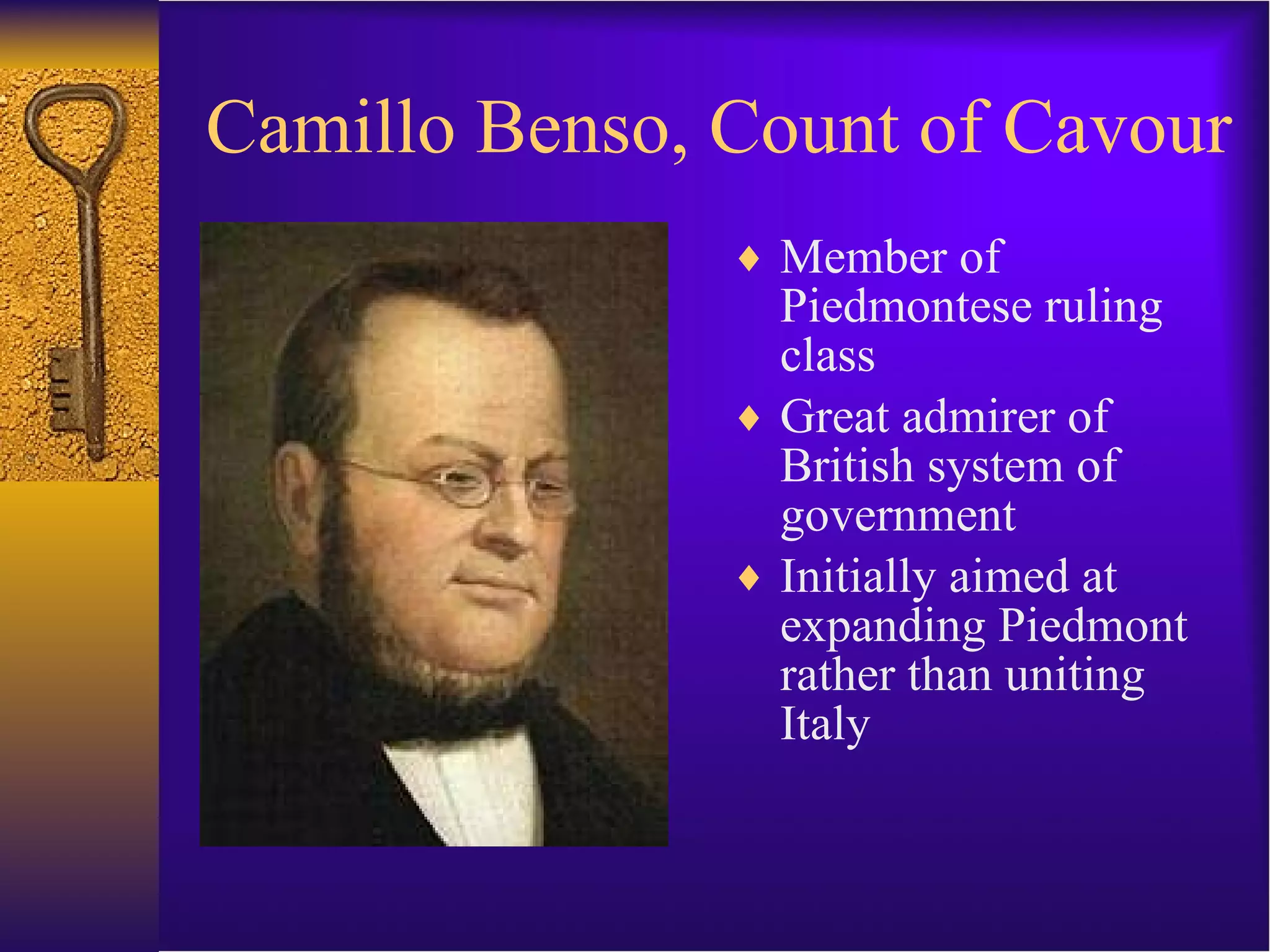
Camillo Benso, Countof Cavour Member of Piedmontese ruling class Great admirer of British system of government Initially aimed at expanding Piedmont rather than uniting Italy
11.
Cavour – ForeignPolicy Aware of shortcomings of ‘Italia fara da se’ ( Italy will operate on its own ”) Aimed to move Austrians out of Lombardy & Venetia As PM had considerable control over foreign policy 1854 – outbreak of Crimean War: Britain & France vs Russia 15,000 troops sent to support France & GB
Cavour and theCrimean War Some doubt over motivation but perhaps aimed to gain support from GB & France Troops played only minor role but did win respect & gratitude from allies Congress of Paris (1856) dealt with peace negotiations Cavour not directly involved in talks
14.
Cavour wins supportForeign support & diplomacy seen as main successes Also important was link with National Society Number of its leaders beginning to accept Piedmont as focus for unification Cavour now looked to France for help against Austria
15.
Napoleon III andItalian Unity Former member of the Carbonari His troops had crushed Roman Republic in 1849 Had his own reasons for aiding Piedmont Probably favoured federation headed by Pope
16.
The Orsini BombPlot! In January 14, 1858 Felice Orsini (an Italian patriot) attempted to assassinate Napoleon III Felt Nap. III was responsible for failure of earlier revolutions Hoped that this would aid Italian unity His act, designed to arouse world interest in the Italian cause, paradoxically influenced Napoleon's own decision to intervene in favor of Italian unification. Orsini was sent to the guillotine on 13 March 1858.
17.
War with Austria1859 War provoked with Austria French (with limited help from Piedmont) won 2 closely fought victories Austria on brink of surrender Napoleon III now pulled put of the war – unexpectedly Cavour was furious – resigned as PM
18.
IV. ItalianUnification Napoleon III committed his troops Victory for S-P but only the Northern States fell under their control Someone else would have to unify the south
19.
Cavour and GaribaldiGaribaldi raised volunteers to fight for Savoy Instead went to Sicily Cavour not happy – feared consequences of Garibaldi’s actions Was torn between trying to stop Garibaldi and offering support Attempts to stop him failed!
20.
Cavour and thePapal States Biggest problem for Cavour was fear of French or Austrian intervention To forestall Garibaldi marching on Rome, Cavour sent troops into the Papal States Piedmontese troops successful but did not receive the same level of support as Garibaldi’s men By end of 1861 Victor Emmanuel acclaimed first King of Italy Cavour died end of 1861
21.
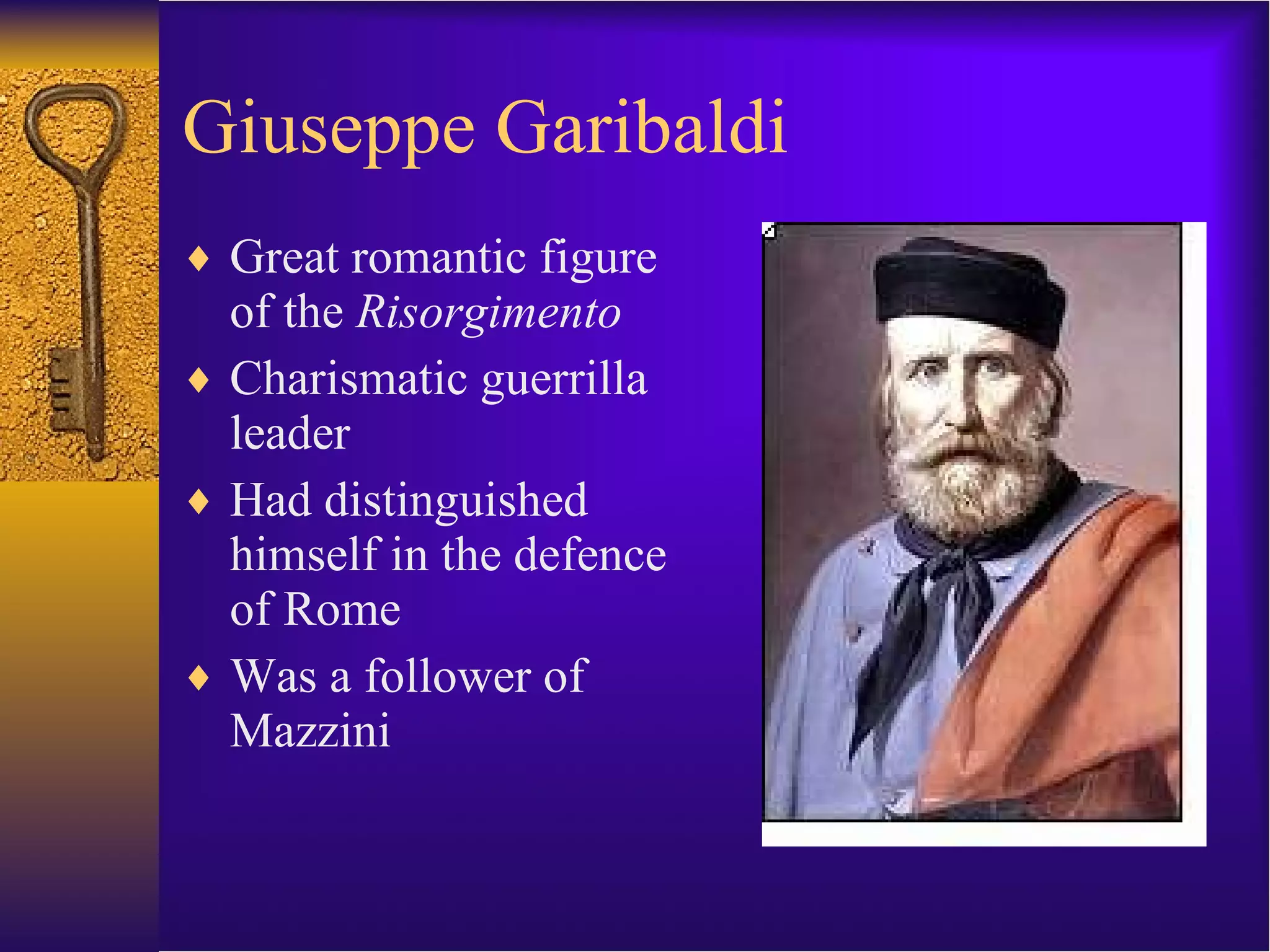
Giuseppe Garibaldi Greatromantic figure of the Risorgimento Charismatic guerrilla leader Had distinguished himself in the defence of Rome Was a follower of Mazzini
Garibaldi & thecampaign of 1861 Hi-jacked the popular revolt in Sicily Used great cunning to gain control of the island His ‘1000 Red Shirts’ gained more and more support Had more problems on the mainland but was successful in defeating King of Naples Handed his conquests over to VE II
24.
A Unified Peninsula!A contemporary British cartoon, entitled " Right Leg in the Boot at Last ," shows Garibaldi helping Victor Emmanuel put on the Italian boot.
25.
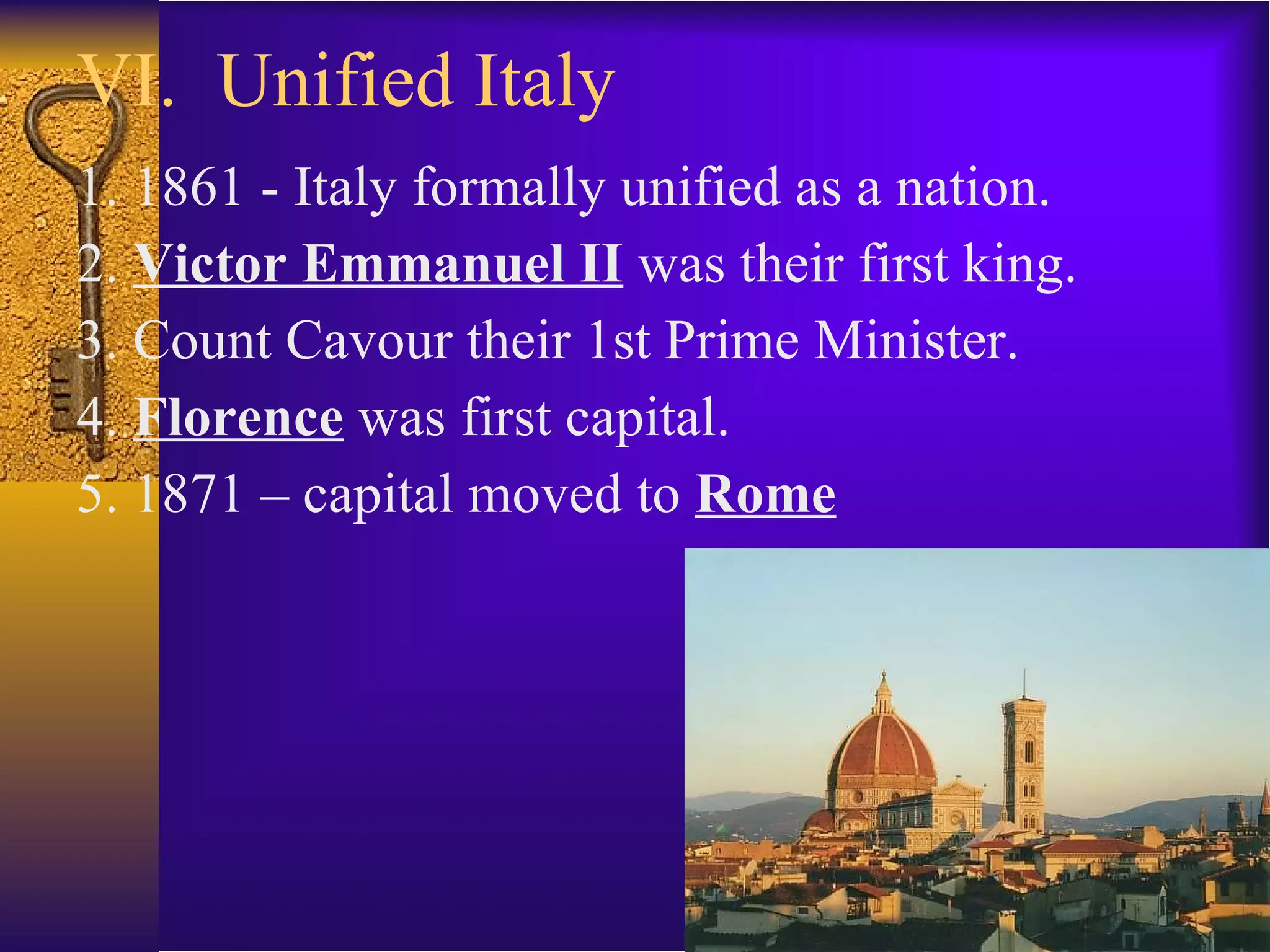
VI. UnifiedItaly 1. 1861 - Italy formally unified as a nation. 2. Victor Emmanuel II was their first king. 3. Count Cavour their 1st Prime Minister. 4. Florence was first capital. 5. 1871 – capital moved to Rome
Italy 1861-1870 Kingdomof Italy declared – Victor Emmanuel II ‘by the grace of God and the rule of the people’ Constitutional Monarchy First parliament met in Turin, March 1861 1866 VE II anxious to prove Italian military prowess
28.
Italy 1861-1870 (2)Venetia occupied after Austrian defeat – voted to join with Italy Garibaldi made 2 failed attempts to seize Rome (1862, 1867) – little support from the Romans 1870 Franco-Prussian War saw withdrawal of French garrison Pius XI soon withdrew to the Vatican
29.
How united wasItaly by 1870? Bad relations with the Papacy Lack of common language Spread of Piedmontese constitution caused conflict Franchise restricted – ½ million/22 million Liberal aims had little in common with peasantry Severe economic problems ‘ Brigands’ War’ in the South for many years Political system did not develop well
30.
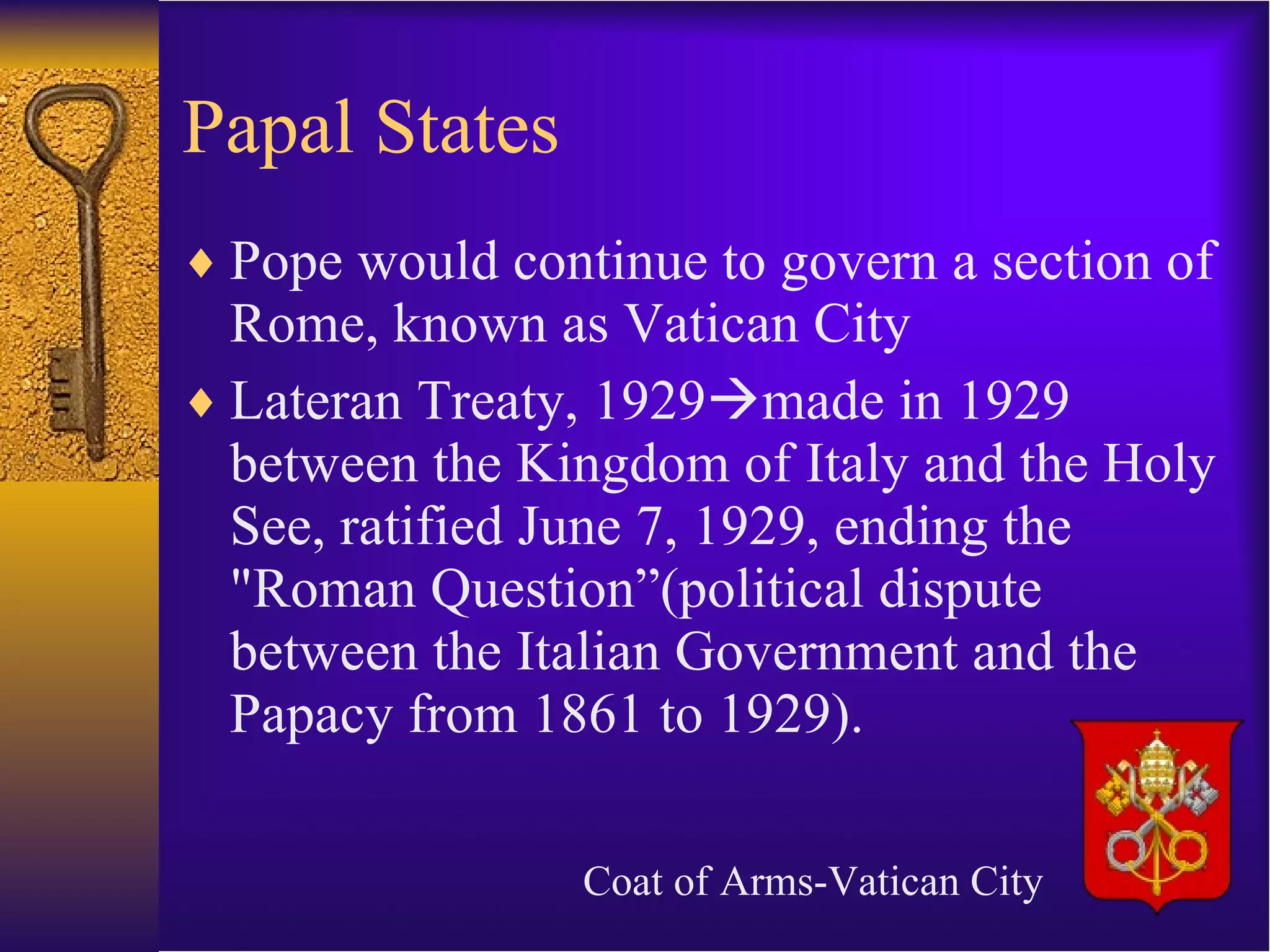
Papal States Popewould continue to govern a section of Rome, known as Vatican City Lateran Treaty, 1929 made in 1929 between the Kingdom of Italy and the Holy See, ratified June 7, 1929, ending the "Roman Question”(political dispute between the Italian Government and the Papacy from 1861 to 1929). Coat of Arms-Vatican City
31.
Papal States con’t…signed for King Victor Emmanuel III of Italy by Prime Minister Benito Mussolini and for Pope Pius XI by Cardinal Secretary of State Pietro Gasparri. The agreements were signed in the Lateran Palace, hence the name by which they are known. *guaranteed full and independent sovereignty to the Holy See *established Catholicism as the religion of Italy
32.
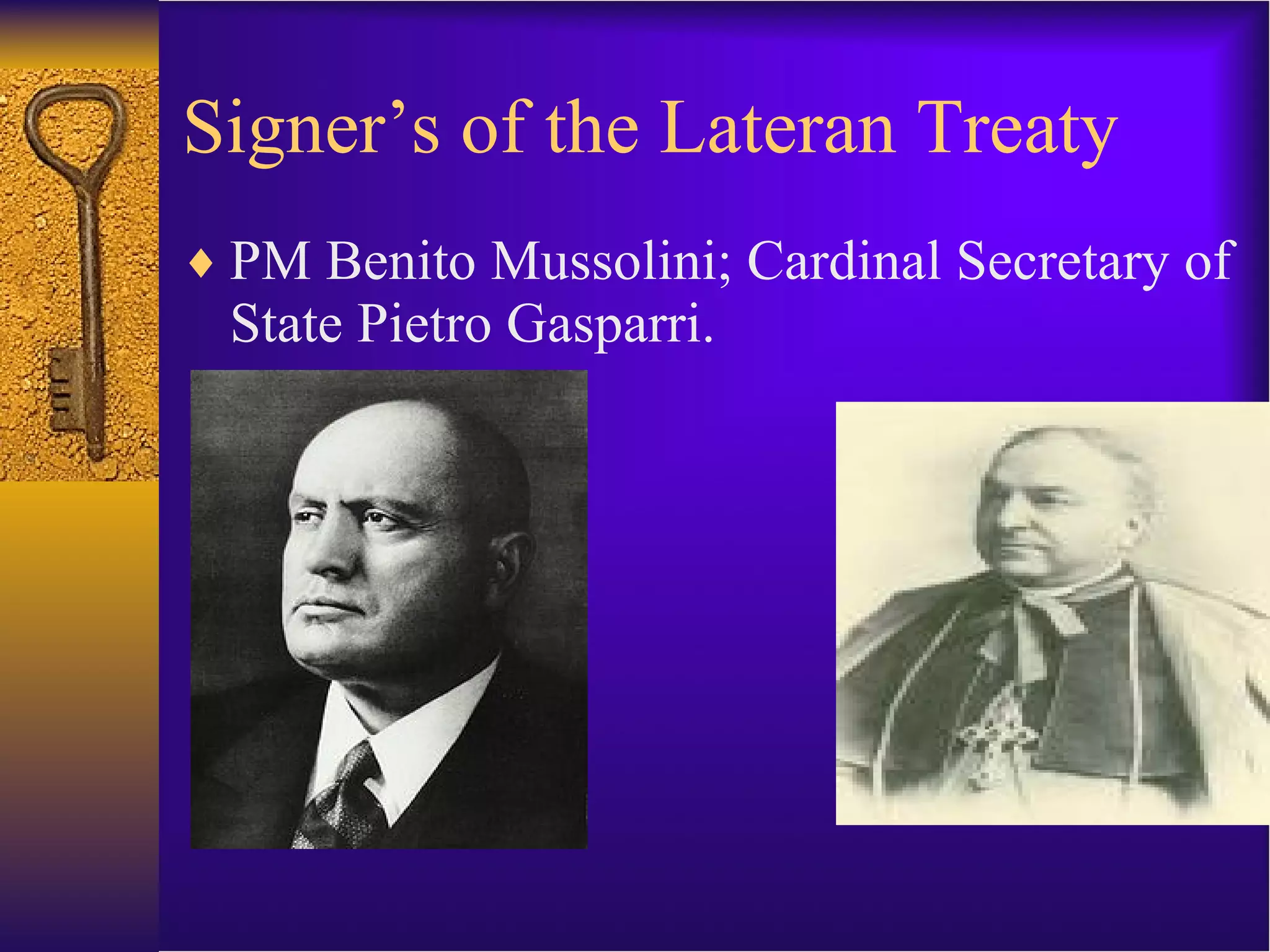
Signer’s of theLateran Treaty PM Benito Mussolini; Cardinal Secretary of State Pietro Gasparri.
33.
The “Holy See”episcopal jurisdiction of the Bishop of Rome (who is commonly known as the Pope) The Holy See is not the same as the Vatican City State, which came into existence only in 1929, while the Holy See dates back to early Christian times. Flag of Vatican City
34.
VATICAN CITY STATECELEBRATES 83 YEARS On February 11th, 1929, an historic treaty was signed between the Italian Government and the Vatican re-establishing the political power and diplomatic standing of the Catholic Church, which had been lost when Italy seized Rome, the last of the Papal States, on September 20th, 1870.