It was a transition from medieval
to modern times.
Renaissance means
“rebirth”
THE
RENAISSANCE
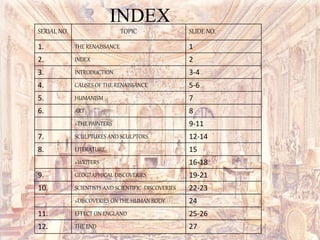
INDEX
SERIAL NO. TOPIC SLIDE NO.
1. THE RENAISSANCE 1
2. INDEX 2
3. INTRODUCTION 3-4
4. CAUSES OF THE RENAISSANCE 5-6
5. HUMANISM 7
6. ART 8
>THE PAINTERS 9-11
7. SCULPTURES AND SCULPTORS 12-14
8. LITERATURE 15
>WRITERS 16-18
9. GEOGTAPHICAL DISCOVERIES 19-21
10. SCIENTISTS AND SCIENTIFIC DISCOVERIES 22-23
>DISCOVERIES ON THE HUMAN BODY 24
11. EFFECT ON ENGLAND 25-26
12. THE END 27
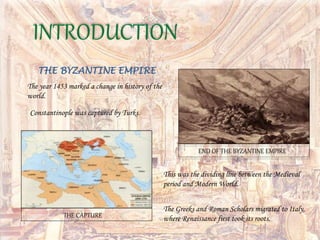
The year 1453 marked a change in history of the
world.
THE BYZANTINE EMPIRE
Constantinople was captured by Turks.
This was the dividing line between the Medieval
period and Modern World.
INTRODUCTION
The Greeks and Roman Scholars migrated to Italy,
where Renaissance first took its roots.
END OF THE BYZANTINE EMPIRE
THE CAPTURE
The end of the medieval period in Europe was marked by
changes in attitudes towards politics, religion, and
learning. These changes became more widespread and
sweeping during the fourteenth and fifteenth centuries,
bringing about the cultural movement called
Renaissance
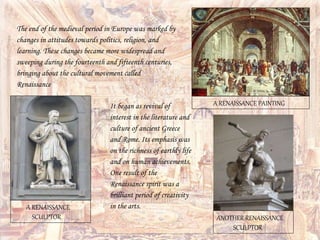
It began as revival of
interest in the literature and
culture of ancient Greece
and Rome. Its emphasis was
on the richness of earthly life
and on human achievements.
One result of the
Renaissance spirit was a
brilliant period of creativity
in the arts.
A RENAISSANCE PAINTING
A RENAISSANCE
SCULPTOR ANOTHER RENAISSANCE
SCULPTOR
SPREAD OF
EDUCATION
The Emergence of
Cathedral churches like
Paris, Padua, Naples,
Oxford and Cambridge
created new thinking
and learning.
DECLINE OF FEUDALISM
The feudal system was opposed to progress.
The feudal lords could not increase the
rents from their subordinates and had to
borrow money to maintain themselves.
They had to sell off their lands to pay their
debts. This led to break up of feudalism.
SPIRIT OF ENQUIRY
The Church controlled all
the education. This
Knowledge was accepted
without questioning.
Scholars like Roger Bacon
and Peter Abelard
challenged the authority of
Church.
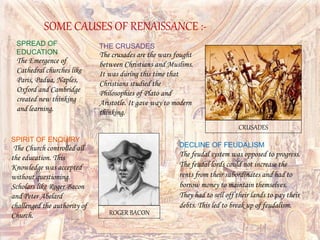
THE CRUSADES
The crusades are the wars fought
between Christians and Muslims.
It was during this time that
Christians studied the
Philosophies of Plato and
Aristotle. It gave way to modern
thinking.
SOME CAUSES OF RENAISSANCE :-
ROGER BACON
CRUSADES
ENCOURAGEMENT TO ART
AND LEARNING
The encouragement given to Art
and learning was by Popes,
Emperors, Kings and rich
merchants. Lorenzo de Medici gave
patronage in Florence in the 15 th
century. This city became a great
centre of art and learning.
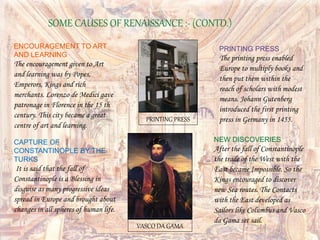
PRINTING PRESS
The printing press enabled
Europe to multiply books and
then put them within the
reach of scholars with modest
means. Johann Gutenberg
introduced the first printing
press in Germany in 1455.
CAPTURE OF
CONSTANTINOPLE BY THE
TURKS
It is said that the fall of
Constantinople is a Blessing in
disguise as many progressive ideas
spread in Europe and brought about
changes in all spheres of human life.
NEW DISCOVERIES
After the fall of Constantinople
the trade of the West with the
East became Impossible. So the
Kings encouraged to discover
new Sea routes. The Contacts
with the East developed as
Sailors like Columbus and Vasco
da Gama set sail.
SOME CAUSES OF RENAISSANCE :- (CONTD.)
PRINTING PRESS
VASCO DA GAMA
HUMANISM
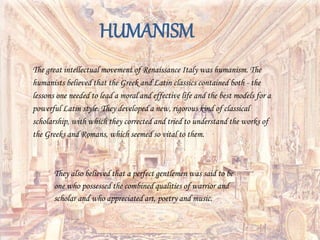
The great intellectual movement of Renaissance Italy was humanism. The
humanists believed that the Greek and Latin classics contained both - the
lessons one needed to lead a moral and effective life and the best models for a
powerful Latin style. They developed a new, rigorous kind of classical
scholarship, with which they corrected and tried to understand the works of
the Greeks and Romans, which seemed so vital to them.
They also believed that a perfect gentlemen was said to be
one who possessed the combined qualities of warrior and
scholar and who appreciated art, poetry and music.
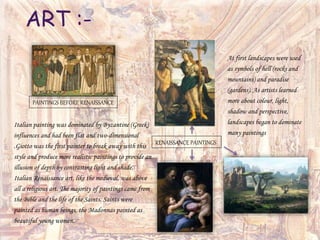
Italian painting was dominated by Byzantine (Greek)
influences and had been flat and two-dimensional
.Giotto was the first painter to break away with this
style and produce more realistic paintings to provide an
illusion of depth by contrasting light and shade.
Italian Renaissance art, like the medieval, was above
all a religious art. The majority of paintings came from
the Bible and the life of the Saints. Saints were
painted as human beings, the Madonnas painted as
beautiful young women.
At first landscapes were used
as symbols of hell (rocks and
mountains) and paradise
(gardens). As artists learned
more about colour, light,
shadow and perspective,
landscapes began to dominate
many paintings
RENAISSANCE PAINTINGS
PAINTINGS BEFORE RENAISSANCE
ART :-
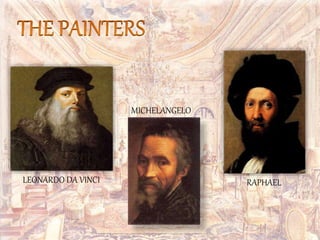
LEONARDO DA VINCI
MICHELANGELO
RAPHAEL
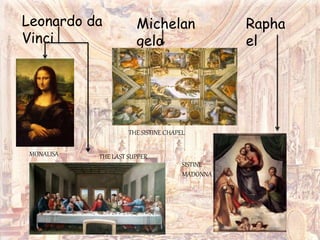
Leonardo da Vinci , was a man of versatile talents. He
was The first scientist to perform human dissections of the body to study anatomy. His
two famous paintings were “The Last Supper”, which shows the last dinner of Christ, and
“Mona Lisa”, which portrays a woman with a bewitching smile
Michelangelo was great in both painting and sculpture. His
genius is shown in his exquisite painting on the ceiling of the Sistine Chapel which tells
the biblical story from the Creation to the Great Deluge. These paintings show his
marvelous knowledge of human anatomy.
Raphael , was the greatest painter of the Renaissance. He was called
“perfect painter” because of the classical harmony and exquisite symmetry of his art. His
masterpiece was the “Sistine Madonna”, which has been acclaimed as the greatest painting
in the world
Leonardo da
Vinci
Michelan
gelo
Rapha
el
MONALISA THE LAST SUPPER
THE SISTINE CHAPEL
SISTINE
MADONNA
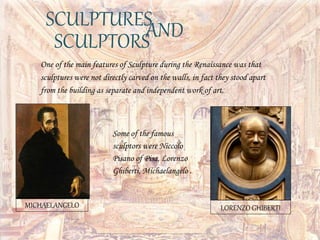
SCULPTURESANDSCULPTORS
One of the main features of Sculpture during the Renaissance was that
sculptures were not directly carved on the walls, in fact they stood apart
from the building as separate and independent work of art.
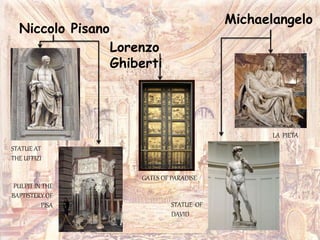
Some of the famous
sculptors were Niccolo
Pisano of Pisa, Lorenzo
Ghiberti, Michaelangelo .
MICHAELANGELO LORENZO GHIBERTI
Michaelangelo- the most famous of all Renaissance
sculptors, whose statue of David is regarded as one of the finest masterpieces of
sculpture. His greatest sculptural work is La Pieta, the most renowned statue in
the world. It is an exquisite statue of Christ after His Crucifixion.
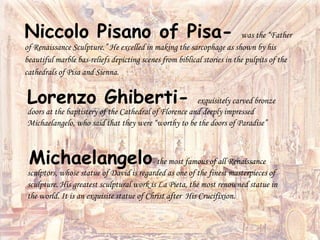
Niccolo Pisano of Pisa- was the “Father
of Renaissance Sculpture.” He excelled in making the sarcophage as shown by his
beautiful marble bas-reliefs depicting scenes from biblical stories in the pulpits of the
cathedrals of Pisa and Sienna.
Lorenzo Ghiberti- exquisitely carved bronze
doors at the baptistery of the Cathedral of Florence and deeply impressed
Michaelangelo, who said that they were “worthy to be the doors of Paradise”
Niccolo Pisano
Lorenzo
Ghiberti
Michaelangelo
STATUE AT
THE UFFIZI
GATES OF PARADISE
PULPIT IN THE
BAPTISTERY OF
PISA
LA PIETA
STATUE OF
DAVID
The renaissance spirit and the renewed interest in ancient Greece and Rome were
the inspiration of a brilliant creative period in literature . Most important, they
portrayed people with greet realism, bringing out the subject’s individuality.
LITERATURE
Writers used stories from ancient history and classical mythology as their
subjects. They also adapted styles used by the greek and roman authors.
Most important, they portrayed people with greet realism, bringing out the subject’s
individuality
Rabelais and Montaigne were two great french renaissance writers. They
expressed the renaissance spirit in France. The emphasis on individuality was
reflected in very different ways in their works.
WRITERS
Francois Rabelais
-was born in France
-He encouraged the Renaissance ideal of living a
full, busy life
- He was a monk, a scholar, and a physician,
who also studied plants and Roman
archaeological sites.
- He wrote Gargantua and Pantagruel- a five-
volume work, that made fun of those who did
not take the humanists point of view.
- The books combined humour, lively
imagination, and exciting adventures with
scholarship.
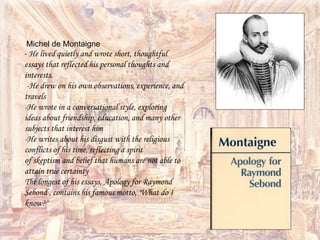
Michel de Montaigne
- He lived quietly and wrote short, thoughtful
essays that reflected his personal thoughts and
interests.
-He drew on his own observations, experience, and
travels
-He wrote in a conversational style, exploring
ideas about friendship, education, and many other
subjects that interest him
-He writes about his disgust with the religious
conflicts of his time, reflecting a spirit
of skeptism and belief that humans are not able to
attain true certainty
The longest of his essays, Apology for Raymond
Sebond , contains his famous motto, "What do I
know?"
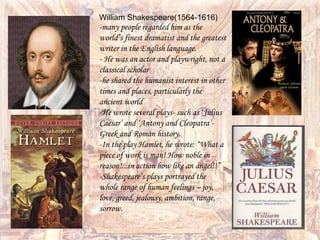
William Shakespeare(1564-1616)
-many people regarded him as the
world’s finest dramatist and the greatest
writer in the English language.
- He was an actor and playwright, not a
classical scholar
-he shared the humanist interest in other
times and places, particularly the
ancient world
-He wrote several plays- such as ‘Julius
Caesar’ and ‘Antony and Cleopatra’-
Greek and Roman history.
-In the play Hamlet, he wrote: “What a
piece of work is man! How noble in
reason!...in action how like an angel!!”
-Shakespeare’s plays portrayed the
whole range of human feelings – joy,
love, greed, jealousy, ambition, range,
sorrow.
Geographical Discoveries
After the crusades, the Europeans became interested in the East, largely
through the travel accounts of travelers and traders who had travelled through
Constantinople. The trade especially in spices was very profitable. If the
Europeans were to continue to have spices and other goods, they had to find out
new sea routes. Portugal and Spain were the pioneers in the Quest.
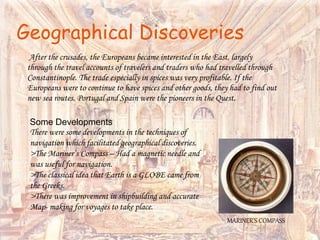
Some Developments
There were some developments in the techniques of
navigation which facilitated geographical discoveries.
>The Mariner’s Compass – Had a magnetic needle and
was useful for navigation.
>The classical idea that Earth is a GLOBE came from
the Greeks.
>There was improvement in shipbuilding and accurate
Map- making for voyages to take place.
MARINER’S COMPASS
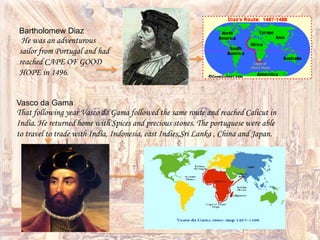
Bartholomew Diaz
He was an adventurous
sailor from Portugal and had
reached CAPE OF GOOD
HOPE in 1496.
Vasco da Gama
That following year Vasco da Gama followed the same route and reached Calicut in
India. He returned home with Spices and precious stones. The portuguese were able
to travel to trade with India, Indonesia, east Indies,Sri Lanka , China and Japan.
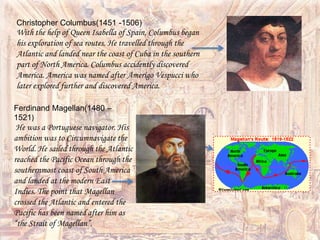
Ferdinand Magellan(1480 –
1521)
He was a Portuguese navigator. His
ambition was to Circumnavigate the
World. He sailed through the Atlantic
reached the Pacific Ocean through the
southernmost coast of South America
and landed at the modern East
Indies. The point that Magellan
crossed the Atlantic and entered the
Pacific has been named after him as
“the Strait of Magellan”.
Christopher Columbus(1451 -1506)
With the help of Queen Isabella of Spain, Columbus began
his exploration of sea routes. He travelled through the
Atlantic and landed near the coast of Cuba in the southern
part of North America. Columbus accidently discovered
America. America was named after Amerigo Vespucci who
later explored further and discovered America.
SCIENTISTS AND SCIENTIFIC
DISCOVERIES
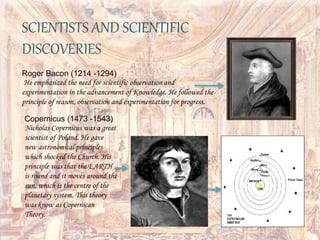
Roger Bacon (1214 -1294)
He emphasized the need for scientific observation and
experimentation in the advancement of Knowledge. He followed the
principle of reason, observation and experimentation for progress.
Copernicus (1473 -1543)
Nicholas Copernicus was a great
scientist of Poland. He gave
new astronomical principles
which shocked the Church. His
principle was that the EARTH
is round and it moves around the
sun, which is the centre of the
planetary system. This theory
was know as Copernican
Theory.
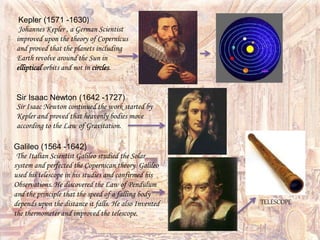
Kepler (1571 -1630)
Johannes Kepler , a German Scientist
improved upon the theory of Copernicus
and proved that the planets including
Earth revolve around the Sun in
elliptical orbits and not in circles.
Sir Isaac Newton (1642 -1727)
Sir Isaac Newton continued the work started by
Kepler and proved that heavenly bodies move
according to the Law of Gravitation.
Galileo (1564 -1642)
The Italian Scientist Galileo studied the Solar
system and perfected the Copernican theory. Galileo
used his telescope in his studies and confirmed his
Observations. He discovered the Law of Pendulum
and the principle that the speed of a falling body
depends upon the distance it falls. He also Invented
the thermometer and improved the telescope.
TELESCOPE
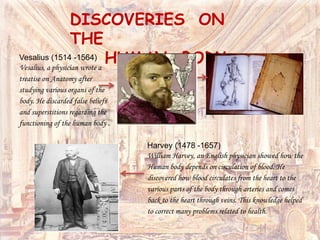
Vesalius (1514 -1564)
Vesalius, a physician wrote a
treatise on Anatomy after
studying various organs of the
body. He discarded false beliefs
and superstitions regarding the
functioning of the human body .
Harvey (1478 -1657)
William Harvey, an English physician showed how the
Human body depends on circulation of blood. He
discovered how blood circulates from the heart to the
various parts of the body through arteries and comes
back to the heart through veins. This knowledge helped
to correct many problems related to health.
DISCOVERIES ON
THE
HUMAN BODY
EFFECTS OF THE EUROPEAN RENAISSANCE WAS THAT IT WAS
THE REBIRTH OF THE MIDDLE AGES–
 The European Renaissance created the classical learning and classical values of the people
in the Middle Ages.
It taught them to question their government and religions.
 The people of the Renaissance also got to witness the discovery of new continents.
They were also able to witness the creation of astronomy.
There were many inventions created during the period of the Renaissance, one of which
includes gunpowder.
Trade lay at the heart of the Renaissance, and city-states such as Florence and Venice
became virtual empires because of it.
They were the first nations to see the importance of diplomacy.
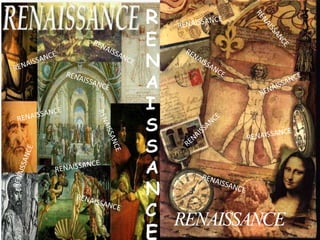
R
E
N
A
I
S
S
A
N
C
E
RENAISSANCE
SWAYAMI BERA
CLASS-IX C
ROLL NO. -27
THE END

Presentation1

  • 1.
    It was atransition from medieval to modern times. Renaissance means “rebirth” THE RENAISSANCE
  • 2.
    INDEX SERIAL NO. TOPICSLIDE NO. 1. THE RENAISSANCE 1 2. INDEX 2 3. INTRODUCTION 3-4 4. CAUSES OF THE RENAISSANCE 5-6 5. HUMANISM 7 6. ART 8 >THE PAINTERS 9-11 7. SCULPTURES AND SCULPTORS 12-14 8. LITERATURE 15 >WRITERS 16-18 9. GEOGTAPHICAL DISCOVERIES 19-21 10. SCIENTISTS AND SCIENTIFIC DISCOVERIES 22-23 >DISCOVERIES ON THE HUMAN BODY 24 11. EFFECT ON ENGLAND 25-26 12. THE END 27
  • 3.
    The year 1453marked a change in history of the world. THE BYZANTINE EMPIRE Constantinople was captured by Turks. This was the dividing line between the Medieval period and Modern World. INTRODUCTION The Greeks and Roman Scholars migrated to Italy, where Renaissance first took its roots. END OF THE BYZANTINE EMPIRE THE CAPTURE
  • 4.
    The end ofthe medieval period in Europe was marked by changes in attitudes towards politics, religion, and learning. These changes became more widespread and sweeping during the fourteenth and fifteenth centuries, bringing about the cultural movement called Renaissance It began as revival of interest in the literature and culture of ancient Greece and Rome. Its emphasis was on the richness of earthly life and on human achievements. One result of the Renaissance spirit was a brilliant period of creativity in the arts. A RENAISSANCE PAINTING A RENAISSANCE SCULPTOR ANOTHER RENAISSANCE SCULPTOR
  • 5.
    SPREAD OF EDUCATION The Emergenceof Cathedral churches like Paris, Padua, Naples, Oxford and Cambridge created new thinking and learning. DECLINE OF FEUDALISM The feudal system was opposed to progress. The feudal lords could not increase the rents from their subordinates and had to borrow money to maintain themselves. They had to sell off their lands to pay their debts. This led to break up of feudalism. SPIRIT OF ENQUIRY The Church controlled all the education. This Knowledge was accepted without questioning. Scholars like Roger Bacon and Peter Abelard challenged the authority of Church. THE CRUSADES The crusades are the wars fought between Christians and Muslims. It was during this time that Christians studied the Philosophies of Plato and Aristotle. It gave way to modern thinking. SOME CAUSES OF RENAISSANCE :- ROGER BACON CRUSADES
  • 6.
    ENCOURAGEMENT TO ART ANDLEARNING The encouragement given to Art and learning was by Popes, Emperors, Kings and rich merchants. Lorenzo de Medici gave patronage in Florence in the 15 th century. This city became a great centre of art and learning. PRINTING PRESS The printing press enabled Europe to multiply books and then put them within the reach of scholars with modest means. Johann Gutenberg introduced the first printing press in Germany in 1455. CAPTURE OF CONSTANTINOPLE BY THE TURKS It is said that the fall of Constantinople is a Blessing in disguise as many progressive ideas spread in Europe and brought about changes in all spheres of human life. NEW DISCOVERIES After the fall of Constantinople the trade of the West with the East became Impossible. So the Kings encouraged to discover new Sea routes. The Contacts with the East developed as Sailors like Columbus and Vasco da Gama set sail. SOME CAUSES OF RENAISSANCE :- (CONTD.) PRINTING PRESS VASCO DA GAMA
  • 7.
    HUMANISM The great intellectualmovement of Renaissance Italy was humanism. The humanists believed that the Greek and Latin classics contained both - the lessons one needed to lead a moral and effective life and the best models for a powerful Latin style. They developed a new, rigorous kind of classical scholarship, with which they corrected and tried to understand the works of the Greeks and Romans, which seemed so vital to them. They also believed that a perfect gentlemen was said to be one who possessed the combined qualities of warrior and scholar and who appreciated art, poetry and music.
  • 8.
    Italian painting wasdominated by Byzantine (Greek) influences and had been flat and two-dimensional .Giotto was the first painter to break away with this style and produce more realistic paintings to provide an illusion of depth by contrasting light and shade. Italian Renaissance art, like the medieval, was above all a religious art. The majority of paintings came from the Bible and the life of the Saints. Saints were painted as human beings, the Madonnas painted as beautiful young women. At first landscapes were used as symbols of hell (rocks and mountains) and paradise (gardens). As artists learned more about colour, light, shadow and perspective, landscapes began to dominate many paintings RENAISSANCE PAINTINGS PAINTINGS BEFORE RENAISSANCE ART :-
  • 9.
  • 10.
    Leonardo da Vinci, was a man of versatile talents. He was The first scientist to perform human dissections of the body to study anatomy. His two famous paintings were “The Last Supper”, which shows the last dinner of Christ, and “Mona Lisa”, which portrays a woman with a bewitching smile Michelangelo was great in both painting and sculpture. His genius is shown in his exquisite painting on the ceiling of the Sistine Chapel which tells the biblical story from the Creation to the Great Deluge. These paintings show his marvelous knowledge of human anatomy. Raphael , was the greatest painter of the Renaissance. He was called “perfect painter” because of the classical harmony and exquisite symmetry of his art. His masterpiece was the “Sistine Madonna”, which has been acclaimed as the greatest painting in the world
  • 11.
    Leonardo da Vinci Michelan gelo Rapha el MONALISA THELAST SUPPER THE SISTINE CHAPEL SISTINE MADONNA
  • 12.
    SCULPTURESANDSCULPTORS One of themain features of Sculpture during the Renaissance was that sculptures were not directly carved on the walls, in fact they stood apart from the building as separate and independent work of art. Some of the famous sculptors were Niccolo Pisano of Pisa, Lorenzo Ghiberti, Michaelangelo . MICHAELANGELO LORENZO GHIBERTI
  • 13.
    Michaelangelo- the mostfamous of all Renaissance sculptors, whose statue of David is regarded as one of the finest masterpieces of sculpture. His greatest sculptural work is La Pieta, the most renowned statue in the world. It is an exquisite statue of Christ after His Crucifixion. Niccolo Pisano of Pisa- was the “Father of Renaissance Sculpture.” He excelled in making the sarcophage as shown by his beautiful marble bas-reliefs depicting scenes from biblical stories in the pulpits of the cathedrals of Pisa and Sienna. Lorenzo Ghiberti- exquisitely carved bronze doors at the baptistery of the Cathedral of Florence and deeply impressed Michaelangelo, who said that they were “worthy to be the doors of Paradise”
  • 14.
    Niccolo Pisano Lorenzo Ghiberti Michaelangelo STATUE AT THEUFFIZI GATES OF PARADISE PULPIT IN THE BAPTISTERY OF PISA LA PIETA STATUE OF DAVID
  • 15.
    The renaissance spiritand the renewed interest in ancient Greece and Rome were the inspiration of a brilliant creative period in literature . Most important, they portrayed people with greet realism, bringing out the subject’s individuality. LITERATURE Writers used stories from ancient history and classical mythology as their subjects. They also adapted styles used by the greek and roman authors. Most important, they portrayed people with greet realism, bringing out the subject’s individuality
  • 16.
    Rabelais and Montaignewere two great french renaissance writers. They expressed the renaissance spirit in France. The emphasis on individuality was reflected in very different ways in their works. WRITERS Francois Rabelais -was born in France -He encouraged the Renaissance ideal of living a full, busy life - He was a monk, a scholar, and a physician, who also studied plants and Roman archaeological sites. - He wrote Gargantua and Pantagruel- a five- volume work, that made fun of those who did not take the humanists point of view. - The books combined humour, lively imagination, and exciting adventures with scholarship.
  • 17.
    Michel de Montaigne -He lived quietly and wrote short, thoughtful essays that reflected his personal thoughts and interests. -He drew on his own observations, experience, and travels -He wrote in a conversational style, exploring ideas about friendship, education, and many other subjects that interest him -He writes about his disgust with the religious conflicts of his time, reflecting a spirit of skeptism and belief that humans are not able to attain true certainty The longest of his essays, Apology for Raymond Sebond , contains his famous motto, "What do I know?"
  • 18.
    William Shakespeare(1564-1616) -many peopleregarded him as the world’s finest dramatist and the greatest writer in the English language. - He was an actor and playwright, not a classical scholar -he shared the humanist interest in other times and places, particularly the ancient world -He wrote several plays- such as ‘Julius Caesar’ and ‘Antony and Cleopatra’- Greek and Roman history. -In the play Hamlet, he wrote: “What a piece of work is man! How noble in reason!...in action how like an angel!!” -Shakespeare’s plays portrayed the whole range of human feelings – joy, love, greed, jealousy, ambition, range, sorrow.
  • 19.
    Geographical Discoveries After thecrusades, the Europeans became interested in the East, largely through the travel accounts of travelers and traders who had travelled through Constantinople. The trade especially in spices was very profitable. If the Europeans were to continue to have spices and other goods, they had to find out new sea routes. Portugal and Spain were the pioneers in the Quest. Some Developments There were some developments in the techniques of navigation which facilitated geographical discoveries. >The Mariner’s Compass – Had a magnetic needle and was useful for navigation. >The classical idea that Earth is a GLOBE came from the Greeks. >There was improvement in shipbuilding and accurate Map- making for voyages to take place. MARINER’S COMPASS
  • 20.
    Bartholomew Diaz He wasan adventurous sailor from Portugal and had reached CAPE OF GOOD HOPE in 1496. Vasco da Gama That following year Vasco da Gama followed the same route and reached Calicut in India. He returned home with Spices and precious stones. The portuguese were able to travel to trade with India, Indonesia, east Indies,Sri Lanka , China and Japan.
  • 21.
    Ferdinand Magellan(1480 – 1521) Hewas a Portuguese navigator. His ambition was to Circumnavigate the World. He sailed through the Atlantic reached the Pacific Ocean through the southernmost coast of South America and landed at the modern East Indies. The point that Magellan crossed the Atlantic and entered the Pacific has been named after him as “the Strait of Magellan”. Christopher Columbus(1451 -1506) With the help of Queen Isabella of Spain, Columbus began his exploration of sea routes. He travelled through the Atlantic and landed near the coast of Cuba in the southern part of North America. Columbus accidently discovered America. America was named after Amerigo Vespucci who later explored further and discovered America.
  • 22.
    SCIENTISTS AND SCIENTIFIC DISCOVERIES RogerBacon (1214 -1294) He emphasized the need for scientific observation and experimentation in the advancement of Knowledge. He followed the principle of reason, observation and experimentation for progress. Copernicus (1473 -1543) Nicholas Copernicus was a great scientist of Poland. He gave new astronomical principles which shocked the Church. His principle was that the EARTH is round and it moves around the sun, which is the centre of the planetary system. This theory was know as Copernican Theory.
  • 23.
    Kepler (1571 -1630) JohannesKepler , a German Scientist improved upon the theory of Copernicus and proved that the planets including Earth revolve around the Sun in elliptical orbits and not in circles. Sir Isaac Newton (1642 -1727) Sir Isaac Newton continued the work started by Kepler and proved that heavenly bodies move according to the Law of Gravitation. Galileo (1564 -1642) The Italian Scientist Galileo studied the Solar system and perfected the Copernican theory. Galileo used his telescope in his studies and confirmed his Observations. He discovered the Law of Pendulum and the principle that the speed of a falling body depends upon the distance it falls. He also Invented the thermometer and improved the telescope. TELESCOPE
  • 24.
    Vesalius (1514 -1564) Vesalius,a physician wrote a treatise on Anatomy after studying various organs of the body. He discarded false beliefs and superstitions regarding the functioning of the human body . Harvey (1478 -1657) William Harvey, an English physician showed how the Human body depends on circulation of blood. He discovered how blood circulates from the heart to the various parts of the body through arteries and comes back to the heart through veins. This knowledge helped to correct many problems related to health. DISCOVERIES ON THE HUMAN BODY
  • 25.
    EFFECTS OF THEEUROPEAN RENAISSANCE WAS THAT IT WAS THE REBIRTH OF THE MIDDLE AGES–  The European Renaissance created the classical learning and classical values of the people in the Middle Ages. It taught them to question their government and religions.  The people of the Renaissance also got to witness the discovery of new continents. They were also able to witness the creation of astronomy. There were many inventions created during the period of the Renaissance, one of which includes gunpowder. Trade lay at the heart of the Renaissance, and city-states such as Florence and Venice became virtual empires because of it. They were the first nations to see the importance of diplomacy.
  • 26.
  • 27.