The Renaissance Renaissance means “rebirth”. A movement in Europe between 14 th  and 17 th  Century.
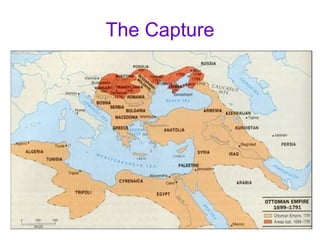
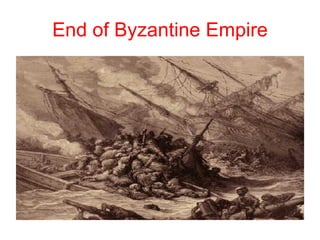
Byzantine Empire The year 1453 marked a change in history of the world. Constantinople was captured by Turks. This was the dividing line between the Medieval period and Modern World. The Greeks and Roman Scholars migrated to Italy, where Renaissance first took its roots.
The Capture
End of Byzantine Empire
Causes of Renaissance Spread of Education The Emergence of Cathedral churches like Paris, Padua, Naples, Oxford and Cambridge created new thinking and learning.
2. Decline of feudalism The feudal system was opposed to progress. The feudal lords could not increase the rents from their subordinates and had to borrow money to maintain themselves. They had to sell off their lands to pay their debts. This led to break up of fedualism.
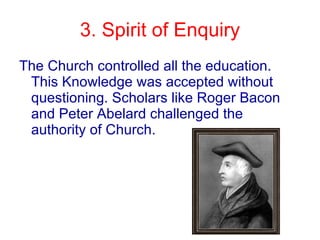
3. Spirit of Enquiry The Church controlled all the education. This Knowledge was accepted without questioning. Scholars like Roger Bacon and Peter Abelard challenged the authority of Church.
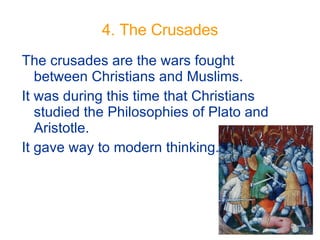
4. The Crusades The crusades are the wars fought between Christians and Muslims. It was during this time that Christians studied the Philosophies of Plato and Aristotle. It gave way to modern thinking.
5. Encouragement to Art and Learning The encouragement  given to Art and learning was by Popes, Emperors, Kings and rich merchants. Lorenzo de Medici gave patronage in Florence in the 15 th  century. This city became  a great centre of art and learning.
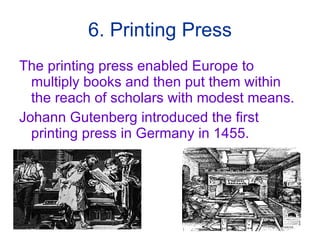
6. Printing Press The printing press enabled Europe to multiply books and then put them within the reach of scholars with modest means. Johann Gutenberg introduced the first printing press in Germany in 1455.
7.Capture of Constantinople by the Turks. It is said that the fall of Constantinople is a  Blessing in disguise as many progressive  ideas spread in Europe and brought about  changes in all spheres of human life.
8. New Discoveries. After the fall of Constantinople the trade of the West with the East became Impossible.  So the Kings encouraged to discover new Sea routes. The Contacts with the East developed as Sailors like Columbus and Vasco da Gama set sail.
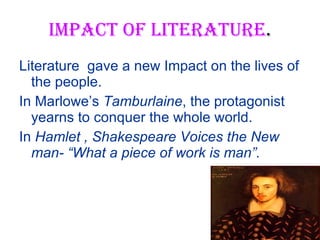
IMPACT OF LITERATURE . Literature  gave a new Impact on the lives of the people. In Marlowe’s  Tamburlaine , the protagonist yearns to conquer the whole world. In  Hamlet , Shakespeare Voices the New man- “What a piece of work is man”.
Humanism Literature led to a new form of life in this world called as Renaissance Humanism. Humanism is a movement in literature where Man is the center of all thoughts. All literature revolved around Man – to know this human being better.
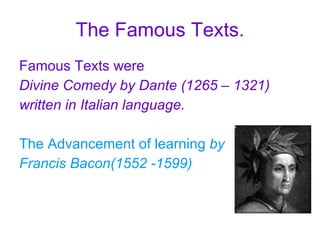
The Famous Texts. Famous Texts were Divine Comedy by Dante (1265 – 1321) written in Italian language. The Advancement of learning  by Francis Bacon(1552 -1599)
IMPACT ON PAINTING The Renaissance painters looked upon Art as imitation of life. They closely observed Nature and Man. Art provided pleasure to the Senses. The artists painted human figures as more beautiful than they actually were. The artists later involved Christian themes to secular themes called as the Greco – Roman Style.
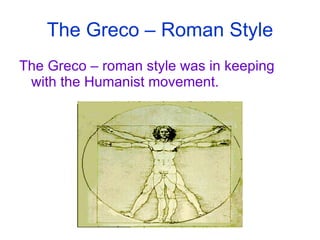
The Greco – Roman Style The Greco – roman style was in keeping with the Humanist movement.
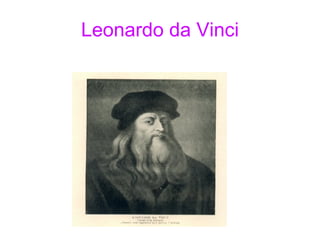
Leonardo da Vinci(1452 -1519) Leonardo da Vinci was the greatest of all renaissance artists. He not only studied the anatomy of the Human body but also the different parts of the body that took shape when it moved. This enabled him to depict accurately the bodily movements.
Leonardo da Vinci
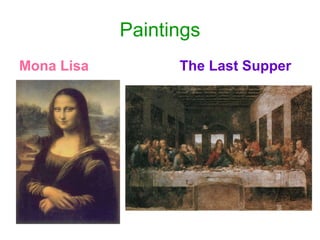
Paintings Mona Lisa   The Last Supper
Paintings The Last Supper is a study of psychological reactions. Christ knows his fate of being Crucified and announces that one of his disciples will betray him. This painting depicts the emotions of surprise, horror and guilt on the face of Jesus’ followers.
Paintings Mona Lisa is a painting of an actual  woman which reflects the various moods of human soul.
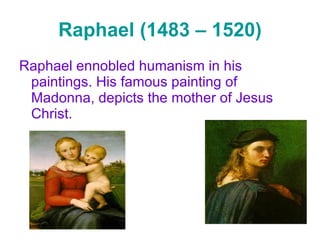
Raphael (1483 – 1520) Raphael ennobled humanism in his paintings. His famous painting of Madonna, depicts the mother of Jesus Christ.
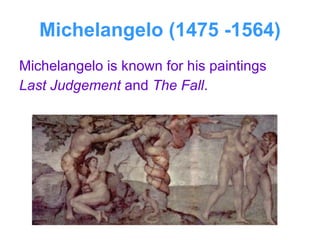
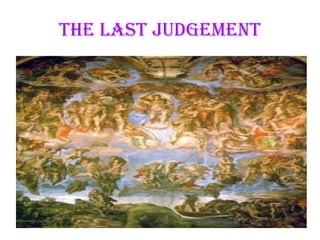
Michelangelo (1475 -1564) Michelangelo is known for his paintings  Last Judgement  and  The Fall .
The last Judgement
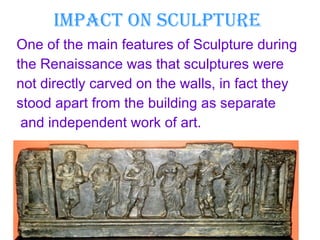
IMPACT ON SCULPTURE One of the main features of Sculpture during  the Renaissance was that sculptures were not directly carved on the walls, in fact they  stood apart from the building as separate and independent work of art.
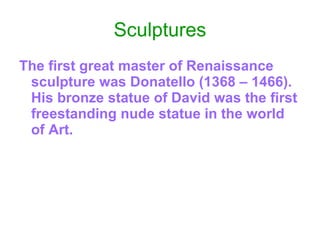
Sculptures The first great master of Renaissance sculpture was Donatello (1368 – 1466). His bronze statue of David was the first freestanding nude statue in the world of Art.
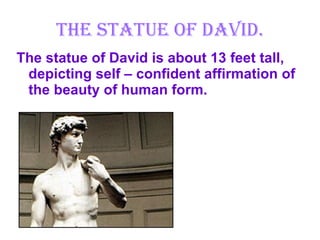
The Statue of David. The statue of David is about 13 feet tall, depicting self – confident affirmation of the beauty of human form.
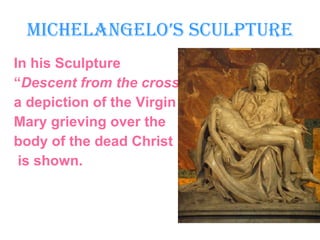
Michelangelo’s Sculpture In his Sculpture  “ Descent from the cross”   a depiction of the Virgin  Mary grieving over the  body of the dead Christ is shown.
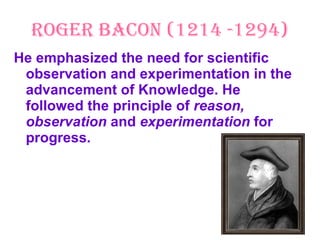
Roger Bacon (1214 -1294) He emphasized the need for scientific observation and experimentation in the advancement of Knowledge. He followed the principle of  reason, observation  and  experimentation  for progress.
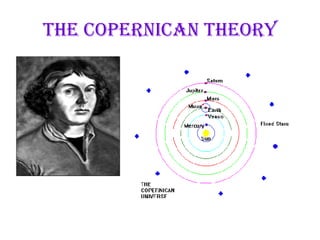
Copernicus (1473 -1543) Nicholas Copernicus was a great scientist of Poland. He gave new astronomical principles which shocked the Church. His principle was that the EARTH is round and it moves around the sun, which is the centre of the planetary system. This theory was know as Copernican Theory.
The Copernican Theory
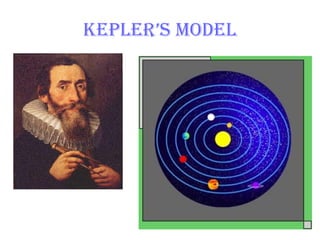
Kepler (1571 -1630) Johannes Kepler , a German Scientist  improved upon the theory of Copernicus  and proved that the planets including  Earth revolve around the Sun in  ELLIPTICAL orbits and not in Circles.
Kepler’s Model
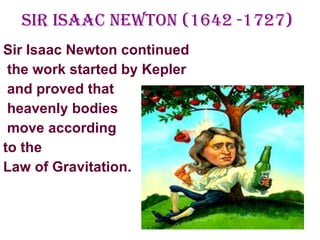
Sir Isaac Newton (1642 -1727) Sir Isaac Newton continued the work started by Kepler and proved that heavenly bodies move according  to the  Law of Gravitation.
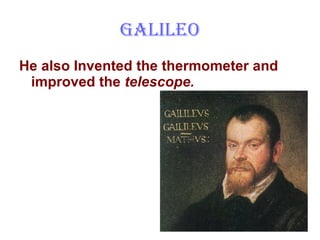
Galileo (1564 -1642) The Italian Scientist Galileo studied the Solar system and perfected the Copernican theory. Galileo used his  telescope  in his studies and confirmed his Observations. He discovered the Law of Pendulum and the principle that the speed of a falling body depends upon the distance it falls.
Galileo He also Invented the thermometer and improved the  telescope.
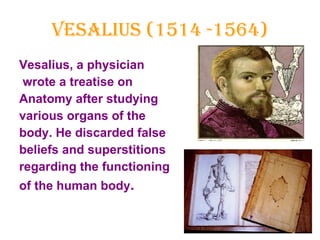
Vesalius (1514 -1564) Vesalius, a physician wrote a treatise on  Anatomy after studying  various organs of the  body. He discarded false  beliefs and superstitions  regarding the functioning  of the human body .
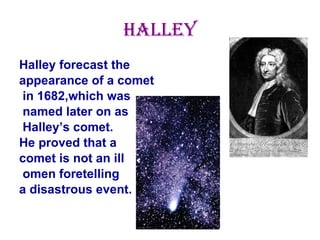
Halley Halley forecast the  appearance of a comet in 1682,which was named later on as Halley’s comet.  He proved that a  comet is not an ill omen foretelling  a disastrous event.
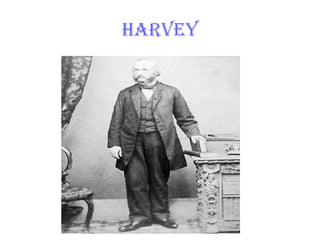
Harvey (1478 -1657) William Harvey, an English physician showed how the Human body depends on circulation of blood. He discovered how blood circulates from the heart to the various parts of the body through arteries and comes back to the heart through veins. This knowledge helped to correct  many problems related to health.
Harvey
Geographical explorations After the crusades, the Europeans became interested in the East, largerly through the travel accounts of travellers and traders who had travelled through Constantinople. The trade especially in spices was very profitable. If the Europeans were to continue to have spices and other goods, they had to find out new sea routes. Portugal and Spain were the pioneers in the Quest.
Some Developments There were some developments in the techniques of navigation which facilitated geographical discoveries. The Mariner’s Compass – Had a magnetic needle and was useful for navigation. The classical idea that Earth is a GLOBE came from the Greeks.  There was improvement in shipbuilding and accurate Map- making for voyages to take place.
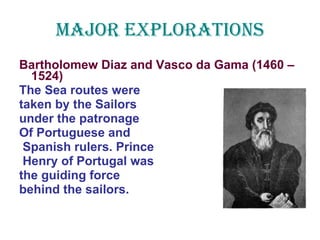
Major Explorations Bartholomew Diaz and Vasco da Gama (1460 – 1524) The Sea routes were  taken by the Sailors under the patronage Of Portuguese and  Spanish rulers. Prince Henry of Portugal was  the guiding force  behind the sailors.
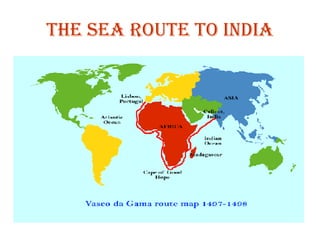
Bartholomew Diaz He was an adventurous sailor from Portugal and  had reached  CAPE OF GOOD HOPE in 1496.
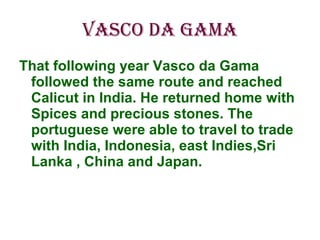
Vasco da Gama That following year Vasco da Gama followed the same route and reached Calicut in India. He returned home with Spices and precious stones. The portuguese were able to travel to trade with India, Indonesia, east Indies,Sri Lanka , China and Japan.
The Sea route to India
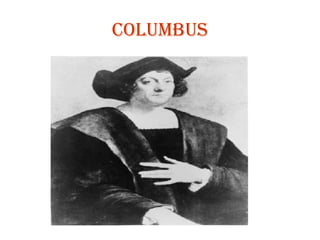
Christopher Columbus(1451 -1506) With the help of  Queen Isabella of Spain,  Columbus began his exploration of sea routes. He travelled through the Atlantic and landed near the coast of Cuba in the southern part of North America. Columbus accidently discovered America. America was named after  Amerigo Vespucci  who later explored further and discovered America.
Columbus
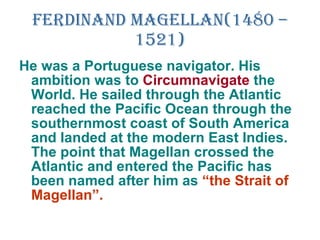
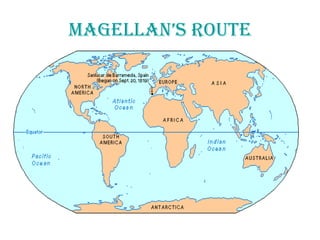
Ferdinand Magellan(1480 – 1521) He was a Portuguese navigator. His ambition was to  Circumnavigate  the World. He sailed through the Atlantic reached the Pacific Ocean through the southernmost coast of South America and landed at the modern East Indies. The point that Magellan crossed the Atlantic and entered the Pacific has been named after him as  “the Strait of Magellan”.
Magellan’s route
Walter Raleigh Walter Raleigh was an experienced sailor and warrior during the reign of Elizabeth. He established a new colony in America named after Virgin Queen Called  “VIRGINIA”.
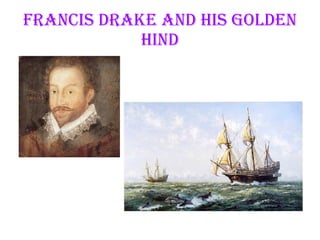
Francis Drake (1541 – 96) Francis Drake was the most outstanding sailor. He attacked the Spanish ships carrying treasure from America to Spain. His greatest achievement was to Circumnavigate the world. He was the first English to sail around the world through his famous Ship, The Golden Hind.
Francis Drake And His Golden Hind


The Renaissance

  • 1.
    The Renaissance Renaissancemeans “rebirth”. A movement in Europe between 14 th and 17 th Century.
  • 2.
    Byzantine Empire Theyear 1453 marked a change in history of the world. Constantinople was captured by Turks. This was the dividing line between the Medieval period and Modern World. The Greeks and Roman Scholars migrated to Italy, where Renaissance first took its roots.
  • 3.
  • 4.
  • 5.
    Causes of RenaissanceSpread of Education The Emergence of Cathedral churches like Paris, Padua, Naples, Oxford and Cambridge created new thinking and learning.
  • 6.
    2. Decline offeudalism The feudal system was opposed to progress. The feudal lords could not increase the rents from their subordinates and had to borrow money to maintain themselves. They had to sell off their lands to pay their debts. This led to break up of fedualism.
  • 7.
    3. Spirit ofEnquiry The Church controlled all the education. This Knowledge was accepted without questioning. Scholars like Roger Bacon and Peter Abelard challenged the authority of Church.
  • 8.
    4. The CrusadesThe crusades are the wars fought between Christians and Muslims. It was during this time that Christians studied the Philosophies of Plato and Aristotle. It gave way to modern thinking.
  • 9.
    5. Encouragement toArt and Learning The encouragement given to Art and learning was by Popes, Emperors, Kings and rich merchants. Lorenzo de Medici gave patronage in Florence in the 15 th century. This city became a great centre of art and learning.
  • 10.
    6. Printing PressThe printing press enabled Europe to multiply books and then put them within the reach of scholars with modest means. Johann Gutenberg introduced the first printing press in Germany in 1455.
  • 11.
    7.Capture of Constantinopleby the Turks. It is said that the fall of Constantinople is a Blessing in disguise as many progressive ideas spread in Europe and brought about changes in all spheres of human life.
  • 12.
    8. New Discoveries.After the fall of Constantinople the trade of the West with the East became Impossible. So the Kings encouraged to discover new Sea routes. The Contacts with the East developed as Sailors like Columbus and Vasco da Gama set sail.
  • 13.
    IMPACT OF LITERATURE. Literature gave a new Impact on the lives of the people. In Marlowe’s Tamburlaine , the protagonist yearns to conquer the whole world. In Hamlet , Shakespeare Voices the New man- “What a piece of work is man”.
  • 14.
    Humanism Literature ledto a new form of life in this world called as Renaissance Humanism. Humanism is a movement in literature where Man is the center of all thoughts. All literature revolved around Man – to know this human being better.
  • 15.
    The Famous Texts.Famous Texts were Divine Comedy by Dante (1265 – 1321) written in Italian language. The Advancement of learning by Francis Bacon(1552 -1599)
  • 16.
    IMPACT ON PAINTINGThe Renaissance painters looked upon Art as imitation of life. They closely observed Nature and Man. Art provided pleasure to the Senses. The artists painted human figures as more beautiful than they actually were. The artists later involved Christian themes to secular themes called as the Greco – Roman Style.
  • 17.
    The Greco –Roman Style The Greco – roman style was in keeping with the Humanist movement.
  • 18.
    Leonardo da Vinci(1452-1519) Leonardo da Vinci was the greatest of all renaissance artists. He not only studied the anatomy of the Human body but also the different parts of the body that took shape when it moved. This enabled him to depict accurately the bodily movements.
  • 19.
  • 20.
    Paintings Mona Lisa The Last Supper
  • 21.
    Paintings The LastSupper is a study of psychological reactions. Christ knows his fate of being Crucified and announces that one of his disciples will betray him. This painting depicts the emotions of surprise, horror and guilt on the face of Jesus’ followers.
  • 22.
    Paintings Mona Lisais a painting of an actual woman which reflects the various moods of human soul.
  • 23.
    Raphael (1483 –1520) Raphael ennobled humanism in his paintings. His famous painting of Madonna, depicts the mother of Jesus Christ.
  • 24.
    Michelangelo (1475 -1564)Michelangelo is known for his paintings Last Judgement and The Fall .
  • 25.
  • 26.
    IMPACT ON SCULPTUREOne of the main features of Sculpture during the Renaissance was that sculptures were not directly carved on the walls, in fact they stood apart from the building as separate and independent work of art.
  • 27.
    Sculptures The firstgreat master of Renaissance sculpture was Donatello (1368 – 1466). His bronze statue of David was the first freestanding nude statue in the world of Art.
  • 28.
    The Statue ofDavid. The statue of David is about 13 feet tall, depicting self – confident affirmation of the beauty of human form.
  • 29.
    Michelangelo’s Sculpture Inhis Sculpture “ Descent from the cross” a depiction of the Virgin Mary grieving over the body of the dead Christ is shown.
  • 30.
    Roger Bacon (1214-1294) He emphasized the need for scientific observation and experimentation in the advancement of Knowledge. He followed the principle of reason, observation and experimentation for progress.
  • 31.
    Copernicus (1473 -1543)Nicholas Copernicus was a great scientist of Poland. He gave new astronomical principles which shocked the Church. His principle was that the EARTH is round and it moves around the sun, which is the centre of the planetary system. This theory was know as Copernican Theory.
  • 32.
  • 33.
    Kepler (1571 -1630)Johannes Kepler , a German Scientist improved upon the theory of Copernicus and proved that the planets including Earth revolve around the Sun in ELLIPTICAL orbits and not in Circles.
  • 34.
  • 35.
    Sir Isaac Newton(1642 -1727) Sir Isaac Newton continued the work started by Kepler and proved that heavenly bodies move according to the Law of Gravitation.
  • 36.
    Galileo (1564 -1642)The Italian Scientist Galileo studied the Solar system and perfected the Copernican theory. Galileo used his telescope in his studies and confirmed his Observations. He discovered the Law of Pendulum and the principle that the speed of a falling body depends upon the distance it falls.
  • 37.
    Galileo He alsoInvented the thermometer and improved the telescope.
  • 38.
    Vesalius (1514 -1564)Vesalius, a physician wrote a treatise on Anatomy after studying various organs of the body. He discarded false beliefs and superstitions regarding the functioning of the human body .
  • 39.
    Halley Halley forecastthe appearance of a comet in 1682,which was named later on as Halley’s comet. He proved that a comet is not an ill omen foretelling a disastrous event.
  • 40.
    Harvey (1478 -1657)William Harvey, an English physician showed how the Human body depends on circulation of blood. He discovered how blood circulates from the heart to the various parts of the body through arteries and comes back to the heart through veins. This knowledge helped to correct many problems related to health.
  • 41.
  • 42.
    Geographical explorations Afterthe crusades, the Europeans became interested in the East, largerly through the travel accounts of travellers and traders who had travelled through Constantinople. The trade especially in spices was very profitable. If the Europeans were to continue to have spices and other goods, they had to find out new sea routes. Portugal and Spain were the pioneers in the Quest.
  • 43.
    Some Developments Therewere some developments in the techniques of navigation which facilitated geographical discoveries. The Mariner’s Compass – Had a magnetic needle and was useful for navigation. The classical idea that Earth is a GLOBE came from the Greeks. There was improvement in shipbuilding and accurate Map- making for voyages to take place.
  • 44.
    Major Explorations BartholomewDiaz and Vasco da Gama (1460 – 1524) The Sea routes were taken by the Sailors under the patronage Of Portuguese and Spanish rulers. Prince Henry of Portugal was the guiding force behind the sailors.
  • 45.
    Bartholomew Diaz Hewas an adventurous sailor from Portugal and had reached CAPE OF GOOD HOPE in 1496.
  • 46.
    Vasco da GamaThat following year Vasco da Gama followed the same route and reached Calicut in India. He returned home with Spices and precious stones. The portuguese were able to travel to trade with India, Indonesia, east Indies,Sri Lanka , China and Japan.
  • 47.
    The Sea routeto India
  • 48.
    Christopher Columbus(1451 -1506)With the help of Queen Isabella of Spain, Columbus began his exploration of sea routes. He travelled through the Atlantic and landed near the coast of Cuba in the southern part of North America. Columbus accidently discovered America. America was named after Amerigo Vespucci who later explored further and discovered America.
  • 49.
  • 50.
    Ferdinand Magellan(1480 –1521) He was a Portuguese navigator. His ambition was to Circumnavigate the World. He sailed through the Atlantic reached the Pacific Ocean through the southernmost coast of South America and landed at the modern East Indies. The point that Magellan crossed the Atlantic and entered the Pacific has been named after him as “the Strait of Magellan”.
  • 51.
  • 52.
    Walter Raleigh WalterRaleigh was an experienced sailor and warrior during the reign of Elizabeth. He established a new colony in America named after Virgin Queen Called “VIRGINIA”.
  • 53.
    Francis Drake (1541– 96) Francis Drake was the most outstanding sailor. He attacked the Spanish ships carrying treasure from America to Spain. His greatest achievement was to Circumnavigate the world. He was the first English to sail around the world through his famous Ship, The Golden Hind.
  • 54.
    Francis Drake AndHis Golden Hind
  • 55.
  • 56.