Age of Exploration
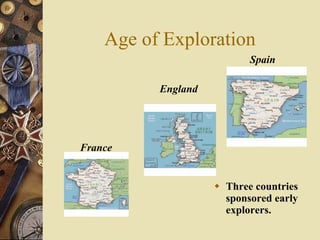
Age of Exploration Three countries sponsored early explorers. France England Spain
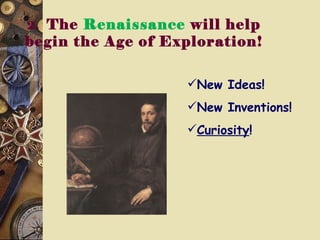
2.  The  Renaissance  will help begin the Age of Exploration! New Ideas! New Inventions!  Curiosity !
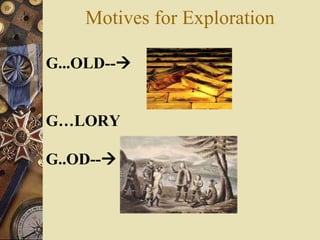
Motives for Exploration G...OLD--  G…LORY G..OD-- 
The First G: Gold Gold was a hot item that explorers were looking for, but remember that it is really wealth, not just literal gold that explorers were after. Europe needed gold (and silver) to fuel the rising banking system Europeans also desired spices (Da Gama’s voyage to India made him a 3000% profit!) Other natural resources would come to be sold for profit as well (timber, sugar, tobacco, ivory, etc.) This competition will be enhanced by the idea of  mercantilism  that emerges, the idea that there is only so much wealth in the world, and that to make your kingdom strong you must have more gold and wealth than the other kingdoms
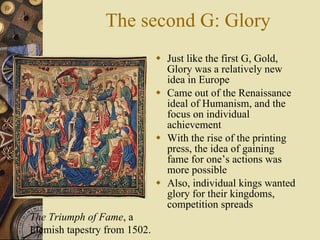
The second G: Glory Just like the first G, Gold, Glory was a relatively new idea in Europe Came out of the Renaissance ideal of Humanism, and the focus on individual achievement With the rise of the printing press, the idea of gaining fame for one’s actions was more possible Also, individual kings wanted glory for their kingdoms, competition spreads The Triumph of Fame , a Flemish tapestry from 1502.
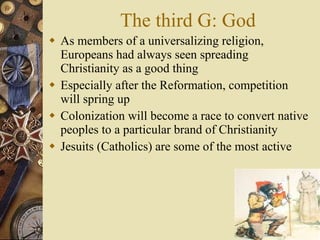
The third G: God As members of a universalizing religion, Europeans had always seen spreading Christianity as a good thing Especially after the Reformation, competition will spring up Colonization will become a race to convert native peoples to a particular brand of Christianity Jesuits (Catholics) are some of the most active
Effects of Exploration Good: Doors to the Americas were opened A ‘New World’ was discovered Bad: Natives got diseases that killed them Natives lost their freedom, customs and pride
II. The European Voyages of Discovery   A. Causes of European Expansion  1. Economics  2. Desire for Spices  3. Religious Fervor  4. Renaissance Curiosity  5. Lack of Economic Opportunity at Home  6. Government Power  B. Technology and the Rise of Exploration   1. Stronger Ships  2. Improvements in Cartography  3. New Technology
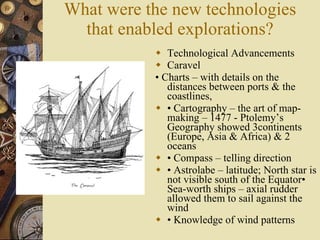
What were the new technologies that enabled explorations? Technological Advancements Caravel •  Charts – with details on the distances between ports & the coastlines, •  Cartography – the art of map-making – 1477 - Ptolemy’s Geography showed 3continents (Europe, Asia & Africa) & 2 oceans •  Compass – telling direction •  Astrolabe – latitude; North star is not visible south of the Equator• Sea-worth ships – axial rudder allowed them to sail against the wind •  Knowledge of wind patterns
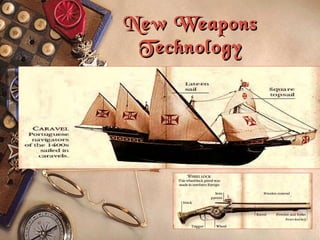
New Maritime Technologies Better Maps [Portulan] Sextant Mariner’s Compass
New Weapons Technology
I. World Contacts Before Columbus   A. The Trade World of the Indian Ocean  1. Trade Routes  2. The Chinese Economy  3. Chinese Voyages of Exploration  4. India
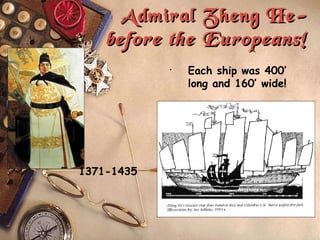
Admiral Zheng He- before the Europeans ! 1371-1435 Each ship was 400’ long and 160’ wide!
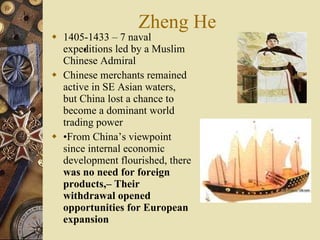
Zheng He 1405-1433 – 7 naval expeditions led by a Muslim Chinese Admiral Chinese merchants remained active in SE Asian waters, but China lost a chance to become a dominant world trading power • From China’s viewpoint since internal economic development flourished, there  was no need for foreign products,– Their withdrawal opened opportunities for European expansion •
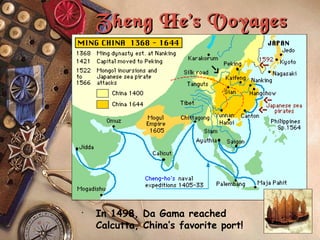
Zheng He’s Voyages In 1498, Da Gama reached Calcutta, China’s favorite port!
II. The European Voyages of Discovery  C. The Portuguese Overseas Empire   1. Favorable Geography  2. Henry the Navigator (1394–1460)  3. Bartholomew Diaz and Vasco da Gama
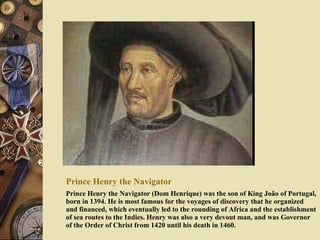
Prince Henry the Navigator Prince Henry the Navigator (Dom Henrique) was the son of King João of Portugal, born in 1394. He is most famous for the voyages of discovery that he organized and financed, which eventually led to the rounding of Africa and the establishment of sea routes to the Indies. Henry was also a very devout man, and was Governor of the Order of Christ from 1420 until his death in 1460.
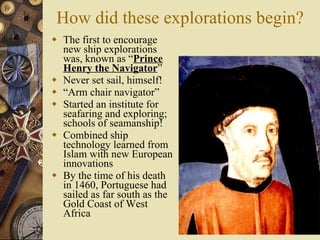
How did these explorations begin? The first to encourage new ship explorations was, known as “ Prince Henry the Navigator ” Never set sail, himself! “ Arm chair navigator” Started an institute for seafaring and exploring; schools of seamanship! Combined ship technology learned from Islam with new European innovations By the time of his death in 1460, Portuguese had sailed as far south as the Gold Coast of West Africa
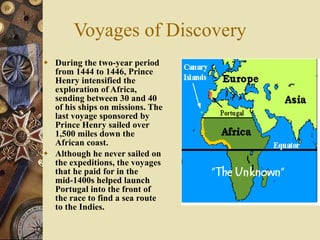
Voyages of Discovery During the two-year period from 1444 to 1446, Prince Henry intensified the exploration of Africa, sending between 30 and 40 of his ships on missions. The last voyage sponsored by Prince Henry sailed over 1,500 miles down the African coast. Although he never sailed on the expeditions, the voyages that he paid for in the mid-1400s helped launch Portugal into the front of the race to find a sea route to the Indies.
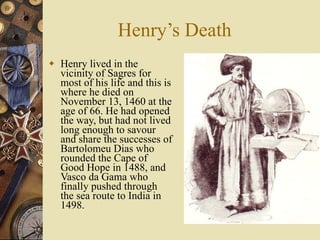
Henry’s Death Henry lived in the vicinity of Sagres for most of his life and this is where he died on November 13, 1460 at the age of 66. He had opened the way, but had not lived long enough to savour and share the successes of Bartolomeu Dias who rounded the Cape of Good Hope in 1488, and Vasco da Gama who finally pushed through the sea route to India in 1498.
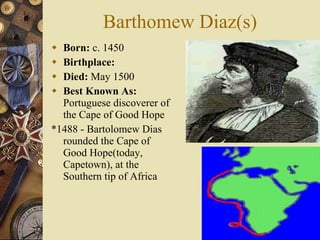
Barthomew Diaz(s) Born:  c. 1450  Birthplace:   Died:  May 1500  Best Known As:  Portuguese discoverer of the Cape of Good Hope *1488 - Bartolomew Dias rounded the Cape of Good Hope(today, Capetown), at the Southern tip of Africa
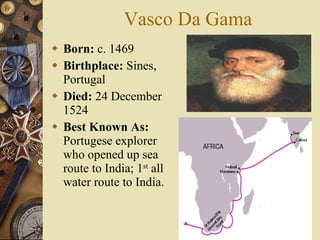
Vasco Da Gama Born:  c. 1469  Birthplace:  Sines, Portugal  Died:  24 December 1524  Best Known As:  Portugese explorer who opened up sea route to India; 1 st  all water route to India.
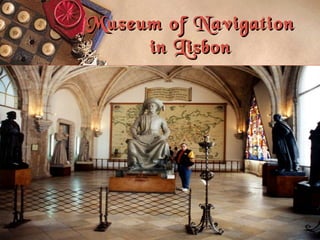
Museum of Navigation in Lisbon
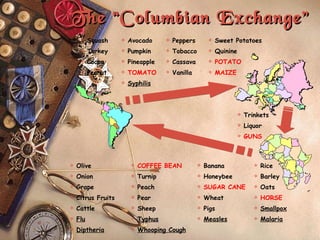
Why would the 'Columbian Exchange' be considered the tsunami of unintentional "bio-terrorism"??
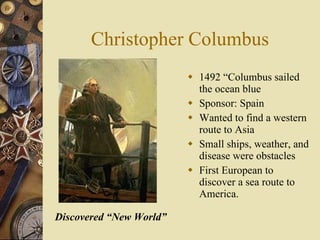
Christopher Columbus 1492 “Columbus sailed the ocean blue Sponsor: Spain Wanted to find a western route to Asia Small ships, weather, and disease were obstacles First European to discover a sea route to America. Discovered “New World”
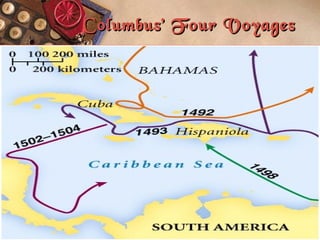
Columbus’ Four Voyages
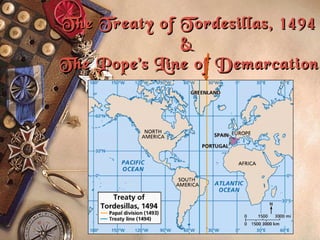
Line of Demarcation• 1493  How to end the rivalry, in exploration, between Spain & Portugal?? –  After Columbus returned, Pope Alexander VI (r. 1492-1503), a Spaniard,  established a line  to distinguish Spanish & Portuguese claims–  Assigned all new lands west of the Azores to Spain –  Lands to the east belonged to Portugal •  The Portuguese protested, leading to the  Treaty of Tordesillas (1494) – established a new line about 1,100 miles to the east of the Pope’s line– Brazil lay in the Portuguese sphere
The Treaty of Tordesillas, 1494 &  The Pope’s Line of Demarcation
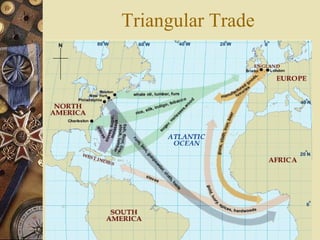
Triangular Trade
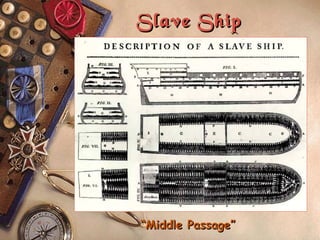
Slave Ship “ Middle Passage”
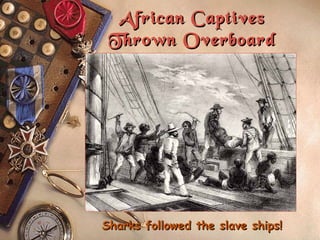
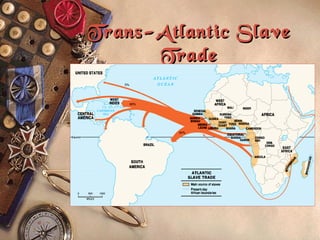
African Slave Trade• Western European  nations sent ships loaded with goods to buy slaves from local rulers on the western coast of Africa, then transported the slaves to the colonies in North & South America & the Caribbean •  Raw commodities produced in the colonies were then shipped back to Europe were they were processed & sold •  1518–first boat of African slaves directly to the New World
African Captives Thrown Overboard Sharks followed the slave ships!
Trans-Atlantic Slave Trade
The “Columbian Exchange” Squash  Avocado Peppers Sweet Potatoes Turkey Pumpkin Tobacco Quinine Cocoa Pineapple Cassava POTATO Peanut TOMATO Vanilla MAIZE Syphilis Olive COFFEE BEAN Banana Rice Onion Turnip Honeybee Barley Grape Peach SUGAR CANE Oats Citrus Fruits Pear Wheat HORSE Cattle Sheep Pigs Smallpox Flu Typhus Measles Malaria Diptheria Whooping Cough Trinkets Liquor GUNS
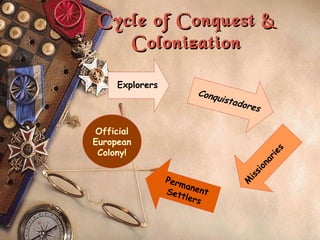
Cycle of Conquest & Colonization Explorers Conquistadores Missionaries Permanent Settlers Official European Colony!
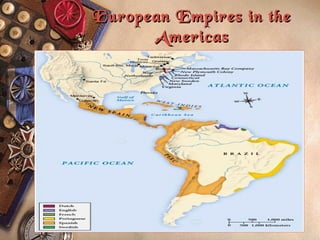
European Empires in the Americas
III. The Impact of Conquest   A. Colonial Administration  1. Four Viceroyalties  2. Viceroy  3. Brazil  B. Impact of European Settlement on the Lives of Indigenous Peoples  1. Indigenous Peoples  2. The Encomienda System  3. Native Population Losses
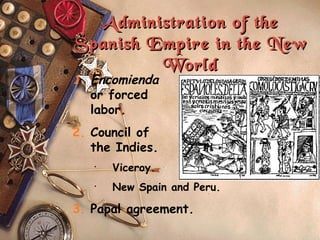
Administration of the Spanish Empire in the New World Encomienda  or forced  labor. Council of  the Indies. Viceroy. New Spain and Peru. Papal agreement.
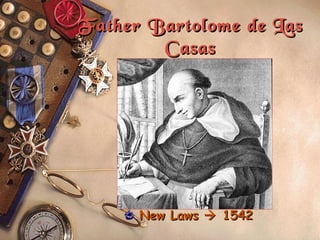
Father Bartolome de Las Casas New Laws    1542
Impact of European Expansion Native populations ravaged by disease. Influx of gold, and especially silver, into Europe created an inflationary economic climate. [ “Price Revolution” ] New products introduced across the continents [“Columbian Exchange”]. Deepened colonial rivalries.
China and Japan during the Age of Exploration Will did both countries chose Isolation over interaction with the Europeans?? KEY IDEA:  Advances   under the Ming and Qing dynasties left China self-contained and uninterested in European contact. KEY IDEA : The Tokugawa regime unified Japan and began a 200-year period of isolation, autocracy, and economic growth.

'11 ap exploration

  • 1.
  • 2.
    Age of ExplorationThree countries sponsored early explorers. France England Spain
  • 3.
    2. The Renaissance will help begin the Age of Exploration! New Ideas! New Inventions! Curiosity !
  • 4.
    Motives for ExplorationG...OLD--  G…LORY G..OD-- 
  • 5.
    The First G:Gold Gold was a hot item that explorers were looking for, but remember that it is really wealth, not just literal gold that explorers were after. Europe needed gold (and silver) to fuel the rising banking system Europeans also desired spices (Da Gama’s voyage to India made him a 3000% profit!) Other natural resources would come to be sold for profit as well (timber, sugar, tobacco, ivory, etc.) This competition will be enhanced by the idea of mercantilism that emerges, the idea that there is only so much wealth in the world, and that to make your kingdom strong you must have more gold and wealth than the other kingdoms
  • 6.
    The second G:Glory Just like the first G, Gold, Glory was a relatively new idea in Europe Came out of the Renaissance ideal of Humanism, and the focus on individual achievement With the rise of the printing press, the idea of gaining fame for one’s actions was more possible Also, individual kings wanted glory for their kingdoms, competition spreads The Triumph of Fame , a Flemish tapestry from 1502.
  • 7.
    The third G:God As members of a universalizing religion, Europeans had always seen spreading Christianity as a good thing Especially after the Reformation, competition will spring up Colonization will become a race to convert native peoples to a particular brand of Christianity Jesuits (Catholics) are some of the most active
  • 8.
    Effects of ExplorationGood: Doors to the Americas were opened A ‘New World’ was discovered Bad: Natives got diseases that killed them Natives lost their freedom, customs and pride
  • 9.
    II. The EuropeanVoyages of Discovery A. Causes of European Expansion 1. Economics 2. Desire for Spices 3. Religious Fervor 4. Renaissance Curiosity 5. Lack of Economic Opportunity at Home 6. Government Power B. Technology and the Rise of Exploration 1. Stronger Ships 2. Improvements in Cartography 3. New Technology
  • 10.
    What were thenew technologies that enabled explorations? Technological Advancements Caravel • Charts – with details on the distances between ports & the coastlines, • Cartography – the art of map-making – 1477 - Ptolemy’s Geography showed 3continents (Europe, Asia & Africa) & 2 oceans • Compass – telling direction • Astrolabe – latitude; North star is not visible south of the Equator• Sea-worth ships – axial rudder allowed them to sail against the wind • Knowledge of wind patterns
  • 11.
    New Maritime TechnologiesBetter Maps [Portulan] Sextant Mariner’s Compass
  • 12.
  • 13.
    I. World ContactsBefore Columbus A. The Trade World of the Indian Ocean 1. Trade Routes 2. The Chinese Economy 3. Chinese Voyages of Exploration 4. India
  • 14.
    Admiral Zheng He-before the Europeans ! 1371-1435 Each ship was 400’ long and 160’ wide!
  • 15.
    Zheng He 1405-1433– 7 naval expeditions led by a Muslim Chinese Admiral Chinese merchants remained active in SE Asian waters, but China lost a chance to become a dominant world trading power • From China’s viewpoint since internal economic development flourished, there was no need for foreign products,– Their withdrawal opened opportunities for European expansion •
  • 16.
    Zheng He’s VoyagesIn 1498, Da Gama reached Calcutta, China’s favorite port!
  • 17.
    II. The EuropeanVoyages of Discovery C. The Portuguese Overseas Empire 1. Favorable Geography 2. Henry the Navigator (1394–1460) 3. Bartholomew Diaz and Vasco da Gama
  • 18.
    Prince Henry theNavigator Prince Henry the Navigator (Dom Henrique) was the son of King João of Portugal, born in 1394. He is most famous for the voyages of discovery that he organized and financed, which eventually led to the rounding of Africa and the establishment of sea routes to the Indies. Henry was also a very devout man, and was Governor of the Order of Christ from 1420 until his death in 1460.
  • 19.
    How did theseexplorations begin? The first to encourage new ship explorations was, known as “ Prince Henry the Navigator ” Never set sail, himself! “ Arm chair navigator” Started an institute for seafaring and exploring; schools of seamanship! Combined ship technology learned from Islam with new European innovations By the time of his death in 1460, Portuguese had sailed as far south as the Gold Coast of West Africa
  • 20.
    Voyages of DiscoveryDuring the two-year period from 1444 to 1446, Prince Henry intensified the exploration of Africa, sending between 30 and 40 of his ships on missions. The last voyage sponsored by Prince Henry sailed over 1,500 miles down the African coast. Although he never sailed on the expeditions, the voyages that he paid for in the mid-1400s helped launch Portugal into the front of the race to find a sea route to the Indies.
  • 21.
    Henry’s Death Henrylived in the vicinity of Sagres for most of his life and this is where he died on November 13, 1460 at the age of 66. He had opened the way, but had not lived long enough to savour and share the successes of Bartolomeu Dias who rounded the Cape of Good Hope in 1488, and Vasco da Gama who finally pushed through the sea route to India in 1498.
  • 22.
    Barthomew Diaz(s) Born: c. 1450 Birthplace: Died: May 1500 Best Known As: Portuguese discoverer of the Cape of Good Hope *1488 - Bartolomew Dias rounded the Cape of Good Hope(today, Capetown), at the Southern tip of Africa
  • 23.
    Vasco Da GamaBorn: c. 1469 Birthplace: Sines, Portugal Died: 24 December 1524 Best Known As: Portugese explorer who opened up sea route to India; 1 st all water route to India.
  • 24.
  • 25.
    Why would the'Columbian Exchange' be considered the tsunami of unintentional "bio-terrorism"??
  • 26.
    Christopher Columbus 1492“Columbus sailed the ocean blue Sponsor: Spain Wanted to find a western route to Asia Small ships, weather, and disease were obstacles First European to discover a sea route to America. Discovered “New World”
  • 27.
  • 28.
    Line of Demarcation•1493 How to end the rivalry, in exploration, between Spain & Portugal?? – After Columbus returned, Pope Alexander VI (r. 1492-1503), a Spaniard, established a line to distinguish Spanish & Portuguese claims– Assigned all new lands west of the Azores to Spain – Lands to the east belonged to Portugal • The Portuguese protested, leading to the Treaty of Tordesillas (1494) – established a new line about 1,100 miles to the east of the Pope’s line– Brazil lay in the Portuguese sphere
  • 29.
    The Treaty ofTordesillas, 1494 & The Pope’s Line of Demarcation
  • 30.
  • 31.
    Slave Ship “Middle Passage”
  • 32.
    African Slave Trade•Western European nations sent ships loaded with goods to buy slaves from local rulers on the western coast of Africa, then transported the slaves to the colonies in North & South America & the Caribbean • Raw commodities produced in the colonies were then shipped back to Europe were they were processed & sold • 1518–first boat of African slaves directly to the New World
  • 33.
    African Captives ThrownOverboard Sharks followed the slave ships!
  • 34.
  • 35.
    The “Columbian Exchange”Squash Avocado Peppers Sweet Potatoes Turkey Pumpkin Tobacco Quinine Cocoa Pineapple Cassava POTATO Peanut TOMATO Vanilla MAIZE Syphilis Olive COFFEE BEAN Banana Rice Onion Turnip Honeybee Barley Grape Peach SUGAR CANE Oats Citrus Fruits Pear Wheat HORSE Cattle Sheep Pigs Smallpox Flu Typhus Measles Malaria Diptheria Whooping Cough Trinkets Liquor GUNS
  • 36.
    Cycle of Conquest& Colonization Explorers Conquistadores Missionaries Permanent Settlers Official European Colony!
  • 37.
    European Empires inthe Americas
  • 38.
    III. The Impactof Conquest A. Colonial Administration 1. Four Viceroyalties 2. Viceroy 3. Brazil B. Impact of European Settlement on the Lives of Indigenous Peoples 1. Indigenous Peoples 2. The Encomienda System 3. Native Population Losses
  • 39.
    Administration of theSpanish Empire in the New World Encomienda or forced labor. Council of the Indies. Viceroy. New Spain and Peru. Papal agreement.
  • 40.
    Father Bartolome deLas Casas New Laws  1542
  • 41.
    Impact of EuropeanExpansion Native populations ravaged by disease. Influx of gold, and especially silver, into Europe created an inflationary economic climate. [ “Price Revolution” ] New products introduced across the continents [“Columbian Exchange”]. Deepened colonial rivalries.
  • 42.
    China and Japanduring the Age of Exploration Will did both countries chose Isolation over interaction with the Europeans?? KEY IDEA: Advances under the Ming and Qing dynasties left China self-contained and uninterested in European contact. KEY IDEA : The Tokugawa regime unified Japan and began a 200-year period of isolation, autocracy, and economic growth.

Editor's Notes

  • #10 II. The European Voyages of Discovery A. Causes of European Expansion 1. Economics — European population and economy were beginning to recover after the Black Death, an expansion which created a demand for luxury goods — the fall of Constantinople and Ottoman control of European trade routes forced Europeans to look for alternative trade routes. 2. Desire for Spices — Flavorings, oil, pleasure. 3. Religious Fervor — Passion ignited by the Christian reconquista in Spain and Portugal (Columbus — a devout Christian who wanted to serve God). 4. Renaissance Curiosity — The desire to learn more about the physical universe (fascination with new people and places). 5. Lack of Economic Opportunity at Home — Cort é s — “I have come to win gold, not plow the fields like a peasant” — young Spanish men of the upper classes founded economic opportunities limited. 6. Government Power — Spanish and Portuguese monarchs were stronger than ever and had more financial resources at their disposal. B. Technology and the Rise of Exploration 1. Stronger Ships (caravel, a small, light, three/mast sailing ship) — Better than the galley in negotiating the waters of the Atlantic. 2. Improvements in Cartography — Arab scholars reintroduced Europeans to Ptolemy’s map. 3. New Technology — Magnetic compasses, astrolabes, sternpost rudder, lateen sails (mostly inventions from Arab, Indian, and Chinese worlds).
  • #14 I. World Contacts Before Columbus A. The Trade World of the Indian Ocean 1. Trade Routes — Centered on cosmopolitan port cities in the Indian Ocean (Malacca — port in the South China Sea that traded in Chinese porcelain, silk and camphor, Moluccan pepper, cloves, nutmeg, Philippinian sugar and Indian textiles, copper weapons, incense, dyes, and opium. 2. The Chinese Economy — The most advanced economy in the world. The Mongol emperors had opened China to the West (Marco Polo’s travels fueled Western interest in the exotic orient) — population tripled to between 150 and 200 million by 1644, Nanjing was the largest city in the world with more than one million inhabitants. 3. Chinese Voyages of Exploration — Admiral Zheng He’s fleet sailed more than 12,000 miles, as far west as Egypt. The voyages, however, were discontinued because of renewed Mongol encroachments and a turn inward by the new emperor. 4. India — Trade between Mesopotamia and South Asia (pepper and cotton textiles).
  • #18 II. The European Voyages of Discovery C. The Portuguese Overseas Empire 1. Favorable Geography — Location on Atlantic allowed Portugal to rise from a backward marginal European land to a pioneer in exploration (winds allowed passage to Africa, the Atlantic islands, and Brazil). 2. Henry the Navigator (1394–1460) — King who sponsored annual expeditions down the western coast of Africa — to Madeira, the Azores, Arguin, Guinea, where they established trading posts and even colonies. 3. Bartholomew Diaz and Vasco da Gama — Explored the African coast as far as the Cape of Good Hope and India. But they encountered problems with Muslim merchants who dominated the trading system in the Indian Ocean, and the Portuguese eventually resorted to bombarding ports to gain entrance to these markets.
  • #39 III. The Impact of Conquest A. Colonial Administration 1. Four Viceroyalties (New Spain — capital at Mexico City, Peru — capital at Lima, New Granada — capital at Bogot á , La Plata — capital at Buenos Aires. 2. Viceroy — Imperial governor — presided over the audiencia (board of 12 to 15 judges who served as his advisory council and the highest judicial colonies), intendants (royal officials with broad military, administrative and financial authority introduced by the reform-minded Spanish King, Charles III [r. 1759–1788]) 3. Brazil — A Portuguese colony that introduced Spanish administrative forms after the Spanish and Portuguese crowns merged in 1580. B. Impact of European Settlement on the Lives of Indigenous Peoples 1. Indigenous Peoples — Many different cultures, languages, and patterns of life — probably numbered about 50 million in 1492. 2. The Encomienda System — The Spanish Crown granted the approximately 200,000 Spanish settlers and conquerors the right to use the Native Americans as laborers or to demand tribute from them (a legalized form of slavery, even if the Spanish were forbidden to enslave the natives). The Spanish settlers introduced haciendas, vast estates for grazing Spanish livestock, tropical sugar plantations, and silver mines. 3. Native Population Losses — From 50 million in 1492 to around 9 million by 1700 — losses stemmed from disease (no resistance to smallpox, typhus, influenza), overwork (because of forced labor), malnutrition, starvation, infant mortality, violence (documented by the Franciscan Bartolome de Las Casas, 1474–1566, who asserted that the Indians had human rights).