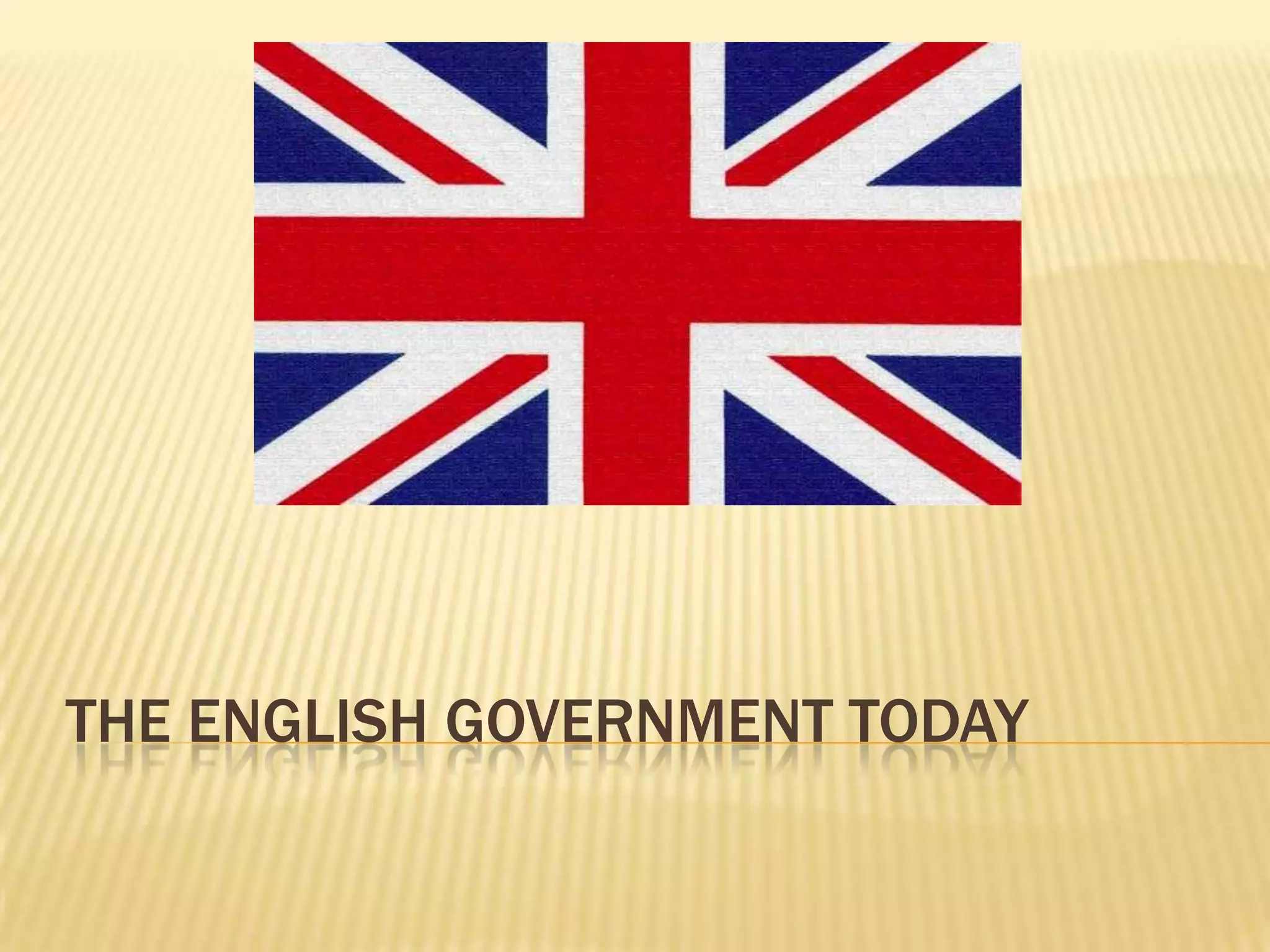
THE ENGLISH GOVERNMENT TODAY
QUEEN ELIZABETH II

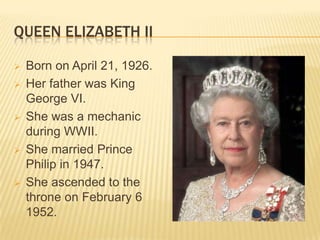
   Born on April 21, 1926.
   Her father was King
    George VI.
   She was a mechanic
    during WWII.
   She married Prince
    Philip in 1947.
   She ascended to the
    throne on February 6
    1952.
QUEEN ELIZABETH II’S REIGN
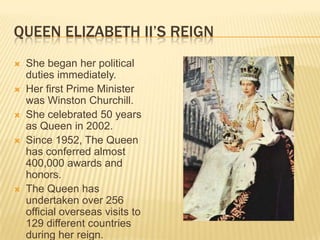
   She began her political
    duties immediately.
   Her first Prime Minister
    was Winston Churchill.
   She celebrated 50 years
    as Queen in 2002.
   Since 1952, The Queen
    has conferred almost
    400,000 awards and
    honors.
   The Queen has
    undertaken over 256
    official overseas visits to
    129 different countries
    during her reign.
LINE OF SUCCESSION
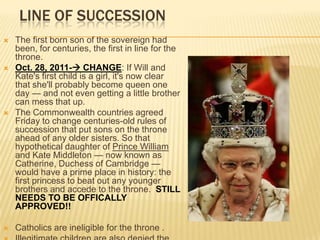
   The first born son of the sovereign had
    been, for centuries, the first in line for the
    throne.
   Oct. 28, 2011- CHANGE: If Will and
    Kate's first child is a girl, it's now clear
    that she'll probably become queen one
    day — and not even getting a little brother
    can mess that up.
   The Commonwealth countries agreed
    Friday to change centuries-old rules of
    succession that put sons on the throne
    ahead of any older sisters. So that
    hypothetical daughter of Prince William
    and Kate Middleton — now known as
    Catherine, Duchess of Cambridge —
    would have a prime place in history: the
    first princess to beat out any younger
    brothers and accede to the throne. STILL
    NEEDS TO BE OFFICALLY
    APPROVED!!

   Catholics are ineligible for the throne .
CURRENT HEIRS TO THE THRONE
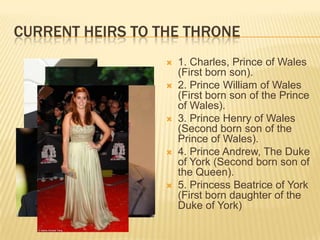
                     1. Charles, Prince of Wales
                      (First born son).
                     2. Prince William of Wales
                      (First born son of the Prince
                      of Wales).
                     3. Prince Henry of Wales
                      (Second born son of the
                      Prince of Wales).
                     4. Prince Andrew, The Duke
                      of York (Second born son of
                      the Queen).
                     5. Princess Beatrice of York
                      (First born daughter of the
                      Duke of York)
THE PARLIAMENT OF THE UNITED KINGDOM

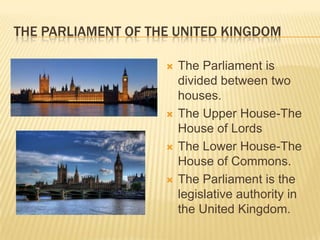
                       The Parliament is
                        divided between two
                        houses.
                       The Upper House-The
                        House of Lords
                       The Lower House-The
                        House of Commons.
                       The Parliament is the
                        legislative authority in
                        the United Kingdom.
THE HOUSE OF COMMONS

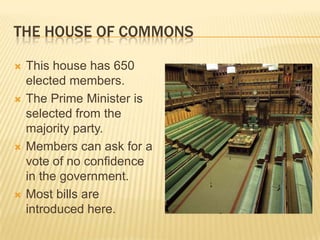
   This house has 650
    elected members.
   The Prime Minister is
    selected from the
    majority party.
   Members can ask for a
    vote of no confidence
    in the government.
   Most bills are
    introduced here.
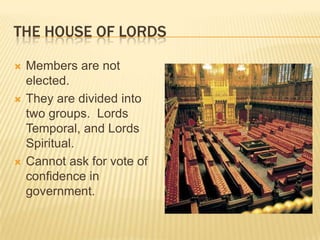
THE HOUSE OF LORDS

   Members are not
    elected.
   They are divided into
    two groups. Lords
    Temporal, and Lords
    Spiritual.
   Cannot ask for vote of
    confidence in
    government.
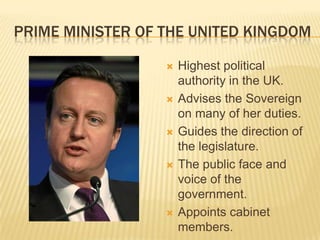
PRIME MINISTER OF THE UNITED KINGDOM

                     Highest political
                      authority in the UK.
                     Advises the Sovereign
                      on many of her duties.
                     Guides the direction of
                      the legislature.
                     The public face and
                      voice of the
                      government.
                     Appoints cabinet
                      members.
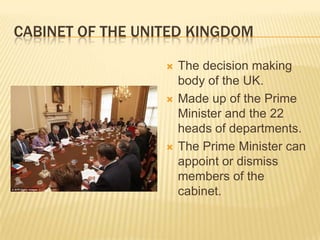
CABINET OF THE UNITED KINGDOM

                     The decision making
                      body of the UK.
                     Made up of the Prime
                      Minister and the 22
                      heads of departments.
                     The Prime Minister can
                      appoint or dismiss
                      members of the
                      cabinet.
HOW IS THIS DIFFERENT FROM ABSOLUTISM?

Constiutionalism

  • 1.
  • 2.
    QUEEN ELIZABETH II  Born on April 21, 1926.  Her father was King George VI.  She was a mechanic during WWII.  She married Prince Philip in 1947.  She ascended to the throne on February 6 1952.
  • 3.
    QUEEN ELIZABETH II’SREIGN  She began her political duties immediately.  Her first Prime Minister was Winston Churchill.  She celebrated 50 years as Queen in 2002.  Since 1952, The Queen has conferred almost 400,000 awards and honors.  The Queen has undertaken over 256 official overseas visits to 129 different countries during her reign.
  • 4.
    LINE OF SUCCESSION  The first born son of the sovereign had been, for centuries, the first in line for the throne.  Oct. 28, 2011- CHANGE: If Will and Kate's first child is a girl, it's now clear that she'll probably become queen one day — and not even getting a little brother can mess that up.  The Commonwealth countries agreed Friday to change centuries-old rules of succession that put sons on the throne ahead of any older sisters. So that hypothetical daughter of Prince William and Kate Middleton — now known as Catherine, Duchess of Cambridge — would have a prime place in history: the first princess to beat out any younger brothers and accede to the throne. STILL NEEDS TO BE OFFICALLY APPROVED!!  Catholics are ineligible for the throne .
  • 5.
    CURRENT HEIRS TOTHE THRONE  1. Charles, Prince of Wales (First born son).  2. Prince William of Wales (First born son of the Prince of Wales).  3. Prince Henry of Wales (Second born son of the Prince of Wales).  4. Prince Andrew, The Duke of York (Second born son of the Queen).  5. Princess Beatrice of York (First born daughter of the Duke of York)
  • 6.
    THE PARLIAMENT OFTHE UNITED KINGDOM  The Parliament is divided between two houses.  The Upper House-The House of Lords  The Lower House-The House of Commons.  The Parliament is the legislative authority in the United Kingdom.
  • 7.
    THE HOUSE OFCOMMONS  This house has 650 elected members.  The Prime Minister is selected from the majority party.  Members can ask for a vote of no confidence in the government.  Most bills are introduced here.
  • 8.
    THE HOUSE OFLORDS  Members are not elected.  They are divided into two groups. Lords Temporal, and Lords Spiritual.  Cannot ask for vote of confidence in government.
  • 9.
    PRIME MINISTER OFTHE UNITED KINGDOM  Highest political authority in the UK.  Advises the Sovereign on many of her duties.  Guides the direction of the legislature.  The public face and voice of the government.  Appoints cabinet members.
  • 10.
    CABINET OF THEUNITED KINGDOM  The decision making body of the UK.  Made up of the Prime Minister and the 22 heads of departments.  The Prime Minister can appoint or dismiss members of the cabinet.
  • 11.
    HOW IS THISDIFFERENT FROM ABSOLUTISM?

Editor's Notes

  • #3 Her father was second in line for the throne. Her Uncle Edward VIII was King for less then a year. He was forced to abdicate, or give up the throne when he intended to marry Wallis Simpson, an American who was still married. They would have been married as soon as she was free to do so. You cannot become remarried in the church of England so a marriage like that to the king would have been illegal since the king is the head of the Anglican church. If he did marry her it would have created a constitutional crisis, so he chose to give up the crown and marry Ms. Simpson, allowing his brother to ascend to the throne.Elizabeth joined the women’s services of the army during WWII. Where she served as a mechanic and truck driver and an occasional ambulance driver. She saw no combat. She remains the last head of state to have served in uniform during WWII. She met her husband, Prince Philip of Greece and Denmark when she was 13. They exchanged letters from then on. She was in Kenya when she heard the news of her father’s death, the day she became Queen. Her mother died shortly before her coronation, or when she receives the crown. This was the first widely broadcast television events in the world.
  • #4 She has Tuesday evening meetings most weeks with her Prime Minister of the day. She has conferred with 12 Prime Ministers. Her golden jubilee was celebrated in 2002. It was celebrated shortly after the deaths of her mother and sister. She is the third lonest reigning monarch at just short of 59 years. She would become the longest serving in 2015, when she is 89. Honors and visits are her main political duties.
  • #5 Most of the succession rules are outlined in the 1701 Act of Succession.The 2nd born son is second in line, the second born daughter would be behind all males and previously born daughters. At the time that the line of succession was established women had none of the rights that they have today (at least not in England) and it was believed a woman succeeding to the throne would mean that she would need to be married and thus the future of England could be controlled by an overseas king.  The British monarch is also the head of the Church of England so it’s quite understandable that this role couldn’t go to a Catholic.   If someone who is in line for the throne should marry a Catholic then they have to forfeit their rights to the throne, however their children are still eligible for the throne as long as they are brought up in the Anglican faith.   Children born to parents who are not married cannot gain the crown, the marriage of their parents does not change this.
  • #9 Lords Temporal are appointed by the sovereign on advice from the Prime Minister. Lords Spiritual are the highest ranking members of the Anglican Church.
  • #10 The Queen asks the prime minister to form a government in her name. The QueenDave Cameron- PM
  • #11 Serve at pleasure of the monarch, like the PM Prime minister: David Cameron, 43, ConservativeDeputy prime minister: Nick Clegg, 43, Liberal DemocratChancellor: George Osborne, 38, ConservativeHome secretary: Theresa May, 53, ConservativeForeign secretary: William Hague, 49, ConservativeDefence secretary: Liam Fox, 48, ConservativeJustice secretary: Kenneth Clarke, 69, ConservativeHealth secretary: Andrew Lansley, 53, ConservativeEducation secretary: Michael Gove, 42, ConservativeBusiness secretary: Vincent Cable, 67, Liberal DemocratChief secretary to the Treasury: David Laws, 44, Liberal DemocratWork and pensions secretary: Iain Duncan Smith, 56, ConservativeEnergy and climate change secretary: Chris Huhne, 55, Liberal DemocratLocal government secretary: Eric Pickles, 58, ConservativeTransport secretary: Philip Hammond, 55, ConservativeEnvironment secretary: Caroline Spelman, 52, ConservativeInternational development secretary: Andrew Mitchell, 54, ConservativeNorthern Ireland secretary: Owen Paterson, 53, ConservativeScotland secretary: Danny Alexander, 37, Liberal DemocratWelsh secretary: Cheryl Gillan, 58, ConservativeCulture, Olympics, media and sport secretary: Jeremy Hunt, 43, ConservativeLeader of the Lords: Lord Strathclyde, 50, ConservativeMinister without portfolio: Lady Warsi, 39, Conservative
  • #12 while The Sovereign is Head of State, the ability to make and pass legislation resides in the Parliamentthe Head of State’s position is more ceremonial than the official duties of party politicsgoverns according to rules, rather than according to her own free willmust remain politically neutral.almost always acts on the advice of ministersrepresentative of nation, supporting unity and identity to the country, rather than governingappoints Prime Minister and clergy positionsNo political power