The Renaissance In Italy The Renaissance & Reformation Section 1
The Renaissance A revival of interest in learning about the classical civilizations of ancient Greece and Rome developed in the city-states of Italy during the 1400s. This was a time of great intellectual and artistic creativity which became known as the  Renaissance , a French word that means “rebirth”.  It began in the Italian city states because of their strategic location between Europe and Asia. Italian city states had grown rich from East-West Trade. Italians were influenced by the heritage of ancient Greece and Rome. Wealthy Italian merchants and nobles acted as  patrons  supporting artists, writers, and scholars.
The Renaissance (Con’t) During the Renaissance, the traditional belief in the authority of the Church came under challenge. People showed greater interest in the concerns of this world, rather than in the life hereafter.—There was a growth of  secularism . Scholars used  observation  and  experience  to explain the world, rather than looking to Church teachings. Renaissance thinkers had confidence in the powers of human reason.  Humanists placed great emphasis on the uniqueness and worth of each person.— New schools taught “humanity related” subjects such as history, philosophy, and classical literature.
The Renaissance (Con’t) The writers of this time wrote in the  vernacular  language instead of Latin. Renaissance artists likewise observed nature and people more closely. These artists developed new techniques like perspective, paintings became astonishing lifelike. During the Renaissance the arts, literature, music and the sciences all flourished.
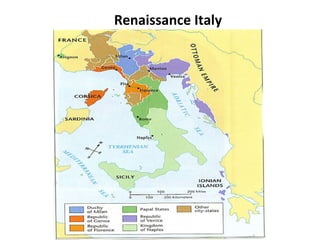
The Italian City States During the Middle Ages, Italy had failed to develop a centralized state.—The lack of a single strong ruler made possible for a number of city states in northern and central Italy to remain independent. (Milan, Venice and Florence) Milan, located in northern Italy at the crossroads of the main trade routes was one of the richest states in Italy. Its rulers created an efficient tax system that generated enormous revenues for the government. Venice, was a link between Asia and western Europe.—A small group of merchants became wealthy through their trading activities.
The Italian City States (Con’t) Venice developed into a trading power through its trading and recognized as an international power. Florence was the final major secular power in Italy, which dominated the region of Tuscany.—In the course of the 14 th  century, a small but wealthy group of merchants established control of the Florentine government. The merchants led the Florentines in a series of successful wars against their neighbors and established Florence as a major state.—Led by Cosimo de’Medici.
Renaissance Italy
Writers Of The Time The humanist interest in this world was also expressed in the literature of the day.—In the late Middle Ages, people had begun to write in the everyday language of ordinary people. Dante Alighieri was an Italian writer who wrote in the years before the Renaissance took hold.—Dante wrote about a journey through hell and heaven in his masterpiece,  The Divine Comedy .  Niccolo Machiavelli wrote  The Prince  (1500s).—In this book he advised rulers on how to gain and maintain power.  He tells rulers that they should use whatever methods are necessary to ensure their success.  “Ends justify the means”
Painters Of The Time The Renaissance produced some of the greatest paintings, sculptures and architecture in the history of the world.—Renaissance artists rejected medieval forms of art and returned  to Greek & Roman styles.  Michelangelo was a sculptor, engineer, poet, painter and architect.—He is probably best known for his enormous mural on the ceiling of the Sistine Chapel in the Vatican, and his statue of the biblical character David. Leonardo da Vinci’s most famous painting was the Mona Lisa.—However, he was interested in many things and that term was described as a Renaissance man.
Painters Of The Time (Con’t ) Some of Da Vinci’s interests were: Human anatomy, and he dissected human corpses to see how muscles and bones worked. He also sketched a flying machine and underwater boats.

Chapter 14 Section 1

  • 1.
    The Renaissance InItaly The Renaissance & Reformation Section 1
  • 2.
    The Renaissance Arevival of interest in learning about the classical civilizations of ancient Greece and Rome developed in the city-states of Italy during the 1400s. This was a time of great intellectual and artistic creativity which became known as the Renaissance , a French word that means “rebirth”. It began in the Italian city states because of their strategic location between Europe and Asia. Italian city states had grown rich from East-West Trade. Italians were influenced by the heritage of ancient Greece and Rome. Wealthy Italian merchants and nobles acted as patrons supporting artists, writers, and scholars.
  • 3.
    The Renaissance (Con’t)During the Renaissance, the traditional belief in the authority of the Church came under challenge. People showed greater interest in the concerns of this world, rather than in the life hereafter.—There was a growth of secularism . Scholars used observation and experience to explain the world, rather than looking to Church teachings. Renaissance thinkers had confidence in the powers of human reason. Humanists placed great emphasis on the uniqueness and worth of each person.— New schools taught “humanity related” subjects such as history, philosophy, and classical literature.
  • 4.
    The Renaissance (Con’t)The writers of this time wrote in the vernacular language instead of Latin. Renaissance artists likewise observed nature and people more closely. These artists developed new techniques like perspective, paintings became astonishing lifelike. During the Renaissance the arts, literature, music and the sciences all flourished.
  • 5.
    The Italian CityStates During the Middle Ages, Italy had failed to develop a centralized state.—The lack of a single strong ruler made possible for a number of city states in northern and central Italy to remain independent. (Milan, Venice and Florence) Milan, located in northern Italy at the crossroads of the main trade routes was one of the richest states in Italy. Its rulers created an efficient tax system that generated enormous revenues for the government. Venice, was a link between Asia and western Europe.—A small group of merchants became wealthy through their trading activities.
  • 6.
    The Italian CityStates (Con’t) Venice developed into a trading power through its trading and recognized as an international power. Florence was the final major secular power in Italy, which dominated the region of Tuscany.—In the course of the 14 th century, a small but wealthy group of merchants established control of the Florentine government. The merchants led the Florentines in a series of successful wars against their neighbors and established Florence as a major state.—Led by Cosimo de’Medici.
  • 7.
  • 8.
    Writers Of TheTime The humanist interest in this world was also expressed in the literature of the day.—In the late Middle Ages, people had begun to write in the everyday language of ordinary people. Dante Alighieri was an Italian writer who wrote in the years before the Renaissance took hold.—Dante wrote about a journey through hell and heaven in his masterpiece, The Divine Comedy . Niccolo Machiavelli wrote The Prince (1500s).—In this book he advised rulers on how to gain and maintain power. He tells rulers that they should use whatever methods are necessary to ensure their success. “Ends justify the means”
  • 9.
    Painters Of TheTime The Renaissance produced some of the greatest paintings, sculptures and architecture in the history of the world.—Renaissance artists rejected medieval forms of art and returned to Greek & Roman styles. Michelangelo was a sculptor, engineer, poet, painter and architect.—He is probably best known for his enormous mural on the ceiling of the Sistine Chapel in the Vatican, and his statue of the biblical character David. Leonardo da Vinci’s most famous painting was the Mona Lisa.—However, he was interested in many things and that term was described as a Renaissance man.
  • 10.
    Painters Of TheTime (Con’t ) Some of Da Vinci’s interests were: Human anatomy, and he dissected human corpses to see how muscles and bones worked. He also sketched a flying machine and underwater boats.

Editor's Notes

  • #8 At the time of the Renaissance, Italy was made up of numerous republics, kingdoms and city-states. Locate the following: Florence, Milan, Papal States and Rome In which state was Pisa an important city? Which republic controlled Corsica? Describe the location of the cultural center of Renaissance Italy?