Lecture 1: Enlightenment philosophy, Race
Lecture 2: Salons, Music, Literature, Enlightened
Despotism
Chapter 17: Toward a
New World View
“Siecle de Lumiere”
“The Century of Light”
Why did the Enlightenment
begin(reached its height) in
France?
1. French was the international
language of the educated classes in the
18thc.
2. In France, intellectual radicals could
battle opposition without level of
restraints found in rest of Europe.
3. French philosophes were indeed
asking fundamental questions.
Deism: “Religion of the
Thinker’s
Enlightenment thinker’s did not
denounce religion.
These thinker’s opted for Deismis a
religious and philosophical belief that a
supreme being created the universe,
and that this (and religious truth in
general) can be determined using
reason and observation of the natural
world alone, without a need for either
faith or organized religion.
Connection across time:
 Today: World Union of Diests—God
gave us reason-not religion
The World Union of Deists and THINK!
were founded in Charlottesville, Virginia,
U.S.A., on April 10, 1993 by Bob
Johnson.
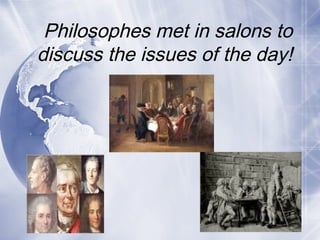
Philosophes met in salons to
discuss the issues of the day!
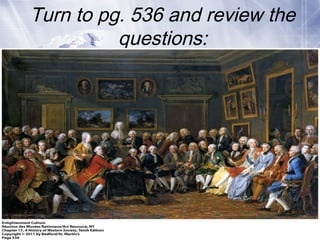
Turn to pg. 536 and review the
questions:
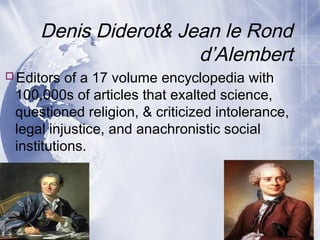
Denis Diderot& Jean le Rond
d’Alembert
Editors of a 17 volume encyclopedia with
100,000s of articles that exalted science,
questioned religion, & criticized intolerance,
legal injustice, and anachronistic social
institutions.
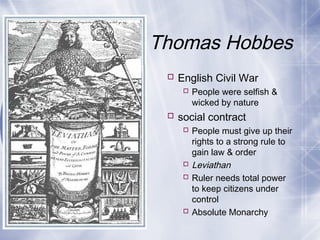
Thomas Hobbes
 English Civil War
 People were selfish &
wicked by nature
 social contract
 People must give up their
rights to a strong rule to
gain law & order
 Leviathan
 Ruler needs total power
to keep citizens under
control
 Absolute Monarchy
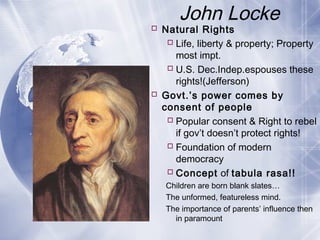
John Locke
 Natural Rights
Life, liberty & property; Property
most impt.
U.S. Dec.Indep.espouses these
rights!(Jefferson)
 Govt.’s power comes by
consent of people
Popular consent & Right to rebel
if gov’t doesn’t protect rights!
Foundation of modern
democracy
Concept of tabula rasa!!
Children are born blank slates…
The unformed, featureless mind.
The importance of parents’ influence then
in paramount
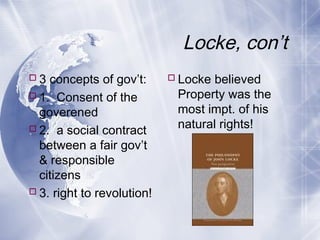
Locke, con’t
3 concepts of gov’t:
1. Consent of the
goverened
2. a social contract
between a fair gov’t
& responsible
citizens
3. right to revolution!
Locke believed
Property was the
most impt. of his
natural rights!
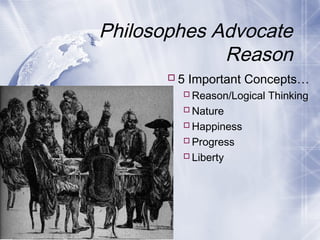
Philosophes Advocate
Reason
5 Important Concepts…
Reason/Logical Thinking
Nature
Happiness
Progress
Liberty
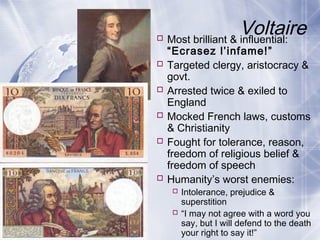
Voltaire Most brilliant & influential:
“Ecrasez l’infame!”
 Targeted clergy, aristocracy &
govt.
 Arrested twice & exiled to
England
 Mocked French laws, customs
& Christianity
 Fought for tolerance, reason,
freedom of religious belief &
freedom of speech
 Humanity’s worst enemies:
 Intolerance, prejudice &
superstition
 “I may not agree with a word you
say, but I will defend to the death
your right to say it!”
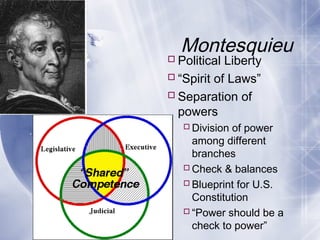
Montesquieu
Political Liberty
“Spirit of Laws”
Separation of
powers
Division of power
among different
branches
Check & balances
Blueprint for U.S.
Constitution
“Power should be a
check to power”
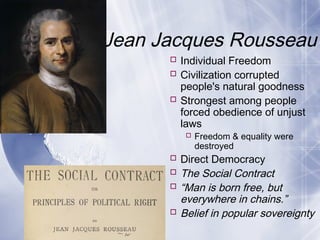
Jean Jacques Rousseau
 Individual Freedom
 Civilization corrupted
people's natural goodness
 Strongest among people
forced obedience of unjust
laws
 Freedom & equality were
destroyed
 Direct Democracy
 The Social Contract
 “Man is born free, but
everywhere in chains.”
 Belief in popular sovereignty
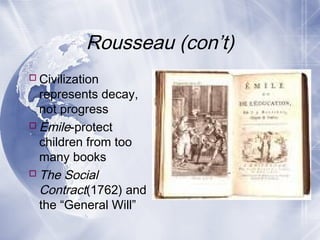
Rousseau (con’t)
Civilization
represents decay,
not progress
Emile-protect
children from too
many books
The Social
Contract(1762) and
the “General Will”
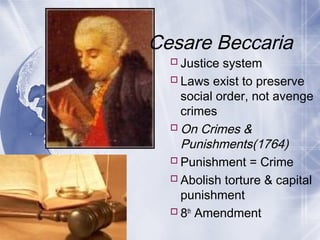
Justice system
Laws exist to preserve
social order, not avenge
crimes
On Crimes &
Punishments(1764)
Punishment = Crime
Abolish torture & capital
punishment
8th
Amendment
Cesare Beccaria
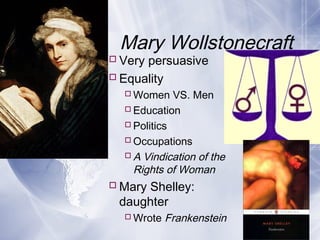
Mary Wollstonecraft
Very persuasive
Equality
Women VS. Men
Education
Politics
Occupations
A Vindication of the
Rights of Woman
Mary Shelley:
daughter
Wrote Frankenstein
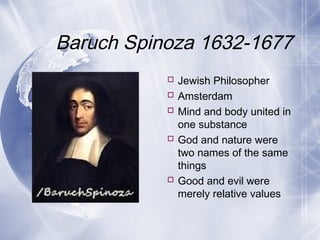
Baruch Spinoza 1632-1677
 Jewish Philosopher
 Amsterdam
 Mind and body united in
one substance
 God and nature were
two names of the same
things
 Good and evil were
merely relative values
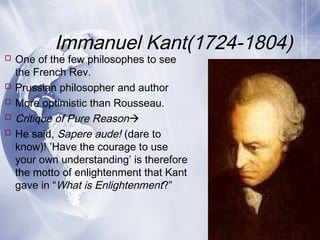
Immanuel Kant(1724-1804)
 One of the few philosophes to see
the French Rev.
 Prussian philosopher and author
 More optimistic than Rousseau.
 Critique of Pure Reason
 He said, Sapere aude! (dare to
know)! ’Have the courage to use
your own understanding’ is therefore
the motto of enlightenment that Kant
gave in “What is Enlightenment?”
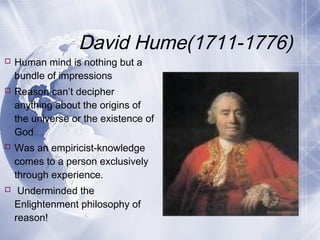
 Human mind is nothing but a
bundle of impressions
 Reason can’t decipher
anything about the origins of
the universe or the existence of
God
 Was an empiricist-knowledge
comes to a person exclusively
through experience.
 Underminded the
Enlightenment philosophy of
reason!
David Hume(1711-1776)
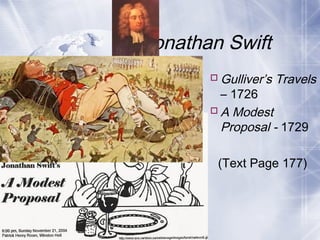
Jonathan Swift
Gulliver’s Travels
– 1726
A Modest
Proposal - 1729
(Text Page 177)
Impact of Enlightenment
Outcomes…
Human reason
could solve social
problems
Secular, worldly
outlook
Better society as a
whole
Rise of Individualism
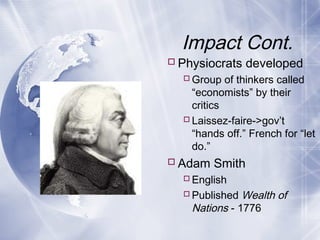
Impact Cont.
Physiocrats developed
Group of thinkers called
“economists” by their
critics
Laissez-faire->gov’t
“hands off.” French for “let
do.”
Adam Smith
English
Published Wealth of
Nations - 1776
II. The Enlightenment
E. Race and the Enlightenment
1. Carl von Linne
2. David Hume and Immanuel Kant
3. The Concept of “Race”
. Race and the Enlightenment (the Enlightenment
represented a turning point in European ideas about race)
1. Carl von Linne –
Swedish botanist and author of The System of Nature (1735)
who claimed that nature was organized into a God-given
hierarchy with distinct species and races
 2. David Hume and Immanuel Kant -
Claimed that there were four human races that had derived
from a original race of “white brunette” people, the white
inhabitants of northern Germany.
 3. The Concept of “Race” –
Used to designate biologically distinct groups of humans and
contained assumptions of superiority and inferiority (which
could justify enslavement or conquest). Not all
Enlightenment thinkers, however, agreed with such
concepts of race.
Jewish Life and the Limits of Enlightened
Absolutism
1. Jewish Life
2. Haskalah
3. Tolerance
Jewish Life and the Limits
of Enlightened Absolutism
 1. Jewish Life –
Characterized by legal discrimination, confinement to tiny ghettos,
and prominence in international trade.
 2. Haskalah –
Enlightenment movement led by Moses Mendelssohn (1729–1786)
that argued for freedom and civil rights for European Jews.
 3. Tolerance –
Attempts to naturalize Jews gained some ground (in Austria), but
moved slowly because of public hostility (as in Britain) or the
opposition of monarchs (like Frederick the Great or Catherine the
Great). The French Revolution was the first time when all
restrictions were abolished in Western and Central Europe.
To know…from your reading
 Reading revolution
The transition in Europe from a society where literacy consisted of
patriarchal and communal reading of religious texts to a society
where literacy was commonplace and reading material was
broad and diverse.
 Public sphere
An idealized intellectual space that emerged in Europe during the
Enlightenment, where the public came together to discuss
important issues relating to society, economics, and politics
 Coffeehouse Culture: Living in the Past, page 538!

Ap ch. 17 enlight.teach.copy-lect.1

  • 1.
    Lecture 1: Enlightenmentphilosophy, Race Lecture 2: Salons, Music, Literature, Enlightened Despotism Chapter 17: Toward a New World View “Siecle de Lumiere” “The Century of Light”
  • 2.
    Why did theEnlightenment begin(reached its height) in France? 1. French was the international language of the educated classes in the 18thc. 2. In France, intellectual radicals could battle opposition without level of restraints found in rest of Europe. 3. French philosophes were indeed asking fundamental questions.
  • 3.
    Deism: “Religion ofthe Thinker’s Enlightenment thinker’s did not denounce religion. These thinker’s opted for Deismis a religious and philosophical belief that a supreme being created the universe, and that this (and religious truth in general) can be determined using reason and observation of the natural world alone, without a need for either faith or organized religion.
  • 4.
    Connection across time: Today: World Union of Diests—God gave us reason-not religion The World Union of Deists and THINK! were founded in Charlottesville, Virginia, U.S.A., on April 10, 1993 by Bob Johnson.
  • 5.
    Philosophes met insalons to discuss the issues of the day!
  • 6.
    Turn to pg.536 and review the questions:
  • 7.
    Denis Diderot& Jeanle Rond d’Alembert Editors of a 17 volume encyclopedia with 100,000s of articles that exalted science, questioned religion, & criticized intolerance, legal injustice, and anachronistic social institutions.
  • 8.
    Thomas Hobbes  EnglishCivil War  People were selfish & wicked by nature  social contract  People must give up their rights to a strong rule to gain law & order  Leviathan  Ruler needs total power to keep citizens under control  Absolute Monarchy
  • 9.
    John Locke  NaturalRights Life, liberty & property; Property most impt. U.S. Dec.Indep.espouses these rights!(Jefferson)  Govt.’s power comes by consent of people Popular consent & Right to rebel if gov’t doesn’t protect rights! Foundation of modern democracy Concept of tabula rasa!! Children are born blank slates… The unformed, featureless mind. The importance of parents’ influence then in paramount
  • 10.
    Locke, con’t 3 conceptsof gov’t: 1. Consent of the goverened 2. a social contract between a fair gov’t & responsible citizens 3. right to revolution! Locke believed Property was the most impt. of his natural rights!
  • 11.
    Philosophes Advocate Reason 5 ImportantConcepts… Reason/Logical Thinking Nature Happiness Progress Liberty
  • 12.
    Voltaire Most brilliant& influential: “Ecrasez l’infame!”  Targeted clergy, aristocracy & govt.  Arrested twice & exiled to England  Mocked French laws, customs & Christianity  Fought for tolerance, reason, freedom of religious belief & freedom of speech  Humanity’s worst enemies:  Intolerance, prejudice & superstition  “I may not agree with a word you say, but I will defend to the death your right to say it!”
  • 13.
    Montesquieu Political Liberty “Spirit ofLaws” Separation of powers Division of power among different branches Check & balances Blueprint for U.S. Constitution “Power should be a check to power”
  • 14.
    Jean Jacques Rousseau Individual Freedom  Civilization corrupted people's natural goodness  Strongest among people forced obedience of unjust laws  Freedom & equality were destroyed  Direct Democracy  The Social Contract  “Man is born free, but everywhere in chains.”  Belief in popular sovereignty
  • 15.
    Rousseau (con’t) Civilization represents decay, notprogress Emile-protect children from too many books The Social Contract(1762) and the “General Will”
  • 16.
    Justice system Laws existto preserve social order, not avenge crimes On Crimes & Punishments(1764) Punishment = Crime Abolish torture & capital punishment 8th Amendment Cesare Beccaria
  • 17.
    Mary Wollstonecraft Very persuasive Equality WomenVS. Men Education Politics Occupations A Vindication of the Rights of Woman Mary Shelley: daughter Wrote Frankenstein
  • 18.
    Baruch Spinoza 1632-1677 Jewish Philosopher  Amsterdam  Mind and body united in one substance  God and nature were two names of the same things  Good and evil were merely relative values
  • 19.
    Immanuel Kant(1724-1804)  Oneof the few philosophes to see the French Rev.  Prussian philosopher and author  More optimistic than Rousseau.  Critique of Pure Reason  He said, Sapere aude! (dare to know)! ’Have the courage to use your own understanding’ is therefore the motto of enlightenment that Kant gave in “What is Enlightenment?”
  • 20.
     Human mindis nothing but a bundle of impressions  Reason can’t decipher anything about the origins of the universe or the existence of God  Was an empiricist-knowledge comes to a person exclusively through experience.  Underminded the Enlightenment philosophy of reason! David Hume(1711-1776)
  • 21.
    Jonathan Swift Gulliver’s Travels –1726 A Modest Proposal - 1729 (Text Page 177)
  • 22.
    Impact of Enlightenment Outcomes… Humanreason could solve social problems Secular, worldly outlook Better society as a whole Rise of Individualism
  • 23.
    Impact Cont. Physiocrats developed Groupof thinkers called “economists” by their critics Laissez-faire->gov’t “hands off.” French for “let do.” Adam Smith English Published Wealth of Nations - 1776
  • 24.
    II. The Enlightenment E.Race and the Enlightenment 1. Carl von Linne 2. David Hume and Immanuel Kant 3. The Concept of “Race”
  • 25.
    . Race andthe Enlightenment (the Enlightenment represented a turning point in European ideas about race) 1. Carl von Linne – Swedish botanist and author of The System of Nature (1735) who claimed that nature was organized into a God-given hierarchy with distinct species and races  2. David Hume and Immanuel Kant - Claimed that there were four human races that had derived from a original race of “white brunette” people, the white inhabitants of northern Germany.  3. The Concept of “Race” – Used to designate biologically distinct groups of humans and contained assumptions of superiority and inferiority (which could justify enslavement or conquest). Not all Enlightenment thinkers, however, agreed with such concepts of race.
  • 26.
    Jewish Life andthe Limits of Enlightened Absolutism 1. Jewish Life 2. Haskalah 3. Tolerance
  • 27.
    Jewish Life andthe Limits of Enlightened Absolutism  1. Jewish Life – Characterized by legal discrimination, confinement to tiny ghettos, and prominence in international trade.  2. Haskalah – Enlightenment movement led by Moses Mendelssohn (1729–1786) that argued for freedom and civil rights for European Jews.  3. Tolerance – Attempts to naturalize Jews gained some ground (in Austria), but moved slowly because of public hostility (as in Britain) or the opposition of monarchs (like Frederick the Great or Catherine the Great). The French Revolution was the first time when all restrictions were abolished in Western and Central Europe.
  • 28.
    To know…from yourreading  Reading revolution The transition in Europe from a society where literacy consisted of patriarchal and communal reading of religious texts to a society where literacy was commonplace and reading material was broad and diverse.  Public sphere An idealized intellectual space that emerged in Europe during the Enlightenment, where the public came together to discuss important issues relating to society, economics, and politics  Coffeehouse Culture: Living in the Past, page 538!

Editor's Notes

  • #25 II. The Enlightenment E. Race and the Enlightenment (the Enlightenment represented a turning point in European ideas about race) 1. Carl von Linne – Swedish botanist and author of The System of Nature (1735) who claimed that nature was organized into a God-given hierarchy with distinct species and races 2. David Hume and Immanuel Kant - Claimed that there were four human races that had derived from a original race of “white brunette” people, the white inhabitants of northern Germany. 3. The Concept of “Race” – Used to designate biologically distinct groups of humans and contained assumptions of superiority and inferiority (which could justify enslavement or conquest). Not all Enlightenment thinkers, however, agreed with such concepts of race. F. Late Enlightenment (attack on the faith in reason, progress, and moderation) 1. Jean-Jacques Rousseau (1712–1778) – Son of a Swiss watchmaker who argued that rationalism and civilization had destroyed the individual and that the basic goodness of the unspoiled child and the individual had to be preserved against cruel civilization. Author of The Social Contract (1762), which put forward concepts of the general will (the true interest of all the people, but not necessarily the will of the majority) and sovereignty. He was a harbinger of Romanticism and reaction against the Enlightenment. 2. Immanuel Kant (1724–1804) – Prussian philosopher and author of “What is Enlightenment?” who attempted to reconcile absolute monarchical authority with a critical public sphere.
  • #27 III. Enlightened Absolutism C. The Austrian Habsburgs 1. Marie Theresa (r. 1740–1780) – Austrian monarch who introduced reforms that included limiting the papacy’s political influence in her realm, reforming and strengthening the bureaucracy, revamping the system of taxation, and improving the lot of the agricultural population. 2. Joseph II (r. 1780–1790) – Abolished serfdom (1781), decreed that peasants could pay landlords in cash rather than through compulsory labor on their land. 3.Leopold II (r. 1790–1792) – Canceled Joseph’s edicts to reestablish order, reinstating forced labor on the lords’ lands. These actions showed the limits of Enlightenment thinking about equality and social justice. B. Jewish Life and the Limits of Enlightened Absolutism 1. Jewish Life – Characterized by legal discrimination, confinement to tiny ghettos, and prominence in international trade. 2. Haskalah – Enlightenment movement led by Moses Mendelssohn (1729–1786) that argued for freedom and civil rights for European Jews. 3. Tolerance - Attempts to naturalize Jews gained some ground (in Austria), but moved slowly because of public hostility (as in Britain) or the opposition of monarchs (like Frederick the Great or Catherine the Great). The French Revolution was the first time when all restrictions were abolished in Western and Central Europe.