AP European History Chapter 16 English Constitutional Monarchy
Magna Carta-1215-1 st  pillar to Constitutionalism ! King John I forced to accept it. A list of demands made by the nobility. Created a CONTRACT between the king and the aristocracy. Established principles which limited the power of the king: Established basic legal rights. The king must ask for popular consent for taxes. Accused must have jury trial.
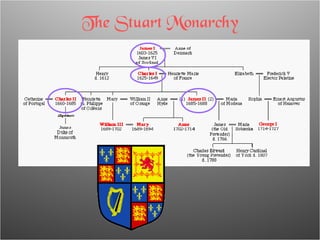
The Stuart Monarchy
James I  [r. 1603-1625]-divine right! James I’s speech to the House of Commons: I am surprised that my ancestors should ever be permitted such an institution to come into existence.  I am a stranger, and found it here when I arrived, so that I am obliged to put up with what I cannot get rid of!
James I  [r. 1603-1625] Wanted absolute power; believer in Divine Right! He quickly alienated a Parliament grown accustomed under the Tudors to act on the premise that monarch and Parliament TOGETHER ruled England as a  “balance polity.”
James I  [r. 1603-1625] He alienated the Puritans by his strong defense of the Anglican Church. Many of England’s gentry [mostly rich landowners below the level of the nobility] became Puritans. These Puritan gentry formed an important and large part of the House of Commons. It was NOT WISE to alienate them!
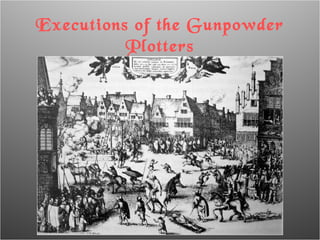
Gunpowder Plot, 1605(Nov.5) An attempt by some provincial Catholics to kill King James I and most of the Protestant aristocracy. Blow up the House of Lords during the state opening of Parliament. Guy Fawkes
Executions of the Gunpowder Plotters
James I  [r. 1603-1625] Problems he faced: Large royal debt. He wasn’t English    he didn’t understand English customs [esp. English law!] Believed in Divine Right of Kings. Pro-Catholic sympathies. Clashed with Parliament He raised money without Parliament’s consent!
King James Bible,  1611
Ulster Plantation Established Under King James I
Background of Plantation of Ulster England(Protestant) VS. Northern Ireland(Catholic) Started during reign of Henry VIII Organized colonization(or, plantation)of Ulster by people from Britain. Planned, organized by James I. Private plantation by wealthy landowners begain in 1606; controlled by the monarchy begain in 1609. All land owned by the Irish chieftains the O’Neills & O’Donnells, were confiscated & used to settle the colonists. The “British tenants”, a term applied to the colonists, mostly from Scotland & England. They were required to be English-speaking Protestant.
James I & Goal of Ulster Plantation Land would be confiscated & redistributed to British settlers Landowners were banned to take Irish tenants & had to import English & Scottish workers Irish were relocated to live near garrisons & Protestant churches All churches & lands previously owned by Roman Catholic Church    lands of Protestant Church of Ireland Native population was to convert to Protestantism The Plantation of Ulster was the biggest & most successful of the Plantations of Ireland. Ulster was colonized so as to prevent further rebellion, as over the preceding century, it had proven to be the region most resistant to English control
Ulster Plantation:  1609-1660
% Of Land Owned by Catholics in Ireland [in green]
Charles I  [r. 1625-1649] Pro-ceremonies and rituals. Uniformity of church services imposed by a church court. Anglican  Book of Common Prayer  for both England AND Scotland. Seen as too pro-Catholic by the Puritans.
Archbishop of Canterbury; 1633-45 One of the High Church Caroline divines Influential theologians & writers in Anglican Church An author of  Common Book of Prayers Opposed radical reforms of Puritanism Supported Charles I Beheaded by Parliamentarians during Civil War: January 10, 1645 Archbishop William Laud 1573-1645
Charles I & Parliament Constantly at war with Spain and France. Always need $, but how to get it?? Usually Parliament would give Charles $ from taxes to fund his wars. Periodically, Parliament would deny funds. In return, Charles would dissolve Parliament and try to rule England without it    find funds in other ways.
Ship Money Assessments, 1636 [per square mile] A medieval tax for coastal cities for defense. Charles applied them to inland counties as well. This got him around the need to call Parliament into session.
The Petition of Rights, 1628-2 nd  pillar to Constitutionalism! In return for money to fund his wars, Charles I agreed: No imprisonment without due cause. No taxation without Parliament’s consent. No putting soldiers in private homes. No martial law during peacetime. Charles signed it, and then ignored it, dissolving Parliament 11 Years Tyranny!!!!
The “Short” Parliament “ Short Parliament” No Parliament in 11 yrs. Rebellion in Scotland over Laud issues. Charles  need $   war with France. Calls Parliament into session in 1640 Charles dismisses them after 3 weeks.(April-May 1640 Charles I  by Van Dyck (1633)
The “Long” Parliament In session from 1640 to 1660. Laud executed. Triennial Act  passed    Parliament must be called in session at least once every 3 yrs. Parliament can’t be adjourned without its own consent! Charles heads north to form an army!
Civil War  (1642-1689) Royalists (Cavaliers) Parliamentarians (Roundheads) House of Lords N & W England Aristocracy Large landowners Church officials More rural House of Commons S & E England Puritans Merchants Townspeople More urban
Oliver Cromwell  [ 1599-1658 ] Officer of the Parliamentary army [cavalry]    the  New Model Army. (“General of the Horse!) Led the army that defeated royal forces and now controlled the government. He wore…a plain cloth-suit, which seemed to have been made by a poor tailor; his shirt  was plain, and not very clean; and I  remember a speck or two of  blood upon his collar…his face was  swollen and red, his voice sharp and  untenable, and his speech full of  passion.  [Sir Philip Warwick,  a Royalist, 1640]
The “Interregnum” Period  [ 1649-1660 ] The  Commonwealth  (1649-1653) The  Protectorate  (1654-1660)
The Coat of Arms & the Flag  of the Commonwealth
Regicide    Beheading of Charles I,  1649 The vote by the Rump Parliament was 68-67.
The Puritan Commonwealth  [1649-1653] Cromwell rules with the Rump Parliament. Constitutional Republic Created a constitution     Instrument of Government An executive [Cromwell] A Council of State    annually elected the committee of Parliament. No monarch. Europe is appalled    other nations don’t recognize it.
Rebels within a Rebellion:  Levellers John Lilburne was their leader. One of the first libertarians in the world. The Agreement of the People  was their political manifesto. Abolish corruption within  the Parliament & judicial process. Toleration of religious differences. Laws written in the vernacular. Universal suffrage as  a “natural right.”
Rebels within a Rebellion:  Diggers Agrarian “communists” led by Gerrard Winstanley and William Everard    seen as the “true Levellers.” With Charles I gone, they felt that land should now be distributed to the poor. Food prices had reached record highs in the 1640s. They alarmed the Commonwealth government and angered the local landowners who wanted to claim confiscated aristocratic lands for themselves.
The Protectorate  [1653-1660] Cromwell tears up the ineffective  Constitution. Dismisses the  Rump Parliament  and rules with the support of the  military. Declares martial law. Military dictator. Religious tolerance for all [esp.  for Jews], except for Catholics. Crushes a rebellion in Scotland. Crushes a rebellion among the Catholics of Ireland    kills 40% of all ethnic Irish!
Cromwell—Lord Protector or King?? England longs for an end to martial law! Cromwell dies in 1658 and his son, Richard, takes over, but is weak and lasts for only two years.
The  Restoration (1660-1688) Parliament could no more exist without the Crown than the Crown without Parliament.   This was the most important lesson of the English Civil War !
Charles II “ Cabal” – Define… King appointed a council of 5 men who served as advisers & members of Parliament Agents between executive & legislature “ Cabal” refers to 5 member names: Clifford, Arlington, Buckingham, Ashley-Cooper, and Lauderdale Ancestor to later cabinet system
King Charles II  [ r. 1660-1685 ] Had charm, poise, & political skills [unlike his father!]. Restored the theaters and reopened the pubs and brothels closed during the Restoration. Favored religious toleration. Had secret Catholic sympathies. Realized that he could not repeat the mistakes his father had made.
King Charles II  [ r. 1660-1685 ] 1661    “Cavalier” Parliament  [filled with Royalists] Disbanded the Puritan army. Pardoned most Puritan rebels. Restored the authority of the Church of England. 1662     Clarendon Code [Act of Uniformity] All clergy & church officials had to conform to the Anglican  Book of Common Prayer. It forbade “non-conformists” to worship publicly, teach their faith, or attend English universities .
Great London Plague, 1665
Great London Fire, 1666
King Charles II  [ r. 1660-1685 ] 1673     Test Act Parliament excluded all but Anglicans from civilian and military positions. [to the Anglican gentry, the Puritans were considered “radicals” and the Catholics were seen as “traitors!”] 1679     Habeas Corpus Act Any unjustly imprisoned persons could obtain a writ of  habeas corpus  compelling the govt. to explain why he had lost his liberty.
Whigs & Tories Debate in Parliament of who should inherit Charles’s throne No legitimate child    brother James II was Catholic Two groups were the ancestors of England’s 1 st  political parties Whigs : Those who opposed James II Tories : Supporters of James II
Charles II’s Foreign Policy 1665 – 1667:  Second Anglo-Dutch War To Charles II, Louis XIV is an ideal ally against the Dutch. 1670     Treaty of Dover
King James II  [ r. 1685-1688 ] Was a bigoted convert to Catholicism without any of Charles II’s shrewdness or ability to compromise. Alienated even the Tories. Provoked the revolution that Charles II had succeeded in avoiding!
King James II  [ r. 1685-1688 ] In  direct violation of the Test Act: he introduced Catholics into the High Command of both the army and navy. Camped a standing army a few miles outside of London. Surrounded himself with  Catholic advisors & attacked Anglican control of the universities. Claimed the power to suspend or dispense with Acts of Parliament. 1687     Declaration of Liberty of Conscience He extended religious toleration without Parliament’s approval or support.
The “Glorious” Revolution: 1688 Whig & Tory leaders offered the throne jointly to  James II’s daughter Mary [raised a Protestant] & her husband, William of Orange. He was a vigorous enemy of Louis XIV. He was seen as a champion of the Protestant cause .
English Bill of Rights  [ 1689 ] It settled all of the major issues between King & Parliament. It served as a model for the U. S. Bill of Rights. It found its best defense in John Locke’s,  Second Treatise of Civil Gov’t It also formed a base for the steady expansion of civil liberties in the 18 c  and early 19 c  in England .
1689-Toleration Act Passed by Parliament giving all non-conformists except Roman Catholics to worship freely to reward Protestant dissenters for not siding with James II.
English Bill of Rights  [ 1689 ]-3 rd  pillar to Constitutionalism! The King could not suspend the operation of laws. The King could not interfere with the ordinary course of justice. No taxes levied or standard army maintained in peacetime without Parliament’s consent. Freedom of speech in Parliament. Sessions of Parliament would be held frequently. Subjects had the right of bail, petition, and freedom from excessive fines and cruel and unusual punishment. The monarch must be a Protestant. Freedom from arbitrary arrest. Censorship of the press was dropped. Religious toleration.
Cabinet After 1688 no Br. Monarch could rule without consent of Parliament! At the same time, Parl. Couldn’t rule without the consent of the monarch!  To eliminate the chance of a stalemate among the two, a  cabinet  was formed Over time, the cabinet has become the center of power & policy making Under the cabinet system, the leader of the majority party in Parliament is the  Prime Minister.
England’s 1 st  PM-Robert Walpole British Whig statesman, considered to the first holder of the office of prime minister, who dominated politics in the reigns of George I and George II 10 Downing Street  in London -official residence of PM
Queen Anne – The Last Stuart Reign: 1702-1714 1701: Act of Settlement…  Designed to secure Protestant succession to the throne, guarantees Parliamentary system of govt. 1707: Act of Union… England & Scotland to be known as Great Britain Marks the official development of the two-party system 1714: Upon her death    George Louis, elector of Hanover, ascends to the throne as George I—Hanover dynasty

Ch.16

  • 1.
    AP European HistoryChapter 16 English Constitutional Monarchy
  • 2.
    Magna Carta-1215-1 st pillar to Constitutionalism ! King John I forced to accept it. A list of demands made by the nobility. Created a CONTRACT between the king and the aristocracy. Established principles which limited the power of the king: Established basic legal rights. The king must ask for popular consent for taxes. Accused must have jury trial.
  • 3.
  • 4.
    James I [r. 1603-1625]-divine right! James I’s speech to the House of Commons: I am surprised that my ancestors should ever be permitted such an institution to come into existence. I am a stranger, and found it here when I arrived, so that I am obliged to put up with what I cannot get rid of!
  • 5.
    James I [r. 1603-1625] Wanted absolute power; believer in Divine Right! He quickly alienated a Parliament grown accustomed under the Tudors to act on the premise that monarch and Parliament TOGETHER ruled England as a “balance polity.”
  • 6.
    James I [r. 1603-1625] He alienated the Puritans by his strong defense of the Anglican Church. Many of England’s gentry [mostly rich landowners below the level of the nobility] became Puritans. These Puritan gentry formed an important and large part of the House of Commons. It was NOT WISE to alienate them!
  • 7.
    Gunpowder Plot, 1605(Nov.5)An attempt by some provincial Catholics to kill King James I and most of the Protestant aristocracy. Blow up the House of Lords during the state opening of Parliament. Guy Fawkes
  • 8.
    Executions of theGunpowder Plotters
  • 9.
    James I [r. 1603-1625] Problems he faced: Large royal debt. He wasn’t English  he didn’t understand English customs [esp. English law!] Believed in Divine Right of Kings. Pro-Catholic sympathies. Clashed with Parliament He raised money without Parliament’s consent!
  • 10.
  • 11.
  • 12.
    Background of Plantationof Ulster England(Protestant) VS. Northern Ireland(Catholic) Started during reign of Henry VIII Organized colonization(or, plantation)of Ulster by people from Britain. Planned, organized by James I. Private plantation by wealthy landowners begain in 1606; controlled by the monarchy begain in 1609. All land owned by the Irish chieftains the O’Neills & O’Donnells, were confiscated & used to settle the colonists. The “British tenants”, a term applied to the colonists, mostly from Scotland & England. They were required to be English-speaking Protestant.
  • 13.
    James I &Goal of Ulster Plantation Land would be confiscated & redistributed to British settlers Landowners were banned to take Irish tenants & had to import English & Scottish workers Irish were relocated to live near garrisons & Protestant churches All churches & lands previously owned by Roman Catholic Church  lands of Protestant Church of Ireland Native population was to convert to Protestantism The Plantation of Ulster was the biggest & most successful of the Plantations of Ireland. Ulster was colonized so as to prevent further rebellion, as over the preceding century, it had proven to be the region most resistant to English control
  • 14.
  • 15.
    % Of LandOwned by Catholics in Ireland [in green]
  • 16.
    Charles I [r. 1625-1649] Pro-ceremonies and rituals. Uniformity of church services imposed by a church court. Anglican Book of Common Prayer for both England AND Scotland. Seen as too pro-Catholic by the Puritans.
  • 17.
    Archbishop of Canterbury;1633-45 One of the High Church Caroline divines Influential theologians & writers in Anglican Church An author of Common Book of Prayers Opposed radical reforms of Puritanism Supported Charles I Beheaded by Parliamentarians during Civil War: January 10, 1645 Archbishop William Laud 1573-1645
  • 18.
    Charles I &Parliament Constantly at war with Spain and France. Always need $, but how to get it?? Usually Parliament would give Charles $ from taxes to fund his wars. Periodically, Parliament would deny funds. In return, Charles would dissolve Parliament and try to rule England without it  find funds in other ways.
  • 19.
    Ship Money Assessments,1636 [per square mile] A medieval tax for coastal cities for defense. Charles applied them to inland counties as well. This got him around the need to call Parliament into session.
  • 20.
    The Petition ofRights, 1628-2 nd pillar to Constitutionalism! In return for money to fund his wars, Charles I agreed: No imprisonment without due cause. No taxation without Parliament’s consent. No putting soldiers in private homes. No martial law during peacetime. Charles signed it, and then ignored it, dissolving Parliament 11 Years Tyranny!!!!
  • 21.
    The “Short” Parliament“ Short Parliament” No Parliament in 11 yrs. Rebellion in Scotland over Laud issues. Charles need $  war with France. Calls Parliament into session in 1640 Charles dismisses them after 3 weeks.(April-May 1640 Charles I by Van Dyck (1633)
  • 22.
    The “Long” ParliamentIn session from 1640 to 1660. Laud executed. Triennial Act passed  Parliament must be called in session at least once every 3 yrs. Parliament can’t be adjourned without its own consent! Charles heads north to form an army!
  • 23.
    Civil War (1642-1689) Royalists (Cavaliers) Parliamentarians (Roundheads) House of Lords N & W England Aristocracy Large landowners Church officials More rural House of Commons S & E England Puritans Merchants Townspeople More urban
  • 24.
    Oliver Cromwell [ 1599-1658 ] Officer of the Parliamentary army [cavalry]  the New Model Army. (“General of the Horse!) Led the army that defeated royal forces and now controlled the government. He wore…a plain cloth-suit, which seemed to have been made by a poor tailor; his shirt was plain, and not very clean; and I remember a speck or two of blood upon his collar…his face was swollen and red, his voice sharp and untenable, and his speech full of passion. [Sir Philip Warwick, a Royalist, 1640]
  • 25.
    The “Interregnum” Period [ 1649-1660 ] The Commonwealth (1649-1653) The Protectorate (1654-1660)
  • 26.
    The Coat ofArms & the Flag of the Commonwealth
  • 27.
    Regicide  Beheading of Charles I, 1649 The vote by the Rump Parliament was 68-67.
  • 28.
    The Puritan Commonwealth [1649-1653] Cromwell rules with the Rump Parliament. Constitutional Republic Created a constitution  Instrument of Government An executive [Cromwell] A Council of State  annually elected the committee of Parliament. No monarch. Europe is appalled  other nations don’t recognize it.
  • 29.
    Rebels within aRebellion: Levellers John Lilburne was their leader. One of the first libertarians in the world. The Agreement of the People was their political manifesto. Abolish corruption within the Parliament & judicial process. Toleration of religious differences. Laws written in the vernacular. Universal suffrage as a “natural right.”
  • 30.
    Rebels within aRebellion: Diggers Agrarian “communists” led by Gerrard Winstanley and William Everard  seen as the “true Levellers.” With Charles I gone, they felt that land should now be distributed to the poor. Food prices had reached record highs in the 1640s. They alarmed the Commonwealth government and angered the local landowners who wanted to claim confiscated aristocratic lands for themselves.
  • 31.
    The Protectorate [1653-1660] Cromwell tears up the ineffective Constitution. Dismisses the Rump Parliament and rules with the support of the military. Declares martial law. Military dictator. Religious tolerance for all [esp. for Jews], except for Catholics. Crushes a rebellion in Scotland. Crushes a rebellion among the Catholics of Ireland  kills 40% of all ethnic Irish!
  • 32.
    Cromwell—Lord Protector orKing?? England longs for an end to martial law! Cromwell dies in 1658 and his son, Richard, takes over, but is weak and lasts for only two years.
  • 33.
    The Restoration(1660-1688) Parliament could no more exist without the Crown than the Crown without Parliament. This was the most important lesson of the English Civil War !
  • 34.
    Charles II “Cabal” – Define… King appointed a council of 5 men who served as advisers & members of Parliament Agents between executive & legislature “ Cabal” refers to 5 member names: Clifford, Arlington, Buckingham, Ashley-Cooper, and Lauderdale Ancestor to later cabinet system
  • 35.
    King Charles II [ r. 1660-1685 ] Had charm, poise, & political skills [unlike his father!]. Restored the theaters and reopened the pubs and brothels closed during the Restoration. Favored religious toleration. Had secret Catholic sympathies. Realized that he could not repeat the mistakes his father had made.
  • 36.
    King Charles II [ r. 1660-1685 ] 1661  “Cavalier” Parliament [filled with Royalists] Disbanded the Puritan army. Pardoned most Puritan rebels. Restored the authority of the Church of England. 1662  Clarendon Code [Act of Uniformity] All clergy & church officials had to conform to the Anglican Book of Common Prayer. It forbade “non-conformists” to worship publicly, teach their faith, or attend English universities .
  • 37.
  • 38.
  • 39.
    King Charles II [ r. 1660-1685 ] 1673  Test Act Parliament excluded all but Anglicans from civilian and military positions. [to the Anglican gentry, the Puritans were considered “radicals” and the Catholics were seen as “traitors!”] 1679  Habeas Corpus Act Any unjustly imprisoned persons could obtain a writ of habeas corpus compelling the govt. to explain why he had lost his liberty.
  • 40.
    Whigs & ToriesDebate in Parliament of who should inherit Charles’s throne No legitimate child  brother James II was Catholic Two groups were the ancestors of England’s 1 st political parties Whigs : Those who opposed James II Tories : Supporters of James II
  • 41.
    Charles II’s ForeignPolicy 1665 – 1667: Second Anglo-Dutch War To Charles II, Louis XIV is an ideal ally against the Dutch. 1670  Treaty of Dover
  • 42.
    King James II [ r. 1685-1688 ] Was a bigoted convert to Catholicism without any of Charles II’s shrewdness or ability to compromise. Alienated even the Tories. Provoked the revolution that Charles II had succeeded in avoiding!
  • 43.
    King James II [ r. 1685-1688 ] In direct violation of the Test Act: he introduced Catholics into the High Command of both the army and navy. Camped a standing army a few miles outside of London. Surrounded himself with Catholic advisors & attacked Anglican control of the universities. Claimed the power to suspend or dispense with Acts of Parliament. 1687  Declaration of Liberty of Conscience He extended religious toleration without Parliament’s approval or support.
  • 44.
    The “Glorious” Revolution:1688 Whig & Tory leaders offered the throne jointly to James II’s daughter Mary [raised a Protestant] & her husband, William of Orange. He was a vigorous enemy of Louis XIV. He was seen as a champion of the Protestant cause .
  • 45.
    English Bill ofRights [ 1689 ] It settled all of the major issues between King & Parliament. It served as a model for the U. S. Bill of Rights. It found its best defense in John Locke’s, Second Treatise of Civil Gov’t It also formed a base for the steady expansion of civil liberties in the 18 c and early 19 c in England .
  • 46.
    1689-Toleration Act Passedby Parliament giving all non-conformists except Roman Catholics to worship freely to reward Protestant dissenters for not siding with James II.
  • 47.
    English Bill ofRights [ 1689 ]-3 rd pillar to Constitutionalism! The King could not suspend the operation of laws. The King could not interfere with the ordinary course of justice. No taxes levied or standard army maintained in peacetime without Parliament’s consent. Freedom of speech in Parliament. Sessions of Parliament would be held frequently. Subjects had the right of bail, petition, and freedom from excessive fines and cruel and unusual punishment. The monarch must be a Protestant. Freedom from arbitrary arrest. Censorship of the press was dropped. Religious toleration.
  • 48.
    Cabinet After 1688no Br. Monarch could rule without consent of Parliament! At the same time, Parl. Couldn’t rule without the consent of the monarch! To eliminate the chance of a stalemate among the two, a cabinet was formed Over time, the cabinet has become the center of power & policy making Under the cabinet system, the leader of the majority party in Parliament is the Prime Minister.
  • 49.
    England’s 1 st PM-Robert Walpole British Whig statesman, considered to the first holder of the office of prime minister, who dominated politics in the reigns of George I and George II 10 Downing Street in London -official residence of PM
  • 50.
    Queen Anne –The Last Stuart Reign: 1702-1714 1701: Act of Settlement… Designed to secure Protestant succession to the throne, guarantees Parliamentary system of govt. 1707: Act of Union… England & Scotland to be known as Great Britain Marks the official development of the two-party system 1714: Upon her death  George Louis, elector of Hanover, ascends to the throne as George I—Hanover dynasty