The Middle Ages# 2
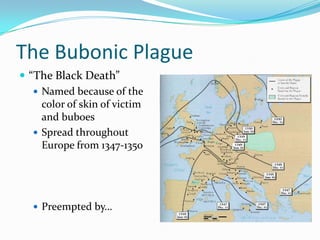
The Bubonic Plague“The Black Death”Named because of the color of skin of victim and buboes Spread throughout Europe from 1347-1350Preempted by…
Great Famine“Seven lean years” (1315-1322)A lack of food due to an increase in stormsNow thought to be a major climate changeAlso known as the Little Ice Age (LIA)As a result, people were more susceptible to diseases
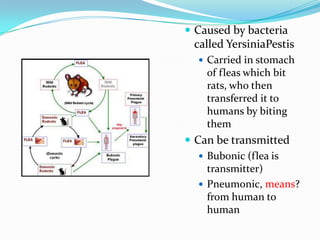
Caused by bacteria called YersiniaPestisCarried in stomach of fleas which bit rats, who then transferred it to humans by biting themCan be transmittedBubonic (flea is transmitter)Pneumonic, means?from human to human
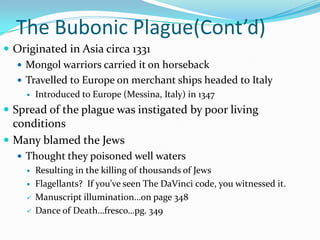
The Bubonic Plague(Cont’d)Originated in Asia circa 1331Mongol warriors carried it on horsebackTravelled to Europe on merchant ships headed to ItalyIntroduced to Europe (Messina, Italy) in 1347Spread of the plague was instigated by poor living conditions Many blamed the Jews Thought they poisoned well watersResulting in the killing of thousands of JewsFlagellants?  If you’ve seen The DaVinci code, you witnessed it.Manuscript illumination…on page 348
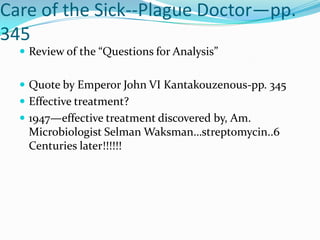
Dance of Death…fresco…pg. 349Care of the Sick--Plague Doctor—pp. 345Review of the “Questions for Analysis”Quote by Emperor John VI Kantakouzenous-pp. 345Effective treatment?1947—effective treatment discovered by, Am. Microbiologist Selman Waksman…streptomycin..6 Centuries later!!!!!!
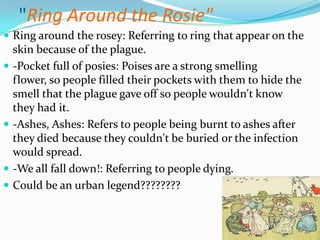
"Ring Around the Rosie"Ring around the rosey: Referring to ring that appear on the skin because of the plague.-Pocket full of posies: Poises are a strong smelling flower, so people filled their pockets with them to hide the smell that the plague gave off so people wouldn't know they had it.-Ashes, Ashes: Refers to people being burnt to ashes after they died because they couldn't be buried or the infection would spread.-We all fall down!: Referring to people dying.Could be an urban legend????????
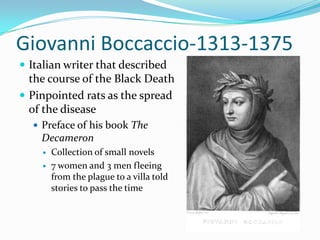
Giovanni Boccaccio-1313-1375Italian writer that described the course of the Black DeathPinpointed rats as the spread of the diseasePreface of his book The DecameronCollection of small novels7 women and 3 men fleeing from the plague to a villa told stories to pass the time
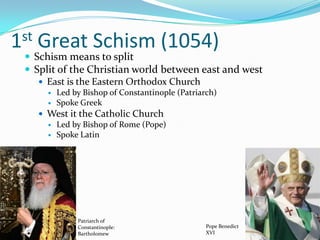
1st Great Schism (1054)Schism means to splitSplit of the Christian world between east and westEast is the Eastern Orthodox ChurchLed by Bishop of Constantinople (Patriarch)Spoke GreekWest it the Catholic ChurchLed by Bishop of Rome (Pope)Spoke LatinPatriarch of  Constantinople: BartholomewPope Benedict XVI
Great Schism (cont’d)Controversy followed over who was the real leader of the Christian worldPope Leo IX said that Rome was the only authorityPetrine Theory: Theory that states that Peter received keys to church and became the first Bishop of Rome (Pope)Differences between Orthodox and Catholic ChurchesPhilosophical UnderstandingLiturgical UsageLanguage Custom
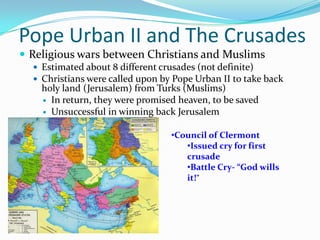
Pope Urban II and The CrusadesReligious wars between Christians and MuslimsEstimated about 8 different crusades (not definite)Christians were called upon by Pope Urban II to take back holy land (Jerusalem) from Turks (Muslims)	In return, they were promised heaven, to be savedUnsuccessful in winning back JerusalemCouncil of Clermont
Issued cry for first crusade
Battle Cry- “God wills it!”Third CrusadeAlso known as “The Crusade of 3 Kings”During Pope Gregory VIII term as Pope(1189-1192)3 Kings accompanied troops to JerusalemPhilip Augustus, King of FranceAbandoned the cause and returned to France Frederick I (Barbarosa). Holy Roman EmperorFell off horse and drowned in river on the way to JerusalemRichard I the Lion-hearted, King of EnglandIn Jerusalem, meets Muslim leader SaladinCome to a truce: Christians could visit Jerusalem without paying, but it was still under Muslim controlSaladin dies in 1198, and treaty is broken.
Crusades (cont’d)“Successful failures”Christians did not accomplish their goal, but as a result trade is increased with the middle-eastAs a result of the Crusades, Feudalism is weakeneddue to lack of serfs because of the Plague
Pope Gregory IX and InquisitionPope Gregory IXWanted to investigate heresy and correct errors within Catholic faithThought it was “poisoning society spiritually”Causing people to stray from churchEliminated heresy by killing or excommunicating anyone who questioned Catholicism DoctrineOccurred in Spain, Rome, and throughout Western Europe
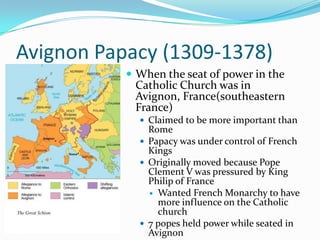
Avignon Papacy (1309-1378)When the seat of power in the Catholic Church was in Avignon, France(southeastern France)Claimed to be more important than RomePapacy was under control of French KingsOriginally moved because Pope Clement V was pressured by King Philip of FranceWanted French Monarchy to have more influence on the Catholic church7 popes held power while seated in Avignon
Avignon Papacy (cont’d)AKA: Babylonian Captivity70 years Hebrews were held captive by Babylonians1378- seat of power moved back to Rome1378-1414: Second Great Schism (Papal)Confusion as to who was the real Pope;Pope in Rome? or Pope in Avignon?Cardinals didn’t like incumbent pope Urban VIThey elected to new pope- Clement VIICouncil of Constance (1414-1418)Council created to end Papal Schism**both the Babylonian Captivity &  Great Schism demonstrate the vulnerability of the papacy  to the increasingly powerful monarchies!!!!
The Conciliar MovementReform Movement in the Catholic Church following the Second Great Schism (Papal Schism)Emerged as response to Avignon PapacyResulted in having two or three different Popes (antipopes)Gave Pope supreme powerConciliarists—Definition?Pg. 356…
3 Reformers of ChurchMarsiglio of Padua (1275-1342)John Wyclif (1324-1384)Jan Huss (1369-1415)
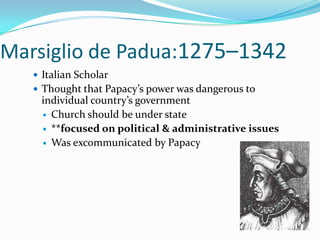
Marsiglio de Padua:1275–1342Italian ScholarThought that Papacy’s power was dangerous to individual country’s governmentChurch should be under state**focused on political & administrative issuesWas excommunicated by Papacy
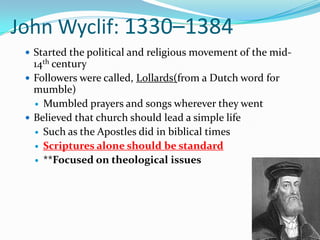
John Wyclif: 1330–1384Started the political and religious movement of the mid-14th centuryFollowers were called, Lollards(from a Dutch word for mumble)Mumbled prayers and songs wherever they wentBelieved that church should lead a simple lifeSuch as the Apostles did in biblical timesScriptures alone should be standard**Focused on theological issues
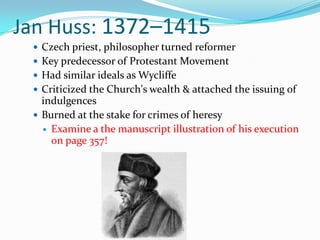
Jan Huss: 1372–1415Czech priest, philosopher turned reformerKey predecessor of Protestant MovementHad similar ideals as WycliffeCriticized the Church's wealth & attached the issuing of indulgencesBurned at the stake for crimes of heresyExamine a the manuscript illustration of his execution on page 357!
Peasant revoltsWhy?Jacquerie(zhah-kuh-ree)? Pp. 358Uprising of the French peasantry, after the costs of the Hundred Years’ War fell disproportionately on the poor (nobles killed, their families were attacked). The upper class united to put down the revolt1381-English peasant revolts?Revolt by Eng. Peasants in 1381 in response to changing economic conditions. Could this happen today with our current economic strife?View Map on pg. 360 on the 14th C. revolts

The middle ages #2

  • 1.
  • 2.
    The Bubonic Plague“TheBlack Death”Named because of the color of skin of victim and buboes Spread throughout Europe from 1347-1350Preempted by…
  • 3.
    Great Famine“Seven leanyears” (1315-1322)A lack of food due to an increase in stormsNow thought to be a major climate changeAlso known as the Little Ice Age (LIA)As a result, people were more susceptible to diseases
  • 4.
    Caused by bacteriacalled YersiniaPestisCarried in stomach of fleas which bit rats, who then transferred it to humans by biting themCan be transmittedBubonic (flea is transmitter)Pneumonic, means?from human to human
  • 5.
    The Bubonic Plague(Cont’d)Originatedin Asia circa 1331Mongol warriors carried it on horsebackTravelled to Europe on merchant ships headed to ItalyIntroduced to Europe (Messina, Italy) in 1347Spread of the plague was instigated by poor living conditions Many blamed the Jews Thought they poisoned well watersResulting in the killing of thousands of JewsFlagellants? If you’ve seen The DaVinci code, you witnessed it.Manuscript illumination…on page 348
  • 6.
    Dance of Death…fresco…pg.349Care of the Sick--Plague Doctor—pp. 345Review of the “Questions for Analysis”Quote by Emperor John VI Kantakouzenous-pp. 345Effective treatment?1947—effective treatment discovered by, Am. Microbiologist Selman Waksman…streptomycin..6 Centuries later!!!!!!
  • 7.
    "Ring Around theRosie"Ring around the rosey: Referring to ring that appear on the skin because of the plague.-Pocket full of posies: Poises are a strong smelling flower, so people filled their pockets with them to hide the smell that the plague gave off so people wouldn't know they had it.-Ashes, Ashes: Refers to people being burnt to ashes after they died because they couldn't be buried or the infection would spread.-We all fall down!: Referring to people dying.Could be an urban legend????????
  • 8.
    Giovanni Boccaccio-1313-1375Italian writerthat described the course of the Black DeathPinpointed rats as the spread of the diseasePreface of his book The DecameronCollection of small novels7 women and 3 men fleeing from the plague to a villa told stories to pass the time
  • 9.
    1st Great Schism(1054)Schism means to splitSplit of the Christian world between east and westEast is the Eastern Orthodox ChurchLed by Bishop of Constantinople (Patriarch)Spoke GreekWest it the Catholic ChurchLed by Bishop of Rome (Pope)Spoke LatinPatriarch of Constantinople: BartholomewPope Benedict XVI
  • 10.
    Great Schism (cont’d)Controversyfollowed over who was the real leader of the Christian worldPope Leo IX said that Rome was the only authorityPetrine Theory: Theory that states that Peter received keys to church and became the first Bishop of Rome (Pope)Differences between Orthodox and Catholic ChurchesPhilosophical UnderstandingLiturgical UsageLanguage Custom
  • 11.
    Pope Urban IIand The CrusadesReligious wars between Christians and MuslimsEstimated about 8 different crusades (not definite)Christians were called upon by Pope Urban II to take back holy land (Jerusalem) from Turks (Muslims) In return, they were promised heaven, to be savedUnsuccessful in winning back JerusalemCouncil of Clermont
  • 12.
    Issued cry forfirst crusade
  • 13.
    Battle Cry- “Godwills it!”Third CrusadeAlso known as “The Crusade of 3 Kings”During Pope Gregory VIII term as Pope(1189-1192)3 Kings accompanied troops to JerusalemPhilip Augustus, King of FranceAbandoned the cause and returned to France Frederick I (Barbarosa). Holy Roman EmperorFell off horse and drowned in river on the way to JerusalemRichard I the Lion-hearted, King of EnglandIn Jerusalem, meets Muslim leader SaladinCome to a truce: Christians could visit Jerusalem without paying, but it was still under Muslim controlSaladin dies in 1198, and treaty is broken.
  • 14.
    Crusades (cont’d)“Successful failures”Christiansdid not accomplish their goal, but as a result trade is increased with the middle-eastAs a result of the Crusades, Feudalism is weakeneddue to lack of serfs because of the Plague
  • 15.
    Pope Gregory IXand InquisitionPope Gregory IXWanted to investigate heresy and correct errors within Catholic faithThought it was “poisoning society spiritually”Causing people to stray from churchEliminated heresy by killing or excommunicating anyone who questioned Catholicism DoctrineOccurred in Spain, Rome, and throughout Western Europe
  • 16.
    Avignon Papacy (1309-1378)Whenthe seat of power in the Catholic Church was in Avignon, France(southeastern France)Claimed to be more important than RomePapacy was under control of French KingsOriginally moved because Pope Clement V was pressured by King Philip of FranceWanted French Monarchy to have more influence on the Catholic church7 popes held power while seated in Avignon
  • 17.
    Avignon Papacy (cont’d)AKA:Babylonian Captivity70 years Hebrews were held captive by Babylonians1378- seat of power moved back to Rome1378-1414: Second Great Schism (Papal)Confusion as to who was the real Pope;Pope in Rome? or Pope in Avignon?Cardinals didn’t like incumbent pope Urban VIThey elected to new pope- Clement VIICouncil of Constance (1414-1418)Council created to end Papal Schism**both the Babylonian Captivity & Great Schism demonstrate the vulnerability of the papacy to the increasingly powerful monarchies!!!!
  • 18.
    The Conciliar MovementReformMovement in the Catholic Church following the Second Great Schism (Papal Schism)Emerged as response to Avignon PapacyResulted in having two or three different Popes (antipopes)Gave Pope supreme powerConciliarists—Definition?Pg. 356…
  • 19.
    3 Reformers ofChurchMarsiglio of Padua (1275-1342)John Wyclif (1324-1384)Jan Huss (1369-1415)
  • 20.
    Marsiglio de Padua:1275–1342ItalianScholarThought that Papacy’s power was dangerous to individual country’s governmentChurch should be under state**focused on political & administrative issuesWas excommunicated by Papacy
  • 21.
    John Wyclif: 1330–1384Startedthe political and religious movement of the mid-14th centuryFollowers were called, Lollards(from a Dutch word for mumble)Mumbled prayers and songs wherever they wentBelieved that church should lead a simple lifeSuch as the Apostles did in biblical timesScriptures alone should be standard**Focused on theological issues
  • 22.
    Jan Huss: 1372–1415Czechpriest, philosopher turned reformerKey predecessor of Protestant MovementHad similar ideals as WycliffeCriticized the Church's wealth & attached the issuing of indulgencesBurned at the stake for crimes of heresyExamine a the manuscript illustration of his execution on page 357!
  • 23.
    Peasant revoltsWhy?Jacquerie(zhah-kuh-ree)? Pp.358Uprising of the French peasantry, after the costs of the Hundred Years’ War fell disproportionately on the poor (nobles killed, their families were attacked). The upper class united to put down the revolt1381-English peasant revolts?Revolt by Eng. Peasants in 1381 in response to changing economic conditions. Could this happen today with our current economic strife?View Map on pg. 360 on the 14th C. revolts