CFBC BOILER STARTUP AND SHUTDOWN
BY
ASHVANI SHUKLA
C&I
RELIANCE DMD
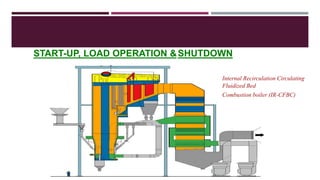
START-UP, LOAD OPERATION &SHUTDOWN
Internal Recirculation Circulating
Fluidized Bed
Combustion boiler (IR-CFBC)
INTRODUCTION
 OPERATION
 COLD STARTUP
COLD STARTUP
 COLD START-UP
 Box up the boiler after thorough inspection.
 Line up the water and steam side valves as per the startup requirement.
 Line up all the dampers in air and flue gas path as per cold start up requirement.
 Line up the fuel feeding system for normal operation.
 Verify all the inputs are available for normal operation.
 Ensure the ESP heaters and rapping system are in service.
 Switch ON the fly ash handling system.
 Verify the burner and associated systems are ready for operation.
 Ensure all the safety interlocks are in service.
 Ensure the DCS and all the electrical systems are lined up for normal operation
COLD STARTUP
 DP TEST:
 Purpose
 To verify the cleanliness of bubble caps
 To reconfirm the DP across the bubble cap as per the design limits at various air flow
conditions.
 Pre-Requisites
 Ensure that the bed is empty without any bed material.
 Verify the bubble cap for any physical damages or any blockages and replace the
damage bubble cap if any and clear the blockage by pinning.
 Verify the floor panel seal welding for any cracks /damage and rectify the defect if
any.
 Ensure that the manhole doors / Inspection doors are properly secured and
tightened on the air / gas ducting.
COLD STARTUP
 PROCEDURE:
 Start the ID fan as per start up procedure.
 Start the PA fan as per startup procedure
 Adjust the furnace draft of -5 mmH2O.
 Note down the Wind box and bubble cap cold DP Corresponding to 60% &
100% MCR air flow.
 If the DP is more than the acceptable limit, reasons to be identified and
rectified.
 Repeat the above procedures at least two times to ensure the correctness of
reading. If the result is within limit, then the system is ready for bed material
filing.
COLD STARTUP
 BED MATERIAL FILLING:
 Note:
 Bed material size and chemical property must be maintained strictly as per the specification for smooth
start up and efficient operation.
 Procedure:
 Start the ID fan & PA fan as per start-up procedure.
 Adjust the furnace pressure to –2 to –4 mmH2O.
 Ensure the isolation gate above and below the Rotary feeder are open
 Switch ON the rotary feeders at bed material bunker outlet and operate it at minimum speed and start
filling the bed material to the furnace.
 Bed material shall be filled up to 600 mm heights above the bubble cap, which is to be verified
physically.
 Record the minimum fluidization wind box pressure and PA air flow as these are the guiding parameter
during Cold startup.
COLD STARTUP
 BURNER:
 PRE- START-UP CHECKS FOR BURNER
 Opening/closing of combustion damper for all the burners are smooth with
complete travel.
 Verify cooling air to scanners and peep holes are available as per the
recommendation.
 Verify the operation of Natural Gas control valve opening and closing.
 All instruments for measurement of NG pressure, flow and temperature are in
service.
 BURNER START UP PROCEDURE
 Maintain the rated Natural Gas pressure at Main fuel trip valve (MFT) inlet.
 Before starting the burner, the pre-interlocks, main interlocks purge interlocks
& NG firing permissive are to be satisfied as per BMS logic
COLD STARTUP
 FURNACE PURGING:
 Whenever the Pre interlocks are satisfied, the system is “Ready for purging”
and is indicated by the glow of lamp “Purge ready to start”.
 Initiate the Purge start from DCS. At this stage “Purge in progress” indication
will appear. After the pre set time i.e. 5 minutes
 “Purge complete indication” will appear.
 After completion of purging wind box burner combustion air damper moves
to start up position.
 Normalize the PA & SA air flow for burner start up.
 MFT Reset:
 On completion of purging all conditions for MFT need to be satisfied for MFT
Relay to be reset.
COLD STARTUP
 NATURAL GAS FIRING
 With MFT Reset, permissive shall be available to start the burner.
 “Burner ready to start” indication will appear. Initiate burner start command to the selected burner.
 Whenever the burner start command is initiated the Following actions takes place.
 Start up burner and Igniter gun assembly is inserted.
 Ignition transformer energises & pilot gas shut off valve opens.
 Ignition transformer will get de-energised after 5 seconds, after issuing the start command.
 Pilot flame is sensed by the flame scanner and the individual NG Shut off valves will open and
corresponding vent valve will get close.
 Main flame is detected and fuel gas solenoid valve remains open in the circuit & operation of
the particular burner continues.
 If the burner is stopped manually by ‘STOP’ push button or tripped for quenching of fire. Purge
required signal will energised automatically.
COLD STARTUP
 CAUTION:
 If the burner fails to light up, find out the cause of failure
 Do not attempt repeatedly to light up the burner unless the fault is
established.
 Repeated failures in lighting off the burner may cause accumulation
of un-burnt fuel and make a threat of explosion.
COLD STARTUP
 BOILER PRESSURING:
 Increase the burner NG pressure by increasing NG flow to increase the boiler
pressure.
 Maintain the furnace pressure around -3 to –5 mmH2O.
 Maintain normal water level in Drum.
 Whenever the steam drum pressure reaches about 2kg/cm2, close the steam
drum vent valve.
 Whenever the pressure reaches to 3 kg/cm2 close the super-heater header
drains wing wall drain valves and SH enclosure panel drain valves.
 Intermittently fluidize the bed at regular intervals, so as to avoid over heating
of bed material.
COLD STARTUP
 CAUTION:
 Firing rate to be adjusted in such a way to maintain the Flue gas
temperature at “U” beam inlet at 500ºc till 20% of MCR steam flow is
established.
 Monitor and maintain the steam drum metal differential
temperature at 25°C by modulating the firing rate.
COLD STARTUP
 COAL FIRING:
 Whenever the Bed temperature reaches around 6000 C initiate the coal firing.
 Prior to start the fuel feeders ensure seal air to the Coal feeder & Coal feed pipes are open and maintain
the required pressure.
 Start two Drag Chain feeders & Gravimetric feeders (One from RHS and one from LHS).
 When Bed temperature will start increasing steadily after coal firing and O2 level in Flue gas start
reducing then continue the coal feeding.
 Monitor the bed temperature raise closely, whenever the bed temperature reaches 750 Deg C, Start the
third DCF & gravimetric feeder at minimum coal flow.
 After reaching the bed temperature around 800 Deg C, Switch off the over bed burners one by one
gradually
 Raise the Boiler pressure up to rated pressure in accordance with the enclosed
 Boiler Cold start up pressure raising curve.
COLD STARTUP
 CAUTION: - After switch off the burner, to cool the burner components
exposed to high temperature and to avoid back shifting of bed material into
burner wind box and air ducting sufficient air pressure has to be maintained at
the burner wind box.
 CAUTION:
 O2 level should not be allowed to drop below 6%.
 Furnace draft should be in -3 to -5 mmH2O.
 Maintain the drum level.
 Boiler pressure to be raised in accordance with boiler cold start up curve.
 Firing rate to be adjusted in such a way to maintain the Flue gas temperature
at “U” beam inlet at 500ºc till 20% of MCR steam flow is established.
 Monitor and maintain the steam drum metal differential temperature at 25°C
by modulating the firing rate.
COLD STARTUP
 STEAM LINE CHARGING FOR FIRST BOILER:
 Whenever the drum pressure reaches near the operating pressure make
preparation for charging the main steam piping and other distribution lines.
 Maintain the drum pressure 10 -15 Kg/cm2 below the operating pressure till
the steam line is charged.
 Open the by-pass valve of the main steam stop valve to warm up the Main
steam line.
 Open Main Steam Line isolation manual valve and then gradually open the
MSSV and close the MSSV by-pass valve after the MSSV is fully open.
 Keep the start-up vent valve open till the steady flow of steam (> 30%) is
ensured from the end users.
 Load operation
 CAUTION:
 During cold start-up, APH primary & secondary air preheater to be bypassed.
 While loading the boiler, feed & boiler water parameters should be in recommended limit
before increasing the steam flow beyond 50% of MCR.
 While increasing the firing rate always increase the air flow first and then increase the fuel.
 While loading the boiler, following conditions are to be ensured to achieve the desired
output.
 Ensure the fuel being fired is as per the design specification.
 Adequate quantity of specified Bed material /Inert should be available, sieve size distribution
and bulk density must be as per design specification.
 Adequate quantity of specified feed water & fuel should be available.
 OPERATION:
 Maintain Bed and furnace temperature as per the operating load.
 Bed Ash bulk density should be maintained as per design specification.
 Bed dP, lower and upper furnace shaft dP must be maintained as per load
demand.
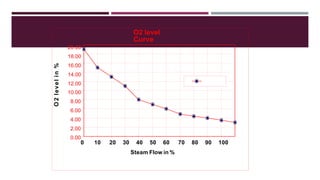
 O2 level in Flue Gas must be maintain as per steam load.
 Mode of Operation
 During low load operation i.e. < 60% MCR, the boiler operation may be semi
CFBC mode. Along with the increase in load i.e. > 60% MCR, the combustion
mode shifts to CFBC mode.
 Load ramp up - Raise the load gradually but not more than 3% of MCR/
minute. During load ramp up sufficient quantity of inventory is made available
to control the bed temperature fluctuations beyond safe limit.
OPERATION CONTROLS
 BED TEMPERATURE CONTROL:
 Bed temperature is a function of
 Operating load
 Furnace inventory/shaft DP / Upper DP
 Furnace primary zone dP/ Middle DP
 Bed ash chemical composition
 Excess air
 Moisture in fuel
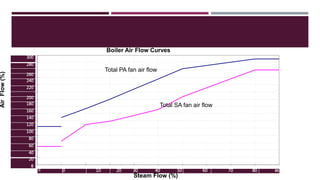
Total SA fan air flow
Total PA fan air flow
300
280
260
240
220
200
180
160
140
120
100
80
60
40
20
0
0 0 10 20 30 40 50 60 70 80 90
Boiler Air Flow Curves
Steam Flow (%)
AirFlow(%)
O2 level
Curve
O2levelin%
Steam Flow in %
0 10 20 30 40 50 60 70 80 90 100
20.00
18.00
16.00
14.00
12.00
10.00
8.00
6.00
4.00
2.00
0.00
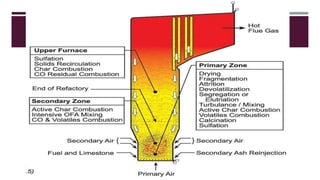
SOLID INVENTORY CONTROL:
 The solids inventory control comprises two interrelated components:
 Solids Mass Control (Total inventory Control)
 The solids mass control is accomplished on-line using sorbent
 (or inert material) feed rate, bed drain purge, multi clone purge and MDC recycle
rate.
 Solids Particle size control
 Solid size control is accomplished on-line by using bed drain purge and MDC
recycle and offline by modifying the sieve size for fuel feed, sorbent (limestone),
fresh inert bed material (sand/crushed refractory) and recycle bed ash feed to the
boiler. Bed particle size distribution can also be changed by rate of MDC ash
recycle and bed drain.

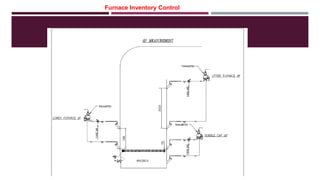
Furnace Inventory Control
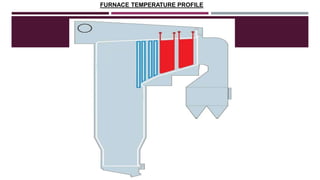
FURNACE TEMPERATURE PROFILE
PART LOAD OPERATION
At times for some reason boiler may have to operate at part load, during
Such condition following procedures to be followed:
• Adjust the fuel feed rate as required.
• Adjust the furnace DP / inventory to suit the operating load.
• Adjust the primary & secondary air flow to suit the steam flow and bed temperature.
CAUTION:
• Since the boiler loading is purely depends upon inventory/ DP across the furnace, it
is mandatory to have sufficient bed material as per specification to meet the sudden
load demand.
• Check & maintain bed bulk density of bed ash as specified.
• Maintain the fuel sieve distribution as specified.
HOT START UP
 Below mentioned sequence to be followed to bring back the boiler into service during hot
startup.
 Normalize the drum level.
 Drain the bed through the bypass gate up to no unburnt coal is observed in the bed.
 Start the ID Fan, PA Fan and SA fan as per start-up sequence described in boiler cold start up
procedure
 Bring back all the Fan and fuel feeder drives to the minimum speed/flow setting.
 In case, bed temperature drops below 600/750 deg C, gas Burner support can be taken.
 Open the start-up vent valve/PRDS dump valve.
 Raise the boiler pressure to the rated pressure as per ‘Hot pressurization curve’.
 Whenever the boiler rated pressure is attained, connect the boiler to CSDH as per procedure
describe in Manual.
WARM STARTUP
 WARM START UP:
 Average Bed Temperature ≤ 600°C (Indonesian/ Indian coal)
 Average Bed Temperature ≤ 750°C (Petcock)
 OR
 Average Bed Temperature ≥ 200°C
 After boiler tripping, if average bed temperature is <600/750 Deg C and
 ≥200 Deg C, boiler cannot be started directly with solid fuel feeding.
 Note:
 Wind box needs to be purged with steam as per the Win box steam purging procedure”. Apart from
steam purging, Furnace purging also need to be carried out as per “Furnace Purging Procedure”.
 Following sequence may be followed to bring back the boiler into service.
 After completion of wind box steam purging, normalize the Dampers in air and gas circuit.
 Start the ID Fan, PA Fan and SA fan as per start-up procedure.
 Prior to starting burner, maintain the bed height.
 Carry out furnace air purge as per Furnace purging procedure.
 Normalize the drum level.
 Open the startup vent valve / PRDS dump valve.
 Start the over bed burner as per burner start up procedure.
 Adjust the gas flow and airflow to raise the bed temperature.
 Once the required bed temperature is attained, initiate the solid fuel firing as per the procedure.
 Raise the boiler pressure as per warm start up curve.
 Whenever the boiler rated pressure is attained, connect the boiler to CSDH as per procedure describe in
manual.
WARM STARTUP
 Boiler shut down can be of two types:
 Planned / Normal shut down where the operator gets advance notice and adequate time to shut down
the boiler in an orderly manner.
 Boiler Trip on interlock protection (MFT Condition) or emergency shutdown by the Operator.
 Normal Shutdown:
 Reduce boiler load gradually.
 Adjust the coal and air flow as per the steam flow.
 When the load is reduced below 30 % of MCR, stop the fuel feeders
 Close the MSSV however, open the startup vent to 30-50 %
 Stop the fans whenever the bed temperature reduced below 200 deg C Fan stopping sequence is SA, PA
and ID.
 When the U Beam temperature is reduced below 500 deg. C Close the startup vent valve.
 Maintain normal water level in steam drum.
BOILER SHUTDOWN
BOILER SHUTDOWN
 • Stop the limestone/ make up bed material & MDC ash recycle rotary feeder.
 • Maintain the PA fan air at all locations to prevent solids sifting back.
 • Switch off the ESP transformer whenever the backend temperature drops below 125°C but keep the
heaters and the rapping system in service.
 • De-energize the overbed burners if in service.
 • Stop the steam supply to the deaerator.
 • Close the CBD valve.
 • Close the sample lines.
 • Maintain normal water level.
 • Verify the IBD valve is closed.
 • Follow the de pressuring curve for cooling.
 • Whenever the steam drum pressure drops to 2-kg/cm2 (g), open the start-up vent
BOILER SHUTDOWN
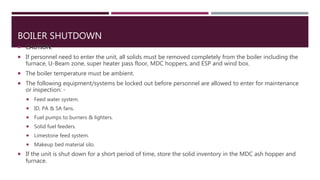
 CAUTION:
 If personnel need to enter the unit, all solids must be removed completely from the boiler including the
furnace, U-Beam zone, super heater pass floor, MDC hoppers, and ESP and wind box.
 The boiler temperature must be ambient.
 The following equipment/systems be locked out before personnel are allowed to enter for maintenance
or inspection: -
 Feed water system.
 ID, PA & SA fans.
 Fuel pumps to burners & lighters.
 Solid fuel feeders.
 Limestone feed system.
 Makeup bed material silo.
 If the unit is shut down for a short period of time, store the solid inventory in the MDC ash hopper and
furnace.
EMERGENCY SHUTDOWN
 Emergency shutdown is initiated as a result of equipment failure OR due to MFT conditions.
 Types of Major Emergency Situations:
 Loss of Feed water supply - Boiler feed pump system is not available.
 Loss of fan – PA/ SA fans and/or induced draft (ID) fan are not available.
 Loss of both water supply and draft - Black plant with the boiler trip and isolated from the power grid,
with only emergency power available. This is the most important emergency situation.
 Loss of solid fuel feed to furnace- If draft and feed water supply equipment remain in service, this
situation may be resolved quickly enough to prevent emergency shutdown.
EMERGENCY SHUTDOWN
 Emergency Response Actions and Priorities:
 Following actions need to be taken for emergency situations:
 Close main steam stop valve.
 Close the CBD valve.
 Close the sample lines.
 Verify the IBD valve is closed.
 During black plant condition establish steam flow through the startup vent and bleed steam vents
quickly to prevent safety valve lifting and loss of water.
 Boiler tripping due to loss of feed water supply, immediate response should be to restore feed water
supply to maintain the safe water level; if not in the normal operation range, at least up to the minimum
visibility of drum direct level gauge glass.
 Target is to restore a water feed to the drum within 5 to 7 minutes of the trip.
EMERGENCY SHUTDOWN
 EMERGENCY SHUTDOWN
 Establish steam flow through the super heaters including steam
cooled wing walls through start up vent / Bleed off vent to protect
super heater & wing walls from overheating. However in case of
water source to drum is not available the bleed steam vent valve
need to be operated ON/OFF considering the water level in drum.
 NOTE: -
 Bleed steam flow can be stopped once the FEGT / U Beam
temperature drops to 500°c.
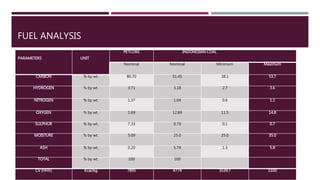
FUEL ANALYSIS
PARAMETERS UNIT
PETCOKE INDONESIAN COAL
Nominal Nominal Minimum Maximum
CARBON % by wt. 80.70 51.45 38.1 53.7
HYDROGEN % by wt. 3.71 3.18 2.7 3.6
NITROGEN % by wt. 1.37 1.04 0.6 1.1
OXYGEN % by wt. 1.69 12.89 11.5 14.8
SULPHUR % by wt. 7.33 0.70 0.1 0.7
MOISTURE % by wt. 5.00 25.0 25.0 35.0
ASH % by wt. 0.20 5.74 1.3 5.8
TOTAL % by wt. 100 100
CV (HHV) Kcal/kg 7895 4774 3539.7 5100
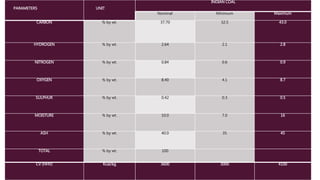
PARAMETERS UNIT
INDIAN COAL
Nominal Minimum Maximum
CARBON % by wt. 37.70 32.5 43.0
HYDROGEN % by wt. 2.64 2.1 2.8
NITROGEN % by wt. 0.84 0.6 0.9
OXYGEN % by wt. 8.40 4.1 8.7
SULPHUR % by wt. 0.42 0.3 0.5
MOISTURE % by wt. 10.0 7.0 16
ASH % by wt. 40.0 35 45
TOTAL % by wt. 100
CV (HHV) Kcal/kg 3600 3000 4100
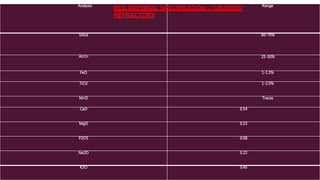
Analysis Range
Silica 60-70%
Al2O3 25-30%
FeO 1-1.5%
TiO2 1-2.0%
MnO Traces
CaO 0.54
MgO 0.23
P2O5 0.08
Na2O 0.22
K2O 0.45
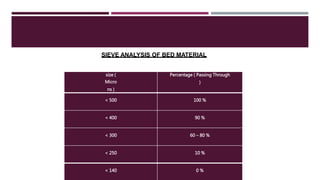
BED MATERIAL SPECIFICATION – CRUSHED
REFRACTORY
size (
Micro
ns )
Percentage ( Passing Through
)
< 500 100 %
< 400 90 %
< 300 60 – 80 %
< 250 10 %
< 140 0 %
SIEVE ANALYSIS OF BED MATERIAL
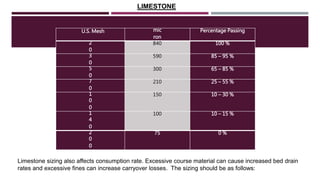
U.S. Mesh mic
ron
Percentage Passing
2
0
840 100 %
3
0
590 85 – 95 %
5
0
300 65 – 85 %
7
0
210 25 – 55 %
1
0
0
150 10 – 30 %
1
4
0
100 10 – 15 %
2
0
0
75 0 %
LIMESTONE
Limestone sizing also affects consumption rate. Excessive course material can cause increased bed drain
rates and excessive fines can increase carryover losses. The sizing should be as follows:
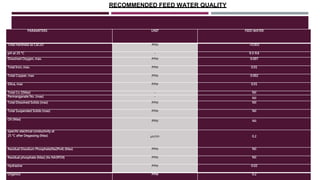
PARAMETERS UNIT FEED WATER
Total Hardness as CaCo3 PPM <0.003
pH at 25 °C - 9.3-9.6
Dissolved Oxygen, max. PPM 0.007
Total Iron, max. PPM 0.01
Total Copper, max PPM 0.002
Silica, max PPM 0.01
Total Co 2(Max) - Nil
Permanganate No. (max) - Nil
Total Dissolved Solids (max) PPM Nil
Total Suspended Solids (max) PPM Nil
Oil (Max) PPM Nil
Specific electrical conductivity at
25 °C after Degassing (Max) µs/cm 0.2
Residual Disodium Phosphate(Na2Po4) (Max) PPM Nil
Residual phosphate (Max) (As NA3PO4) PPM Nil
Hydrazine PPM 0.02
Organics PPM 0.2
RECOMMENDED FEED WATER QUALITY
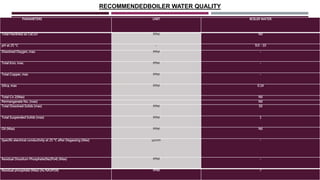
PARAMETERS UNIT BOILER WATER
Total Hardness as CaCo3 PPM Nil
pH at 25 °C - 9.0 - 10
Dissolved Oxygen, max. PPM -
Total Iron, max. PPM -
Total Copper, max PPM -
Silica, max PPM 0.14
Total Co 2(Max) Nil
Permanganate No. (max) Nil
Total Dissolved Solids (max) PPM 50
Total Suspended Solids (max) PPM 1
Oil (Max) PPM Nil
Specific electrical conductivity at 25 °C after Degassing (Max) µs/cm -
Residual Disodium Phosphate(Na2Po4) (Max) PPM -
Residual phosphate (Max) (As NA3PO4) PPM 7
RECOMMENDEDBOILER WATER QUALITY

Cfbc boiler startup and shutdown

  • 1.
    CFBC BOILER STARTUPAND SHUTDOWN BY ASHVANI SHUKLA C&I RELIANCE DMD
  • 2.
    START-UP, LOAD OPERATION&SHUTDOWN Internal Recirculation Circulating Fluidized Bed Combustion boiler (IR-CFBC)
  • 3.
  • 4.
    COLD STARTUP  COLDSTART-UP  Box up the boiler after thorough inspection.  Line up the water and steam side valves as per the startup requirement.  Line up all the dampers in air and flue gas path as per cold start up requirement.  Line up the fuel feeding system for normal operation.  Verify all the inputs are available for normal operation.  Ensure the ESP heaters and rapping system are in service.  Switch ON the fly ash handling system.  Verify the burner and associated systems are ready for operation.  Ensure all the safety interlocks are in service.  Ensure the DCS and all the electrical systems are lined up for normal operation
  • 5.
    COLD STARTUP  DPTEST:  Purpose  To verify the cleanliness of bubble caps  To reconfirm the DP across the bubble cap as per the design limits at various air flow conditions.  Pre-Requisites  Ensure that the bed is empty without any bed material.  Verify the bubble cap for any physical damages or any blockages and replace the damage bubble cap if any and clear the blockage by pinning.  Verify the floor panel seal welding for any cracks /damage and rectify the defect if any.  Ensure that the manhole doors / Inspection doors are properly secured and tightened on the air / gas ducting.
  • 6.
    COLD STARTUP  PROCEDURE: Start the ID fan as per start up procedure.  Start the PA fan as per startup procedure  Adjust the furnace draft of -5 mmH2O.  Note down the Wind box and bubble cap cold DP Corresponding to 60% & 100% MCR air flow.  If the DP is more than the acceptable limit, reasons to be identified and rectified.  Repeat the above procedures at least two times to ensure the correctness of reading. If the result is within limit, then the system is ready for bed material filing.
  • 7.
    COLD STARTUP  BEDMATERIAL FILLING:  Note:  Bed material size and chemical property must be maintained strictly as per the specification for smooth start up and efficient operation.  Procedure:  Start the ID fan & PA fan as per start-up procedure.  Adjust the furnace pressure to –2 to –4 mmH2O.  Ensure the isolation gate above and below the Rotary feeder are open  Switch ON the rotary feeders at bed material bunker outlet and operate it at minimum speed and start filling the bed material to the furnace.  Bed material shall be filled up to 600 mm heights above the bubble cap, which is to be verified physically.  Record the minimum fluidization wind box pressure and PA air flow as these are the guiding parameter during Cold startup.
  • 8.
    COLD STARTUP  BURNER: PRE- START-UP CHECKS FOR BURNER  Opening/closing of combustion damper for all the burners are smooth with complete travel.  Verify cooling air to scanners and peep holes are available as per the recommendation.  Verify the operation of Natural Gas control valve opening and closing.  All instruments for measurement of NG pressure, flow and temperature are in service.  BURNER START UP PROCEDURE  Maintain the rated Natural Gas pressure at Main fuel trip valve (MFT) inlet.  Before starting the burner, the pre-interlocks, main interlocks purge interlocks & NG firing permissive are to be satisfied as per BMS logic
  • 9.
    COLD STARTUP  FURNACEPURGING:  Whenever the Pre interlocks are satisfied, the system is “Ready for purging” and is indicated by the glow of lamp “Purge ready to start”.  Initiate the Purge start from DCS. At this stage “Purge in progress” indication will appear. After the pre set time i.e. 5 minutes  “Purge complete indication” will appear.  After completion of purging wind box burner combustion air damper moves to start up position.  Normalize the PA & SA air flow for burner start up.  MFT Reset:  On completion of purging all conditions for MFT need to be satisfied for MFT Relay to be reset.
  • 10.
    COLD STARTUP  NATURALGAS FIRING  With MFT Reset, permissive shall be available to start the burner.  “Burner ready to start” indication will appear. Initiate burner start command to the selected burner.  Whenever the burner start command is initiated the Following actions takes place.  Start up burner and Igniter gun assembly is inserted.  Ignition transformer energises & pilot gas shut off valve opens.  Ignition transformer will get de-energised after 5 seconds, after issuing the start command.  Pilot flame is sensed by the flame scanner and the individual NG Shut off valves will open and corresponding vent valve will get close.  Main flame is detected and fuel gas solenoid valve remains open in the circuit & operation of the particular burner continues.  If the burner is stopped manually by ‘STOP’ push button or tripped for quenching of fire. Purge required signal will energised automatically.
  • 11.
    COLD STARTUP  CAUTION: If the burner fails to light up, find out the cause of failure  Do not attempt repeatedly to light up the burner unless the fault is established.  Repeated failures in lighting off the burner may cause accumulation of un-burnt fuel and make a threat of explosion.
  • 12.
    COLD STARTUP  BOILERPRESSURING:  Increase the burner NG pressure by increasing NG flow to increase the boiler pressure.  Maintain the furnace pressure around -3 to –5 mmH2O.  Maintain normal water level in Drum.  Whenever the steam drum pressure reaches about 2kg/cm2, close the steam drum vent valve.  Whenever the pressure reaches to 3 kg/cm2 close the super-heater header drains wing wall drain valves and SH enclosure panel drain valves.  Intermittently fluidize the bed at regular intervals, so as to avoid over heating of bed material.
  • 13.
    COLD STARTUP  CAUTION: Firing rate to be adjusted in such a way to maintain the Flue gas temperature at “U” beam inlet at 500ºc till 20% of MCR steam flow is established.  Monitor and maintain the steam drum metal differential temperature at 25°C by modulating the firing rate.
  • 14.
    COLD STARTUP  COALFIRING:  Whenever the Bed temperature reaches around 6000 C initiate the coal firing.  Prior to start the fuel feeders ensure seal air to the Coal feeder & Coal feed pipes are open and maintain the required pressure.  Start two Drag Chain feeders & Gravimetric feeders (One from RHS and one from LHS).  When Bed temperature will start increasing steadily after coal firing and O2 level in Flue gas start reducing then continue the coal feeding.  Monitor the bed temperature raise closely, whenever the bed temperature reaches 750 Deg C, Start the third DCF & gravimetric feeder at minimum coal flow.  After reaching the bed temperature around 800 Deg C, Switch off the over bed burners one by one gradually  Raise the Boiler pressure up to rated pressure in accordance with the enclosed  Boiler Cold start up pressure raising curve.
  • 15.
    COLD STARTUP  CAUTION:- After switch off the burner, to cool the burner components exposed to high temperature and to avoid back shifting of bed material into burner wind box and air ducting sufficient air pressure has to be maintained at the burner wind box.  CAUTION:  O2 level should not be allowed to drop below 6%.  Furnace draft should be in -3 to -5 mmH2O.  Maintain the drum level.  Boiler pressure to be raised in accordance with boiler cold start up curve.  Firing rate to be adjusted in such a way to maintain the Flue gas temperature at “U” beam inlet at 500ºc till 20% of MCR steam flow is established.  Monitor and maintain the steam drum metal differential temperature at 25°C by modulating the firing rate.
  • 16.
    COLD STARTUP  STEAMLINE CHARGING FOR FIRST BOILER:  Whenever the drum pressure reaches near the operating pressure make preparation for charging the main steam piping and other distribution lines.  Maintain the drum pressure 10 -15 Kg/cm2 below the operating pressure till the steam line is charged.  Open the by-pass valve of the main steam stop valve to warm up the Main steam line.  Open Main Steam Line isolation manual valve and then gradually open the MSSV and close the MSSV by-pass valve after the MSSV is fully open.  Keep the start-up vent valve open till the steady flow of steam (> 30%) is ensured from the end users.
  • 17.
     Load operation CAUTION:  During cold start-up, APH primary & secondary air preheater to be bypassed.  While loading the boiler, feed & boiler water parameters should be in recommended limit before increasing the steam flow beyond 50% of MCR.  While increasing the firing rate always increase the air flow first and then increase the fuel.  While loading the boiler, following conditions are to be ensured to achieve the desired output.  Ensure the fuel being fired is as per the design specification.  Adequate quantity of specified Bed material /Inert should be available, sieve size distribution and bulk density must be as per design specification.  Adequate quantity of specified feed water & fuel should be available.
  • 18.
     OPERATION:  MaintainBed and furnace temperature as per the operating load.  Bed Ash bulk density should be maintained as per design specification.  Bed dP, lower and upper furnace shaft dP must be maintained as per load demand.  O2 level in Flue Gas must be maintain as per steam load.  Mode of Operation  During low load operation i.e. < 60% MCR, the boiler operation may be semi CFBC mode. Along with the increase in load i.e. > 60% MCR, the combustion mode shifts to CFBC mode.  Load ramp up - Raise the load gradually but not more than 3% of MCR/ minute. During load ramp up sufficient quantity of inventory is made available to control the bed temperature fluctuations beyond safe limit.
  • 19.
    OPERATION CONTROLS  BEDTEMPERATURE CONTROL:  Bed temperature is a function of  Operating load  Furnace inventory/shaft DP / Upper DP  Furnace primary zone dP/ Middle DP  Bed ash chemical composition  Excess air  Moisture in fuel
  • 20.
    Total SA fanair flow Total PA fan air flow 300 280 260 240 220 200 180 160 140 120 100 80 60 40 20 0 0 0 10 20 30 40 50 60 70 80 90 Boiler Air Flow Curves Steam Flow (%) AirFlow(%)
  • 21.
    O2 level Curve O2levelin% Steam Flowin % 0 10 20 30 40 50 60 70 80 90 100 20.00 18.00 16.00 14.00 12.00 10.00 8.00 6.00 4.00 2.00 0.00
  • 22.
    SOLID INVENTORY CONTROL: The solids inventory control comprises two interrelated components:  Solids Mass Control (Total inventory Control)  The solids mass control is accomplished on-line using sorbent  (or inert material) feed rate, bed drain purge, multi clone purge and MDC recycle rate.  Solids Particle size control  Solid size control is accomplished on-line by using bed drain purge and MDC recycle and offline by modifying the sieve size for fuel feed, sorbent (limestone), fresh inert bed material (sand/crushed refractory) and recycle bed ash feed to the boiler. Bed particle size distribution can also be changed by rate of MDC ash recycle and bed drain. 
  • 23.
  • 25.
  • 26.
    PART LOAD OPERATION Attimes for some reason boiler may have to operate at part load, during Such condition following procedures to be followed: • Adjust the fuel feed rate as required. • Adjust the furnace DP / inventory to suit the operating load. • Adjust the primary & secondary air flow to suit the steam flow and bed temperature. CAUTION: • Since the boiler loading is purely depends upon inventory/ DP across the furnace, it is mandatory to have sufficient bed material as per specification to meet the sudden load demand. • Check & maintain bed bulk density of bed ash as specified. • Maintain the fuel sieve distribution as specified.
  • 27.
    HOT START UP Below mentioned sequence to be followed to bring back the boiler into service during hot startup.  Normalize the drum level.  Drain the bed through the bypass gate up to no unburnt coal is observed in the bed.  Start the ID Fan, PA Fan and SA fan as per start-up sequence described in boiler cold start up procedure  Bring back all the Fan and fuel feeder drives to the minimum speed/flow setting.  In case, bed temperature drops below 600/750 deg C, gas Burner support can be taken.  Open the start-up vent valve/PRDS dump valve.  Raise the boiler pressure to the rated pressure as per ‘Hot pressurization curve’.  Whenever the boiler rated pressure is attained, connect the boiler to CSDH as per procedure describe in Manual.
  • 28.
    WARM STARTUP  WARMSTART UP:  Average Bed Temperature ≤ 600°C (Indonesian/ Indian coal)  Average Bed Temperature ≤ 750°C (Petcock)  OR  Average Bed Temperature ≥ 200°C  After boiler tripping, if average bed temperature is <600/750 Deg C and  ≥200 Deg C, boiler cannot be started directly with solid fuel feeding.  Note:  Wind box needs to be purged with steam as per the Win box steam purging procedure”. Apart from steam purging, Furnace purging also need to be carried out as per “Furnace Purging Procedure”.
  • 29.
     Following sequencemay be followed to bring back the boiler into service.  After completion of wind box steam purging, normalize the Dampers in air and gas circuit.  Start the ID Fan, PA Fan and SA fan as per start-up procedure.  Prior to starting burner, maintain the bed height.  Carry out furnace air purge as per Furnace purging procedure.  Normalize the drum level.  Open the startup vent valve / PRDS dump valve.  Start the over bed burner as per burner start up procedure.  Adjust the gas flow and airflow to raise the bed temperature.  Once the required bed temperature is attained, initiate the solid fuel firing as per the procedure.  Raise the boiler pressure as per warm start up curve.  Whenever the boiler rated pressure is attained, connect the boiler to CSDH as per procedure describe in manual. WARM STARTUP
  • 30.
     Boiler shutdown can be of two types:  Planned / Normal shut down where the operator gets advance notice and adequate time to shut down the boiler in an orderly manner.  Boiler Trip on interlock protection (MFT Condition) or emergency shutdown by the Operator.  Normal Shutdown:  Reduce boiler load gradually.  Adjust the coal and air flow as per the steam flow.  When the load is reduced below 30 % of MCR, stop the fuel feeders  Close the MSSV however, open the startup vent to 30-50 %  Stop the fans whenever the bed temperature reduced below 200 deg C Fan stopping sequence is SA, PA and ID.  When the U Beam temperature is reduced below 500 deg. C Close the startup vent valve.  Maintain normal water level in steam drum. BOILER SHUTDOWN
  • 31.
    BOILER SHUTDOWN  •Stop the limestone/ make up bed material & MDC ash recycle rotary feeder.  • Maintain the PA fan air at all locations to prevent solids sifting back.  • Switch off the ESP transformer whenever the backend temperature drops below 125°C but keep the heaters and the rapping system in service.  • De-energize the overbed burners if in service.  • Stop the steam supply to the deaerator.  • Close the CBD valve.  • Close the sample lines.  • Maintain normal water level.  • Verify the IBD valve is closed.  • Follow the de pressuring curve for cooling.  • Whenever the steam drum pressure drops to 2-kg/cm2 (g), open the start-up vent
  • 32.
    BOILER SHUTDOWN  CAUTION: If personnel need to enter the unit, all solids must be removed completely from the boiler including the furnace, U-Beam zone, super heater pass floor, MDC hoppers, and ESP and wind box.  The boiler temperature must be ambient.  The following equipment/systems be locked out before personnel are allowed to enter for maintenance or inspection: -  Feed water system.  ID, PA & SA fans.  Fuel pumps to burners & lighters.  Solid fuel feeders.  Limestone feed system.  Makeup bed material silo.  If the unit is shut down for a short period of time, store the solid inventory in the MDC ash hopper and furnace.
  • 33.
    EMERGENCY SHUTDOWN  Emergencyshutdown is initiated as a result of equipment failure OR due to MFT conditions.  Types of Major Emergency Situations:  Loss of Feed water supply - Boiler feed pump system is not available.  Loss of fan – PA/ SA fans and/or induced draft (ID) fan are not available.  Loss of both water supply and draft - Black plant with the boiler trip and isolated from the power grid, with only emergency power available. This is the most important emergency situation.  Loss of solid fuel feed to furnace- If draft and feed water supply equipment remain in service, this situation may be resolved quickly enough to prevent emergency shutdown.
  • 34.
    EMERGENCY SHUTDOWN  EmergencyResponse Actions and Priorities:  Following actions need to be taken for emergency situations:  Close main steam stop valve.  Close the CBD valve.  Close the sample lines.  Verify the IBD valve is closed.  During black plant condition establish steam flow through the startup vent and bleed steam vents quickly to prevent safety valve lifting and loss of water.  Boiler tripping due to loss of feed water supply, immediate response should be to restore feed water supply to maintain the safe water level; if not in the normal operation range, at least up to the minimum visibility of drum direct level gauge glass.  Target is to restore a water feed to the drum within 5 to 7 minutes of the trip.
  • 35.
    EMERGENCY SHUTDOWN  EMERGENCYSHUTDOWN  Establish steam flow through the super heaters including steam cooled wing walls through start up vent / Bleed off vent to protect super heater & wing walls from overheating. However in case of water source to drum is not available the bleed steam vent valve need to be operated ON/OFF considering the water level in drum.  NOTE: -  Bleed steam flow can be stopped once the FEGT / U Beam temperature drops to 500°c.
  • 36.
    FUEL ANALYSIS PARAMETERS UNIT PETCOKEINDONESIAN COAL Nominal Nominal Minimum Maximum CARBON % by wt. 80.70 51.45 38.1 53.7 HYDROGEN % by wt. 3.71 3.18 2.7 3.6 NITROGEN % by wt. 1.37 1.04 0.6 1.1 OXYGEN % by wt. 1.69 12.89 11.5 14.8 SULPHUR % by wt. 7.33 0.70 0.1 0.7 MOISTURE % by wt. 5.00 25.0 25.0 35.0 ASH % by wt. 0.20 5.74 1.3 5.8 TOTAL % by wt. 100 100 CV (HHV) Kcal/kg 7895 4774 3539.7 5100
  • 37.
    PARAMETERS UNIT INDIAN COAL NominalMinimum Maximum CARBON % by wt. 37.70 32.5 43.0 HYDROGEN % by wt. 2.64 2.1 2.8 NITROGEN % by wt. 0.84 0.6 0.9 OXYGEN % by wt. 8.40 4.1 8.7 SULPHUR % by wt. 0.42 0.3 0.5 MOISTURE % by wt. 10.0 7.0 16 ASH % by wt. 40.0 35 45 TOTAL % by wt. 100 CV (HHV) Kcal/kg 3600 3000 4100
  • 38.
    Analysis Range Silica 60-70% Al2O325-30% FeO 1-1.5% TiO2 1-2.0% MnO Traces CaO 0.54 MgO 0.23 P2O5 0.08 Na2O 0.22 K2O 0.45 BED MATERIAL SPECIFICATION – CRUSHED REFRACTORY
  • 39.
    size ( Micro ns ) Percentage( Passing Through ) < 500 100 % < 400 90 % < 300 60 – 80 % < 250 10 % < 140 0 % SIEVE ANALYSIS OF BED MATERIAL
  • 40.
    U.S. Mesh mic ron PercentagePassing 2 0 840 100 % 3 0 590 85 – 95 % 5 0 300 65 – 85 % 7 0 210 25 – 55 % 1 0 0 150 10 – 30 % 1 4 0 100 10 – 15 % 2 0 0 75 0 % LIMESTONE Limestone sizing also affects consumption rate. Excessive course material can cause increased bed drain rates and excessive fines can increase carryover losses. The sizing should be as follows:
  • 41.
    PARAMETERS UNIT FEEDWATER Total Hardness as CaCo3 PPM <0.003 pH at 25 °C - 9.3-9.6 Dissolved Oxygen, max. PPM 0.007 Total Iron, max. PPM 0.01 Total Copper, max PPM 0.002 Silica, max PPM 0.01 Total Co 2(Max) - Nil Permanganate No. (max) - Nil Total Dissolved Solids (max) PPM Nil Total Suspended Solids (max) PPM Nil Oil (Max) PPM Nil Specific electrical conductivity at 25 °C after Degassing (Max) µs/cm 0.2 Residual Disodium Phosphate(Na2Po4) (Max) PPM Nil Residual phosphate (Max) (As NA3PO4) PPM Nil Hydrazine PPM 0.02 Organics PPM 0.2 RECOMMENDED FEED WATER QUALITY
  • 42.
    PARAMETERS UNIT BOILERWATER Total Hardness as CaCo3 PPM Nil pH at 25 °C - 9.0 - 10 Dissolved Oxygen, max. PPM - Total Iron, max. PPM - Total Copper, max PPM - Silica, max PPM 0.14 Total Co 2(Max) Nil Permanganate No. (max) Nil Total Dissolved Solids (max) PPM 50 Total Suspended Solids (max) PPM 1 Oil (Max) PPM Nil Specific electrical conductivity at 25 °C after Degassing (Max) µs/cm - Residual Disodium Phosphate(Na2Po4) (Max) PPM - Residual phosphate (Max) (As NA3PO4) PPM 7 RECOMMENDEDBOILER WATER QUALITY