COMBUSTION IN A CFBC
BOILER
TAPASH NAG
TN - 28 Nov 2013 V0

1
CFBC CHARACTERISTICS
Operates under special fluid dynamic condition
Solid particles are mixed through furnace at a velocity
exceeding the average terminal velocity of the particles
Major fractions of solids are captured by cyclone
High recycle rate intensifies solid mixing and evens out
combustion temperature
High turbulence, solid mixing and absence of a defined
bed level
Solids are distributed through out the furnace with
steadily decreasing density from bottom to top of
furnace
TN - 28 Nov 2013 V0

2
COMBUSTION FACTORS
COAL
QUALITY

SA

PA
FURNACE
VOLUME

COMBUSTION

BED
TEMP

ASH REC
BED
HEIGHT

COAL
SIZE
TN - 28 Nov 2013 V0

3
PRIMARY AIR

Conveys coal
 Uniform distribution of coal in
furnace
 Provides air for combustion
Fluidizes the bed ash
Ensures proper mixing
Provides sealing air to feeders
TN - 28 Nov 2013 V0

4
SECONDARY AIR

Staged Combustion
 Maintains bed temperature
Burner air
Provides excess air requirement
Controls overboard temperature
Eliminates NOx formation
TN - 28 Nov 2013 V0

5
AIR DISTRIBUTION CRITERIA
The primary air shall be adjusted in such a manner that it provides minimum
fluidization and better combustion
The secondary air shall be adjusted in such a manner that it has maximum
penetration so that there is adequate reaction of oxygen with fuel.
High pressure for bottom SA is required, to guarantee high penetration and
better mixing of air with bed material
If PA quantity is high and SA quantity is not adequate, the fuel combustion in
dense phase of furnace, i.e., the lower portion will decrease but increase in the
lean phase or the upper portion resulting in more water wall erosion.
Secondary combustion shall occur in boiler cyclone and seal pot due to less
SA quantity.
The temperature of flue gas at cyclone outlet will rise and there will be wide
variation between cyclone inlet and outlet temperatures The heat transfer in
back pass will increase due to high flue gas temperature. Attemperation will
increase and heating surface will be damaged
RU - 30 July 2013 V0

6
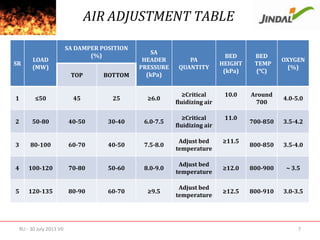
AIR ADJUSTMENT TABLE
SA DAMPER POSITION
(%)
TOP

SR

LOAD
(MW)

BOTTOM

SA
HEADER
PRESSURE
(kPa)

PA
QUANTITY

BED
HEIGHT
(kPa)

BED
TEMP
(℃)

OXYGEN
(%)

Around
700

4.0-5.0

700-850

3.5-4.2

800-850

3.5-4.0

1

≤50

45

25

≥6.0

≥Critical
fluidizing air

10.0

2

50-80

40-50

30-40

6.0-7.5

≥Critical
fluidizing air

11.0

3

80-100

60-70

40-50

7.5-8.0

Adjust bed
temperature

≥11.5

4

100-120

70-80

50-60

8.0-9.0

Adjust bed
temperature

≥12.0

800-900

~ 3.5

5

120-135

80-90

60-70

≥9.5

Adjust bed
temperature

≥12.5

800-910

3.0-3.5

RU - 30 July 2013 V0

7
OXYGEN PROFILE IN CFBC FURNACE

POOR
OXYGEN
CORE

RU - 30 July 2013 V0

1. Poor oxygen core formed due to the
combustion in reducing atmosphere
due to insufficient mixing of air
2. Results in bad combustion efficiency
when burning coals with low
volatile content
3. Staged air supply to be provided for
better combustion
4. Proper PA to SA ratio should be
maintained
SECONDARY 5. Proper air velocities should be
AIR
maintained
6. Angle and size of SA duct should be
such that the penetration length of
air jet is deep in to the furnace

8
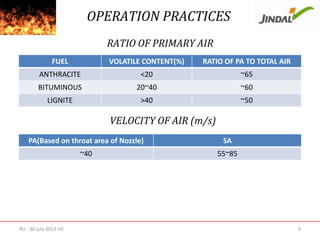
OPERATION PRACTICES
RATIO OF PRIMARY AIR
FUEL

VOLATILE CONTENT(%)

RATIO OF PA TO TOTAL AIR

ANTHRACITE

<20

~65

BITUMINOUS

20~40

~60

LIGNITE

>40

~50

VELOCITY OF AIR (m/s)
PA(Based on throat area of Nozzle)

SA

~40

55~85

RU - 30 July 2013 V0

9
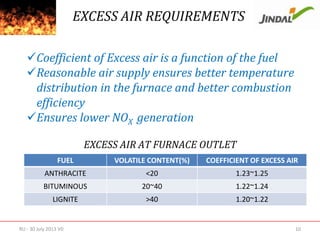
EXCESS AIR REQUIREMENTS
Coefficient of Excess air is a function of the fuel
Reasonable air supply ensures better temperature
distribution in the furnace and better combustion
efficiency
Ensures lower NOX generation
EXCESS AIR AT FURNACE OUTLET
FUEL

VOLATILE CONTENT(%)

COEFFICIENT OF EXCESS AIR

ANTHRACITE

<20

1.23~1.25

BITUMINOUS

20~40

1.22~1.24

LIGNITE

>40

1.20~1.22

RU - 30 July 2013 V0

10
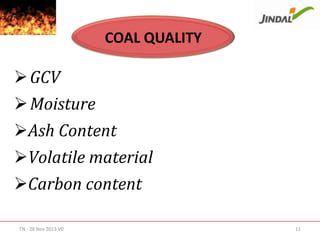
COAL QUALITY

 GCV
 Moisture
Ash Content
Volatile material
Carbon content
TN - 28 Nov 2013 V0

11
COAL SIZE

 Fines
 Oversize
Distribution
Volatile material
Carbon content
TN - 28 Nov 2013 V0

12
FEW FACTS
Hard Coal with less volatile don’t burn effectively in CFBC boiler
Reactivity of carbon decreases while in circulation for a long time
Coals having low fusion temperature can be burnt as temperature in dense
bed and free board is around 850-900oC
Fuel grain size distribution depends upon the material balance, the rate of
combustion in the dense phase and free board and combustion efficiency

The biggest grain size will be fluidized in dense phase and will start burning
The finer grains shall be entrained in the flue gas and burn in free board zone
The finest grains up to 90 microns shall be returned by the separator
The coal of size higher than 6 mm may be permitted, if the coal has
fragmentation characteristics during heating
RU - 30 July 2013 V0

13
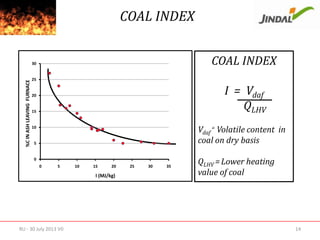
COAL INDEX
COAL INDEX

%C IN ASH LEAVING FURNACE

30

25

I = Vdaf
QLHV

20

15

Vdaf = Volatile content in
coal on dry basis

10

5

0
0

5

10

15

20

I (MJ/kg)

RU - 30 July 2013 V0

25

30

35

QLHV = Lower heating
value of coal

14
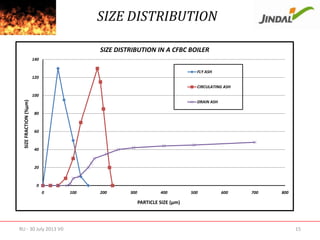
SIZE DISTRIBUTION
SIZE DISTRIBUTION IN A CFBC BOILER
140
FLY ASH
120
CIRCULATING ASH

SIZE FRACTION (%µm)

100

DRAIN ASH
80

60

40

20

0
0

100

200

300

400

500

600

700

800

PARTICLE SIZE (µm)

RU - 30 July 2013 V0

15
BED HEIGHT
 Should be sufficient enough to burn the large size particles in
dense phase
 Bed height should be such that it provides enough resistance
to the PA supplied to the furnace
 Lower bed height will increase the PA velocity resulting in
erosion of water walls and entrainment of high size particles
in lean phase
 Depends on the coal quality and size
 Bed height higher than normal will reduce the bed
temperature and will reduce combustion efficiency
 Bed height is a function of load
TN - 28 Nov 2013 V0

16
BED TEMPERATURE
 Should be around 850-900oC
 Too low the temperature will result in inefficient combustion, will
increase the cyclone and seal pot temperatures. Back pass
temperatures will increase. Will increase attemperation.
 Too high the temperature will result in clinker formation and
agglomeration
 Depends on coal quality, bed height, air velocity and quantity
 Maintaining bed temperatures within the specified range is very
important for ensuring that the heat transfer takes place in the
boiler as per the design specifications

TN - 28 Nov 2013 V0

17
FURNACE VOLUME
 Cross section determines the velocity(5 to 6m/s) of air in the
furnace
 If cyclone separators are arranged in one direction, the ratio
of furnace width to depth is equal to the no of cyclones
 If cyclone separators are arranged in side, the ratio of
furnace width to depth is equal to ¼th of no of cyclones
 Ratio of width and depth determines the SA penetration in the
furnace
 Minimum 20m height is required for a CFBC boiler for
ensuring better combustion efficiency
 Furnace height is too high for the water wall length required
TN - 28 Nov 2013 V0

18
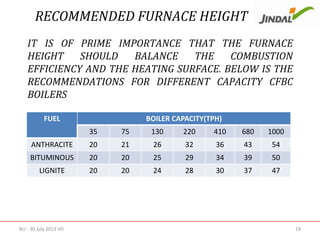
RECOMMENDED FURNACE HEIGHT
IT IS OF PRIME IMPORTANCE THAT THE FURNACE
HEIGHT
SHOULD
BALANCE
THE
COMBUSTION
EFFICIENCY AND THE HEATING SURFACE. BELOW IS THE
RECOMMENDATIONS FOR DIFFERENT CAPACITY CFBC
BOILERS
FUEL

BOILER CAPACITY(TPH)
35

75

130

220

410

680

1000

ANTHRACITE

20

21

26

32

36

43

54

BITUMINOUS

20

20

25

29

34

39

50

LIGNITE

20

20

24

28

30

37

47

RU - 30 July 2013 V0

19
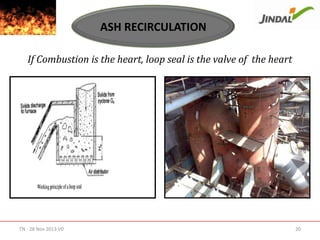
ASH RECIRCULATION
If Combustion is the heart, loop seal is the valve of the heart

TN - 28 Nov 2013 V0

20
LOOP SEAL – FUNCTION & ADVANTAGES
Returns solids captured by the cyclone to the furnace
Prevents backflow of flue gas from furnace to cyclone
Failure of loop seal to transfer the solids at required rate will result in an
entrained bed conditions
Large temperature gradient along the furnace, low heat absorption & higher
back pass temperature
Loss in steam output, excessive steam temperatures & high stack temperature
Height of dip leg is very important. It shall be always more than riser leg
Pressure difference between dip leg and riser shall be around 2kPa

The air velocity in dip leg shall be around 0.3m/s and in riser leg shall be
around 1.3 m/s
The velocity of circulating material in loop seal shall be around 0.2m/s
High air velocity may result in combustion in loop seal causing
agglomeration
RU - 30 July 2013 V0

21
QUESTIONS PLEASE
RU - 30 July 2013 V0

22

Combustion in a CFBC Boiler

  • 1.
    COMBUSTION IN ACFBC BOILER TAPASH NAG TN - 28 Nov 2013 V0 1
  • 2.
    CFBC CHARACTERISTICS Operates underspecial fluid dynamic condition Solid particles are mixed through furnace at a velocity exceeding the average terminal velocity of the particles Major fractions of solids are captured by cyclone High recycle rate intensifies solid mixing and evens out combustion temperature High turbulence, solid mixing and absence of a defined bed level Solids are distributed through out the furnace with steadily decreasing density from bottom to top of furnace TN - 28 Nov 2013 V0 2
  • 3.
  • 4.
    PRIMARY AIR Conveys coal Uniform distribution of coal in furnace  Provides air for combustion Fluidizes the bed ash Ensures proper mixing Provides sealing air to feeders TN - 28 Nov 2013 V0 4
  • 5.
    SECONDARY AIR Staged Combustion Maintains bed temperature Burner air Provides excess air requirement Controls overboard temperature Eliminates NOx formation TN - 28 Nov 2013 V0 5
  • 6.
    AIR DISTRIBUTION CRITERIA Theprimary air shall be adjusted in such a manner that it provides minimum fluidization and better combustion The secondary air shall be adjusted in such a manner that it has maximum penetration so that there is adequate reaction of oxygen with fuel. High pressure for bottom SA is required, to guarantee high penetration and better mixing of air with bed material If PA quantity is high and SA quantity is not adequate, the fuel combustion in dense phase of furnace, i.e., the lower portion will decrease but increase in the lean phase or the upper portion resulting in more water wall erosion. Secondary combustion shall occur in boiler cyclone and seal pot due to less SA quantity. The temperature of flue gas at cyclone outlet will rise and there will be wide variation between cyclone inlet and outlet temperatures The heat transfer in back pass will increase due to high flue gas temperature. Attemperation will increase and heating surface will be damaged RU - 30 July 2013 V0 6
  • 7.
    AIR ADJUSTMENT TABLE SADAMPER POSITION (%) TOP SR LOAD (MW) BOTTOM SA HEADER PRESSURE (kPa) PA QUANTITY BED HEIGHT (kPa) BED TEMP (℃) OXYGEN (%) Around 700 4.0-5.0 700-850 3.5-4.2 800-850 3.5-4.0 1 ≤50 45 25 ≥6.0 ≥Critical fluidizing air 10.0 2 50-80 40-50 30-40 6.0-7.5 ≥Critical fluidizing air 11.0 3 80-100 60-70 40-50 7.5-8.0 Adjust bed temperature ≥11.5 4 100-120 70-80 50-60 8.0-9.0 Adjust bed temperature ≥12.0 800-900 ~ 3.5 5 120-135 80-90 60-70 ≥9.5 Adjust bed temperature ≥12.5 800-910 3.0-3.5 RU - 30 July 2013 V0 7
  • 8.
    OXYGEN PROFILE INCFBC FURNACE POOR OXYGEN CORE RU - 30 July 2013 V0 1. Poor oxygen core formed due to the combustion in reducing atmosphere due to insufficient mixing of air 2. Results in bad combustion efficiency when burning coals with low volatile content 3. Staged air supply to be provided for better combustion 4. Proper PA to SA ratio should be maintained SECONDARY 5. Proper air velocities should be AIR maintained 6. Angle and size of SA duct should be such that the penetration length of air jet is deep in to the furnace 8
  • 9.
    OPERATION PRACTICES RATIO OFPRIMARY AIR FUEL VOLATILE CONTENT(%) RATIO OF PA TO TOTAL AIR ANTHRACITE <20 ~65 BITUMINOUS 20~40 ~60 LIGNITE >40 ~50 VELOCITY OF AIR (m/s) PA(Based on throat area of Nozzle) SA ~40 55~85 RU - 30 July 2013 V0 9
  • 10.
    EXCESS AIR REQUIREMENTS Coefficientof Excess air is a function of the fuel Reasonable air supply ensures better temperature distribution in the furnace and better combustion efficiency Ensures lower NOX generation EXCESS AIR AT FURNACE OUTLET FUEL VOLATILE CONTENT(%) COEFFICIENT OF EXCESS AIR ANTHRACITE <20 1.23~1.25 BITUMINOUS 20~40 1.22~1.24 LIGNITE >40 1.20~1.22 RU - 30 July 2013 V0 10
  • 11.
    COAL QUALITY  GCV Moisture Ash Content Volatile material Carbon content TN - 28 Nov 2013 V0 11
  • 12.
    COAL SIZE  Fines Oversize Distribution Volatile material Carbon content TN - 28 Nov 2013 V0 12
  • 13.
    FEW FACTS Hard Coalwith less volatile don’t burn effectively in CFBC boiler Reactivity of carbon decreases while in circulation for a long time Coals having low fusion temperature can be burnt as temperature in dense bed and free board is around 850-900oC Fuel grain size distribution depends upon the material balance, the rate of combustion in the dense phase and free board and combustion efficiency The biggest grain size will be fluidized in dense phase and will start burning The finer grains shall be entrained in the flue gas and burn in free board zone The finest grains up to 90 microns shall be returned by the separator The coal of size higher than 6 mm may be permitted, if the coal has fragmentation characteristics during heating RU - 30 July 2013 V0 13
  • 14.
    COAL INDEX COAL INDEX %CIN ASH LEAVING FURNACE 30 25 I = Vdaf QLHV 20 15 Vdaf = Volatile content in coal on dry basis 10 5 0 0 5 10 15 20 I (MJ/kg) RU - 30 July 2013 V0 25 30 35 QLHV = Lower heating value of coal 14
  • 15.
    SIZE DISTRIBUTION SIZE DISTRIBUTIONIN A CFBC BOILER 140 FLY ASH 120 CIRCULATING ASH SIZE FRACTION (%µm) 100 DRAIN ASH 80 60 40 20 0 0 100 200 300 400 500 600 700 800 PARTICLE SIZE (µm) RU - 30 July 2013 V0 15
  • 16.
    BED HEIGHT  Shouldbe sufficient enough to burn the large size particles in dense phase  Bed height should be such that it provides enough resistance to the PA supplied to the furnace  Lower bed height will increase the PA velocity resulting in erosion of water walls and entrainment of high size particles in lean phase  Depends on the coal quality and size  Bed height higher than normal will reduce the bed temperature and will reduce combustion efficiency  Bed height is a function of load TN - 28 Nov 2013 V0 16
  • 17.
    BED TEMPERATURE  Shouldbe around 850-900oC  Too low the temperature will result in inefficient combustion, will increase the cyclone and seal pot temperatures. Back pass temperatures will increase. Will increase attemperation.  Too high the temperature will result in clinker formation and agglomeration  Depends on coal quality, bed height, air velocity and quantity  Maintaining bed temperatures within the specified range is very important for ensuring that the heat transfer takes place in the boiler as per the design specifications TN - 28 Nov 2013 V0 17
  • 18.
    FURNACE VOLUME  Crosssection determines the velocity(5 to 6m/s) of air in the furnace  If cyclone separators are arranged in one direction, the ratio of furnace width to depth is equal to the no of cyclones  If cyclone separators are arranged in side, the ratio of furnace width to depth is equal to ¼th of no of cyclones  Ratio of width and depth determines the SA penetration in the furnace  Minimum 20m height is required for a CFBC boiler for ensuring better combustion efficiency  Furnace height is too high for the water wall length required TN - 28 Nov 2013 V0 18
  • 19.
    RECOMMENDED FURNACE HEIGHT ITIS OF PRIME IMPORTANCE THAT THE FURNACE HEIGHT SHOULD BALANCE THE COMBUSTION EFFICIENCY AND THE HEATING SURFACE. BELOW IS THE RECOMMENDATIONS FOR DIFFERENT CAPACITY CFBC BOILERS FUEL BOILER CAPACITY(TPH) 35 75 130 220 410 680 1000 ANTHRACITE 20 21 26 32 36 43 54 BITUMINOUS 20 20 25 29 34 39 50 LIGNITE 20 20 24 28 30 37 47 RU - 30 July 2013 V0 19
  • 20.
    ASH RECIRCULATION If Combustionis the heart, loop seal is the valve of the heart TN - 28 Nov 2013 V0 20
  • 21.
    LOOP SEAL –FUNCTION & ADVANTAGES Returns solids captured by the cyclone to the furnace Prevents backflow of flue gas from furnace to cyclone Failure of loop seal to transfer the solids at required rate will result in an entrained bed conditions Large temperature gradient along the furnace, low heat absorption & higher back pass temperature Loss in steam output, excessive steam temperatures & high stack temperature Height of dip leg is very important. It shall be always more than riser leg Pressure difference between dip leg and riser shall be around 2kPa The air velocity in dip leg shall be around 0.3m/s and in riser leg shall be around 1.3 m/s The velocity of circulating material in loop seal shall be around 0.2m/s High air velocity may result in combustion in loop seal causing agglomeration RU - 30 July 2013 V0 21
  • 22.
    QUESTIONS PLEASE RU -30 July 2013 V0 22