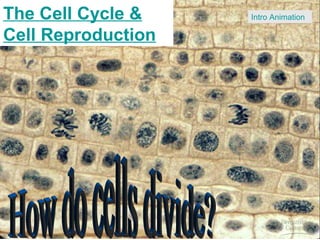
The Cell Cycle &
Cell Reproduction
Intro Animation
• Reproduction
– A single-celled organism can divide to become two
living organisms (next generation of the species)
– A multicellular organism can grow from a single
cell created by fertilization (zygote)
• Growth
– Division of a single cell can result in numerous
cells
– DNA is passed from one cellular generation to the
next
• Repair
– Damaged cells can repair themselves as they
spend time in interphase
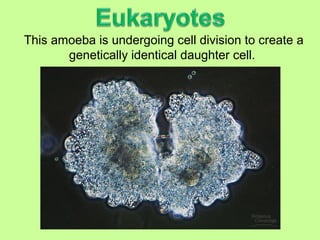
This amoeba is undergoing cell division to create a
genetically identical daughter cell.
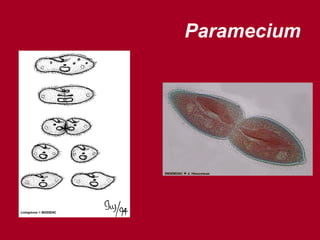
Paramecium
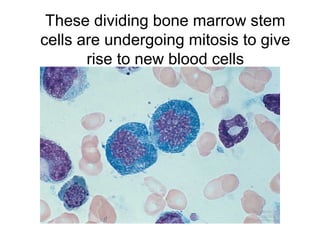
These dividing bone marrow stem
cells are undergoing mitosis to give
rise to new blood cells
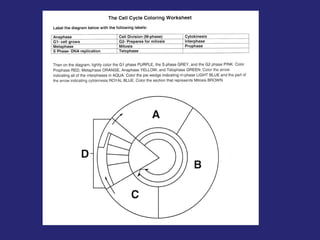
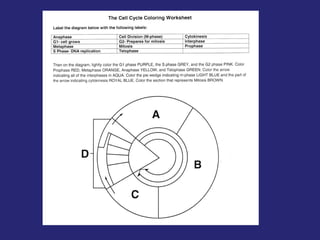
• The cell cycle (in eukaryotes)
• Includes two MAIN stages…
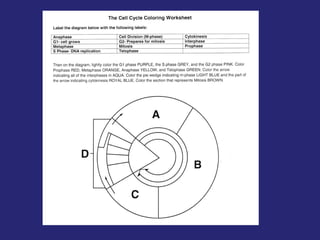
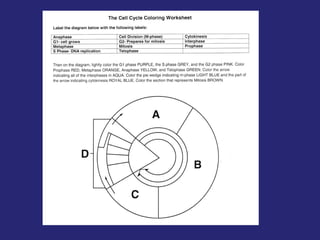
1. Interphase = cell growth,
metabolism, replication of DNA,
preparation for cell division
2. M Phase = nuclear division and
splitting of the cytoplasm/cell
Interphase
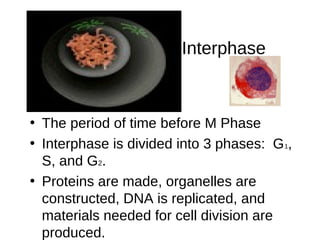
• The period of time before M Phase
• Interphase is divided into 3 phases: G1,
S, and G2.
• Proteins are made, organelles are
constructed, DNA is replicated, and
materials needed for cell division are
produced.
The M Phase: Mitosis
and Cytokinesis
• Mitosis- the process by which the nucleus
of the cell divides into two nuclei, each
with the same number and kinds of
chromosomes as the parent cell.
• Cytokinesis- the process by which the
cytoplasm divides and the cell splits,
forming two cells.
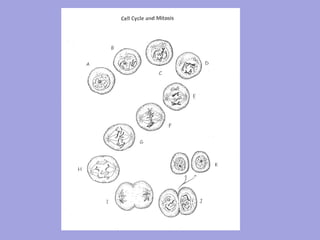
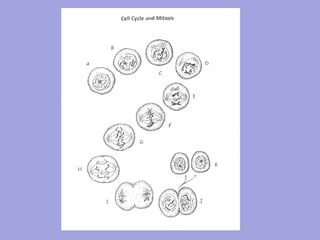
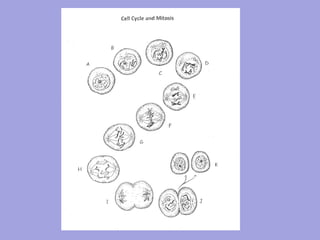
Four Phases of Mitosis
•Prophase
•Metaphase
•Anaphase
•Telophase
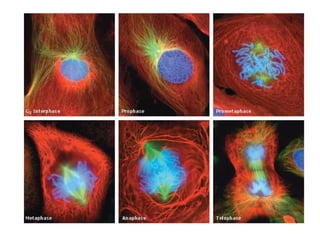
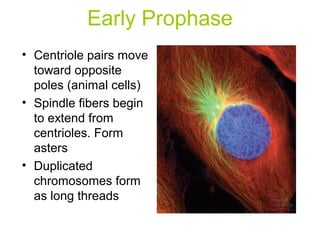
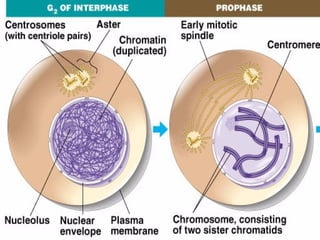
Early Prophase
• Centriole pairs move
toward opposite
poles (animal cells)
• Spindle fibers begin
to extend from
centrioles. Form
asters
• Duplicated
chromosomes form
as long threads
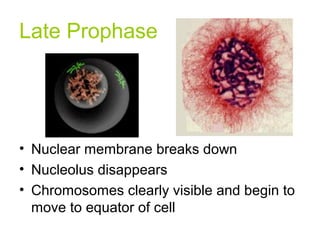
Late Prophase
• Nuclear membrane breaks down
• Nucleolus disappears
• Chromosomes clearly visible and begin to
move to equator of cell
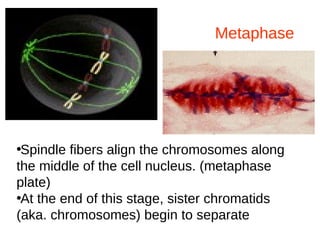
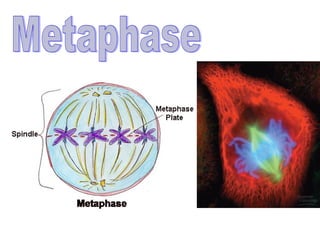
Metaphase
•Spindle fibers align the chromosomes along
the middle of the cell nucleus. (metaphase
plate)
•At the end of this stage, sister chromatids
(aka. chromosomes) begin to separate
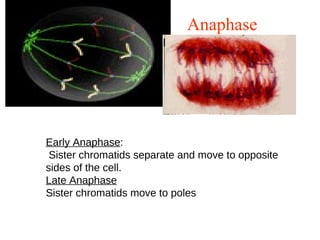
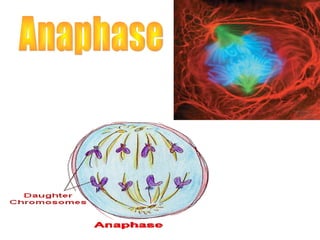
Anaphase
Early Anaphase:
Sister chromatids separate and move to opposite
sides of the cell.
Late Anaphase
Sister chromatids move to poles
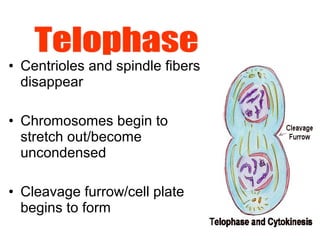
• Centrioles and spindle fibers
disappear
• Chromosomes begin to
stretch out/become
uncondensed
• Cleavage furrow/cell plate
begins to form
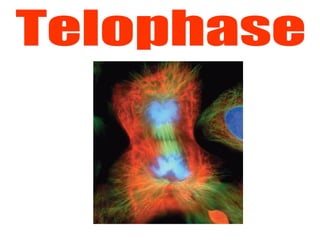
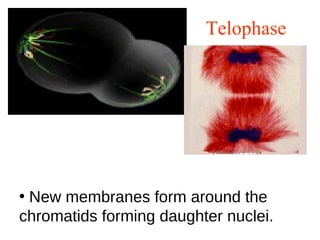
Telophase
• New membranes form around the
chromatids forming daughter nuclei.
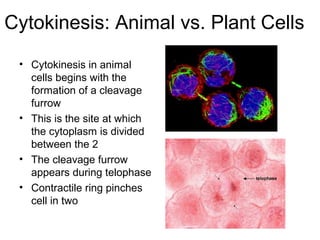
Cytokinesis: Animal vs. Plant Cells
• Cytokinesis in animal
cells begins with the
formation of a cleavage
furrow
• This is the site at which
the cytoplasm is divided
between the 2
• The cleavage furrow
appears during telophase
• Contractile ring pinches
cell in two
Cytokinesis: Animal vs. Plant Cells
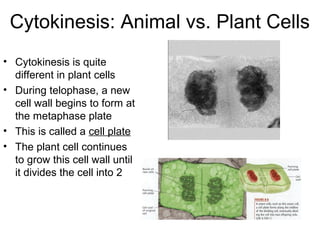
• Cytokinesis is quite
different in plant cells
• During telophase, a new
cell wall begins to form at
the metaphase plate
• This is called a cell plate
• The plant cell continues
to grow this cell wall until
it divides the cell into 2
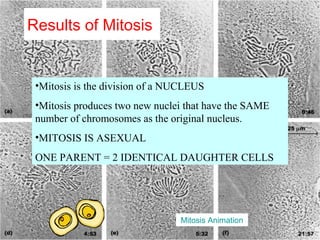
Results of Mitosis
•Mitosis is the division of a NUCLEUS
•Mitosis produces two new nuclei that have the SAME
number of chromosomes as the original nucleus.
•MITOSIS IS ASEXUAL
ONE PARENT = 2 IDENTICAL DAUGHTER CELLS
Mitosis Animation

Cell reproduction

  • 1.
    The Cell Cycle& Cell Reproduction Intro Animation
  • 2.
    • Reproduction – Asingle-celled organism can divide to become two living organisms (next generation of the species) – A multicellular organism can grow from a single cell created by fertilization (zygote) • Growth – Division of a single cell can result in numerous cells – DNA is passed from one cellular generation to the next • Repair – Damaged cells can repair themselves as they spend time in interphase
  • 5.
    This amoeba isundergoing cell division to create a genetically identical daughter cell.
  • 6.
  • 7.
    These dividing bonemarrow stem cells are undergoing mitosis to give rise to new blood cells
  • 8.
    • The cellcycle (in eukaryotes) • Includes two MAIN stages… 1. Interphase = cell growth, metabolism, replication of DNA, preparation for cell division 2. M Phase = nuclear division and splitting of the cytoplasm/cell
  • 10.
    Interphase • The periodof time before M Phase • Interphase is divided into 3 phases: G1, S, and G2. • Proteins are made, organelles are constructed, DNA is replicated, and materials needed for cell division are produced.
  • 12.
    The M Phase:Mitosis and Cytokinesis • Mitosis- the process by which the nucleus of the cell divides into two nuclei, each with the same number and kinds of chromosomes as the parent cell. • Cytokinesis- the process by which the cytoplasm divides and the cell splits, forming two cells.
  • 14.
    Four Phases ofMitosis •Prophase •Metaphase •Anaphase •Telophase
  • 18.
    Early Prophase • Centriolepairs move toward opposite poles (animal cells) • Spindle fibers begin to extend from centrioles. Form asters • Duplicated chromosomes form as long threads
  • 20.
    Late Prophase • Nuclearmembrane breaks down • Nucleolus disappears • Chromosomes clearly visible and begin to move to equator of cell
  • 22.
    Metaphase •Spindle fibers alignthe chromosomes along the middle of the cell nucleus. (metaphase plate) •At the end of this stage, sister chromatids (aka. chromosomes) begin to separate
  • 25.
    Anaphase Early Anaphase: Sister chromatidsseparate and move to opposite sides of the cell. Late Anaphase Sister chromatids move to poles
  • 29.
    • Centrioles andspindle fibers disappear • Chromosomes begin to stretch out/become uncondensed • Cleavage furrow/cell plate begins to form
  • 30.
    Telophase • New membranesform around the chromatids forming daughter nuclei.
  • 32.
    Cytokinesis: Animal vs.Plant Cells • Cytokinesis in animal cells begins with the formation of a cleavage furrow • This is the site at which the cytoplasm is divided between the 2 • The cleavage furrow appears during telophase • Contractile ring pinches cell in two
  • 33.
    Cytokinesis: Animal vs.Plant Cells • Cytokinesis is quite different in plant cells • During telophase, a new cell wall begins to form at the metaphase plate • This is called a cell plate • The plant cell continues to grow this cell wall until it divides the cell into 2
  • 34.
    Results of Mitosis •Mitosisis the division of a NUCLEUS •Mitosis produces two new nuclei that have the SAME number of chromosomes as the original nucleus. •MITOSIS IS ASEXUAL ONE PARENT = 2 IDENTICAL DAUGHTER CELLS Mitosis Animation