SPECIATION
Chapter 16
Section 3
Formation of Species
• Speciation: process of
forming new species
• Results in many related
populations
• May remain similar or
become quite different
Concepts of “Species”
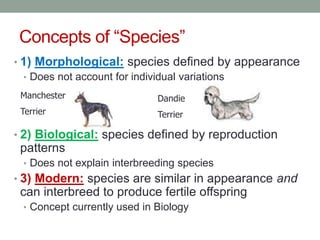
• 1) Morphological: species defined by appearance
• Does not account for individual variations
• 2) Biological: species defined by reproduction
patterns
• Does not explain interbreeding species
• 3) Modern: species are similar in appearance and
can interbreed to produce fertile offspring
• Concept currently used in Biology
Manchester
Terrier
Dandie
Terrier
Isolating Mechanisms
• Speciation occurs when members of a species stop
interbreeding and split
• Become isolated from each other
• 2 Types Isolating Mechanisms:
• 1) Geographic
• 2) Reproductive
Isolating Mechanisms
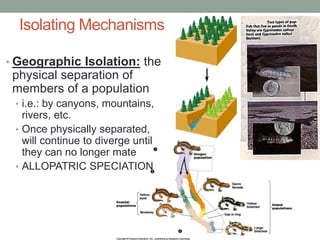
• Geographic Isolation: the
physical separation of
members of a population
• i.e.: by canyons, mountains,
rivers, etc.
• Once physically separated,
will continue to diverge until
they can no longer mate
• ALLOPATRIC SPECIATION
Isolating Mechanisms
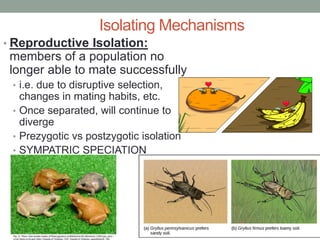
• Reproductive Isolation:
members of a population no
longer able to mate successfully
• i.e. due to disruptive selection,
changes in mating habits, etc.
• Once separated, will continue to
diverge
• Prezygotic vs postzygotic isolation
• SYMPATRIC SPECIATION
Rates of Speciation
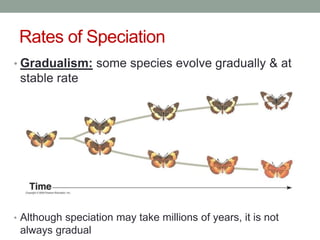
• Gradualism: some species evolve gradually & at
stable rate
• Although speciation may take millions of years, it is not
always gradual
Rates of Speciation
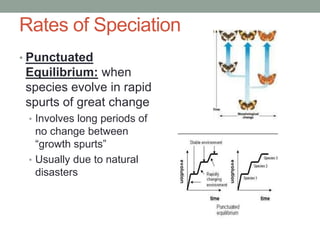
• Punctuated
Equilibrium: when
species evolve in rapid
spurts of great change
• Involves long periods of
no change between
“growth spurts”
• Usually due to natural
disasters
Phylogeny
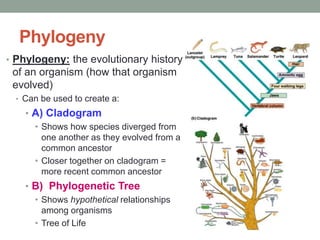
• Phylogeny: the evolutionary history
of an organism (how that organism
evolved)
• Can be used to create a:
• A) Cladogram
• Shows how species diverged from
one another as they evolved from a
common ancestor
• Closer together on cladogram =
more recent common ancestor
• B) Phylogenetic Tree
• Shows hypothetical relationships
among organisms
• Tree of Life

Speciation

  • 1.
  • 2.
    Formation of Species •Speciation: process of forming new species • Results in many related populations • May remain similar or become quite different
  • 3.
    Concepts of “Species” •1) Morphological: species defined by appearance • Does not account for individual variations • 2) Biological: species defined by reproduction patterns • Does not explain interbreeding species • 3) Modern: species are similar in appearance and can interbreed to produce fertile offspring • Concept currently used in Biology Manchester Terrier Dandie Terrier
  • 4.
    Isolating Mechanisms • Speciationoccurs when members of a species stop interbreeding and split • Become isolated from each other • 2 Types Isolating Mechanisms: • 1) Geographic • 2) Reproductive
  • 5.
    Isolating Mechanisms • GeographicIsolation: the physical separation of members of a population • i.e.: by canyons, mountains, rivers, etc. • Once physically separated, will continue to diverge until they can no longer mate • ALLOPATRIC SPECIATION
  • 6.
    Isolating Mechanisms • ReproductiveIsolation: members of a population no longer able to mate successfully • i.e. due to disruptive selection, changes in mating habits, etc. • Once separated, will continue to diverge • Prezygotic vs postzygotic isolation • SYMPATRIC SPECIATION
  • 7.
    Rates of Speciation •Gradualism: some species evolve gradually & at stable rate • Although speciation may take millions of years, it is not always gradual
  • 8.
    Rates of Speciation •Punctuated Equilibrium: when species evolve in rapid spurts of great change • Involves long periods of no change between “growth spurts” • Usually due to natural disasters
  • 9.
    Phylogeny • Phylogeny: theevolutionary history of an organism (how that organism evolved) • Can be used to create a: • A) Cladogram • Shows how species diverged from one another as they evolved from a common ancestor • Closer together on cladogram = more recent common ancestor • B) Phylogenetic Tree • Shows hypothetical relationships among organisms • Tree of Life