The Earth’s Spheres
Biosphere
• The term biosphere is used to describe
the entire interconnected ecosystem of
Earth.
• Includes any and all:
– air, land, surface rocks, and water where life
occurs
• Nearly every part of the planet, from the
polar ice caps to the equator, supports life
of some kind.
– Scientists are always finding life in new places
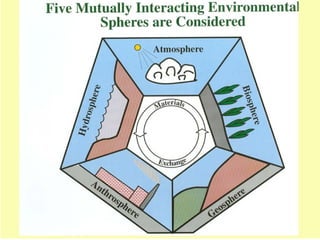
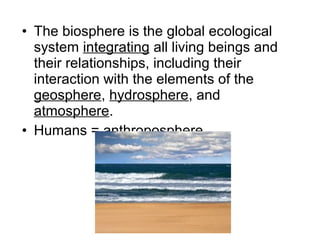
• The biosphere is the global ecological
system integrating all living beings and
their relationships, including their
interaction with the elements of the
geosphere, hydrosphere, and
atmosphere.
• Humans = anthroposphere
Geosphere
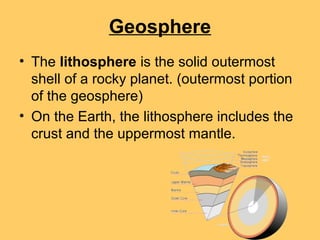
• The lithosphere is the solid outermost
shell of a rocky planet. (outermost portion
of the geosphere)
• On the Earth, the lithosphere includes the
crust and the uppermost mantle.
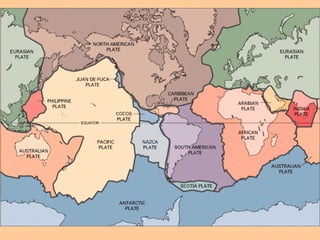
• The lithosphere is fragmented into tectonic
plates which move independently relative
to one another.
• This movement of lithospheric plates is
described as plate tectonics.
• Movement of the lithospheric plated is
related to the history and distribution of life
on Earth.
Hydrosphere
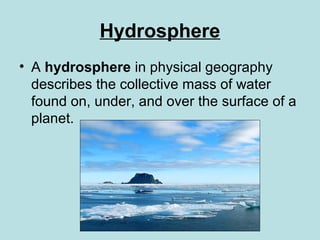
• A hydrosphere in physical geography
describes the collective mass of water
found on, under, and over the surface of a
planet.
• The Earth's hydrosphere consists of water
in all forms:
– the ocean (which is the bulk of the
hydrosphere),
– other surface waters including inland seas,
lakes, and rivers;
– rain;
– underground water;
– ice (as in glaciers and snow);
– and atmospheric water vapor (as in clouds).
• Cryosphere = all frozen water on Earth
Atmosphere
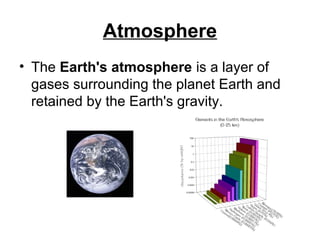
• The Earth's atmosphere is a layer of
gases surrounding the planet Earth and
retained by the Earth's gravity.
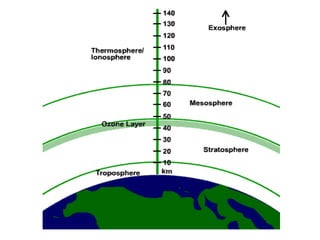
• There is no definite boundary between the
atmosphere and outer space.
• It slowly becomes thinner and fades into
space. Three quarters of the atmosphere's
mass is within 11 km of the planetary
surface.
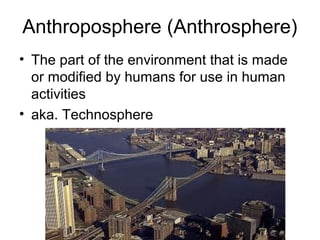
Anthroposphere (Anthrosphere)
• The part of the environment that is made
or modified by humans for use in human
activities
• aka. Technosphere
Closed Ecosystem Research
• Biosphere 1 = the planet Earth
• Biosphere 2 = A laboratory in Arizona
• Other experiments:
– Biosphere 3
– Biosphere J = An experiment in Japan
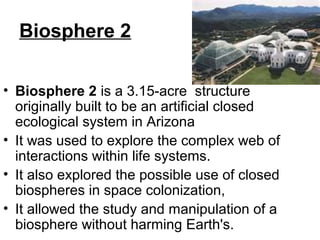
Biosphere 2
• Biosphere 2 is a 3.15-acre structure
originally built to be an artificial closed
ecological system in Arizona
• It was used to explore the complex web of
interactions within life systems.
• It also explored the possible use of closed
biospheres in space colonization,
• It allowed the study and manipulation of a
biosphere without harming Earth's.
• At a size comparable to two and a half
football fields, it was the largest closed
system ever created.
• The sealed nature of the structure allowed
scientists to monitor the ever-changing
chemistry of the air, water and soil
contained within.
• The health of the human crew was
continuously monitored by a medical
team.
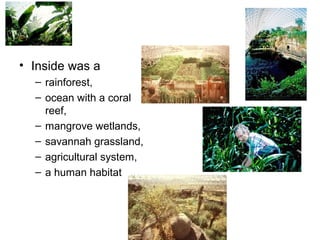
• Inside was a
– rainforest,
– ocean with a coral
reef,
– mangrove wetlands,
– savannah grassland,
– agricultural system,
– a human habitat
Problems Identified
• Too much CO2
• Not enough O2
• Not enough food production
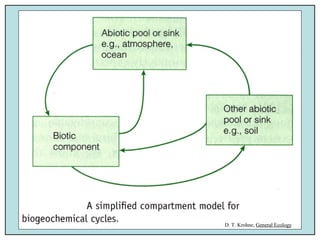
The Biogeochemical Cycles
© 2003 John Wiley and Sons Publishers
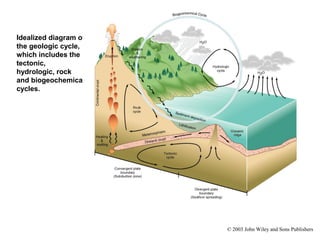
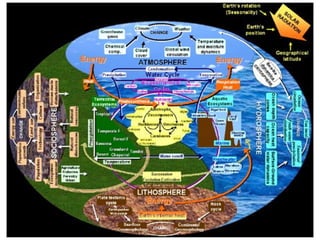
Idealized diagram of
the geologic cycle,
which includes the
tectonic,
hydrologic, rock
and biogeochemical
cycles.
D. T. Krohne, General Ecology
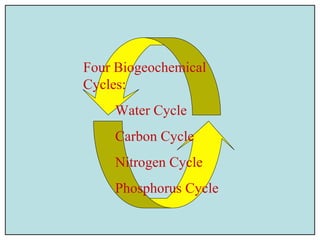
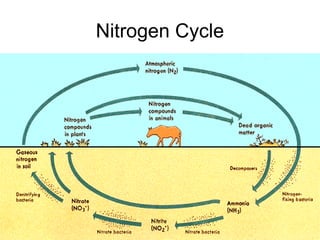
Four Biogeochemical
Cycles:
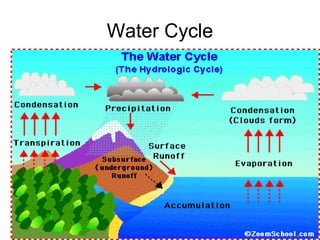
Water Cycle
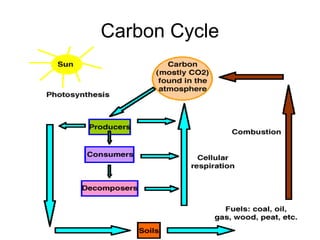
Carbon Cycle
Nitrogen Cycle
Phosphorus Cycle
Water Cycle
Carbon Cycle
Nitrogen Cycle
© 2003 John Wiley and Sons Publishers
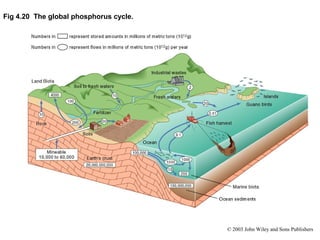
Fig 4.20 The global phosphorus cycle.
The biosphere

The biosphere

  • 1.
  • 3.
    Biosphere • The termbiosphere is used to describe the entire interconnected ecosystem of Earth. • Includes any and all: – air, land, surface rocks, and water where life occurs • Nearly every part of the planet, from the polar ice caps to the equator, supports life of some kind. – Scientists are always finding life in new places
  • 4.
    • The biosphereis the global ecological system integrating all living beings and their relationships, including their interaction with the elements of the geosphere, hydrosphere, and atmosphere. • Humans = anthroposphere
  • 5.
    Geosphere • The lithosphereis the solid outermost shell of a rocky planet. (outermost portion of the geosphere) • On the Earth, the lithosphere includes the crust and the uppermost mantle.
  • 6.
    • The lithosphereis fragmented into tectonic plates which move independently relative to one another. • This movement of lithospheric plates is described as plate tectonics. • Movement of the lithospheric plated is related to the history and distribution of life on Earth.
  • 8.
    Hydrosphere • A hydrospherein physical geography describes the collective mass of water found on, under, and over the surface of a planet.
  • 9.
    • The Earth'shydrosphere consists of water in all forms: – the ocean (which is the bulk of the hydrosphere), – other surface waters including inland seas, lakes, and rivers; – rain; – underground water; – ice (as in glaciers and snow); – and atmospheric water vapor (as in clouds). • Cryosphere = all frozen water on Earth
  • 10.
    Atmosphere • The Earth'satmosphere is a layer of gases surrounding the planet Earth and retained by the Earth's gravity.
  • 11.
    • There isno definite boundary between the atmosphere and outer space. • It slowly becomes thinner and fades into space. Three quarters of the atmosphere's mass is within 11 km of the planetary surface.
  • 13.
    Anthroposphere (Anthrosphere) • Thepart of the environment that is made or modified by humans for use in human activities • aka. Technosphere
  • 14.
    Closed Ecosystem Research •Biosphere 1 = the planet Earth • Biosphere 2 = A laboratory in Arizona • Other experiments: – Biosphere 3 – Biosphere J = An experiment in Japan
  • 15.
    Biosphere 2 • Biosphere2 is a 3.15-acre structure originally built to be an artificial closed ecological system in Arizona • It was used to explore the complex web of interactions within life systems. • It also explored the possible use of closed biospheres in space colonization, • It allowed the study and manipulation of a biosphere without harming Earth's.
  • 16.
    • At asize comparable to two and a half football fields, it was the largest closed system ever created. • The sealed nature of the structure allowed scientists to monitor the ever-changing chemistry of the air, water and soil contained within. • The health of the human crew was continuously monitored by a medical team.
  • 17.
    • Inside wasa – rainforest, – ocean with a coral reef, – mangrove wetlands, – savannah grassland, – agricultural system, – a human habitat
  • 18.
    Problems Identified • Toomuch CO2 • Not enough O2 • Not enough food production
  • 19.
  • 20.
    © 2003 JohnWiley and Sons Publishers Idealized diagram of the geologic cycle, which includes the tectonic, hydrologic, rock and biogeochemical cycles.
  • 21.
    D. T. Krohne,General Ecology
  • 22.
    Four Biogeochemical Cycles: Water Cycle CarbonCycle Nitrogen Cycle Phosphorus Cycle
  • 23.
  • 24.
  • 25.
  • 26.
    © 2003 JohnWiley and Sons Publishers Fig 4.20 The global phosphorus cycle.

Editor's Notes

  • #21 Fig 4.6 Idealized diagram of the geologic cycle, which includes the tectonic, hydrologic, rock and biogeochemical cycles.
  • #27 Fig 4.20 The global phosphorus cycle. Phosphorus is recycled to soil and land biota through geologic processes that uplift the land an erode rocks, by birds that produce guano, and by human beings. Although Earth’s crust contains a very large amount of phosphorus, only a small fraction of it can be mined by conventional techniques. Therefore, phosphorus is an expensive resource to produce. Values of the amount of phosphorus stored or in flux are compiled from various sources. Estimates are approximate to the order of magnitude. (Source: Based primarily on C. C. Delwiche and G. E. Likens, “Biological Response to Fossil Fuel Combustion Products,” in global Chemical Cycles and Their Alterations by Man, ed. W. Stumm, [Berlin: Abakon Verlagsgesellschaft, 1977], pp. 73-88; and U. Pierrou, “The Global Phosphorus Cycle,” in Nitrogen, Phosphorus and Sulfur—Global Cycles, eds. B. H. Svensson and R. Soderlund [Stockholm: Ecological Bulletin, 1976, pp. 75-88.)