11/20/2024
1
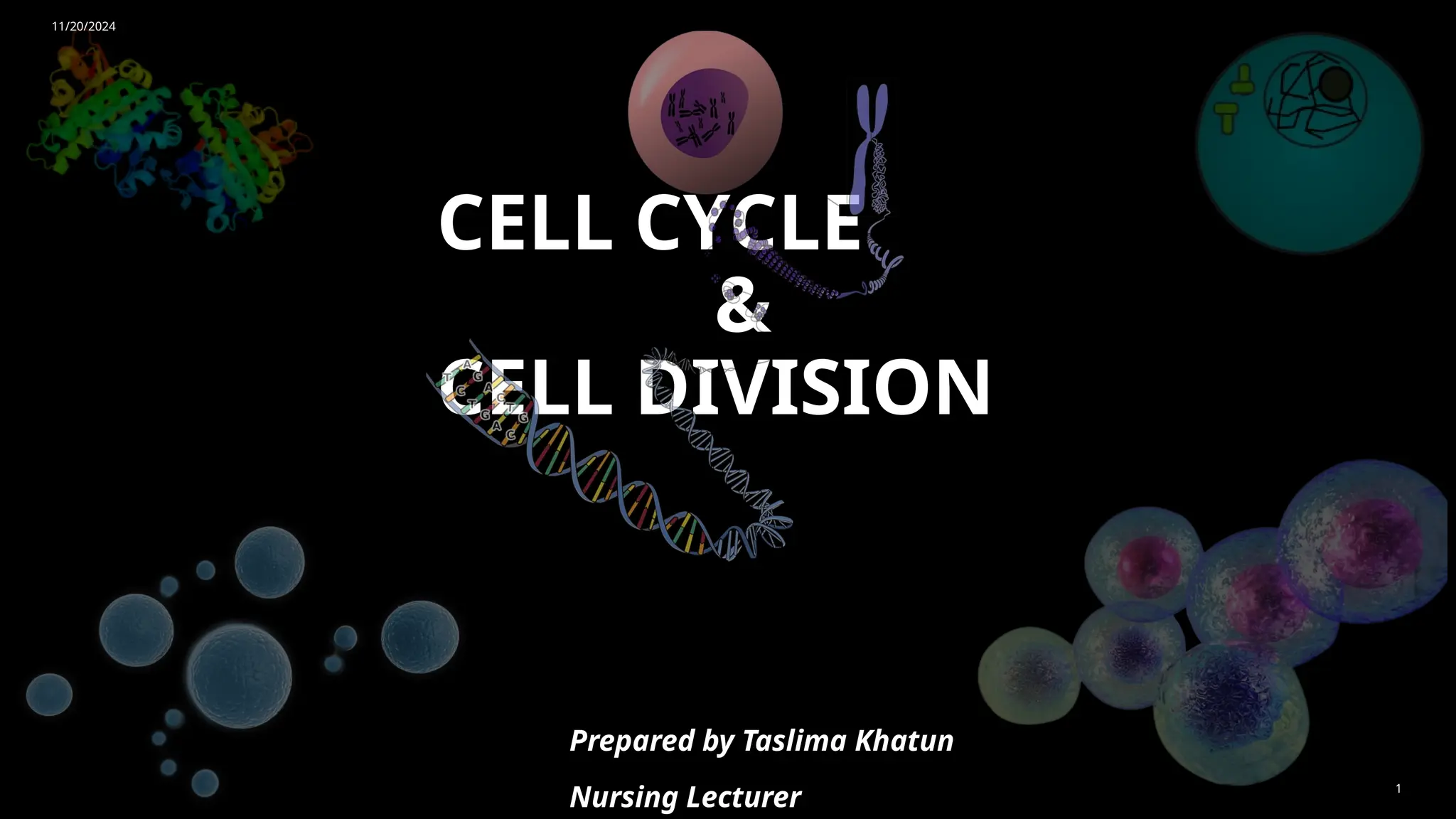
CELL CYCLE
&
CELL DIVISION
Prepared by Taslima Khatun
Nursing Lecturer
11/20/2024
2
Cell Cycle:
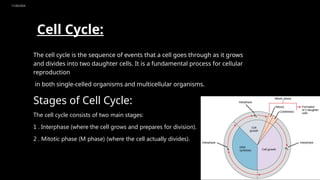
The cell cycle is the sequence of events that a cell goes through as it grows
and divides into two daughter cells. It is a fundamental process for cellular
reproduction
in both single-celled organisms and multicellular organisms.
Stages of Cell Cycle:
The cell cycle consists of two main stages:
1 . Interphase (where the cell grows and prepares for division).
2 . Mitotic phase (M phase) (where the cell actually divides).
11/20/2024
3
1. Interphase (the cell is preparing for
division)
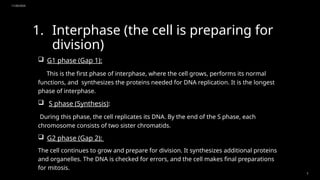
 G1 phase (Gap 1):
This is the first phase of interphase, where the cell grows, performs its normal
functions, and synthesizes the proteins needed for DNA replication. It is the longest
phase of interphase.
 S phase (Synthesis):
During this phase, the cell replicates its DNA. By the end of the S phase, each
chromosome consists of two sister chromatids.
 G2 phase (Gap 2):
The cell continues to grow and prepare for division. It synthesizes additional proteins
and organelles. The DNA is checked for errors, and the cell makes final preparations
for mitosis.
11/20/2024
4
2. Mitotic phase:
The mitotic phase is a crucial part of the cell cycle, responsible for the actual division of
the cell into two genetically identical daughter cells. It involves a series of carefully
orchestrated steps, each designed to ensure that the genetic material (DNA) is properly
replicated, organized, and separated.
STAGES:
A . Mitosis – the division of the nucleus.
B . Cytokinesis – the division of the cytoplasm, which results in two
distinct daughter cells.
11/20/2024
5
A. MITOSIS:
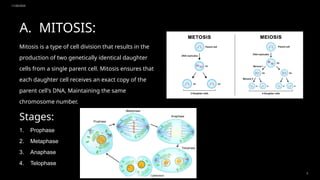
Mitosis is a type of cell division that results in the
production of two genetically identical daughter
cells from a single parent cell. Mitosis ensures that
each daughter cell receives an exact copy of the
parent cell's DNA, Maintaining the same
chromosome number.
Stages:
1. Prophase
2. Metaphase
3. Anaphase
4. Telophase
11/20/2024
6
1. Prophase:
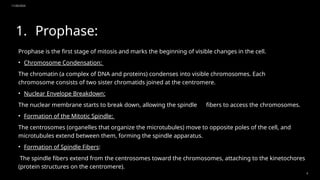
Prophase is the first stage of mitosis and marks the beginning of visible changes in the cell.
• Chromosome Condensation:
The chromatin (a complex of DNA and proteins) condenses into visible chromosomes. Each
chromosome consists of two sister chromatids joined at the centromere.
• Nuclear Envelope Breakdown:
The nuclear membrane starts to break down, allowing the spindle fibers to access the chromosomes.
• Formation of the Mitotic Spindle:
The centrosomes (organelles that organize the microtubules) move to opposite poles of the cell, and
microtubules extend between them, forming the spindle apparatus.
• Formation of Spindle Fibers:
The spindle fibers extend from the centrosomes toward the chromosomes, attaching to the kinetochores
(protein structures on the centromere).
11/20/2024
7
2. Metaphase:
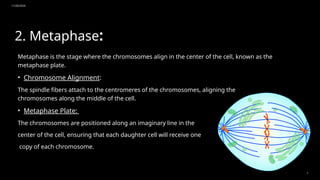
Metaphase is the stage where the chromosomes align in the center of the cell, known as the
metaphase plate.
• Chromosome Alignment:
The spindle fibers attach to the centromeres of the chromosomes, aligning the
chromosomes along the middle of the cell.
• Metaphase Plate:
The chromosomes are positioned along an imaginary line in the
center of the cell, ensuring that each daughter cell will receive one
copy of each chromosome.
11/20/2024
8
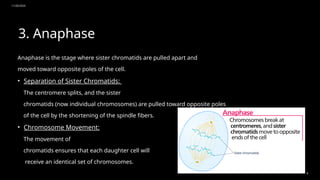
3. Anaphase
Anaphase is the stage where sister chromatids are pulled apart and
moved toward opposite poles of the cell.
• Separation of Sister Chromatids:
The centromere splits, and the sister
chromatids (now individual chromosomes) are pulled toward opposite poles
of the cell by the shortening of the spindle fibers.
• Chromosome Movement:
The movement of
chromatids ensures that each daughter cell will
receive an identical set of chromosomes.
11/20/2024
9
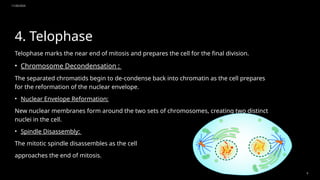
4. Telophase
Telophase marks the near end of mitosis and prepares the cell for the final division.
• Chromosome Decondensation :
The separated chromatids begin to de-condense back into chromatin as the cell prepares
for the reformation of the nuclear envelope.
• Nuclear Envelope Reformation:
New nuclear membranes form around the two sets of chromosomes, creating two distinct
nuclei in the cell.
• Spindle Disassembly:
The mitotic spindle disassembles as the cell
approaches the end of mitosis.
11/20/2024
10
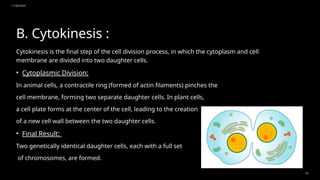
B. Cytokinesis :
Cytokinesis is the final step of the cell division process, in which the cytoplasm and cell
membrane are divided into two daughter cells.
• Cytoplasmic Division:
In animal cells, a contractile ring (formed of actin filaments) pinches the
cell membrane, forming two separate daughter cells. In plant cells,
a cell plate forms at the center of the cell, leading to the creation
of a new cell wall between the two daughter cells.
• Final Result:
Two genetically identical daughter cells, each with a full set
of chromosomes, are formed.
11/20/2024
11
MEIOSIS:
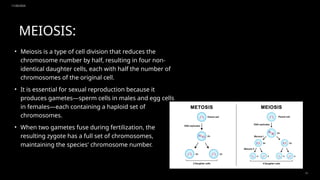
• Meiosis is a type of cell division that reduces the
chromosome number by half, resulting in four non-
identical daughter cells, each with half the number of
chromosomes of the original cell.
• It is essential for sexual reproduction because it
produces gametes—sperm cells in males and egg cells
in females—each containing a haploid set of
chromosomes.
• When two gametes fuse during fertilization, the
resulting zygote has a full set of chromosomes,
maintaining the species' chromosome number.
11/20/2024
12
TYPES:
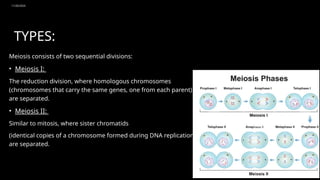
Meiosis consists of two sequential divisions:
• Meiosis I:
The reduction division, where homologous chromosomes
(chromosomes that carry the same genes, one from each parent)
are separated.
• Meiosis II:
Similar to mitosis, where sister chromatids
(identical copies of a chromosome formed during DNA replication)
are separated.
11/20/2024
13
MEIOSIS 1:
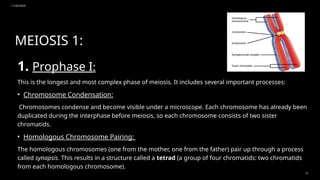
1. Prophase I:
This is the longest and most complex phase of meiosis. It includes several important processes:
• Chromosome Condensation:
Chromosomes condense and become visible under a microscope. Each chromosome has already been
duplicated during the interphase before meiosis, so each chromosome consists of two sister
chromatids.
• Homologous Chromosome Pairing:
The homologous chromosomes (one from the mother, one from the father) pair up through a process
called synapsis. This results in a structure called a tetrad (a group of four chromatids: two chromatids
from each homologous chromosome).
11/20/2024
14
CONT...
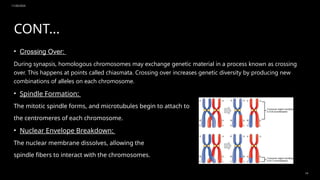
• Crossing Over:
During synapsis, homologous chromosomes may exchange genetic material in a process known as crossing
over. This happens at points called chiasmata. Crossing over increases genetic diversity by producing new
combinations of alleles on each chromosome.
• Spindle Formation:
The mitotic spindle forms, and microtubules begin to attach to
the centromeres of each chromosome.
• Nuclear Envelope Breakdown:
The nuclear membrane dissolves, allowing the
spindle fibers to interact with the chromosomes.
11/20/2024
15
METAPHASE1:
• The tetrads (homologous chromosome pairs) line up at the metaphase plate (center of the
cell).
• Independent Assortment occurs here, where the orientation of the homologous
chromosome pairs is random. This contributes to genetic variation because the chromosome
from either parent can be inherited on either side of the cell.
ANAPHASE1:
• The homologous chromosomes are pulled apart toward opposite poles of the cell. Importantly, the
sister chromatids stay attached to each other at this stage. This is a key difference from mitosis,
where sister chromatids are separated in anaphase.
11/20/2024
16
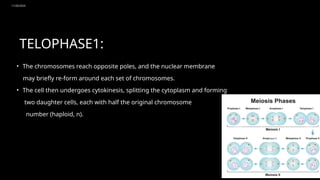
TELOPHASE1:
• The chromosomes reach opposite poles, and the nuclear membrane
may briefly re-form around each set of chromosomes.
• The cell then undergoes cytokinesis, splitting the cytoplasm and forming
two daughter cells, each with half the original chromosome
number (haploid, n).
11/20/2024
17
MEIOSIS2 :
1. Prophase II
• The chromosomes in the two haploid cells condense again, and the nuclear membrane
dissolves.
• New spindles form in each of the two cells, and the chromosomes begin to move
toward the metaphase plate.
2. METAPHASE2 :
• The chromosomes (each consisting of two sister chromatids) align along the metaphase
plate in each haploid cell.
• Unlike metaphase I, where homologous chromosomes lined up, here, individual
chromosomes line up.
11/20/2024
18
3. ANAPHASE2 :
• The sister chromatids of each chromosome are finally separated and pulled toward
opposite poles. This is similar to what happens during anaphase of mitosis.
4. TELOPHASE2 :
• Chromatids reach opposite poles of the cell.
• The nuclear membrane reforms around each set of chromosomes.
• Cytokinesis occurs, splitting the two cells into four non-identical haploid daughter cells, each
containing half the original chromosome number (n).
11/20/2024
19

Cell division & Cell Cycle (Prepared by Taslima Khatun)

  • 1.
    11/20/2024 1 CELL CYCLE & CELL DIVISION Preparedby Taslima Khatun Nursing Lecturer
  • 2.
    11/20/2024 2 Cell Cycle: The cellcycle is the sequence of events that a cell goes through as it grows and divides into two daughter cells. It is a fundamental process for cellular reproduction in both single-celled organisms and multicellular organisms. Stages of Cell Cycle: The cell cycle consists of two main stages: 1 . Interphase (where the cell grows and prepares for division). 2 . Mitotic phase (M phase) (where the cell actually divides).
  • 3.
    11/20/2024 3 1. Interphase (thecell is preparing for division)  G1 phase (Gap 1): This is the first phase of interphase, where the cell grows, performs its normal functions, and synthesizes the proteins needed for DNA replication. It is the longest phase of interphase.  S phase (Synthesis): During this phase, the cell replicates its DNA. By the end of the S phase, each chromosome consists of two sister chromatids.  G2 phase (Gap 2): The cell continues to grow and prepare for division. It synthesizes additional proteins and organelles. The DNA is checked for errors, and the cell makes final preparations for mitosis.
  • 4.
    11/20/2024 4 2. Mitotic phase: Themitotic phase is a crucial part of the cell cycle, responsible for the actual division of the cell into two genetically identical daughter cells. It involves a series of carefully orchestrated steps, each designed to ensure that the genetic material (DNA) is properly replicated, organized, and separated. STAGES: A . Mitosis – the division of the nucleus. B . Cytokinesis – the division of the cytoplasm, which results in two distinct daughter cells.
  • 5.
    11/20/2024 5 A. MITOSIS: Mitosis isa type of cell division that results in the production of two genetically identical daughter cells from a single parent cell. Mitosis ensures that each daughter cell receives an exact copy of the parent cell's DNA, Maintaining the same chromosome number. Stages: 1. Prophase 2. Metaphase 3. Anaphase 4. Telophase
  • 6.
    11/20/2024 6 1. Prophase: Prophase isthe first stage of mitosis and marks the beginning of visible changes in the cell. • Chromosome Condensation: The chromatin (a complex of DNA and proteins) condenses into visible chromosomes. Each chromosome consists of two sister chromatids joined at the centromere. • Nuclear Envelope Breakdown: The nuclear membrane starts to break down, allowing the spindle fibers to access the chromosomes. • Formation of the Mitotic Spindle: The centrosomes (organelles that organize the microtubules) move to opposite poles of the cell, and microtubules extend between them, forming the spindle apparatus. • Formation of Spindle Fibers: The spindle fibers extend from the centrosomes toward the chromosomes, attaching to the kinetochores (protein structures on the centromere).
  • 7.
    11/20/2024 7 2. Metaphase: Metaphase isthe stage where the chromosomes align in the center of the cell, known as the metaphase plate. • Chromosome Alignment: The spindle fibers attach to the centromeres of the chromosomes, aligning the chromosomes along the middle of the cell. • Metaphase Plate: The chromosomes are positioned along an imaginary line in the center of the cell, ensuring that each daughter cell will receive one copy of each chromosome.
  • 8.
    11/20/2024 8 3. Anaphase Anaphase isthe stage where sister chromatids are pulled apart and moved toward opposite poles of the cell. • Separation of Sister Chromatids: The centromere splits, and the sister chromatids (now individual chromosomes) are pulled toward opposite poles of the cell by the shortening of the spindle fibers. • Chromosome Movement: The movement of chromatids ensures that each daughter cell will receive an identical set of chromosomes.
  • 9.
    11/20/2024 9 4. Telophase Telophase marksthe near end of mitosis and prepares the cell for the final division. • Chromosome Decondensation : The separated chromatids begin to de-condense back into chromatin as the cell prepares for the reformation of the nuclear envelope. • Nuclear Envelope Reformation: New nuclear membranes form around the two sets of chromosomes, creating two distinct nuclei in the cell. • Spindle Disassembly: The mitotic spindle disassembles as the cell approaches the end of mitosis.
  • 10.
    11/20/2024 10 B. Cytokinesis : Cytokinesisis the final step of the cell division process, in which the cytoplasm and cell membrane are divided into two daughter cells. • Cytoplasmic Division: In animal cells, a contractile ring (formed of actin filaments) pinches the cell membrane, forming two separate daughter cells. In plant cells, a cell plate forms at the center of the cell, leading to the creation of a new cell wall between the two daughter cells. • Final Result: Two genetically identical daughter cells, each with a full set of chromosomes, are formed.
  • 11.
    11/20/2024 11 MEIOSIS: • Meiosis isa type of cell division that reduces the chromosome number by half, resulting in four non- identical daughter cells, each with half the number of chromosomes of the original cell. • It is essential for sexual reproduction because it produces gametes—sperm cells in males and egg cells in females—each containing a haploid set of chromosomes. • When two gametes fuse during fertilization, the resulting zygote has a full set of chromosomes, maintaining the species' chromosome number.
  • 12.
    11/20/2024 12 TYPES: Meiosis consists oftwo sequential divisions: • Meiosis I: The reduction division, where homologous chromosomes (chromosomes that carry the same genes, one from each parent) are separated. • Meiosis II: Similar to mitosis, where sister chromatids (identical copies of a chromosome formed during DNA replication) are separated.
  • 13.
    11/20/2024 13 MEIOSIS 1: 1. ProphaseI: This is the longest and most complex phase of meiosis. It includes several important processes: • Chromosome Condensation: Chromosomes condense and become visible under a microscope. Each chromosome has already been duplicated during the interphase before meiosis, so each chromosome consists of two sister chromatids. • Homologous Chromosome Pairing: The homologous chromosomes (one from the mother, one from the father) pair up through a process called synapsis. This results in a structure called a tetrad (a group of four chromatids: two chromatids from each homologous chromosome).
  • 14.
    11/20/2024 14 CONT... • Crossing Over: Duringsynapsis, homologous chromosomes may exchange genetic material in a process known as crossing over. This happens at points called chiasmata. Crossing over increases genetic diversity by producing new combinations of alleles on each chromosome. • Spindle Formation: The mitotic spindle forms, and microtubules begin to attach to the centromeres of each chromosome. • Nuclear Envelope Breakdown: The nuclear membrane dissolves, allowing the spindle fibers to interact with the chromosomes.
  • 15.
    11/20/2024 15 METAPHASE1: • The tetrads(homologous chromosome pairs) line up at the metaphase plate (center of the cell). • Independent Assortment occurs here, where the orientation of the homologous chromosome pairs is random. This contributes to genetic variation because the chromosome from either parent can be inherited on either side of the cell. ANAPHASE1: • The homologous chromosomes are pulled apart toward opposite poles of the cell. Importantly, the sister chromatids stay attached to each other at this stage. This is a key difference from mitosis, where sister chromatids are separated in anaphase.
  • 16.
    11/20/2024 16 TELOPHASE1: • The chromosomesreach opposite poles, and the nuclear membrane may briefly re-form around each set of chromosomes. • The cell then undergoes cytokinesis, splitting the cytoplasm and forming two daughter cells, each with half the original chromosome number (haploid, n).
  • 17.
    11/20/2024 17 MEIOSIS2 : 1. ProphaseII • The chromosomes in the two haploid cells condense again, and the nuclear membrane dissolves. • New spindles form in each of the two cells, and the chromosomes begin to move toward the metaphase plate. 2. METAPHASE2 : • The chromosomes (each consisting of two sister chromatids) align along the metaphase plate in each haploid cell. • Unlike metaphase I, where homologous chromosomes lined up, here, individual chromosomes line up.
  • 18.
    11/20/2024 18 3. ANAPHASE2 : •The sister chromatids of each chromosome are finally separated and pulled toward opposite poles. This is similar to what happens during anaphase of mitosis. 4. TELOPHASE2 : • Chromatids reach opposite poles of the cell. • The nuclear membrane reforms around each set of chromosomes. • Cytokinesis occurs, splitting the two cells into four non-identical haploid daughter cells, each containing half the original chromosome number (n).
  • 19.