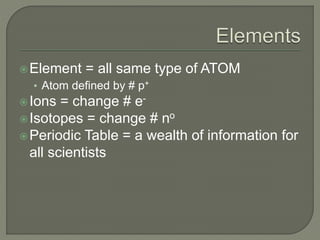
Element = all same type of ATOM
• Atom defined by # p+
Ions = change # e-
Isotopes = change # no
Periodic Table = a wealth of information for
all scientists
Ionic compounds  dissolve in water to
form AQUEOUS SOLUTIONS
•Life processes occur in
aqueous solutions!
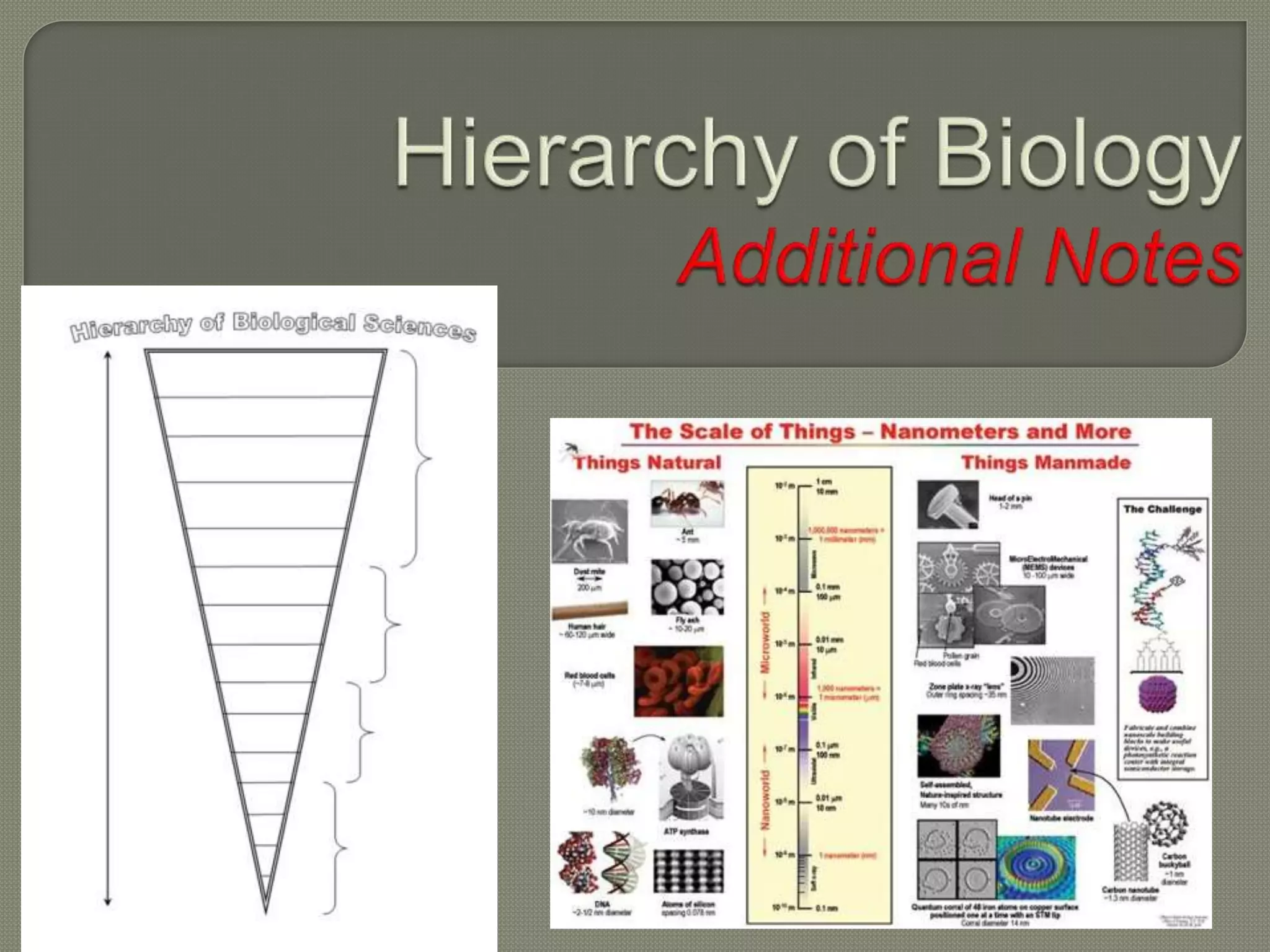
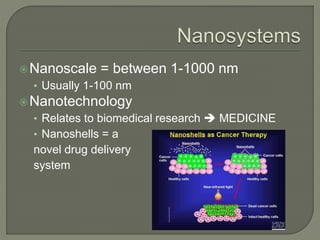
Nanoscale = between 1-1000 nm
• Usually 1-100 nm
Nanotechnology
• Relates to biomedical research  MEDICINE
• Nanoshells = a
novel drug delivery
system
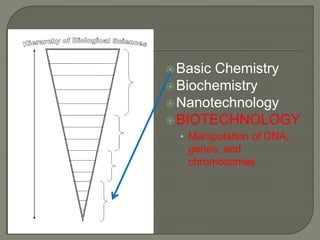
Basic Chemistry
Biochemistry
Nanotechnology
BIOTECHNOLOGY
• Manipulation of DNA,
genes, and
chromosomes
Basic structural and functional units of ALL
LIFE ON EARTH!
Vary widely across the six kingdoms of life
(sizes range from 0.1µm to 1 mm!)
Two basic types:
• Prokaryotic = ALL bacteria
• Eukaryotic = ALL other kingdoms
(Protista, Fungi, Plantae, Animalia)
Only occurs in organisms that are
multicellular
• NO bacteria have tissue!
• Unicellular life forms do not have tissue!
 Most Protista
 Many Fungi
ALL Plantae and Animalia have tissue!
Only occur in complex multicellular
organisms:
• Plantae,
• Animalia,
• some Fungi,
• few Protista
An individual living thing.
Can be:
• Unicellular
• Multicellular
Complex definition in biology
Generally a biological species is:
• A group of actually or potentially interbreeding
natural populations which are reproductively
isolated from other such groups
• What is a species?
In biology, populations are groups of
individuals belonging to the same species
that live in the same region at the same
time.
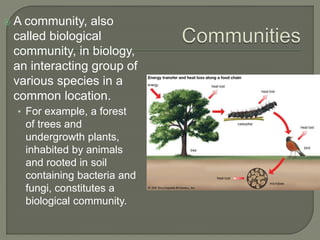
 A community, also
called biological
community, in biology,
an interacting group of
various species in a
common location.
• For example, a forest
of trees and
undergrowth plants,
inhabited by animals
and rooted in soil
containing bacteria and
fungi, constitutes a
biological community.
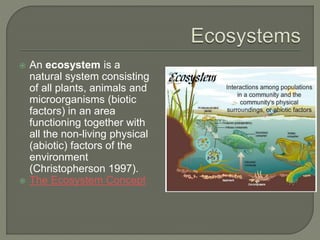
 An ecosystem is a
natural system consisting
of all plants, animals and
microorganisms (biotic
factors) in an area
functioning together with
all the non-living physical
(abiotic) factors of the
environment
(Christopherson 1997).
 The Ecosystem Concept
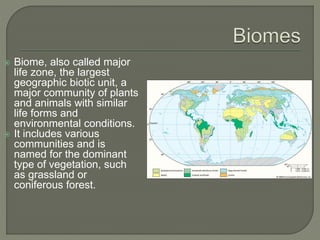
 Biome, also called major
life zone, the largest
geographic biotic unit, a
major community of plants
and animals with similar
life forms and
environmental conditions.
 It includes various
communities and is
named for the dominant
type of vegetation, such
as grassland or
coniferous forest.
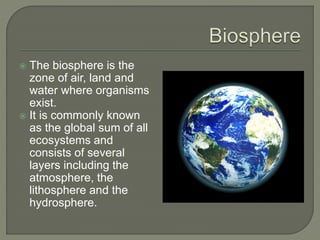
 The biosphere is the
zone of air, land and
water where organisms
exist.
 It is commonly known
as the global sum of all
ecosystems and
consists of several
layers including the
atmosphere, the
lithosphere and the
hydrosphere.

Hierarchy of biology additional notes

  • 2.
    Element = allsame type of ATOM • Atom defined by # p+ Ions = change # e- Isotopes = change # no Periodic Table = a wealth of information for all scientists
  • 4.
    Ionic compounds dissolve in water to form AQUEOUS SOLUTIONS •Life processes occur in aqueous solutions!
  • 5.
    Nanoscale = between1-1000 nm • Usually 1-100 nm Nanotechnology • Relates to biomedical research  MEDICINE • Nanoshells = a novel drug delivery system
  • 6.
  • 8.
    Basic structural andfunctional units of ALL LIFE ON EARTH! Vary widely across the six kingdoms of life (sizes range from 0.1µm to 1 mm!) Two basic types: • Prokaryotic = ALL bacteria • Eukaryotic = ALL other kingdoms (Protista, Fungi, Plantae, Animalia)
  • 9.
    Only occurs inorganisms that are multicellular • NO bacteria have tissue! • Unicellular life forms do not have tissue!  Most Protista  Many Fungi ALL Plantae and Animalia have tissue!
  • 10.
    Only occur incomplex multicellular organisms: • Plantae, • Animalia, • some Fungi, • few Protista
  • 11.
    An individual livingthing. Can be: • Unicellular • Multicellular
  • 12.
    Complex definition inbiology Generally a biological species is: • A group of actually or potentially interbreeding natural populations which are reproductively isolated from other such groups • What is a species? In biology, populations are groups of individuals belonging to the same species that live in the same region at the same time.
  • 13.
     A community,also called biological community, in biology, an interacting group of various species in a common location. • For example, a forest of trees and undergrowth plants, inhabited by animals and rooted in soil containing bacteria and fungi, constitutes a biological community.
  • 14.
     An ecosystemis a natural system consisting of all plants, animals and microorganisms (biotic factors) in an area functioning together with all the non-living physical (abiotic) factors of the environment (Christopherson 1997).  The Ecosystem Concept
  • 15.
     Biome, alsocalled major life zone, the largest geographic biotic unit, a major community of plants and animals with similar life forms and environmental conditions.  It includes various communities and is named for the dominant type of vegetation, such as grassland or coniferous forest.
  • 16.
     The biosphereis the zone of air, land and water where organisms exist.  It is commonly known as the global sum of all ecosystems and consists of several layers including the atmosphere, the lithosphere and the hydrosphere.

Editor's Notes

  • #2 Notes handout. Recommended for students to color-code their notes.