WHAT IS CELL DIVISION
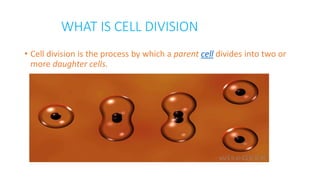
• Cell division is the process by which a parent cell divides into two or
more daughter cells.
TYPES OF CELL DIVISION
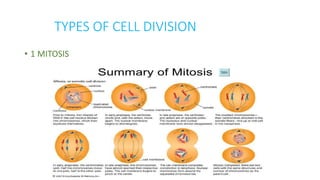
• 1 MITOSIS
MITOSIS DIVISION
• One cell splits into two identical daughter cells (cloning)
• Before the cell can divide the chromosomes have to be
copied
WHAT IS MITOSIS FOR?
• Produce new body cells for GROWTH
• Repair damaged tissue
• Simple plants and animals can also use mitosis to reproduce
• This is called Asexual reproduction
PHASES OF MITOSIS
• PHASE 1
• The chromosomes get thicker
PHASE 1 INTERPHASE
• The nucleolus and nuclear envelop are distinct and the chromosomes
are in a form of a threadlike chromatin
PHASE 2 PROPHASE
• The chromosomes are replicated and can now be seen as x-
shapes
PHASE 3 METHAPHASE
• The nuclear membrane disappears. The chromosomes line up
on the spindle. The chromosomes are pulled to opposite ends
of the cell.
PHASE 4 ANAPHASE
• The chromosomes split. Half the chromosome moves up to the pole
and the other half to the other pole.
PHASE 4 TELOPHASE
• Each new cell is IDENTICAL to the original and has THE SAME
number of chromosomes (diploid number = 2n)
Characteristics of authentic tasks Characteristic Tick if used  Description of use
Authentic activities have real-world relevance 
Authentic activities are ill-defined, requiring
students to define the tasks and sub-tasks needed
to complete the activity

Authentic activities comprise complex tasks to be
investigated by students over a sustained period of
time

Authentic activities provide the opportunity for
students to examine the task from different
perspectives, using a variety of resources

Authentic activities provide the opportunity to
collaborate
Authentic activities provide the opportunity to
reflect

Authentic activities can be integrated and applied
across different subject areas and lead beyond
domain-specific outcomes

Authentic activities are seamlessly integrated with
assessment

Authentic activities create polished products
valuable in their own right rather than as
preparation for something else

Authentic activities allow competing solutions and
diversity of outcome


CELL DIVISION

  • 2.
    WHAT IS CELLDIVISION • Cell division is the process by which a parent cell divides into two or more daughter cells.
  • 3.
    TYPES OF CELLDIVISION • 1 MITOSIS
  • 4.
    MITOSIS DIVISION • Onecell splits into two identical daughter cells (cloning) • Before the cell can divide the chromosomes have to be copied
  • 5.
    WHAT IS MITOSISFOR? • Produce new body cells for GROWTH • Repair damaged tissue • Simple plants and animals can also use mitosis to reproduce • This is called Asexual reproduction
  • 6.
    PHASES OF MITOSIS •PHASE 1 • The chromosomes get thicker
  • 7.
    PHASE 1 INTERPHASE •The nucleolus and nuclear envelop are distinct and the chromosomes are in a form of a threadlike chromatin
  • 8.
    PHASE 2 PROPHASE •The chromosomes are replicated and can now be seen as x- shapes
  • 9.
    PHASE 3 METHAPHASE •The nuclear membrane disappears. The chromosomes line up on the spindle. The chromosomes are pulled to opposite ends of the cell.
  • 10.
    PHASE 4 ANAPHASE •The chromosomes split. Half the chromosome moves up to the pole and the other half to the other pole.
  • 11.
    PHASE 4 TELOPHASE •Each new cell is IDENTICAL to the original and has THE SAME number of chromosomes (diploid number = 2n)
  • 12.
    Characteristics of authentictasks Characteristic Tick if used  Description of use Authentic activities have real-world relevance  Authentic activities are ill-defined, requiring students to define the tasks and sub-tasks needed to complete the activity  Authentic activities comprise complex tasks to be investigated by students over a sustained period of time  Authentic activities provide the opportunity for students to examine the task from different perspectives, using a variety of resources  Authentic activities provide the opportunity to collaborate Authentic activities provide the opportunity to reflect  Authentic activities can be integrated and applied across different subject areas and lead beyond domain-specific outcomes  Authentic activities are seamlessly integrated with assessment  Authentic activities create polished products valuable in their own right rather than as preparation for something else  Authentic activities allow competing solutions and diversity of outcome 