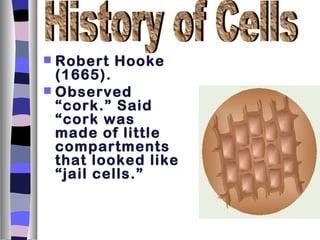
 Robert Hooke
  (1665).
 Observed
  “cork.” Said
  “cork was
  made of little
  compartments
  that looked like
  “jail cells.”
 Cells  are the smallest
  working units of living
  things.
 All living things are
  made of cells.
 All cells come from pre-
  existing cells.
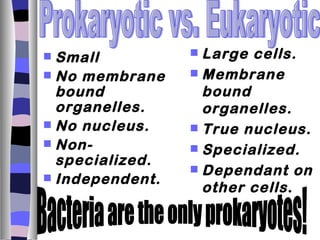
 Small           Large cells.
 No membrane     Membrane
  bound            bound
  organelles.      organelles.
 No nucleus.     True nucleus.
 Non-            Specialized.
  specialized.
                  Dependant on
 Independent.
                   other cells .
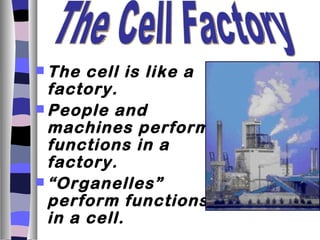
 The  cell is like a
  factory.
 People and
  machines perform
  functions in a
  factory.
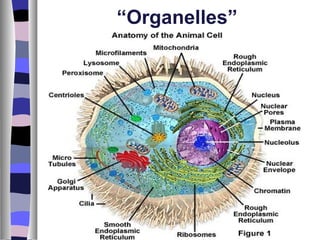
 “Organelles”
  perform functions
  in a cell.
 All factories
  produce a product.
 Cell product =
  proteins.
 Different cells
  produce different
  proteins.
 What is needed to
  build a protein?
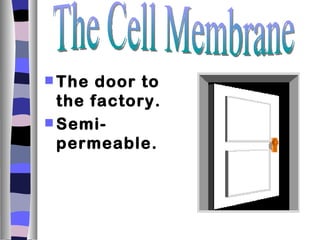
 The  door to
  the factory.
 Semi-
  permeable.
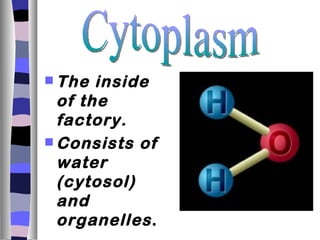
 The  inside
  of the
  factory.
 Consists of
  water
  (cytosol)
  and
  organelles .
“Organelles”
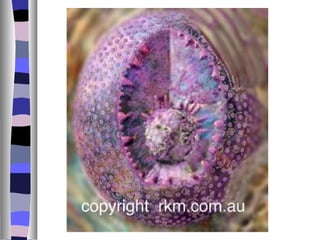
 The   “central office” of the
  cell.
 Most cell activity is
  initiated here.
 Contains chromosomes
  (DNA).
 DNA carries instructions
  for how to build something.
  What?
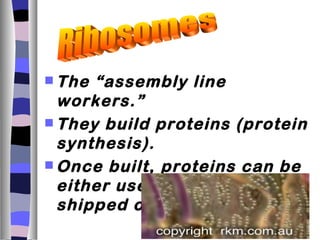
 The “assembly line
  workers.”
 They build proteins (protein
  synthesis).
 Once built, proteins can be
  either used by the cell or
  shipped out to other cells .
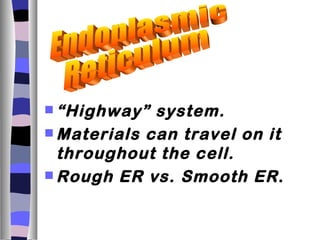
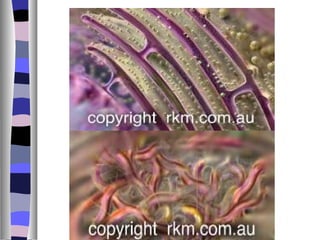
 “Highway”  system.
 Materials can travel on it
  throughout the cell.
 Rough ER vs. Smooth ER .
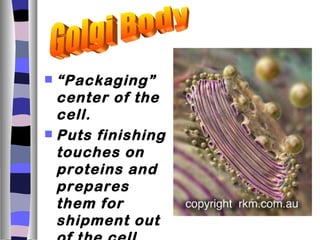
 “Packaging”
  center of the
  cell.
 Puts finishing
  touches on
  proteins and
  prepares
  them for
  shipment out
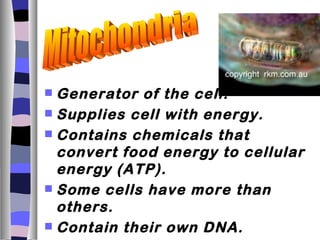
 Generator of the cell.
 Supplies cell with energy.
 Contains chemicals that
  convert food energy to cellular
  energy (ATP).
 Some cells have more than
  others.
 Contain their own DNA.
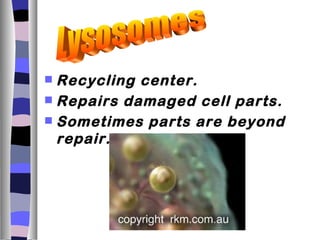
 Recycling center.
 Repairs damaged cell parts.
 Sometimes parts are beyond
  repair.
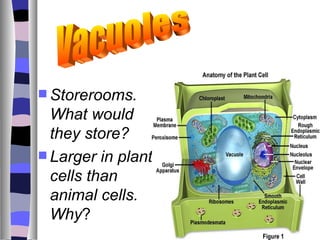
 Storerooms.
  What would
  they store?
 Larger in plant
  cells than
  animal cells.
  Why?
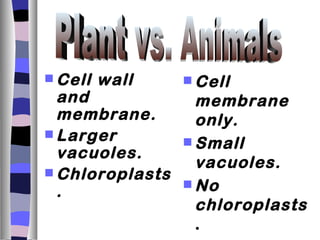
 Cell   wall     Cell
  and              membrane
  membrane.        only.
 Larger
                  Small
  vacuoles.
                   vacuoles.
 Chloroplasts
                  No
  .
                   chloroplasts
                   .
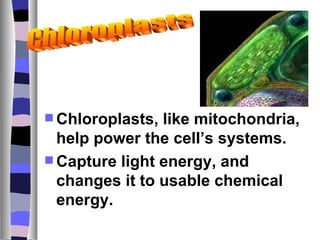
 Chloroplasts, like mitochondria,
  help power the cell’s systems.
 Capture light energy, and
  changes it to usable chemical
  energy.
 A network of thin materials that
  act as a scaffold and support the
  organelles.
 Microtubules– hollow filaments of
  protein.
 Microfilaments– solid filaments of
  protein.
Locomotion

Cilia
    •Short, numerous, hair-like
     projections from the
     plasma membrane.
    •Move with a coordinated
     beating action.
Locomotion

 Flagella
   •Longer, less numerous
    projections from the
    plasma membrane.
   •Move with a whiplike
    action.
Any Questions over

Prokaryotic/eukaryotic cells?
Eukaryotic cell organelles?
Organelle functions?

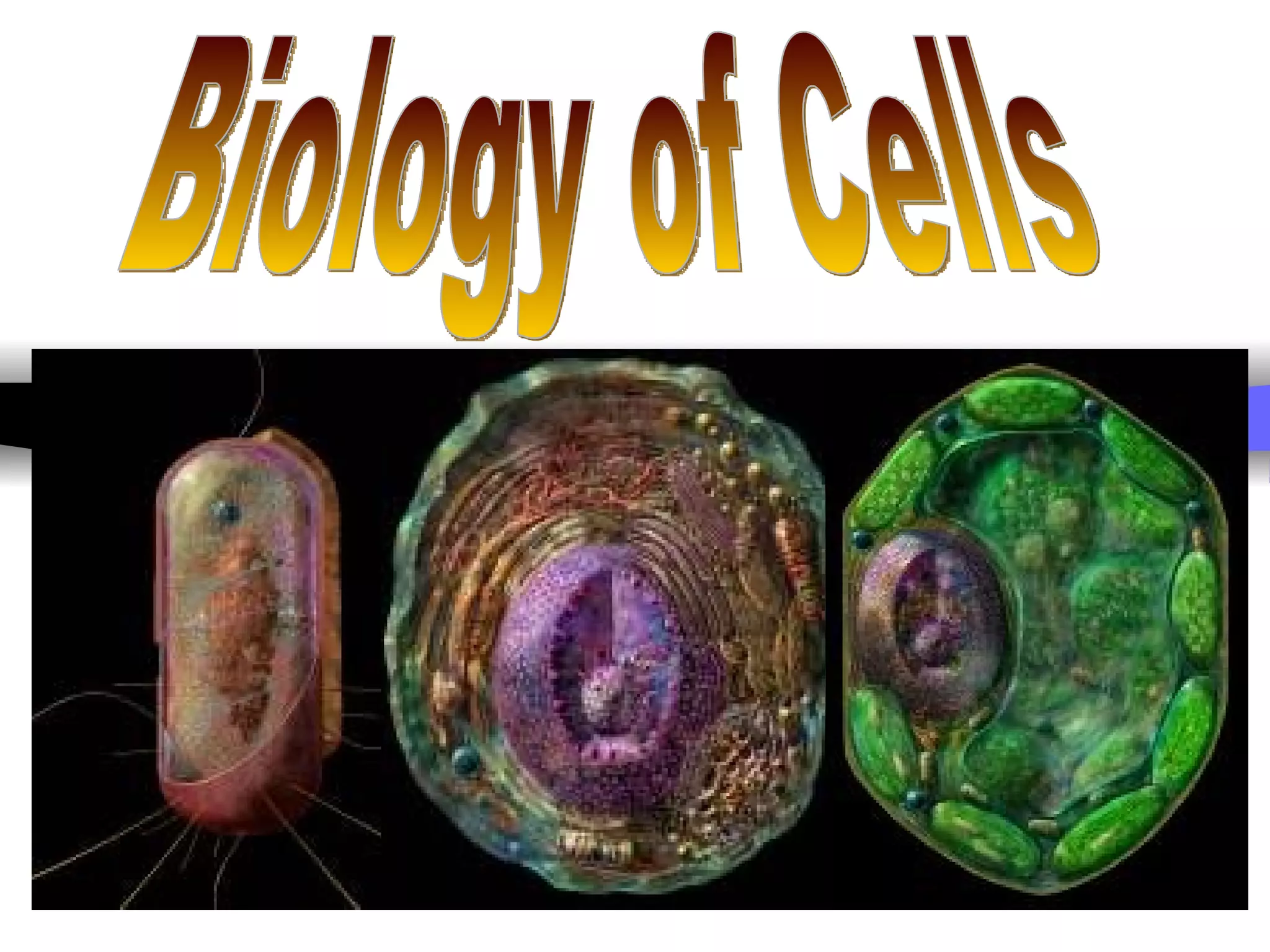
Cell factory2012

  • 2.
     Robert Hooke (1665).  Observed “cork.” Said “cork was made of little compartments that looked like “jail cells.”
  • 3.
     Cells are the smallest working units of living things.  All living things are made of cells.  All cells come from pre- existing cells.
  • 4.
     Small  Large cells.  No membrane  Membrane bound bound organelles. organelles.  No nucleus.  True nucleus.  Non-  Specialized. specialized.  Dependant on  Independent. other cells .
  • 5.
     The cell is like a factory.  People and machines perform functions in a factory.  “Organelles” perform functions in a cell.
  • 6.
     All factories produce a product.  Cell product = proteins.  Different cells produce different proteins.  What is needed to build a protein?
  • 7.
     The door to the factory.  Semi- permeable.
  • 8.
     The inside of the factory.  Consists of water (cytosol) and organelles .
  • 9.
  • 10.
     The “central office” of the cell.  Most cell activity is initiated here.  Contains chromosomes (DNA).  DNA carries instructions for how to build something. What?
  • 12.
     The “assemblyline workers.”  They build proteins (protein synthesis).  Once built, proteins can be either used by the cell or shipped out to other cells .
  • 13.
     “Highway” system.  Materials can travel on it throughout the cell.  Rough ER vs. Smooth ER .
  • 15.
     “Packaging” center of the cell.  Puts finishing touches on proteins and prepares them for shipment out
  • 16.
     Generator ofthe cell.  Supplies cell with energy.  Contains chemicals that convert food energy to cellular energy (ATP).  Some cells have more than others.  Contain their own DNA.
  • 17.
     Recycling center. Repairs damaged cell parts.  Sometimes parts are beyond repair.
  • 18.
     Storerooms. What would they store?  Larger in plant cells than animal cells. Why?
  • 19.
     Cell wall  Cell and membrane membrane. only.  Larger  Small vacuoles. vacuoles.  Chloroplasts  No . chloroplasts .
  • 20.
     Chloroplasts, likemitochondria, help power the cell’s systems.  Capture light energy, and changes it to usable chemical energy.
  • 21.
     A networkof thin materials that act as a scaffold and support the organelles.  Microtubules– hollow filaments of protein.  Microfilaments– solid filaments of protein.
  • 22.
    Locomotion Cilia •Short, numerous, hair-like projections from the plasma membrane. •Move with a coordinated beating action.
  • 23.
    Locomotion Flagella •Longer, less numerous projections from the plasma membrane. •Move with a whiplike action.
  • 24.
    Any Questions over Prokaryotic/eukaryoticcells? Eukaryotic cell organelles? Organelle functions?