Comparative Analysis - Footnotes
1)Howto footnote:
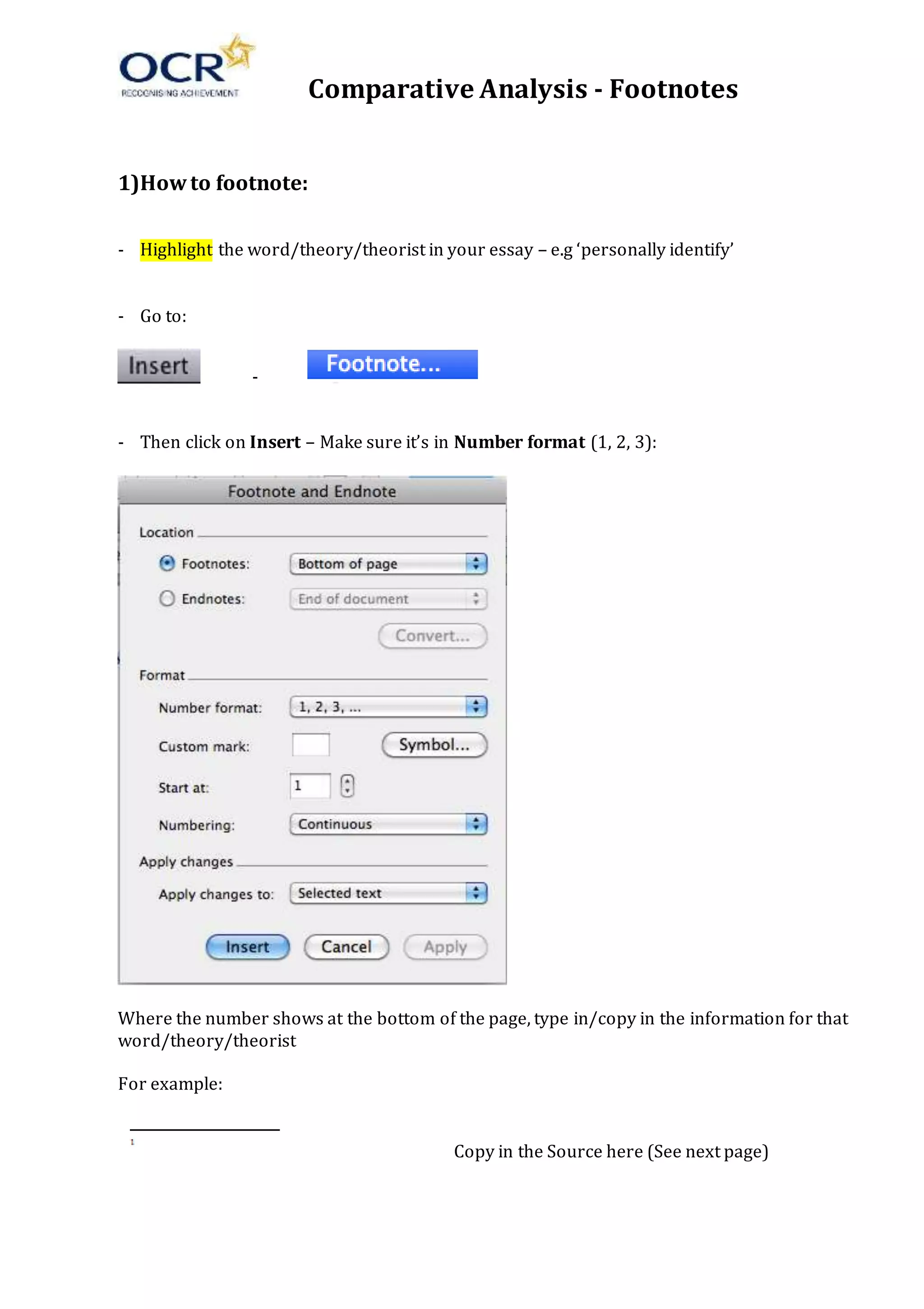
- Highlight the word/theory/theorist in your essay – e.g ‘personally identify’
- Go to:
-
- Then click on Insert – Make sure it’s in Number format (1, 2, 3):
Where the number shows at the bottom of the page, type in/copy in the information for that
word/theory/theorist
For example:
Copy in the Source here (See next page)
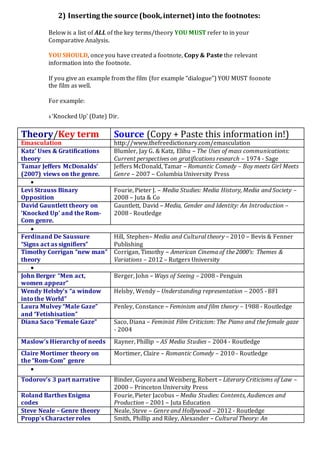
2) Inserting the source (book,internet) into the footnotes:
Below is a list of ALL of the key terms/theory YOU MUST refer to in your
Comparative Analysis.
YOU SHOULD, once you have created a footnote, Copy & Paste the relevant
information into the footnote.
If you give an example from the film (for example “dialogue”) YOU MUST foonote
the film as well.
For example:
4 ‘Knocked Up’ (Date) Dir.
Theory/Key term Source (Copy + Paste this information in!)
Emasculation http://www.thefreedictionary.com/emasculation
Katz’ Uses & Gratifications
theory
Blumler, Jay G. & Katz, Elihu – The Uses of mass communications:
Current perspectives on gratifications research – 1974 - Sage
Tamar Jeffers McDonalds’
(2007) views on the genre.
Jeffers McDonald, Tamar – Romantic Comedy – Boy meets Girl Meets
Genre – 2007 – Columbia University Press

Levi Strauss Binary
Opposition
Fourie, Pieter J. – Media Studies: Media History, Media and Society –
2008 – Juta & Co
David Gauntlett theory on
‘Knocked Up’ and the Rom-
Com genre.
Gauntlett, David – Media, Gender and Identity: An Introduction –
2008 - Routledge

Ferdinand De Saussure
“Signs act as signifiers”
Hill, Stephen– Media and Cultural theory – 2010 – Bevis & Fenner
Publishing
Timothy Corrigan “new man”
theory
Corrigan, Timothy – American Cinema of the 2000’s: Themes &
Variations – 2012 – Rutgers University

John Berger “Men act,
women appear”
Berger, John – Ways of Seeing – 2008 - Penguin
Wendy Helsby’s “a window
into the World”
Helsby, Wendy – Understanding representation – 2005 - BFI
Laura Mulvey “Male Gaze”
and “Fetishisation”
Penley, Constance – Feminism and film theory – 1988 - Routledge
Diana Saco “Female Gaze” Saco, Diana – Feminist Film Criticism: The Piano and the female gaze
- 2004
Maslow’s Hierarchy of needs Rayner, Phillip – AS Media Studies – 2004 - Routledge
Claire Mortimer theory on
the “Rom-Com” genre
Mortimer, Claire – Romantic Comedy – 2010 - Routledge

Todorov’s 3 part narrative Binder, Guyora and Weisberg, Robert – Literary Criticisms of Law –
2000 – Princeton University Press
Roland Barthes Enigma
codes
Fourie, Pieter Jacobus – Media Studies: Contents, Audiences and
Production – 2001 – Juta Education
Steve Neale – Genre theory Neale, Steve – Genre and Hollywood – 2012 - Routledge
Propp’s Character roles Smith, Phillip and Riley, Alexander – Cultural Theory: An
theory Introduction – 2011 – Blackwell Publishing
Zeitgeist http://www.thefreedictionary.com/Zeitgeist
Hartley’s 7 Subjectivities Hartley, John – Understanding News – 1982 – Methuen and Co Ltd
Antonio Gramsci –
Hegemony/Hegemonic
Equilibrium
Adamson, Water. L – Hegemony and Revolution: A study of Antonio
Gramsci’s political and cultural theory – 1983 – University of
California Press
Phillip Morency “Emotional
Role reversal” in ‘Forgetting
Sarah Marshall’
Morency, Phillip - On the Aisle – Volume 2: Film, Reviews – 2010 -
Stanley Cavell “Comedy re-
marriage”
Cavell, Stanley – Pursuits of Happiness: The Hollywood comedy of
remarriage – 1981 – Harvard Film Studies
“Drone” Game Axis Magazine – July 2008
Misogyny Gilmore, David D. – Misogyny: The Male Malady – 2009 – University
of Pennsylvania Press
Metrosexual Tungate, Mark – Branded Men: Marketing to Men – 2008
Machismo http://dictionary.reference.com/browse/machismo
Misandry http://www.thefreedictionary.com/misandry
‘Test of maturity’ (Robert Bly
– 1986)
Pease, Bob and Camilleri, Peter – Working with men in the human
services – 2001 – National Library of Australia
Femme-fatale http://www.thefreedictionary.com/femme+fatale
Neale & Krutnik “Monstrous
characters”
Neale, Steve and Krutnik, Frank – Popular Film and Television
Comedy – 1990 - Routledge
Alpha-Male http://www.urbandictionary.com/define.php?term=alpha%20male
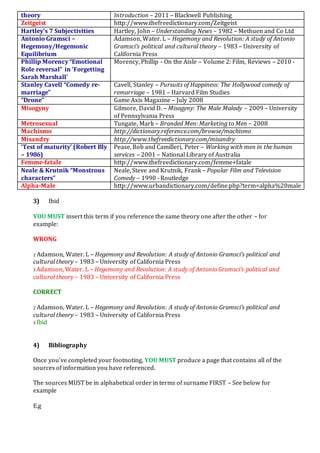
3) Ibid
YOU MUST insert this term if you reference the same theory one after the other – for
example:
WRONG
2 Adamson, Water. L – Hegemony and Revolution: A study of Antonio Gramsci’s political and
cultural theory – 1983 – University of California Press
3 Adamson, Water. L – Hegemony and Revolution: A study of Antonio Gramsci’s political and
cultural theory – 1983 – University of California Press
CORRECT
2 Adamson, Water. L – Hegemony and Revolution: A study of Antonio Gramsci’s political and
cultural theory – 1983 – University of California Press
3 Ibid
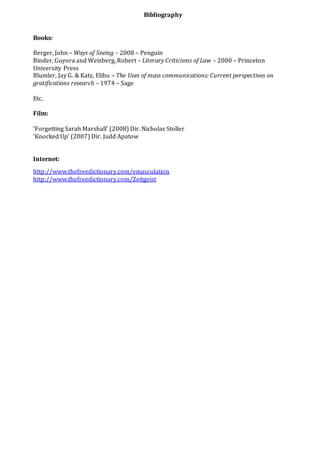
4) Bibliography
Once you’ve completed your footnoting, YOU MUST produce a page that contains all of the
sources of information you have referenced.
The sources MUST be in alphabetical order in terms of surname FIRST – See below for
example
E.g
Bibliography
Books:
Berger, John – Ways of Seeing – 2008 – Penguin
Binder, Guyora and Weisberg, Robert – Literary Criticisms of Law – 2000 – Princeton
University Press
Blumler, Jay G. & Katz, Elihu – The Uses of mass communications: Current perspectives on
gratifications research – 1974 – Sage
Etc.
Film:
‘Forgetting Sarah Marshall’ (2008) Dir. Nicholas Stoller
‘Knocked Up’ (2007) Dir. Judd Apatow
Internet:
http://www.thefreedictionary.com/emasculation
http://www.thefreedictionary.com/Zeitgeist

L11 l14 - footnote resource

  • 1.
    Comparative Analysis -Footnotes 1)Howto footnote: - Highlight the word/theory/theorist in your essay – e.g ‘personally identify’ - Go to: - - Then click on Insert – Make sure it’s in Number format (1, 2, 3): Where the number shows at the bottom of the page, type in/copy in the information for that word/theory/theorist For example: Copy in the Source here (See next page)
  • 2.
    2) Inserting thesource (book,internet) into the footnotes: Below is a list of ALL of the key terms/theory YOU MUST refer to in your Comparative Analysis. YOU SHOULD, once you have created a footnote, Copy & Paste the relevant information into the footnote. If you give an example from the film (for example “dialogue”) YOU MUST foonote the film as well. For example: 4 ‘Knocked Up’ (Date) Dir. Theory/Key term Source (Copy + Paste this information in!) Emasculation http://www.thefreedictionary.com/emasculation Katz’ Uses & Gratifications theory Blumler, Jay G. & Katz, Elihu – The Uses of mass communications: Current perspectives on gratifications research – 1974 - Sage Tamar Jeffers McDonalds’ (2007) views on the genre. Jeffers McDonald, Tamar – Romantic Comedy – Boy meets Girl Meets Genre – 2007 – Columbia University Press  Levi Strauss Binary Opposition Fourie, Pieter J. – Media Studies: Media History, Media and Society – 2008 – Juta & Co David Gauntlett theory on ‘Knocked Up’ and the Rom- Com genre. Gauntlett, David – Media, Gender and Identity: An Introduction – 2008 - Routledge  Ferdinand De Saussure “Signs act as signifiers” Hill, Stephen– Media and Cultural theory – 2010 – Bevis & Fenner Publishing Timothy Corrigan “new man” theory Corrigan, Timothy – American Cinema of the 2000’s: Themes & Variations – 2012 – Rutgers University  John Berger “Men act, women appear” Berger, John – Ways of Seeing – 2008 - Penguin Wendy Helsby’s “a window into the World” Helsby, Wendy – Understanding representation – 2005 - BFI Laura Mulvey “Male Gaze” and “Fetishisation” Penley, Constance – Feminism and film theory – 1988 - Routledge Diana Saco “Female Gaze” Saco, Diana – Feminist Film Criticism: The Piano and the female gaze - 2004 Maslow’s Hierarchy of needs Rayner, Phillip – AS Media Studies – 2004 - Routledge Claire Mortimer theory on the “Rom-Com” genre Mortimer, Claire – Romantic Comedy – 2010 - Routledge  Todorov’s 3 part narrative Binder, Guyora and Weisberg, Robert – Literary Criticisms of Law – 2000 – Princeton University Press Roland Barthes Enigma codes Fourie, Pieter Jacobus – Media Studies: Contents, Audiences and Production – 2001 – Juta Education Steve Neale – Genre theory Neale, Steve – Genre and Hollywood – 2012 - Routledge Propp’s Character roles Smith, Phillip and Riley, Alexander – Cultural Theory: An
  • 3.
    theory Introduction –2011 – Blackwell Publishing Zeitgeist http://www.thefreedictionary.com/Zeitgeist Hartley’s 7 Subjectivities Hartley, John – Understanding News – 1982 – Methuen and Co Ltd Antonio Gramsci – Hegemony/Hegemonic Equilibrium Adamson, Water. L – Hegemony and Revolution: A study of Antonio Gramsci’s political and cultural theory – 1983 – University of California Press Phillip Morency “Emotional Role reversal” in ‘Forgetting Sarah Marshall’ Morency, Phillip - On the Aisle – Volume 2: Film, Reviews – 2010 - Stanley Cavell “Comedy re- marriage” Cavell, Stanley – Pursuits of Happiness: The Hollywood comedy of remarriage – 1981 – Harvard Film Studies “Drone” Game Axis Magazine – July 2008 Misogyny Gilmore, David D. – Misogyny: The Male Malady – 2009 – University of Pennsylvania Press Metrosexual Tungate, Mark – Branded Men: Marketing to Men – 2008 Machismo http://dictionary.reference.com/browse/machismo Misandry http://www.thefreedictionary.com/misandry ‘Test of maturity’ (Robert Bly – 1986) Pease, Bob and Camilleri, Peter – Working with men in the human services – 2001 – National Library of Australia Femme-fatale http://www.thefreedictionary.com/femme+fatale Neale & Krutnik “Monstrous characters” Neale, Steve and Krutnik, Frank – Popular Film and Television Comedy – 1990 - Routledge Alpha-Male http://www.urbandictionary.com/define.php?term=alpha%20male 3) Ibid YOU MUST insert this term if you reference the same theory one after the other – for example: WRONG 2 Adamson, Water. L – Hegemony and Revolution: A study of Antonio Gramsci’s political and cultural theory – 1983 – University of California Press 3 Adamson, Water. L – Hegemony and Revolution: A study of Antonio Gramsci’s political and cultural theory – 1983 – University of California Press CORRECT 2 Adamson, Water. L – Hegemony and Revolution: A study of Antonio Gramsci’s political and cultural theory – 1983 – University of California Press 3 Ibid 4) Bibliography Once you’ve completed your footnoting, YOU MUST produce a page that contains all of the sources of information you have referenced. The sources MUST be in alphabetical order in terms of surname FIRST – See below for example E.g
  • 4.
    Bibliography Books: Berger, John –Ways of Seeing – 2008 – Penguin Binder, Guyora and Weisberg, Robert – Literary Criticisms of Law – 2000 – Princeton University Press Blumler, Jay G. & Katz, Elihu – The Uses of mass communications: Current perspectives on gratifications research – 1974 – Sage Etc. Film: ‘Forgetting Sarah Marshall’ (2008) Dir. Nicholas Stoller ‘Knocked Up’ (2007) Dir. Judd Apatow Internet: http://www.thefreedictionary.com/emasculation http://www.thefreedictionary.com/Zeitgeist