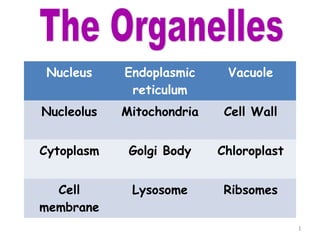
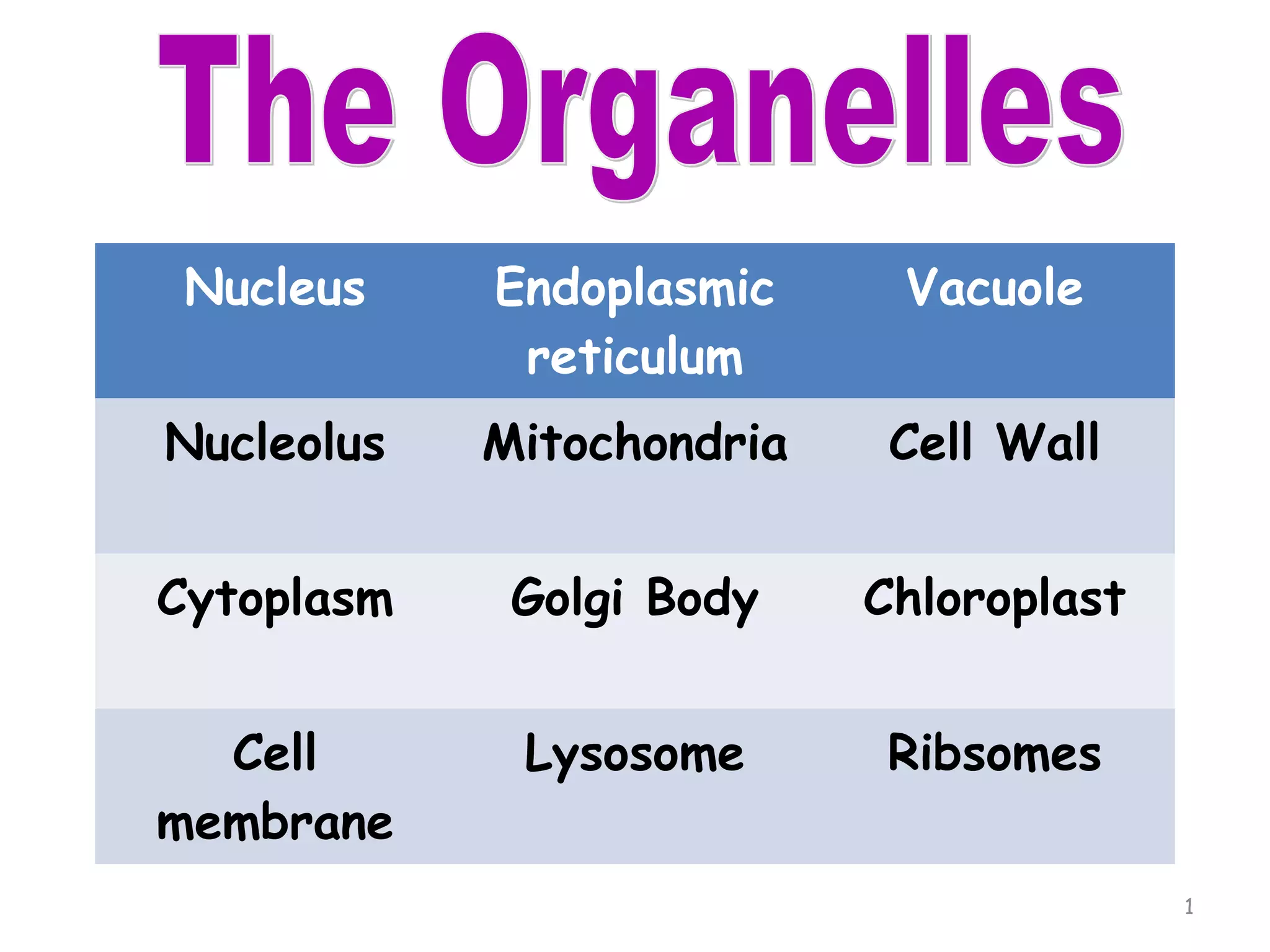
Nucleus    Endoplasmic     Vacuole
             reticulum
Nucleolus   Mitochondria    Cell Wall


Cytoplasm    Golgi Body    Chloroplast


  Cell       Lysosome       Ribsomes
membrane
                                         1
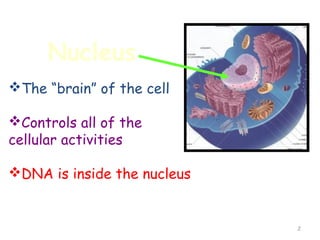
Nucleus
The “brain” of the cell

Controls all of the
cellular activities

DNA is inside the nucleus


                             2
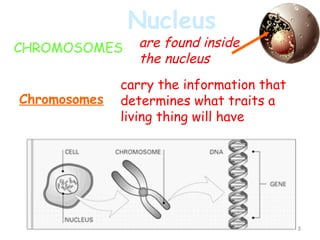
Nucleus
CHROMOSOMES- are found inside
             the nucleus
              carry the information that
Chromosomes – determines what traits a
              living thing will have


                                           3
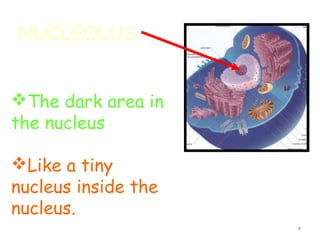
NUCLEOLUS


The dark area in
the nucleus

Like a tiny
nucleus inside the
nucleus.
                     4
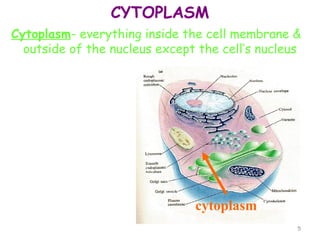
CYTOPLASM
Cytoplasm- everything inside the cell membrane &
  outside of the nucleus except the cell’s nucleus


                               cytoplasm
                                                 5
CELL MEMBRANE
 holds the cell together

 keeps all of the pieces (like the organelles
and the cytoplasm) inside the cell

 controls what goes in and out of the cell


   Example: like a big plastic bag with
              tiny holes in it

                                              6
Endoplasmic Reticulum
 known as the “ER”

 it is an organelle inside the cell that is
made up of membranes that are in the
CYTOPLASM of the cell

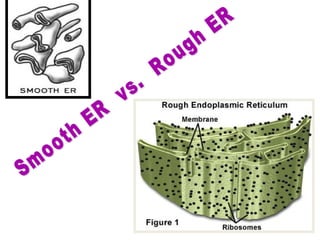
There are two different
 Smooth ER
 Rough ER


                                               7
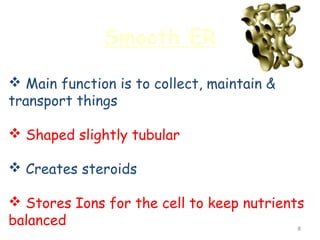
Smooth ER
 Main function is to collect, maintain &
transport things

 Shaped slightly tubular

 Creates steroids

 Stores Ions for the cell to keep nutrients
balanced                                    8
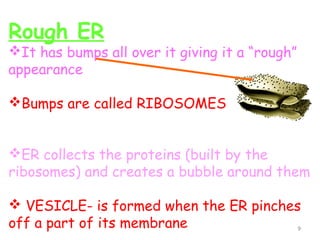
Rough ER
It has bumps all over it giving it a “rough”
appearance

Bumps are called RIBOSOMES


ER collects the proteins (built by the
ribosomes) and creates a bubble around them

 VESICLE- is formed when the ER pinches
off a part of its membrane                      9
10
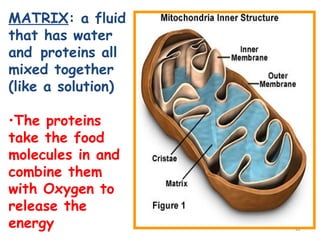
Mitochondria
 Mito = Mighty / Power

 The Power-House of the cell

 They break down food molecules so the
cell has the energy to live

 If a cell needs a lot of energy…it will have
more mitochondria (some could have 200 or
more)
                                            11
MATRIX: a fluid
that has water
and proteins all
mixed together
(like a solution)

•The proteins
take the food
molecules in and
combine them
with Oxygen to
release the
energy              12
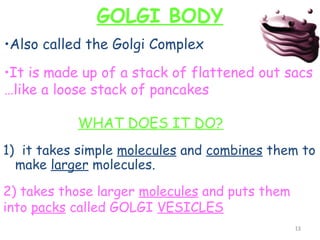
GOLGI BODY
•Also called the Golgi Complex
•It is made up of a stack of flattened out sacs
…like a loose stack of pancakes

           WHAT DOES IT DO?
1) it takes simple molecules and combines them to
  make larger molecules.

2) takes those larger molecules and puts them
into packs called GOLGI VESICLES
                                                13
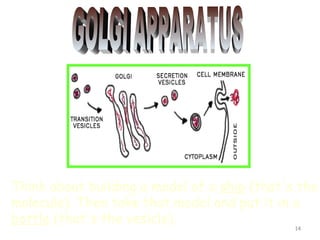
Think about building a model of a ship (that's the
molecule). Then take that model and put it in a
bottle (that's the vesicle).
                                              14
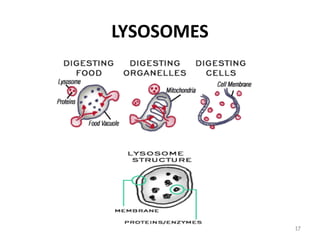
LYSOSOMES (primarily animal)

•They combine with the food taken in by the cell

•The enzymes in the lysosome bond to food &
digest it (acidic interior)

• Next…smaller molecules are released which
  are absorbed by the mitochondria


                                              15
LYSOSOMES
• When an organelle no longer works, the
  lysosome will attach itself to it and break it
  down like food (kind of like a cannibal)
   – Chemicals can then be reabsorbed or
     excreted

• Lysosomes can also destroy the cell if it
  breaks open accidentally
   – “Suicide Sacs”
   – UV light damages lysosome membrane

• The enzymes inside the lysosome spread
  throughout the cell and digest it            16
LYSOSOMES


            17
VACUOLE

• Vacuoles are “bubbles” that float in the
  cell 

• Vacuoles are more important to the
  survival of plant cells than they are to
  animal cells


                                         18
VACUOLE: STORAGE IN PLANT CELLS
• Vacuoles in plants support structure

• Vacuoles hold onto things that the cell might
  need…like a backpack

• There are some vacuoles that hold onto waste
  products, similar to having a big septic tank

• Storing waste products protects the cell from
  contamination

                                              19
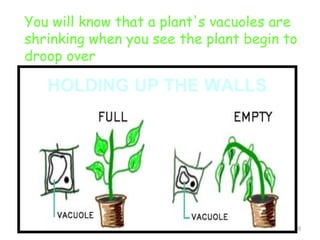
You will know that a plant's vacuoles are
shrinking when you see the plant begin to
droop over

   HOLDING UP THE WALLS


                                        20
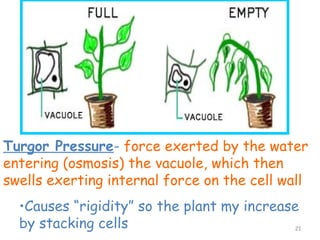
Turgor Pressure- force exerted by the water
entering (osmosis) the vacuole, which then
swells exerting internal force on the cell wall
  •Causes “rigidity” so the plant my increase
  by stacking cells                          21
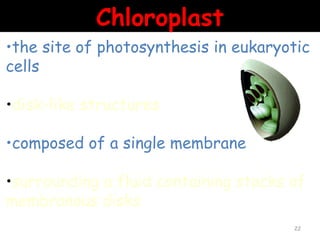
Chloroplast
•the site of photosynthesis in eukaryotic
cells

•disk-like structures

•composed of a single membrane

•surrounding a fluid containing stacks of
membranous disks
                                       22
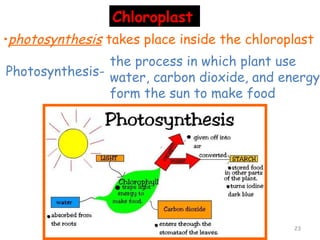
Chloroplast
•photosynthesis takes place inside the chloroplast
                the process in which plant use
Photosynthesis- water, carbon dioxide, and energy
                form the sun to make food


                                              23
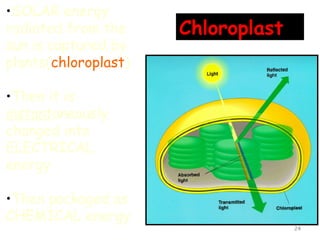
•SOLAR energy
radiated from the     Chloroplast
sun is captured by
plants(chloroplast)

•Then it is
instantaneously
changed into
ELECTRICAL
energy

•Then packaged as
CHEMICAL energy
                                    24
Ribosomes
•small dot-like structures in cells

•they are often associated with forming
 rough ER

•Ribosomes are the site of protein synthesis
in cells

•they are made in the nucleus of the cell

•A ribosome can make the average protein in
about one minute                            25
Types of Ribosomes
•There are two kinds of ribosomes
    1) Attached to the rough ER
    2) floating in the cell cytoplasm
•Attached ribosomes make proteins that are
used in the ER or transported within the ER
•Free ribosomes make proteins that are used
in the cytoplasm

                                         26
27
1. Which organelle is known as the “Brain” of the cell?
2. If you look at a picture of a cell, how would you
recognize the nucleolus?
3. List the 3 main jobs of the cell membrane
4. Explain why the cell membrane has tiny holes made
of protein in it (think of the gate).
5. The term hydro means _________.
     A. If something is hydrophobic it is _________
                                                   28
     B. If something is hydrophilic it is __________
1. Which organelle is known as the Power House” of
the cell?
2. The mitochondria of a cell share the same job as
the __________ (hint- an organ) in the human body.
3. Explain how you could distinguish the rough ER
from the smooth ER.
4. What is the main job of the smooth ER?
5. What type of reactions occur on the inner
membrane of the mitochondria? (produces energy)

                                                    29
1. What is the main function of a lysosome?

2. What happens if a lysosome breaks open?

3. Explain the difference between cytoplasm and
protoplasm. (draw a diagram if it will help you)

4. Why are vacuoles important to PLANTS?
5. Which organelle is the site of photosynthesis?
6. What are the three main ingredients for
photosynthesis?
                                                    30

Cell organelle power point notes

  • 1.
    Nucleus Endoplasmic Vacuole reticulum Nucleolus Mitochondria Cell Wall Cytoplasm Golgi Body Chloroplast Cell Lysosome Ribsomes membrane 1
  • 2.
    Nucleus The “brain” ofthe cell Controls all of the cellular activities DNA is inside the nucleus 2
  • 3.
    Nucleus CHROMOSOMES- are foundinside the nucleus carry the information that Chromosomes – determines what traits a living thing will have 3
  • 4.
    NUCLEOLUS The dark areain the nucleus Like a tiny nucleus inside the nucleus. 4
  • 5.
    CYTOPLASM Cytoplasm- everything insidethe cell membrane & outside of the nucleus except the cell’s nucleus cytoplasm 5
  • 6.
    CELL MEMBRANE  holdsthe cell together  keeps all of the pieces (like the organelles and the cytoplasm) inside the cell  controls what goes in and out of the cell Example: like a big plastic bag with tiny holes in it 6
  • 7.
    Endoplasmic Reticulum  knownas the “ER”  it is an organelle inside the cell that is made up of membranes that are in the CYTOPLASM of the cell There are two different Smooth ER Rough ER 7
  • 8.
    Smooth ER  Mainfunction is to collect, maintain & transport things  Shaped slightly tubular  Creates steroids  Stores Ions for the cell to keep nutrients balanced 8
  • 9.
    Rough ER It hasbumps all over it giving it a “rough” appearance Bumps are called RIBOSOMES ER collects the proteins (built by the ribosomes) and creates a bubble around them  VESICLE- is formed when the ER pinches off a part of its membrane 9
  • 10.
  • 11.
    Mitochondria  Mito =Mighty / Power  The Power-House of the cell  They break down food molecules so the cell has the energy to live  If a cell needs a lot of energy…it will have more mitochondria (some could have 200 or more) 11
  • 12.
    MATRIX: a fluid thathas water and proteins all mixed together (like a solution) •The proteins take the food molecules in and combine them with Oxygen to release the energy 12
  • 13.
    GOLGI BODY •Also calledthe Golgi Complex •It is made up of a stack of flattened out sacs …like a loose stack of pancakes WHAT DOES IT DO? 1) it takes simple molecules and combines them to make larger molecules. 2) takes those larger molecules and puts them into packs called GOLGI VESICLES 13
  • 14.
    Think about buildinga model of a ship (that's the molecule). Then take that model and put it in a bottle (that's the vesicle). 14
  • 15.
    LYSOSOMES (primarily animal) •Theycombine with the food taken in by the cell •The enzymes in the lysosome bond to food & digest it (acidic interior) • Next…smaller molecules are released which are absorbed by the mitochondria 15
  • 16.
    LYSOSOMES • When anorganelle no longer works, the lysosome will attach itself to it and break it down like food (kind of like a cannibal) – Chemicals can then be reabsorbed or excreted • Lysosomes can also destroy the cell if it breaks open accidentally – “Suicide Sacs” – UV light damages lysosome membrane • The enzymes inside the lysosome spread throughout the cell and digest it 16
  • 17.
  • 18.
    VACUOLE • Vacuoles are“bubbles” that float in the cell  • Vacuoles are more important to the survival of plant cells than they are to animal cells 18
  • 19.
    VACUOLE: STORAGE INPLANT CELLS • Vacuoles in plants support structure • Vacuoles hold onto things that the cell might need…like a backpack • There are some vacuoles that hold onto waste products, similar to having a big septic tank • Storing waste products protects the cell from contamination 19
  • 20.
    You will knowthat a plant's vacuoles are shrinking when you see the plant begin to droop over HOLDING UP THE WALLS 20
  • 21.
    Turgor Pressure- forceexerted by the water entering (osmosis) the vacuole, which then swells exerting internal force on the cell wall •Causes “rigidity” so the plant my increase by stacking cells 21
  • 22.
    Chloroplast •the site ofphotosynthesis in eukaryotic cells •disk-like structures •composed of a single membrane •surrounding a fluid containing stacks of membranous disks 22
  • 23.
    Chloroplast •photosynthesis takes placeinside the chloroplast the process in which plant use Photosynthesis- water, carbon dioxide, and energy form the sun to make food 23
  • 24.
    •SOLAR energy radiated fromthe Chloroplast sun is captured by plants(chloroplast) •Then it is instantaneously changed into ELECTRICAL energy •Then packaged as CHEMICAL energy 24
  • 25.
    Ribosomes •small dot-like structuresin cells •they are often associated with forming rough ER •Ribosomes are the site of protein synthesis in cells •they are made in the nucleus of the cell •A ribosome can make the average protein in about one minute 25
  • 26.
    Types of Ribosomes •Thereare two kinds of ribosomes 1) Attached to the rough ER 2) floating in the cell cytoplasm •Attached ribosomes make proteins that are used in the ER or transported within the ER •Free ribosomes make proteins that are used in the cytoplasm 26
  • 27.
  • 28.
    1. Which organelleis known as the “Brain” of the cell? 2. If you look at a picture of a cell, how would you recognize the nucleolus? 3. List the 3 main jobs of the cell membrane 4. Explain why the cell membrane has tiny holes made of protein in it (think of the gate). 5. The term hydro means _________. A. If something is hydrophobic it is _________ 28 B. If something is hydrophilic it is __________
  • 29.
    1. Which organelleis known as the Power House” of the cell? 2. The mitochondria of a cell share the same job as the __________ (hint- an organ) in the human body. 3. Explain how you could distinguish the rough ER from the smooth ER. 4. What is the main job of the smooth ER? 5. What type of reactions occur on the inner membrane of the mitochondria? (produces energy) 29
  • 30.
    1. What isthe main function of a lysosome? 2. What happens if a lysosome breaks open? 3. Explain the difference between cytoplasm and protoplasm. (draw a diagram if it will help you) 4. Why are vacuoles important to PLANTS? 5. Which organelle is the site of photosynthesis? 6. What are the three main ingredients for photosynthesis? 30

Editor's Notes

  • #4 http://www.bioethics.org.nz/publications/human-genes-discussion-jan04/html/page4.html
  • #11 http://micro.magnet.fsu.edu/cells/animals/images/endoplasmic.jpg
  • #12 vilenski.org/science/safari/ cellstructure/mito.html
  • #13 http://cwx.prenhall.com/horton/medialib/media_portfolio/text_images/FG01_15-03UN.JPG
  • #15 Pic: http://biology4kids.com/files/cell_golgi.html
  • #17 -
  • #25 http://fig.cox.miami.edu/Faculty/Dana/chloroplast1.jpg