THE FUNDAMENTAL
UNIT OF LIFE
Farhan alam
IX – B
14
PresentatIon By -
ROBERT HOOKEROBERT HOOKE
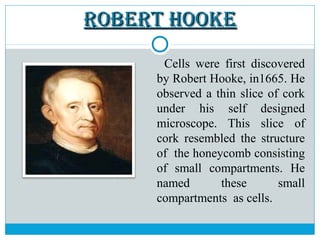
Cells were first discovered
by Robert Hooke, in1665. He
observed a thin slice of cork
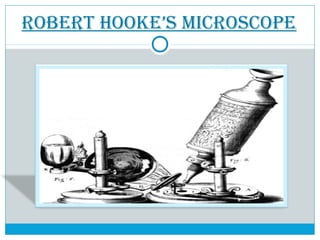
under his self designed
microscope. This slice of
cork resembled the structure
of the honeycomb consisting
of small compartments. He
named these small
compartments as cells.
ROBERT HOOKE’S MICROSCOPE
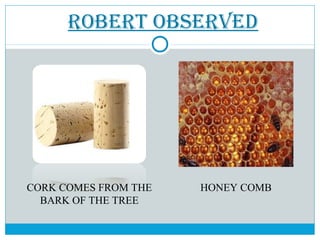
ROBERT OBSERVED
CORK COMES FROM THE
BARK OF THE TREE
HONEY COMB
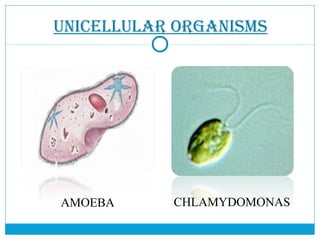
UNICELLULAR ORGANISMS
AMOEBA CHLAMYDOMONAS
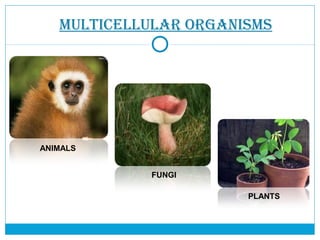
MULTICELLULAR ORGANISMS
ANIMALS
PLANTS
FUNGI
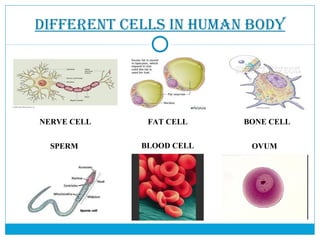
DIFFERENT CELLS IN HUMAN BODY
BONE CELL
OVUMSPERM BLOOD CELL
NERVE CELL FAT CELL
CELL
 A cell is the smallest unit that is capable
of performing life functions.
CELL
The shape and size of cells are related to
the specific function they perform.
Each living cell has the capacity to perform
certain basic functions.
Cell contains a specific component called
organelles.
Each kind of cell organelle performs a
special function.
All cells are found to have the same
organelles , irrespective of their function
and which organism they are found in.
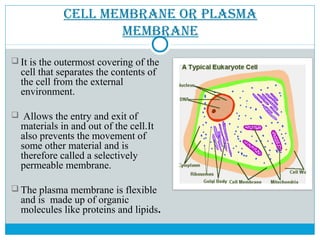
CELL mEmbranE or PLasma
mEmbranE
 It is the outermost covering of the
cell that separates the contents of
the cell from the external
environment.
 Allows the entry and exit of
materials in and out of the cell.It
also prevents the movement of
some other material and is
therefore called a selectively
permeable membrane.
 The plasma membrane is flexible
and is made up of organic
molecules like proteins and lipids.
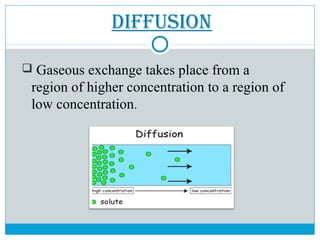
DIFFUsIon
 Gaseous exchange takes place from a
region of higher concentration to a region of
low concentration.
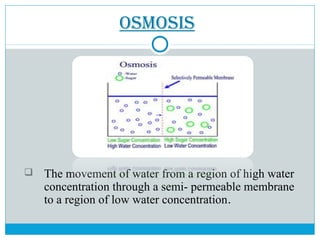
osmosIs
 The movement of water from a region of high water
concentration through a semi- permeable membrane
to a region of low water concentration.
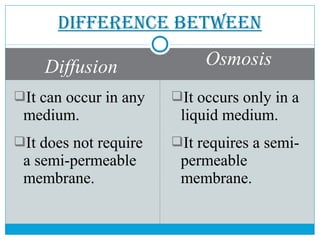
Diffusion Osmosis
It can occur in any
medium.
It does not require
a semi-permeable
membrane.
It occurs only in a
liquid medium.
It requires a semi-
permeable
membrane.
DIFFErEnCE bEtwEEn
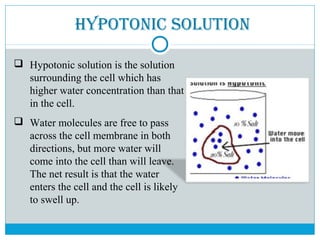
HyPotonIC soLUtIon
 Hypotonic solution is the solution
surrounding the cell which has
higher water concentration than that
in the cell.
 Water molecules are free to pass
across the cell membrane in both
directions, but more water will
come into the cell than will leave.
The net result is that the water
enters the cell and the cell is likely
to swell up.
IsotonIC soLUtIon
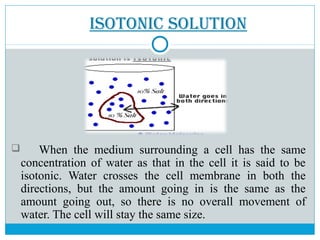
 When the medium surrounding a cell has the same
concentration of water as that in the cell it is said to be
isotonic. Water crosses the cell membrane in both the
directions, but the amount going in is the same as the
amount going out, so there is no overall movement of
water. The cell will stay the same size.
HyPErtonIC soLUtIon
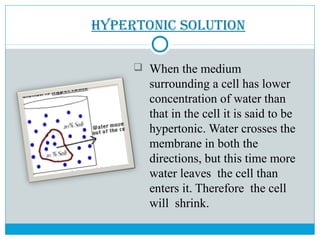
 When the medium
surrounding a cell has lower
concentration of water than
that in the cell it is said to be
hypertonic. Water crosses the
membrane in both the
directions, but this time more
water leaves the cell than
enters it. Therefore the cell
will shrink.
Plasmolysis
 Plasmolysis is
the phenomenon
by which a plant
cell shrinks away
from the cell wall
when it loses
water by osmosis.
Cell wall
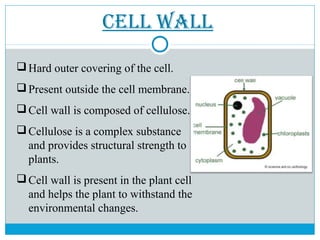
Hard outer covering of the cell.
Present outside the cell membrane.
Cell wall is composed of cellulose.
Cellulose is a complex substance
and provides structural strength to
plants.
Cell wall is present in the plant cell
and helps the plant to withstand the
environmental changes.
NuCleus
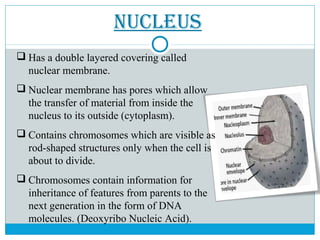
 Has a double layered covering called
nuclear membrane.
 Nuclear membrane has pores which allow
the transfer of material from inside the
nucleus to its outside (cytoplasm).
 Contains chromosomes which are visible as
rod-shaped structures only when the cell is
about to divide.
 Chromosomes contain information for
inheritance of features from parents to the
next generation in the form of DNA
molecules. (Deoxyribo Nucleic Acid).
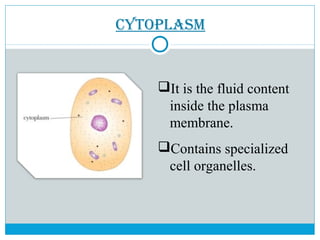
CytoPlasm
It is the fluid content
inside the plasma
membrane.
Contains specialized
cell organelles.
ENDOPLASMIC RETICULUM
GOLGI APPARATUS
LYSOSOMES
MITOCHONDRIA
PLASTIDS
VACUOLES
Cell orgaNelles
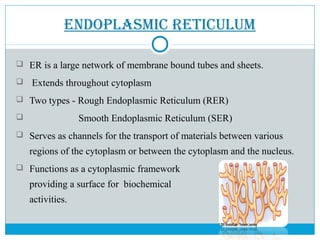
eNdoPlasmiC retiCulum
 ER is a large network of membrane bound tubes and sheets.
 Extends throughout cytoplasm
 Two types - Rough Endoplasmic Reticulum (RER)
 Smooth Endoplasmic Reticulum (SER)
 Serves as channels for the transport of materials between various
regions of the cytoplasm or between the cytoplasm and the nucleus.
 Functions as a cytoplasmic framework
providing a surface for biochemical
activities.
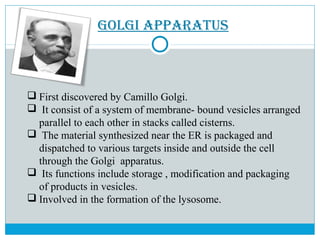
golgi aPParatus
 First discovered by Camillo Golgi.
 It consist of a system of membrane- bound vesicles arranged
parallel to each other in stacks called cisterns.
 The material synthesized near the ER is packaged and
dispatched to various targets inside and outside the cell
through the Golgi apparatus.
 Its functions include storage , modification and packaging
of products in vesicles.
 Involved in the formation of the lysosome.
lysosomes
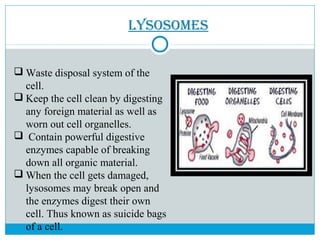
 Waste disposal system of the
cell.
 Keep the cell clean by digesting
any foreign material as well as
worn out cell organelles.
 Contain powerful digestive
enzymes capable of breaking
down all organic material.
 When the cell gets damaged,
lysosomes may break open and
the enzymes digest their own
cell. Thus known as suicide bags
of a cell.
Mitochondria
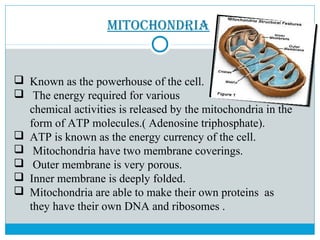
 Known as the powerhouse of the cell.
 The energy required for various
chemical activities is released by the mitochondria in the
form of ATP molecules.( Adenosine triphosphate).
 ATP is known as the energy currency of the cell.
 Mitochondria have two membrane coverings.
 Outer membrane is very porous.
 Inner membrane is deeply folded.
 Mitochondria are able to make their own proteins as
they have their own DNA and ribosomes .
Plastids
 Present in plant cells.
 Two types- 1) Chromoplasts (coloured)
 2) Leucoplasts (colourless)
 Plastids containing green pigment chlorophyll
are called Chloroplasts.
 Leucoplasts store materials as starch, oils and
protein granules.
 Plastids contain membrane layers embedded in
a material called stoma.
 Has a similar structure like the mitochondria.
 Have their own DNA and ribosomes.
Vacuoles
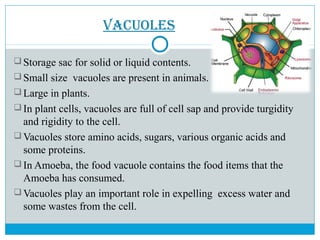
 Storage sac for solid or liquid contents.
 Small size vacuoles are present in animals.
 Large in plants.
 In plant cells, vacuoles are full of cell sap and provide turgidity
and rigidity to the cell.
 Vacuoles store amino acids, sugars, various organic acids and
some proteins.
 In Amoeba, the food vacuole contains the food items that the
Amoeba has consumed.
 Vacuoles play an important role in expelling excess water and
some wastes from the cell.
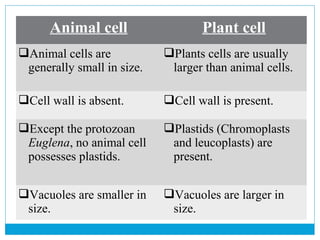
Animal cell Plant cell
Animal cells are
generally small in size.
Plants cells are usually
larger than animal cells.
Cell wall is absent. Cell wall is present.
Except the protozoan
Euglena, no animal cell
possesses plastids.
Plastids (Chromoplasts
and leucoplasts) are
present.
Vacuoles are smaller in
size.
Vacuoles are larger in
size.
The fundamental unit of life