Cell Organelles © J Beauchemin 2006
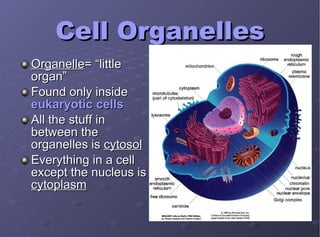
Cell Organelles Organelle = “little organ” Found only inside  eukaryotic cells All the stuff in between the organelles is  cytosol Everything in a cell except the nucleus is  cytoplasm
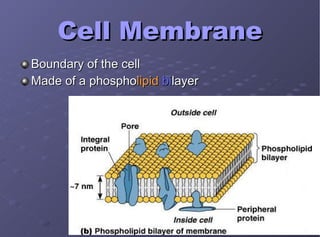
Cell Membrane Boundary of the cell Made of a phospho lipid   bi layer
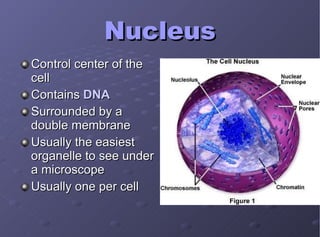
Nucleus Control center of the cell Contains  DNA Surrounded by a double membrane Usually the easiest organelle to see under a microscope Usually one per cell
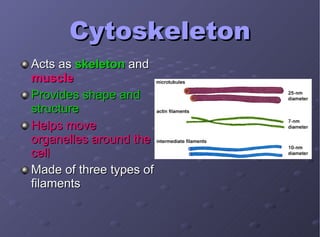
Cytoskeleton Acts as  skeleton  and  muscle Provides shape and structure Helps move organelles around the cell Made of three types of filaments
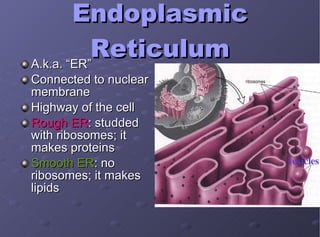
Endoplasmic Reticulum A.k.a. “ER” Connected to nuclear membrane Highway of the cell Rough ER : studded with ribosomes; it makes proteins Smooth ER : no ribosomes; it makes lipids
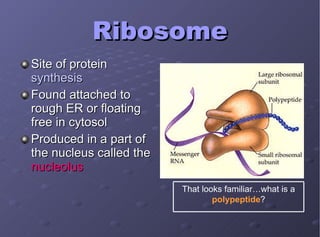
Ribosome Site of protein  synthesis Found attached to rough ER or floating free in cytosol Produced in a part of the nucleus called the  nucleolus That looks familiar…what is a  polypeptide ?
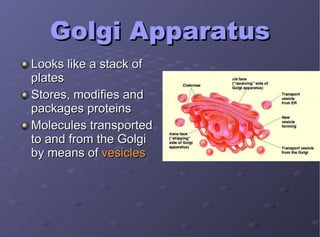
Golgi Apparatus Looks like a stack of plates Stores, modifies and packages proteins Molecules transported to and from the Golgi by means of  vesicles
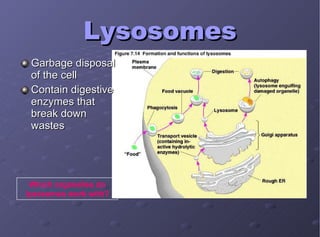
Lysosomes Garbage disposal of the cell Contain digestive enzymes that break down wastes Which organelles do lysosomes work with?
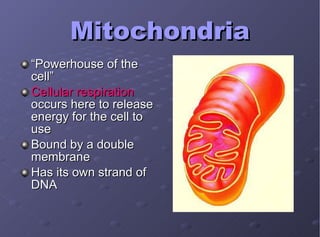
Mitochondria “ Powerhouse of the cell” Cellular respiration  occurs here to release energy for the cell to use Bound by a double membrane Has its own strand of DNA
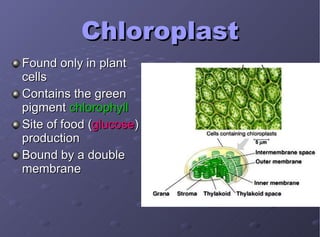
Chloroplast Found only in plant cells Contains the green pigment  chlorophyll Site of food ( glucose ) production Bound by a double membrane
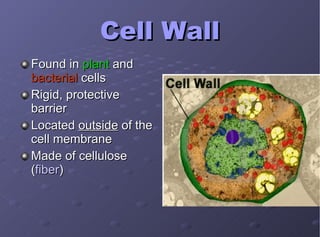
Cell Wall Found in  plant  and  bacterial  cells Rigid, protective barrier Located  outside  of the cell membrane Made of cellulose ( fiber )
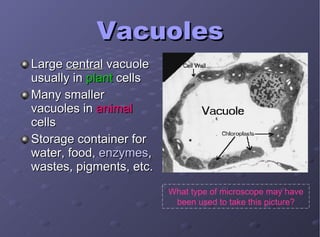
Vacuoles Large  central  vacuole usually in  plant  cells Many smaller vacuoles in  animal  cells Storage container for water, food,  enzymes , wastes, pigments, etc. What type of microscope may have been used to take this picture?
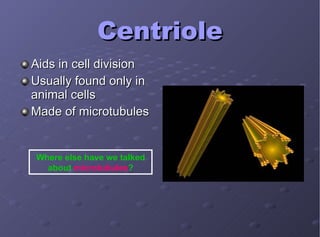
Centriole Aids in cell division Usually found only in animal cells Made of microtubules Where else have we talked about  microtubules ?
Quick Review Which organelle is the control center of the cell?  Nucleus Which organelle holds the cell together? Cell membrane Which organelles are not found in animal cells? Cell wall, central vacuole, chloroplasts Which organelle helps plant cells make food? Chloroplasts What does  E.R. stand for? Endoplasmic reticulum

Cell Organelles

  • 1.
    Cell Organelles ©J Beauchemin 2006
  • 2.
    Cell Organelles Organelle= “little organ” Found only inside eukaryotic cells All the stuff in between the organelles is cytosol Everything in a cell except the nucleus is cytoplasm
  • 3.
    Cell Membrane Boundaryof the cell Made of a phospho lipid bi layer
  • 4.
    Nucleus Control centerof the cell Contains DNA Surrounded by a double membrane Usually the easiest organelle to see under a microscope Usually one per cell
  • 5.
    Cytoskeleton Acts as skeleton and muscle Provides shape and structure Helps move organelles around the cell Made of three types of filaments
  • 6.
    Endoplasmic Reticulum A.k.a.“ER” Connected to nuclear membrane Highway of the cell Rough ER : studded with ribosomes; it makes proteins Smooth ER : no ribosomes; it makes lipids
  • 7.
    Ribosome Site ofprotein synthesis Found attached to rough ER or floating free in cytosol Produced in a part of the nucleus called the nucleolus That looks familiar…what is a polypeptide ?
  • 8.
    Golgi Apparatus Lookslike a stack of plates Stores, modifies and packages proteins Molecules transported to and from the Golgi by means of vesicles
  • 9.
    Lysosomes Garbage disposalof the cell Contain digestive enzymes that break down wastes Which organelles do lysosomes work with?
  • 10.
    Mitochondria “ Powerhouseof the cell” Cellular respiration occurs here to release energy for the cell to use Bound by a double membrane Has its own strand of DNA
  • 11.
    Chloroplast Found onlyin plant cells Contains the green pigment chlorophyll Site of food ( glucose ) production Bound by a double membrane
  • 12.
    Cell Wall Foundin plant and bacterial cells Rigid, protective barrier Located outside of the cell membrane Made of cellulose ( fiber )
  • 13.
    Vacuoles Large central vacuole usually in plant cells Many smaller vacuoles in animal cells Storage container for water, food, enzymes , wastes, pigments, etc. What type of microscope may have been used to take this picture?
  • 14.
    Centriole Aids incell division Usually found only in animal cells Made of microtubules Where else have we talked about microtubules ?
  • 15.
    Quick Review Whichorganelle is the control center of the cell? Nucleus Which organelle holds the cell together? Cell membrane Which organelles are not found in animal cells? Cell wall, central vacuole, chloroplasts Which organelle helps plant cells make food? Chloroplasts What does E.R. stand for? Endoplasmic reticulum

Editor's Notes

  • #2 Use this presentation in conjunction with the Cell Organelle note-taking worksheet. Run through the entire presentation before using it in class so that you know what’s coming next! It helps to print the outline and notes to have with you while presenting so that there are no surprises. –JessB.org
  • #3 You may or may not wish to distinguish between cytosol and cytoplasm. The correct use of each term is shown here. Most high school textbooks, however, use the word “cytoplasm” to mean “cytosol.”
  • #4 Emphasize word parts here: phospho= phosphate head; lipid= fatty acid tail bi= 2
  • #5 Cells with more than one nucleus include muscle cells and liver cells, largely because of the massive volume of cytoplasm and number of organelles that need controlling.
  • #6 Actin, also found in muscle cells, mainly help maintain cell shape in their cytoskeletal role. Microtubules mostly move organelles around the cell. Intermediate filaments also provide structural support.
  • #7 It’s not necessary that the students can read the labels here; just point out the black dots are ribosomes.
  • #8 A polypeptide is a chain of amino acids. In this diagram, you can see the ribosome is making a polypeptide, also known as a protein.
  • #9 AKA Golgi Complex. It is not necessary that the students read the labels, this diagram gives them a general idea of the Golgi’s shape.
  • #10 Students should recognize the shapes of the Golgi and ER even if they cannot read the captions.
  • #11 Explain that this diagram shows the mitochondria cut open to reveal the internal membranes.
  • #12 Chloroplasts absorb light, which is the catalyst for photosynthesis.
  • #13 This is an actual microscopic image. Explain that the colors are added digitally to enhance the different parts.
  • #14 The image is 2D, so it must have been a light microscope or TEM. If the cell is very tiny, then a TEM was used. Otherwise, a strong light microscope could have captured this image.
  • #15 Microtubules are also part of the cytoskeleton.
  • #16 You may choose to delete the answers from the PowerPoint or change the animation so that they come in after all 5 questions are asked in case you want to quiz students individually at the end.