Why Do Cells Need To Divide?
 It depends on the organism
 Unicellular organisms like bacteria
  (prokaryotes) divide to reproduce
 Multicellular organisms (most eukaryotes)
  use it to grow larger and repair damaged
  cells.
3 Types of Cell Division
 1. Binary fission-cell division in
  prokaryotes
 2. Cell Cycle (with Mitosis)-cell division in
  eukaryotes
 3. Meiosis—cell division to form sex cells
  (egg and sperm)
Prokaryotes
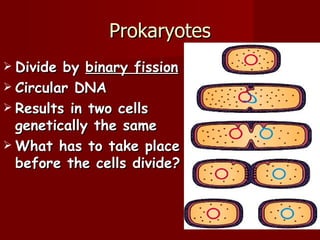
 Divide by binary fission
 Circular DNA
 Results in two cells
  genetically the same
 What has to take place
  before the cells divide?
Eukaryotes
   The Cell Cycle
    – Growth
    – Repair or replacement of cells.
 Some cells die quickly and need to be
  replaced a lot (skin cells).
 Some cells never get replaced (nerve
  cells).
 Some organisms can regenerate whole
  body parts.
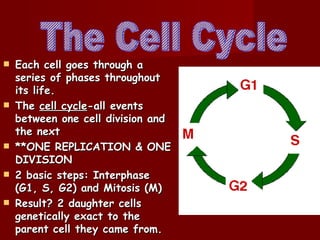
   Each cell goes through a
    series of phases throughout
    its life.
   The cell cycle-all events
    between one cell division and
    the next
   **ONE REPLICATION & ONE
    DIVISION
   2 basic steps: Interphase
    (G1, S, G2) and Mitosis (M)
   Result? 2 daughter cells
    genetically exact to the
    parent cell they came from.
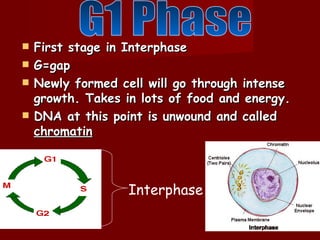
   First stage in Interphase
   G=gap
   Newly formed cell will go through intense
    growth. Takes in lots of food and energy.
   DNA at this point is unwound and called
    chromatin


                   Interphase
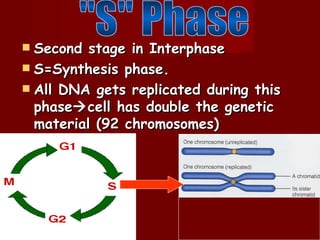
 Second stage in Interphase
 S=Synthesis phase.
 All DNA gets replicated during this
  phase cell has double the genetic
  material (92 chromosomes)
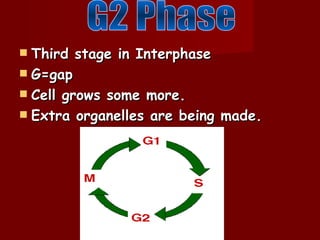
 Third stage in Interphase
 G=gap
 Cell grows some more.
 Extra organelles are being made.
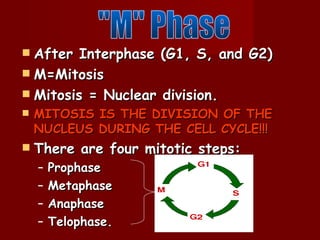
 After Interphase (G1, S, and G2)
 M=Mitosis
 Mitosis = Nuclear division.
   MITOSIS IS THE DIVISION OF THE
    NUCLEUS DURING THE CELL CYCLE!!!
   There are four mitotic steps:
    –   Prophase
    –   Metaphase
    –   Anaphase
    –   Telophase.
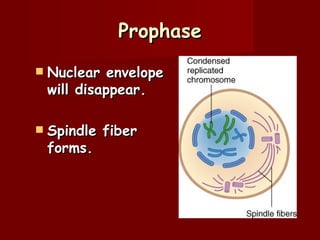
Prophase
   Nuclear envelope
    will disappear.

   Spindle fiber
    forms.
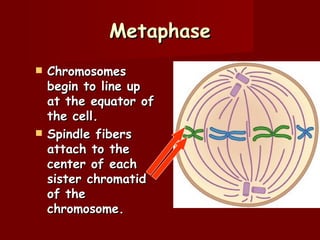
Metaphase
   Chromosomes
    begin to line up
    at the equator of
    the cell.
   Spindle fibers
    attach to the
    center of each
    sister chromatid
    of the
    chromosome.
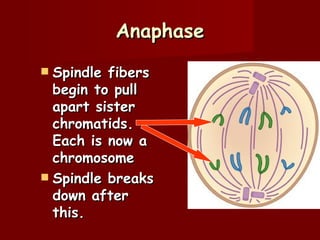
Anaphase
 Spindle fibers
  begin to pull
  apart sister
  chromatids.
  Each is now a
  chromosome
 Spindle breaks
  down after
  this.
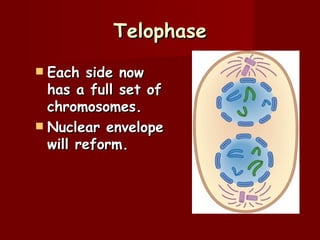
Telophase
 Each side now
  has a full set of
  chromosomes.
 Nuclear envelope
  will reform.
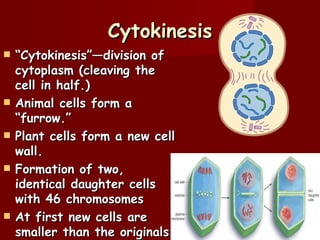
Cytokinesis
   “Cytokinesis”—division of
    cytoplasm (cleaving the
    cell in half.)
   Animal cells form a
    “furrow.”
   Plant cells form a new cell
    wall.
   Formation of two,
    identical daughter cells
    with 46 chromosomes
   At first new cells are
    smaller than the originals.
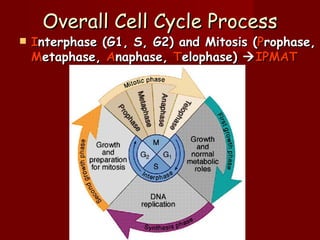
Overall Cell Cycle Process
   Interphase (G1, S, G2) and Mitosis (Prophase,
    Metaphase, Anaphase, Telophase)  IPMAT
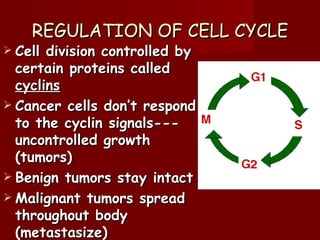
REGULATION OF CELL CYCLE
 Cell division controlled by
  certain proteins called
  cyclins
 Cancer cells don’t respond
  to the cyclin signals---
  uncontrolled growth
  (tumors)
 Benign tumors stay intact
 Malignant tumors spread
  throughout body
  (metastasize)

Mitosiscellcycle2012

  • 2.
    Why Do CellsNeed To Divide?  It depends on the organism  Unicellular organisms like bacteria (prokaryotes) divide to reproduce  Multicellular organisms (most eukaryotes) use it to grow larger and repair damaged cells.
  • 3.
    3 Types ofCell Division  1. Binary fission-cell division in prokaryotes  2. Cell Cycle (with Mitosis)-cell division in eukaryotes  3. Meiosis—cell division to form sex cells (egg and sperm)
  • 4.
    Prokaryotes  Divide bybinary fission  Circular DNA  Results in two cells genetically the same  What has to take place before the cells divide?
  • 5.
    Eukaryotes  The Cell Cycle – Growth – Repair or replacement of cells.  Some cells die quickly and need to be replaced a lot (skin cells).  Some cells never get replaced (nerve cells).  Some organisms can regenerate whole body parts.
  • 6.
    Each cell goes through a series of phases throughout its life.  The cell cycle-all events between one cell division and the next  **ONE REPLICATION & ONE DIVISION  2 basic steps: Interphase (G1, S, G2) and Mitosis (M)  Result? 2 daughter cells genetically exact to the parent cell they came from.
  • 7.
    First stage in Interphase  G=gap  Newly formed cell will go through intense growth. Takes in lots of food and energy.  DNA at this point is unwound and called chromatin Interphase
  • 8.
     Second stagein Interphase  S=Synthesis phase.  All DNA gets replicated during this phase cell has double the genetic material (92 chromosomes)
  • 9.
     Third stagein Interphase  G=gap  Cell grows some more.  Extra organelles are being made.
  • 10.
     After Interphase(G1, S, and G2)  M=Mitosis  Mitosis = Nuclear division.  MITOSIS IS THE DIVISION OF THE NUCLEUS DURING THE CELL CYCLE!!!  There are four mitotic steps: – Prophase – Metaphase – Anaphase – Telophase.
  • 11.
    Prophase  Nuclear envelope will disappear.  Spindle fiber forms.
  • 12.
    Metaphase  Chromosomes begin to line up at the equator of the cell.  Spindle fibers attach to the center of each sister chromatid of the chromosome.
  • 13.
    Anaphase  Spindle fibers begin to pull apart sister chromatids. Each is now a chromosome  Spindle breaks down after this.
  • 14.
    Telophase  Each sidenow has a full set of chromosomes.  Nuclear envelope will reform.
  • 15.
    Cytokinesis  “Cytokinesis”—division of cytoplasm (cleaving the cell in half.)  Animal cells form a “furrow.”  Plant cells form a new cell wall.  Formation of two, identical daughter cells with 46 chromosomes  At first new cells are smaller than the originals.
  • 16.
    Overall Cell CycleProcess  Interphase (G1, S, G2) and Mitosis (Prophase, Metaphase, Anaphase, Telophase)  IPMAT
  • 17.
    REGULATION OF CELLCYCLE  Cell division controlled by certain proteins called cyclins  Cancer cells don’t respond to the cyclin signals--- uncontrolled growth (tumors)  Benign tumors stay intact  Malignant tumors spread throughout body (metastasize)