Quest 3:
   Cells and
microscopes
NOTES


Develop a timeline showing dates and
scientists that led to this theory. Include the
following scientists: Theodor Schwann,
Matthias Schleiden, Virchow, Robert
Hooke, Van Leeuwenhoek, (remember
Redi, and Louis Pasteur add them also).
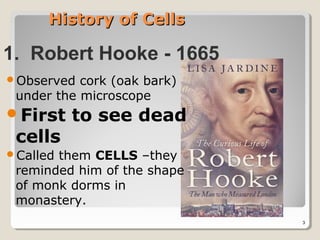
History of Cells

1. Robert Hooke - 1665
Observed  cork (oak bark)
 under the microscope
First    to see dead
 cells
Calledthem CELLS –they
 reminded him of the shape
 of monk dorms in
 monastery.
                             3
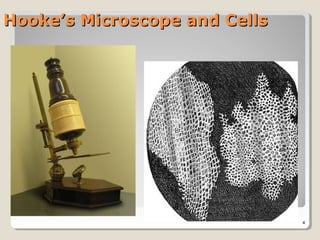
Hooke’s Microscope and Cells


                               4
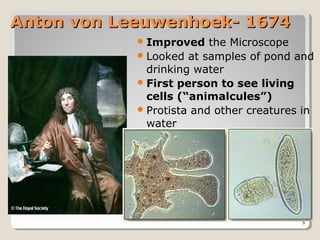
Anton von Leeuwenhoek- 1674
             Improved    the Microscope
             Looked at samples of pond and
              drinking water
             First person to see living
              cells (“animalcules”)
             Protista and other creatures in
              water


                                          5
150-200 Year Gap???
Between     the Hooke/Leuwenhoek
 discoveries and the mid 19th century, very
 little cell advancements were made.
This is probably due to the widely
 accepted, traditional belief in Spontaneous
 Generation.
Examples:
 -Mice from dirty clothes/corn husks
 -Maggots from rotting meat
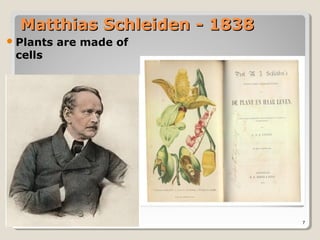
Matthias Schleiden - 1838
 Plants   are made of
 cells


                              7
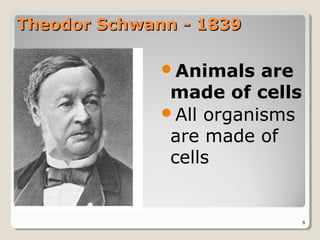
Theodor Schwann - 1839

              Animals   are
               made of cells
              All organisms
               are made of
               cells


                               8
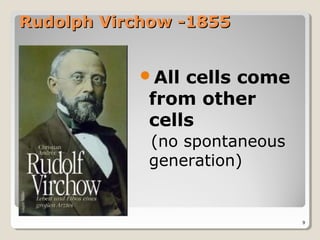
Rudolph Virchow -1855


           All cells come
            from other
            cells
            (no spontaneous
            generation)


                              9
NOTES
State   the 3 parts of the cell theory.
The Cell Theory
1. All living things are made of
   cells = A
2. Cells are the basic units of of
   structure and function in living
   organisms = B
3. New cells come from preexisting
   cells = C
                                              11
                     Remember you’re ABC’s!
Modern Cell Theory
 Modern Cell Theory contains 3 statements,
 in addition to the original Cell Theory:

 The    cell contains hereditary information(DNA)

  All cells are basically the same in chemical
 composition and metabolic activities.
 Cellcontain specialized structures
 (organelles) to perform life functions
Notes


Thinking Question: How did our
 knowledge of cells evolve with the
 collaboration among scientists and new
 technologies? (Modern Cell Theory)
NOTES
Draw  the cells in slides 15-17 explaining what
 you think their function is related to its structure.
    Cells       How does their shape relate to
                their/aid their function
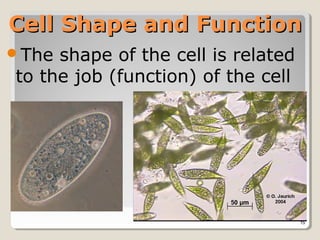
Cell Shape and Function
The shape of the cell is related
to the job (function) of the cell


                                    15
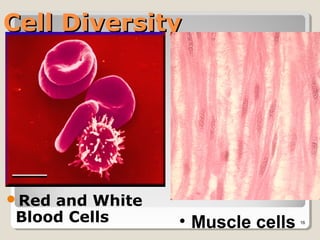
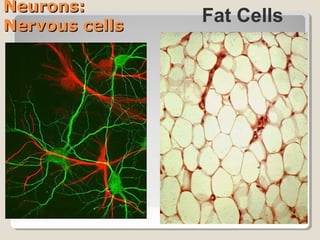
Cell Diversity


Redand White
Blood Cells     • Muscle cells   16
Neurons:
Nervous cells
                Fat Cells


                            17
NOTES


        Draw and label parts of a microscope.
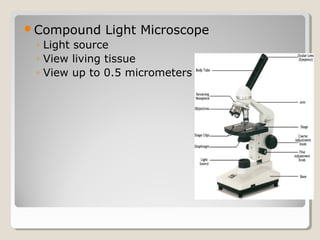
Compound    Light Microscope
 ◦ Light source
 ◦ View living tissue
 ◦ View up to 0.5 micrometers
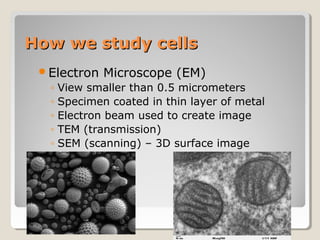
How we study cells
 Electron    Microscope (EM)
  ◦   View smaller than 0.5 micrometers
  ◦   Specimen coated in thin layer of metal
  ◦   Electron beam used to create image
  ◦   TEM (transmission)
  ◦   SEM (scanning) – 3D surface image
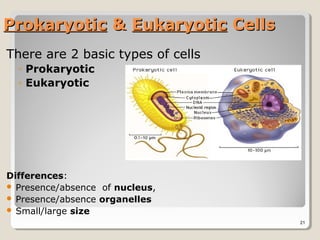
Prokaryotic & Eukaryotic Cells
There are 2 basic types of cells
  ◦ Prokaryotic
  ◦ Eukaryotic


Differences:
 Presence/absence of nucleus,
 Presence/absence organelles
 Small/large size
                                   21
NOTES
1. List 3 ways that prokaryotic and eukaryotic cells are SIMILAR and DIFFERENT. Give an example of
   a prokaryotic cell and an example of a eukaryotic cell.
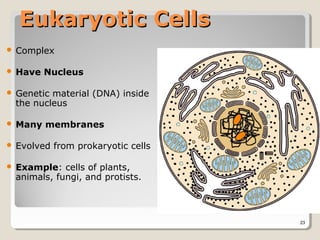
Eukaryotic Cells
   Complex

   Have Nucleus

   Genetic material (DNA) inside
    the nucleus

   Many membranes

   Evolved from prokaryotic cells

   Example: cells of plants,
    animals, fungi, and protists.


                                     23
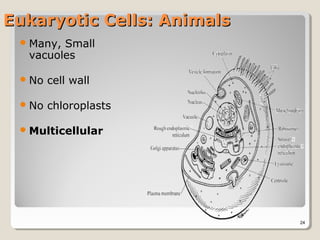
Eukaryotic Cells: Animals
  Many,Small
  vacuoles

  No   cell wall

  No   chloroplasts

  Multicellular


                            24
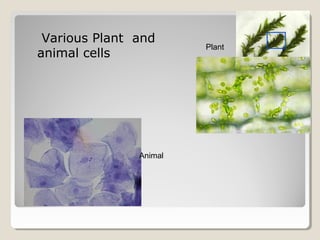
Various Plant and
                        Plant
animal cells


               Animal
NOTES
Use the next slides to fill in the vocab
 chart and color the cell pictures
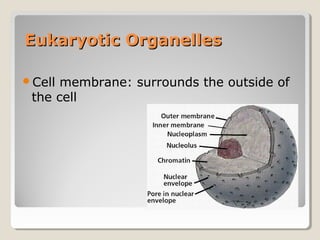
Eukaryotic Organelles

Cell membrane: surrounds the outside of
 the cell
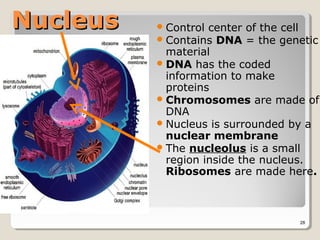
Nucleus    Control center   of the cell
           Contains DNA     = the genetic
            material
           DNA has the coded
            information to make
            proteins
           Chromosomes are made of
            DNA
           Nucleus is surrounded by a
            nuclear membrane
           The nucleolus is a small
            region inside the nucleus.
            Ribosomes are made here.


                                      28
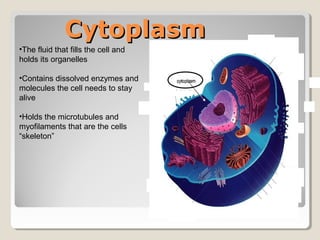
Cytoplasm
•The fluid that fills the cell and
holds its organelles

•Contains dissolved enzymes and
molecules the cell needs to stay
alive

•Holds the microtubules and
myofilaments that are the cells
“skeleton”
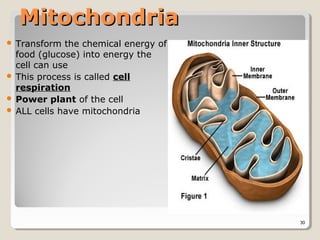
Mitochondria
 Transform the chemical energy of
  food (glucose) into energy the
  cell can use
 This process is called cell
  respiration
 Power plant of the cell
 ALL cells have mitochondria


                                     30
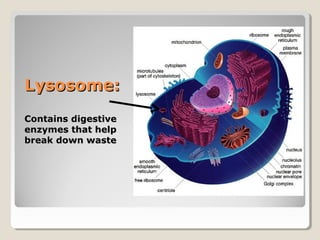
Lysosome:
Contains digestive
enzymes that help
break down waste
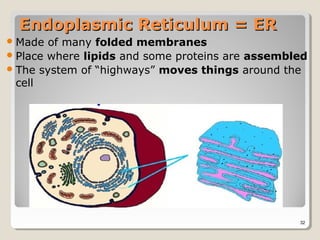
Endoplasmic Reticulum = ER
 Made  of many folded membranes
 Place where lipids and some proteins are assembled
 The system of “highways” moves things around the
  cell


                                                  32
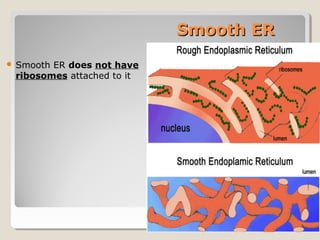
Smooth ER
   Smooth ER does not have
    ribosomes attached to it


                                           33
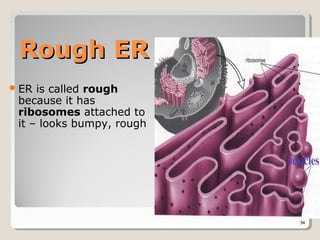
Rough ER
 ER is called rough
 because it has
 ribosomes attached to
 it – looks bumpy, rough


                           34
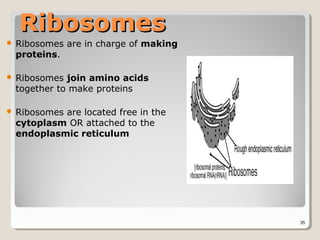
Ribosomes
   Ribosomes are in charge of making
    proteins.

   Ribosomes join amino acids
    together to make proteins

   Ribosomes are located free in the
    cytoplasm OR attached to the
    endoplasmic reticulum


                                        35
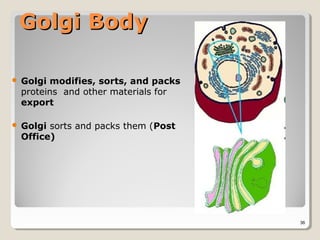
Golgi Body

   Golgi modifies, sorts, and packs
    proteins and other materials for
    export

   Golgi sorts and packs them (Post
    Office)


                                       36
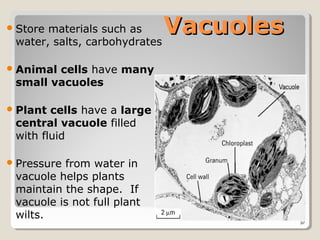
 Storematerials such as
 water, salts, carbohydrates
                               Vacuoles
 Animalcells have many
 small vacuoles

 Plant cells have a large
 central vacuole filled
 with fluid

 Pressurefrom water in
 vacuole helps plants
 maintain the shape. If
 vacuole is not full plant
 wilts.
                                          37
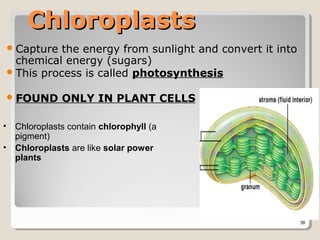
Chloroplasts
 Capture  the energy from sunlight and convert it into
  chemical energy (sugars)
 This process is called photosynthesis

 FOUND       ONLY IN PLANT CELLS

• Chloroplasts contain chlorophyll (a
  pigment)
• Chloroplasts are like solar power
  plants


                                                          38
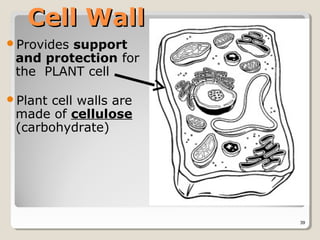
Cell Wall
Providessupport
 and protection for
 the PLANT cell

Plantcell walls are
 made of cellulose
 (carbohydrate)


                       39
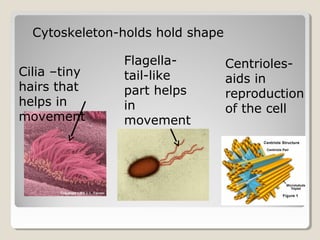
Cytoskeleton-holds hold shape

               Flagella-          Centrioles-
Cilia –tiny    tail-like          aids in
hairs that     part helps         reproduction
helps in       in                 of the cell
movement       movement
NOTES

  1. How are animal and plant cells similar? How are they different?
Types of Eukaryotic organisms
NOTES
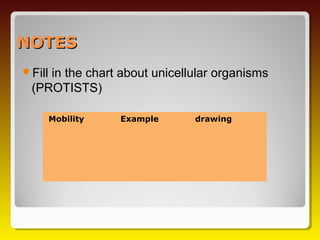
Fill
    in the chart about unicellular organisms
 (PROTISTS)

        Mobility   Example    drawing
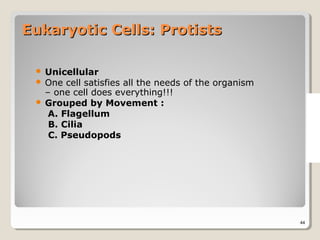
Eukaryotic Cells: Protists

  Unicellular
  One  cell satisfies all the needs of the organism
   – one cell does everything!!!
  Grouped by Movement :
    A. Flagellum
    B. Cilia
    C. Pseudopods


                                                       44
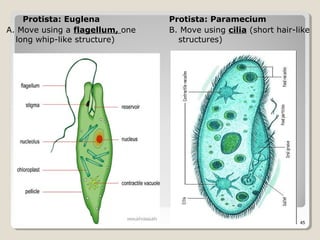
Protista: Euglena            Protista: Paramecium
A. Move using a flagellum, one   B. Move using cilia (short hair-like
  long whip-like structure)        structures)


                                                                  45
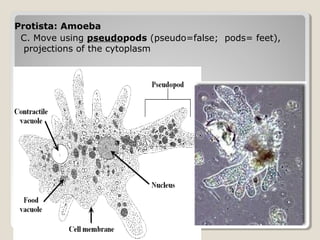
Protista: Amoeba
 C. Move using pseudopods (pseudo=false; pods= feet),
  projections of the cytoplasm


                                                        46
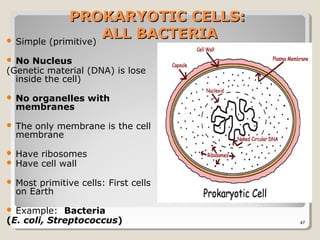
PROKARYOTIC CELLS:
 Simple (primitive)
                     ALL BACTERIA
 No Nucleus
(Genetic material (DNA) is lose
  inside the cell)

   No organelles with
    membranes

   The only membrane is the cell
    membrane

   Have ribosomes
   Have cell wall

   Most primitive cells: First cells
    on Earth

 Example: Bacteria
(E. coli, Streptococcus)                47
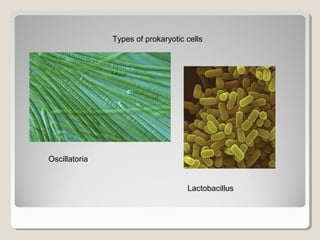
Types of prokaryotic cells


Oscillatoria


                                    Lactobacillus
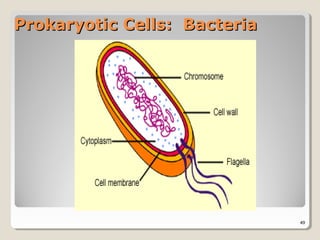
Prokaryotic Cells: Bacteria


                              49

Cells

  • 1.
    Quest 3: Cells and microscopes
  • 2.
    NOTES Develop a timelineshowing dates and scientists that led to this theory. Include the following scientists: Theodor Schwann, Matthias Schleiden, Virchow, Robert Hooke, Van Leeuwenhoek, (remember Redi, and Louis Pasteur add them also).
  • 3.
    History of Cells 1.Robert Hooke - 1665 Observed cork (oak bark) under the microscope First to see dead cells Calledthem CELLS –they reminded him of the shape of monk dorms in monastery. 3
  • 4.
  • 5.
    Anton von Leeuwenhoek-1674  Improved the Microscope  Looked at samples of pond and drinking water  First person to see living cells (“animalcules”)  Protista and other creatures in water 5
  • 6.
    150-200 Year Gap??? Between the Hooke/Leuwenhoek discoveries and the mid 19th century, very little cell advancements were made. This is probably due to the widely accepted, traditional belief in Spontaneous Generation. Examples: -Mice from dirty clothes/corn husks -Maggots from rotting meat
  • 7.
    Matthias Schleiden -1838  Plants are made of cells 7
  • 8.
    Theodor Schwann -1839 Animals are made of cells All organisms are made of cells 8
  • 9.
    Rudolph Virchow -1855 All cells come from other cells (no spontaneous generation) 9
  • 10.
    NOTES State the 3 parts of the cell theory.
  • 11.
    The Cell Theory 1.All living things are made of cells = A 2. Cells are the basic units of of structure and function in living organisms = B 3. New cells come from preexisting cells = C 11 Remember you’re ABC’s!
  • 12.
    Modern Cell Theory Modern Cell Theory contains 3 statements, in addition to the original Cell Theory: The cell contains hereditary information(DNA)  All cells are basically the same in chemical composition and metabolic activities. Cellcontain specialized structures (organelles) to perform life functions
  • 13.
    Notes Thinking Question: Howdid our knowledge of cells evolve with the collaboration among scientists and new technologies? (Modern Cell Theory)
  • 14.
    NOTES Draw thecells in slides 15-17 explaining what you think their function is related to its structure. Cells How does their shape relate to their/aid their function
  • 15.
    Cell Shape andFunction The shape of the cell is related to the job (function) of the cell 15
  • 16.
    Cell Diversity Redand White BloodCells • Muscle cells 16
  • 17.
  • 18.
    NOTES Draw and label parts of a microscope.
  • 19.
    Compound Light Microscope ◦ Light source ◦ View living tissue ◦ View up to 0.5 micrometers
  • 20.
    How we studycells Electron Microscope (EM) ◦ View smaller than 0.5 micrometers ◦ Specimen coated in thin layer of metal ◦ Electron beam used to create image ◦ TEM (transmission) ◦ SEM (scanning) – 3D surface image
  • 21.
    Prokaryotic & EukaryoticCells There are 2 basic types of cells ◦ Prokaryotic ◦ Eukaryotic Differences:  Presence/absence of nucleus,  Presence/absence organelles  Small/large size 21
  • 22.
    NOTES 1. List 3ways that prokaryotic and eukaryotic cells are SIMILAR and DIFFERENT. Give an example of a prokaryotic cell and an example of a eukaryotic cell.
  • 23.
    Eukaryotic Cells  Complex  Have Nucleus  Genetic material (DNA) inside the nucleus  Many membranes  Evolved from prokaryotic cells  Example: cells of plants, animals, fungi, and protists. 23
  • 24.
    Eukaryotic Cells: Animals  Many,Small vacuoles  No cell wall  No chloroplasts  Multicellular 24
  • 25.
    Various Plant and Plant animal cells Animal
  • 26.
    NOTES Use the nextslides to fill in the vocab chart and color the cell pictures
  • 27.
    Eukaryotic Organelles Cell membrane:surrounds the outside of the cell
  • 28.
    Nucleus  Control center of the cell  Contains DNA = the genetic material  DNA has the coded information to make proteins  Chromosomes are made of DNA  Nucleus is surrounded by a nuclear membrane  The nucleolus is a small region inside the nucleus. Ribosomes are made here. 28
  • 29.
    Cytoplasm •The fluid thatfills the cell and holds its organelles •Contains dissolved enzymes and molecules the cell needs to stay alive •Holds the microtubules and myofilaments that are the cells “skeleton”
  • 30.
    Mitochondria  Transform thechemical energy of food (glucose) into energy the cell can use  This process is called cell respiration  Power plant of the cell  ALL cells have mitochondria 30
  • 31.
  • 32.
    Endoplasmic Reticulum =ER  Made of many folded membranes  Place where lipids and some proteins are assembled  The system of “highways” moves things around the cell 32
  • 33.
    Smooth ER  Smooth ER does not have ribosomes attached to it 33
  • 34.
    Rough ER  ERis called rough because it has ribosomes attached to it – looks bumpy, rough 34
  • 35.
    Ribosomes  Ribosomes are in charge of making proteins.  Ribosomes join amino acids together to make proteins  Ribosomes are located free in the cytoplasm OR attached to the endoplasmic reticulum 35
  • 36.
    Golgi Body  Golgi modifies, sorts, and packs proteins and other materials for export  Golgi sorts and packs them (Post Office) 36
  • 37.
     Storematerials suchas water, salts, carbohydrates Vacuoles  Animalcells have many small vacuoles  Plant cells have a large central vacuole filled with fluid  Pressurefrom water in vacuole helps plants maintain the shape. If vacuole is not full plant wilts. 37
  • 38.
    Chloroplasts  Capture the energy from sunlight and convert it into chemical energy (sugars)  This process is called photosynthesis  FOUND ONLY IN PLANT CELLS • Chloroplasts contain chlorophyll (a pigment) • Chloroplasts are like solar power plants 38
  • 39.
    Cell Wall Providessupport andprotection for the PLANT cell Plantcell walls are made of cellulose (carbohydrate) 39
  • 40.
    Cytoskeleton-holds hold shape Flagella- Centrioles- Cilia –tiny tail-like aids in hairs that part helps reproduction helps in in of the cell movement movement
  • 41.
    NOTES 1.How are animal and plant cells similar? How are they different?
  • 42.
  • 43.
    NOTES Fill in the chart about unicellular organisms (PROTISTS) Mobility Example drawing
  • 44.
    Eukaryotic Cells: Protists  Unicellular  One cell satisfies all the needs of the organism – one cell does everything!!!  Grouped by Movement : A. Flagellum B. Cilia C. Pseudopods 44
  • 45.
    Protista: Euglena Protista: Paramecium A. Move using a flagellum, one B. Move using cilia (short hair-like long whip-like structure) structures) 45
  • 46.
    Protista: Amoeba C.Move using pseudopods (pseudo=false; pods= feet), projections of the cytoplasm 46
  • 47.
    PROKARYOTIC CELLS:  Simple(primitive) ALL BACTERIA  No Nucleus (Genetic material (DNA) is lose inside the cell)  No organelles with membranes  The only membrane is the cell membrane  Have ribosomes  Have cell wall  Most primitive cells: First cells on Earth  Example: Bacteria (E. coli, Streptococcus) 47
  • 48.
    Types of prokaryoticcells Oscillatoria Lactobacillus
  • 49.

Editor's Notes

  • #24 Types of Cells p.172-173
  • #47 Types of Cells p.172-173